Feed Mycotoxin Binder (Clay-Based Adsorbent)
A guide to evaluating natural clinoptilolite as a clay-based mycotoxin binder that adsorbs and sequesters mycotoxins such as aflatoxin and zearalenone in feed. It connects the adsorption mechanism, animal feeding trial evidence, recommended particle size, and an FAQ-everything you need when considering a feed additive.
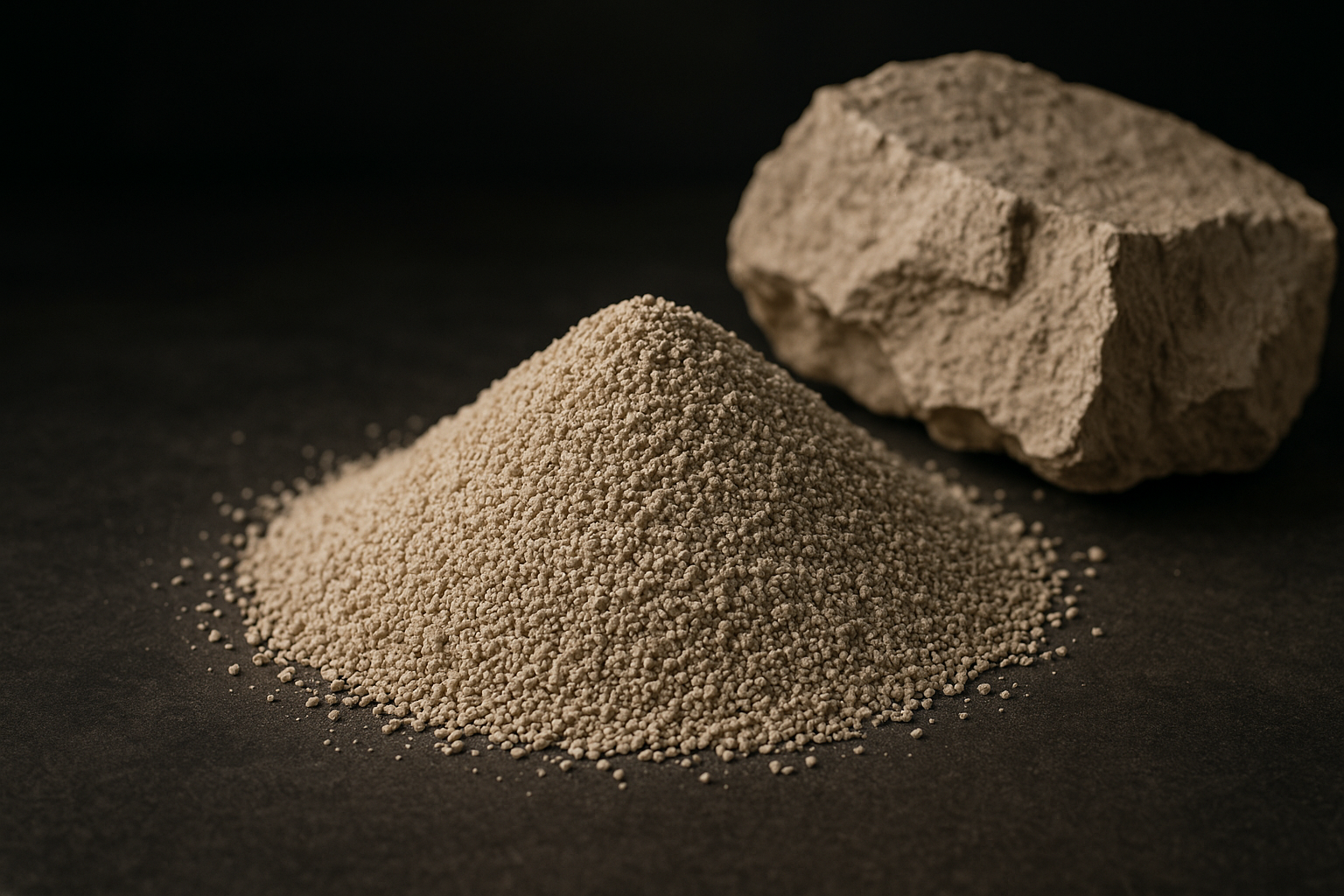
The Mycotoxin Problem: Why Adsorption and Sequestration Are Needed
Grain raw materials such as corn, wheat, and DDGS become contaminated with Aspergillus, Fusarium, and Penicillium molds during storage and transport, producing mycotoxins such as aflatoxin (AFB1), zearalenone (ZEN), deoxynivalenol (DON), ochratoxin, and fumonisin. These toxins impair the liver function, immunity, and reproduction of livestock, worsen average daily gain and feed conversion ratio (FCR), and in dairy cows, feed aflatoxin B1 carries over into milk, causing aflatoxin M1 (AFM1) residue issues.
The core challenge is that aflatoxin is chemically very stable. It is not removed by typical pelleting, drying, or washing. As a result, on feed operations the most widely used approach is not to break down the toxin but to bind and sequester it within the digestive tract (binding) to reduce intestinal absorption by livestock-a non-nutritive approach known as the mycotoxin binder. The review by Liu et al. (2022) notes that clay- and zeolite-based inorganic aluminosilicates can be applied with almost no loss of feed nutritional value and have become the first-line choice in practice (Liu et al., Journal of Animal Science and Biotechnology, 2022).
Why Zeolite (Clinoptilolite) Is Considered as a Binder
Natural clinoptilolite is a porous aluminosilicate with micropores of 4.0-7.0 Å, a specific surface area of 40.0 m²/g, and a cation exchange capacity (CEC) of 1.6-2.0 meq/g. Thanks to this porous surface and negatively charged framework, it binds polar and cationic toxin molecules to its surface within the digestive tract, temporarily sequestering them. Aflatoxin B1 is a representative toxin known to bind well to such aluminosilicate surfaces due to its molecular structure.
Animal feeding trial evidence has also accumulated. Rizzi et al. (2003) reported that co-feeding aflatoxin B1 and clinoptilolite in laying hen feed mitigated the negative effects of the toxin (Rizzi et al., Journal of Food Protection, 2003), and Katsoulos et al. (2006) reported a study applying natural clinoptilolite as an aflatoxin binder in dairy cattle feed (Katsoulos et al., Microporous and Mesoporous Materials, 2006). An in-field study (2016) evaluated the effect of clinoptilolite feeding in reducing milk aflatoxin M1 concentration (In-field evaluation of clinoptilolite on reduction of milk aflatoxin M1, Journal of Animal Science and Technology, 2016), and the AFB1 detoxification effect of modified clinoptilolite in broilers has also been reported (Effects of modified clinoptilolite zeolite on detoxification of aflatoxin B1 in broilers, British Poultry Science, 2021).
However, binding efficiency depends heavily on the toxin type. The Liu et al. (2022) review notes that aluminosilicate adsorbents bind a high proportion of aflatoxin under test conditions, while binding rates are much lower for non-polar, larger-molecule toxins such as zearalenone (ZEN) and deoxynivalenol (DON). Therefore, zeolite should be understood as an aflatoxin-focused binder, and for multi-toxin loads it is appropriate to use it alongside adsorbent combinations and management.
KMIZEOLITE's natural clinoptilolite is 97% pure, mined and processed at the Amargosa Valley mine in Nevada, USA, with a pH stability range of 3.0-10.0 (covering gastric and intestinal pH fluctuations) and thermal stability up to 700°C (handling pelleting temperatures), making it suitable for feed blending processes. The FDA recognizes it as GRAS for anti-caking use under 21 CFR 582.2729, and the European Union has approved its use in the swine and poultry industries.
KMIZEOLITE Key Properties
| Item | Value |
|---|---|
| Clinoptilolite purity | 97% |
| Cation exchange capacity (CEC) | 1.6–2.0 meq/g |
| Specific surface area | 40.0 m²/g |
| Pore diameter | 4.0–7.0 Å |
| pH stability range | 3.0–10.0 |
| Hardness | 4.0–5.0 Mohs |
| Thermal stability | 700°C |
| Specific gravity | 1.89 |
| Bulk density | 45–54 lbs/ft³ |
| Certifications | OMRI KMI-10365, FDA GRAS, TSCA, EN-71-3 |
Mycotoxin Binder Application Examples: Evaluation Scenarios by Toxin Load
Below are representative scenarios in which zeolite is considered for feed mycotoxin adsorption. All feed additions are evaluated under the FDA GRAS standard at 2% or less of the total formulation, for anti-caking and adsorption support purposes.
- Handling aflatoxin-risk raw materials: When blending raw materials with high AFB1 load, such as corn, peanut meal, and DDGS, adding 100-mesh powder at a 0.2-2% level as an adsorption aid (see Rizzi et al., 2003)
- Reducing milk AFM1 in dairy cows: Adding a binder to lactating-cow feed to reduce the carry-over of feed aflatoxin B1 into milk (AFM1) (see Katsoulos et al., 2006; in-field 2016)
- Detoxification support for broilers and layers: Applying it as an adsorption aid in AFB1-loaded segments of poultry feed to mitigate liver and immune marker damage (see British Poultry Science, 2021)
- Combined anti-caking for mash feed: Adding powder to mash feed to combine the anti-caking function that reduces caking on automated feeding lines with mycotoxin adsorption
- Pilot feeding trial: Applying a small amount to one herd, comparing weight gain, FCR, and toxin residues (serum, milk, eggs) against a control group, and then deciding on full-scale adoption
Recommended Particle Size and Product Specifications
A mycotoxin binder must be uniformly dispersed in mash feed or pellets to secure the adsorption surface, so Powder (100 mesh) is used first. The smaller the particle, the larger the specific surface area, increasing the binding surface per unit weight. Powder is the default for feed mixing, while Medium Granule (14×40 mesh) is suitable for bedding and litter application. Refer to the table below to select the product line that matches your use.
| Product line | Mesh | Particle size | Typical use |
|---|---|---|---|
| Powder | 100 mesh or finer | <150μm | Pozzolan, feed, powder adsorption |
| Fine Granule | 30×50 mesh | 0.3–0.6mm | Water treatment, filtration, soil |
| Medium Granule | 14×40 mesh | 0.4–1.4mm | Filter media, bedding, litter |
| Coarse Granule | 8×14 mesh | 1.4–2.4mm | Swimming pools, de-icing, large-scale filtration |
| Extra Coarse | 4×8 mesh | 2.4–4.8mm | Packed beds, air scrubbers |
→ View products by mesh size · Application-based product selection guide
Points to Review Before Adoption
When applying a mycotoxin adsorbent to feed, be sure to check the following items together.
- Identify the toxin type: Clinoptilolite binds aflatoxin strongly but binds ZEN and DON poorly. First test and confirm the raw material's toxin profile (whether it is aflatoxin-focused or a multi-toxin load)
- Inclusion limit: Under FDA GRAS (21 CFR 582.2729), the feed inclusion rate for anti-caking use is 2% or less of the total formulation. Do not claim pharmacological effects beyond this limit
- Quantitative measurement of effect: Record toxin residue indicators such as serum, milk AFM1, and eggs, along with average daily gain (ADG) and FCR against a control group, to evaluate the binding effect (see the Rizzi 2003 and Katsoulos 2006 methods)
- Particle size and uniformity: Use 100-mesh powder to secure the adsorption surface and check the mixing process so that it is uniformly dispersed in mash feed
- Nutrient adsorption risk: An adsorbent may non-specifically capture nutrients such as vitamins and minerals, so review the inclusion rate and formulation balance together (see Liu et al., 2022)
- Verify certification: To use it as an organic livestock feed ingredient, confirm OMRI Listed (KMI-10365) compliance. The EU has approved use in the swine and poultry industries
→ View TDS (Technical Data Sheet) · View MSDS (Material Safety Data Sheet)
Mycotoxin Adsorbent FAQ
Why use a clay-based adsorbent as a mycotoxin binder?
Aflatoxin is chemically very stable and difficult to remove by ordinary processing. Inorganic aluminosilicate adsorbents such as clay and zeolite bind and sequester toxins on their surface within the digestive tract to reduce absorption. This non-nutritive approach can be applied with almost no loss of feed nutritional value, making it the most widely used mycotoxin binder strategy (Liu et al., 2022 review).
Which mycotoxins is clinoptilolite reported to be effective against?
Clinoptilolite is most consistently reported to bind aflatoxin B1 (AFB1). Rizzi et al. (2003) reported on laying hens, Katsoulos et al. (2006) and an in-field study (2016) on dairy cows and milk aflatoxin M1, and British Poultry Science (2021) on the AFB1 detoxification effect of modified clinoptilolite in broilers. Non-polar, larger-molecule toxins such as zearalenone (ZEN) tend to have lower binding rates, so effectiveness varies by toxin type.
What are the typical adsorption efficiency and inclusion rate?
The Liu et al. (2022) review notes that aluminosilicate adsorbents bind a high proportion of aflatoxin under test conditions, while binding rates for zearalenone and deoxynivalenol (DON) are much lower. In practice, inclusion is usually evaluated in the range of 0.2-2% of the total feed formulation, and the FDA GRAS inclusion limit for anti-caking use is 2% or less. Efficiency depends on toxin type, pH, and raw material condition, so a pilot trial is recommended before adoption.
What particle size should be used for uniform mixing into feed?
A mycotoxin binder must be uniformly dispersed in mash feed or pellets to secure the adsorption surface, so 100-mesh (under 150 μm) powder is used first. The smaller the particle, the larger the specific surface area, increasing the binding surface per unit weight. Check the particle size in the application-based product selection guide.
Is certification documentation available?
KMIZEOLITE holds numerous certifications, including OMRI Listed (KMI-10365), FDA GRAS (21 CFR 582.2729), TSCA compliance, and EN-71-3 PASS, and has been approved for use in the EU swine and poultry industries. Check the certifications page for details.
Inquiries and Sample Requests
If you are evaluating zeolite for feed mycotoxin binder (clay-based adsorbent) applications, please contact us through the channels below.
Notice
Applicability may vary depending on field conditions, regulations, and test results. Before actual application, test review suited to the specific field conditions must always be carried out first. Zeolite should be understood not as a universal solution to the mycotoxin problem but as an adsorption material that supports raw material management, toxin testing, and sanitary processes. Toxin binding effectiveness varies with the toxin type, concentration, pH, and raw material condition.
Related Pages
science Related Papers
Academic papers covering zeolite application in this field. Please refer to them when evaluating adoption.
- Invited review: Remediation strategies for mycotoxin control in feed
Liu, M. et al. — Journal of Animal Science and Biotechnology, 2022 - Aflatoxin B1 and Clinoptilolite in Feed for Laying Hens
Rizzi, L. et al. — Journal of Food Protection, 2003 - Natural clinoptilolite as aflatoxin binder in dairy cattle feed
Katsoulos, P.D. et al. — Microporous and Mesoporous Materials, 2006 - In-field evaluation of clinoptilolite on reduction of milk aflatoxin M1
Journal of Animal Science and Technology, 2016 - Effects of modified clinoptilolite zeolite on detoxification of aflatoxin B1 in broilers
British Poultry Science, 2021 - Decontamination of Mycotoxin-Contaminated Feedstuffs and Compound Feed
Čolović, R. et al. — Toxins, 2019
The papers above are reference material; actual application requires a separate review suited to the specific field conditions.