Zeolite for Feed Storage Stabilization
A B2B technical page in which natural clinoptilolite with CEC 1.6-2.0 meq/g and a specific surface area of 40 m²/g is added at 2% or less of the total formulation (the GRAS anti-caking limit) to buffer caking and moisture uptake, also linking to mycotoxin-binder data in which in-field trials lowered milk aflatoxin M1 by about 56%.
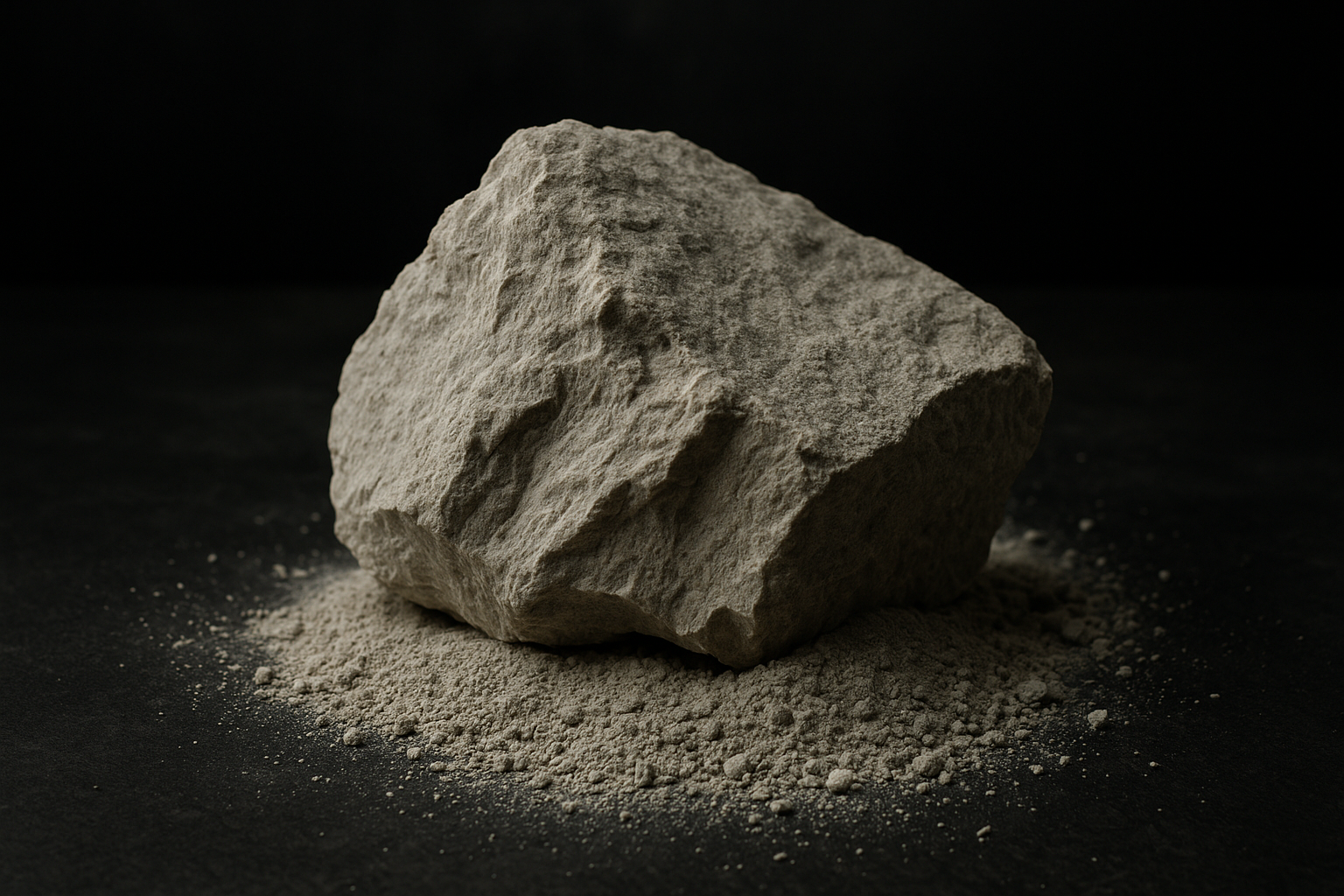
Why compound feed storage stability breaks down
Finished compound feed gradually loses quality while stored in silos, ton-bags, and bulk bins. The three most common degradation pathways are caking (clumping), rising moisture from hygroscopic uptake, and, when moisture and temperature align, mold growth and mycotoxin contamination such as aflatoxin. The key control variable is water activity (aw). Most storage molds (Aspergillus, Penicillium) grow above aw 0.70-0.80, while the aflatoxin-producing strains A. flavus and A. parasiticus become active in toxin production above aw 0.82 at 25-35°C. Pellets containing molasses or fats, and mash feed high in fines, are especially vulnerable to caking and moisture uptake; once storage moisture exceeds 14% (corresponding to aw≈0.70 for grain), storage bacteria and molds proliferate rapidly.
This is not merely a cosmetic issue but is directly tied to blockages in automated feeding lines, reduced feed efficiency, and the risk of mycotoxin poisoning that leads to liver damage and declining egg-laying rates in livestock. In particular, when a dairy cow ingests aflatoxin B1 (AFB1), about 1-6% is metabolized and carried over into milk as the carcinogenic metabolite aflatoxin M1 (AFM1); the EU and Korean residue limit for milk is a very strict 0.05 μg/kg. Storage stabilization therefore needs to be designed considering storage temperature, relative humidity, feed moisture (aw), and turnover cycle together.
Why zeolite is studied for feed storage stabilization
Natural clinoptilolite zeolite is a mineral that has been studied as an anti-caking, moisture-buffering, and mycotoxin-binding aid for compound feed, based on its 4.0-7.0 Å micropore structure and cation-exchange properties (CEC 1.6-2.0 meq/g). The US FDA recognizes zeolite as GRAS for use as an anti-caking agent added directly to animal feed; the basis for ingestion (animal feed) is 21 CFR 582.2729, and the basis for general food additives is 21 CFR 182.2729. Both provisions cap the inclusion limit at 2% or less of the total formulation.
The mechanism works along three lines, each with a different physical role.
- Anti-caking (physical separation): Fine-powder zeolite with a median particle size of about 50 μm disperses across the surface of feed particles, acting as a lubricant and parting agent. Hard inorganic particles with a Mohs hardness of 4.0-5.0 reduce the formation of inter-particle liquid bridges and agglomeration, suppressing caking and feeding-line blockages.
- Moisture buffering (pore adsorption): The 4.0-7.0 Å crystalline pores and 40.0 m²/g specific surface area adsorb free water, buffering local water-activity (aw) fluctuations and condensation in the feed. Because zeolite is a hydrophilic framework that electrostatically attracts water molecules, it reversibly adsorbs and desorbs moisture even in high-humidity environments, lowering free-water activity and delaying conditions for mold growth.
- Mycotoxin binder (adsorptive binding): The clinoptilolite framework has cation-exchange properties, but mycotoxin binding is driven mainly by physical adsorption at the pores and surface (hydrophobic interaction and hydrogen bonding) rather than ion exchange. Polar, planar molecules such as aflatoxin have high adsorption affinity and are bound during passage through the digestive tract, reducing absorption. Conversely, non-polar toxins with large steric hindrance, such as zearalenone (ZEN) and ochratoxin, are weakly bound by unmodified natural zeolite, so a surface-modified type or a multi-component binder is needed separately for broad-spectrum toxins.
Quantitative evidence has also accumulated. In a Greek in-field trial (J. Anim. Sci. Technol., 2016), feeding clinoptilolite (85-87% purity) to AFB1-exposed dairy cow feed reduced milk AFM1 residue by about 56.2% (SD 15), raising the proportion compliant with the EU limit (0.05 μg/kg). Katsoulos et al. (2006, Microporous and Mesoporous Materials) also reported that adding natural clinoptilolite to dairy cow feed significantly reduced milk AFM1 carryover.
KMIZEOLITE's natural clinoptilolite has a purity of 97% and is mined and processed at the Amargosa Valley mine in Nevada, USA. With a pH stability range of 3.0-10.0 and thermal stability up to 700°C, its structure remains stable under pelleting processes and long-term storage conditions.
KMIZEOLITE key properties
| Item | Value |
|---|---|
| Clinoptilolite purity | 97% |
| Cation-exchange capacity (CEC) | 1.6-2.0 meq/g |
| Specific surface area | 40.0 m²/g |
| Pore diameter | 4.0-7.0 Å |
| pH stability range | 3.0-10.0 |
| Hardness | 4.0-5.0 Mohs |
| Thermal stability | 700°C |
| Specific gravity | 1.89 |
| Bulk density | 45-54 lbs/ft³ |
| Certifications | OMRI KMI-10365, FDA GRAS, TSCA, EN-71-3 |
Feed storage stabilization application examples
Below are representative application scenarios in which zeolite is considered for compound feed storage stabilization. The recommended inclusion rate is set according to purpose, within the GRAS limit of 2% or less of the total formulation.
- Anti-caking formulation: During mash or pellet feed manufacturing, Powder (100 mesh) is blended uniformly in a mixer at 0.5-2% to suppress fine-powder agglomeration and clumping.
- Moisture buffering (moisture stabilization): The moisture-adsorption capacity of the crystalline pores is used to buffer feed water-activity (aw) fluctuations and condensation during storage.
- Combined use as a mycotoxin binder: When using raw materials at risk of mold contamination, zeolite is added as an adsorptive material to aid binding of polar toxins such as aflatoxin (typically 1-2%).
- Silo/bin moisture-uptake pad or support layer: Granular forms (Medium/Coarse Granule) are placed supplementarily to manage humidity inside the storage vessel.
- Trial/pilot application: A small sample is used to confirm caking suppression and moisture change in advance under your own formulation and storage conditions.
Quantitative guide to inclusion rate, particle size, and effect by purpose
The values below are starting points within the cited research and KMIZEOLITE spec ranges, and must be re-confirmed by pilot in your own feed matrix.
| Purpose | Recommended inclusion rate | Recommended particle size | Reference effect basis |
|---|---|---|---|
| Anti-caking | 0.5-2% | Powder 100 mesh (≈50μm) | FDA GRAS anti-caking limit of 2% or less |
| Moisture uptake / moisture buffering | 1-2% | Powder ~ Fine Granule | Specific surface area 40 m²/g, hydrophilic adsorption via 4-7Å pores |
| Aflatoxin binder (AFM1/AFB1) | 1-2% | Powder 100 mesh | In-field dairy AFM1 reduction of about 56% (2016) |
| Silo/bin moisture-uptake support layer | Supplementary placement | Medium 14×40 mesh or coarser | Low-dust granular form for condensation buffering |
In terms of weight gain and productivity, poultry trials (Acta Vet. Brno series) have reported cases where 2-4% clinoptilolite inclusion had a positive effect on feed efficiency and some performance indicators; however, above 4% feed intake can decline due to a nutrient-dilution effect, so for storage-stabilization purposes 2% or less is recommended.
Recommended particle size and product specifications
For feed storage stabilization, Powder (100 mesh, median 50μm) is the standard for blend mixing. Fine particles are needed so the material disperses uniformly throughout the feed, keeping anti-caking and toxin-binding effects consistent. For silo/bin moisture-uptake support layers, a low-dust Medium Granule (14×40 mesh) or coarser is suitable. Refer to the table below to select the right product group for your use.
| Product group | Mesh | Particle size | Typical uses |
|---|---|---|---|
| Powder | 100 mesh or finer | <150μm | Pozzolan, feed, powder adsorption |
| Fine Granule | 30×50 mesh | 0.3-0.6mm | Water treatment, filtration, soil |
| Medium Granule | 14×40 mesh | 0.4-1.4mm | Filter media, bedding, floor material |
| Coarse Granule | 8×14 mesh | 1.4-2.4mm | Pools, snow melting, large-scale filtration |
| Extra Coarse | 4×8 mesh | 2.4-4.8mm | Packed beds, air scrubbers |
→ View products by mesh size · Product selection guide by application
Pilot testing and on-site review points
When applying zeolite to compound feed storage stabilization, be sure to check the following items as well.
- Inclusion limit: Under FDA GRAS, zeolite may be added only at 2% or less of the total formulation for anti-caking purposes. Considering the nutrient-dilution effect, it is typically set in the 0.5-2% range.
- Storage moisture baseline: Measure moisture at feed intake and the relative humidity inside the silo to set the moisture-buffering target. Keeping moisture at 14% or below is the baseline for mold suppression.
- Particle size and mixing uniformity: For mash feed, disperse Powder (100 mesh) thoroughly in the mixer to prevent local caking.
- Mycotoxin management: If the raw material has a history of aflatoxin contamination, evaluate the inclusion effect as a binder alongside toxin testing. Rizzi et al. (2003) reported that combined zeolite use mitigated the adverse effects of aflatoxin B1 in a laying-hen feed trial. Natural zeolite is effective against polar aflatoxin, but a surface-modified type is advantageous for further increasing AFB1 binding strength or for covering non-polar toxins such as ZEN and DON. A study of modified clinoptilolite (Br. Poult. Sci., 2021) reported improved AFB1 detoxification efficiency in broilers compared with the natural form.
- Regulatory check: If organic livestock feed ingredients are required, confirm OMRI Listed (KMI-10365) compliance. The EU has approved use in the swine and poultry industries.
- Product stability: With thermal stability up to 700°C, zeolite's structure is not damaged during the pelleting heat process, and being odorless and non-toxic (IARC Non-Toxic), it has little effect on feed palatability.
→ View TDS (Technical Data Sheet) · View MSDS (Safety Data Sheet)
Feed storage stabilization FAQ
Does zeolite reduce feed caking (clumping)?
Yes. Zeolite is a material the FDA recognizes as GRAS for use as an anti-caking agent in feed. Zeolite particles dispersed across the fine-powder surface reduce inter-particle agglomeration, while the crystalline pores buffer moisture, suppressing clumping and feeding-line blockages during storage. It is typically blended uniformly at 0.5-2% of the total formulation.
Does it also help manage mold toxins such as aflatoxin?
Natural clinoptilolite is studied as a binder that physically adsorbs polar mycotoxins (especially aflatoxin) at its pores and surface. In a Greek in-field dairy trial (2016), clinoptilolite feeding reduced milk aflatoxin M1 by about 56%, and Katsoulos et al. (2006) also reported reduced AFM1 carryover. However, non-polar toxins such as zearalenone and DON are weakly bound by the unmodified natural form, so a surface-modified type is needed; it does not replace the fundamental substitution of raw materials with high toxin concentrations, so it must be used alongside toxin testing.
How do I determine the inclusion rate and particle size?
The inclusion rate is set, within the FDA limit of 2% or less of the total formulation, typically at 0.5-2% according to the purpose (anti-caking, moisture uptake, toxin binding). For particle size, Powder (100 mesh, median 50μm) is the standard for blend mixing, while a Medium Granule (14×40 mesh) or coarser is used for moisture-uptake support layers in silos and bins. See the product selection guide by application.
Does zeolite degrade during the pelleting heat process?
Zeolite has thermal stability up to 700°C, so its crystal structure is not damaged under typical pelleting conditions (80-90°C). It is stable across a pH range of 3.0-10.0 and is odorless and non-toxic, so it has little effect on feed palatability.
Can I receive a test sample and certification documents?
Yes. KMIZEOLITE supports sample provision for reviewing your own formulation and storage conditions. Please leave your application purpose and desired particle size on the sample request page. Certifications include OMRI Listed (KMI-10365), FDA GRAS (for animal-feed ingestion, 21 CFR 582.2729), TSCA compliance, and EN-71-3 PASS, which can be verified on the certifications page.
Inquiries and sample requests
If you are considering zeolite application in the field of feed storage stabilization, please reach out through the channels below.
Notes
Applicability may vary depending on site conditions, regulations, and test results. Before actual application, a test review suited to your site conditions must always come first. Zeolite should be understood not as a cure-all for this field, but as a material that supports existing processes.
Related pages
science Related Papers
Academic papers covering zeolite application in this field. Please use them as reference when reviewing adoption.
- Zeolite as a natural feed additive for animal nutrition: A review
Papaioannou, D. et al. — Microporous and Mesoporous Materials, 2005 - Zeolites as feed additives in livestock: A review
Ural, D.A. — Scientific Papers: Series D, Animal Science, 2014 - Natural clinoptilolite as aflatoxin binder in dairy cattle feed
Katsoulos, P.D. et al. — Microporous and Mesoporous Materials, 2006 - Aflatoxin B1 and Clinoptilolite in Feed for Laying Hens
Rizzi, L. et al. — Journal of Food Protection, 2003 - In-field evaluation of clinoptilolite on reduction of milk aflatoxin M1
Maki, C.R. et al. — Journal of Animal Science and Technology, 2016 - Effects of modified clinoptilolite zeolite on detoxification of aflatoxin B1 in broilers
Various — British Poultry Science, 2021
The papers above are reference material; actual application requires a separate review suited to site conditions.