Feed Anti-Caking Agent & Feed Additive Certification
Technical data organizing CEC 1.6-2.0 meq/g, 100-mesh (<150μm) natural clinoptilolite as an anti-caking agent that, within the FDA GRAS animal-feed limit (21 CFR 582.2729, 2% or less of the mix, anti-caking use) and the OMRI KMI-10365 scope, captures free water and ammonium in compound feed to suppress moisture-induced caking and maintain silo/mixer flowability.
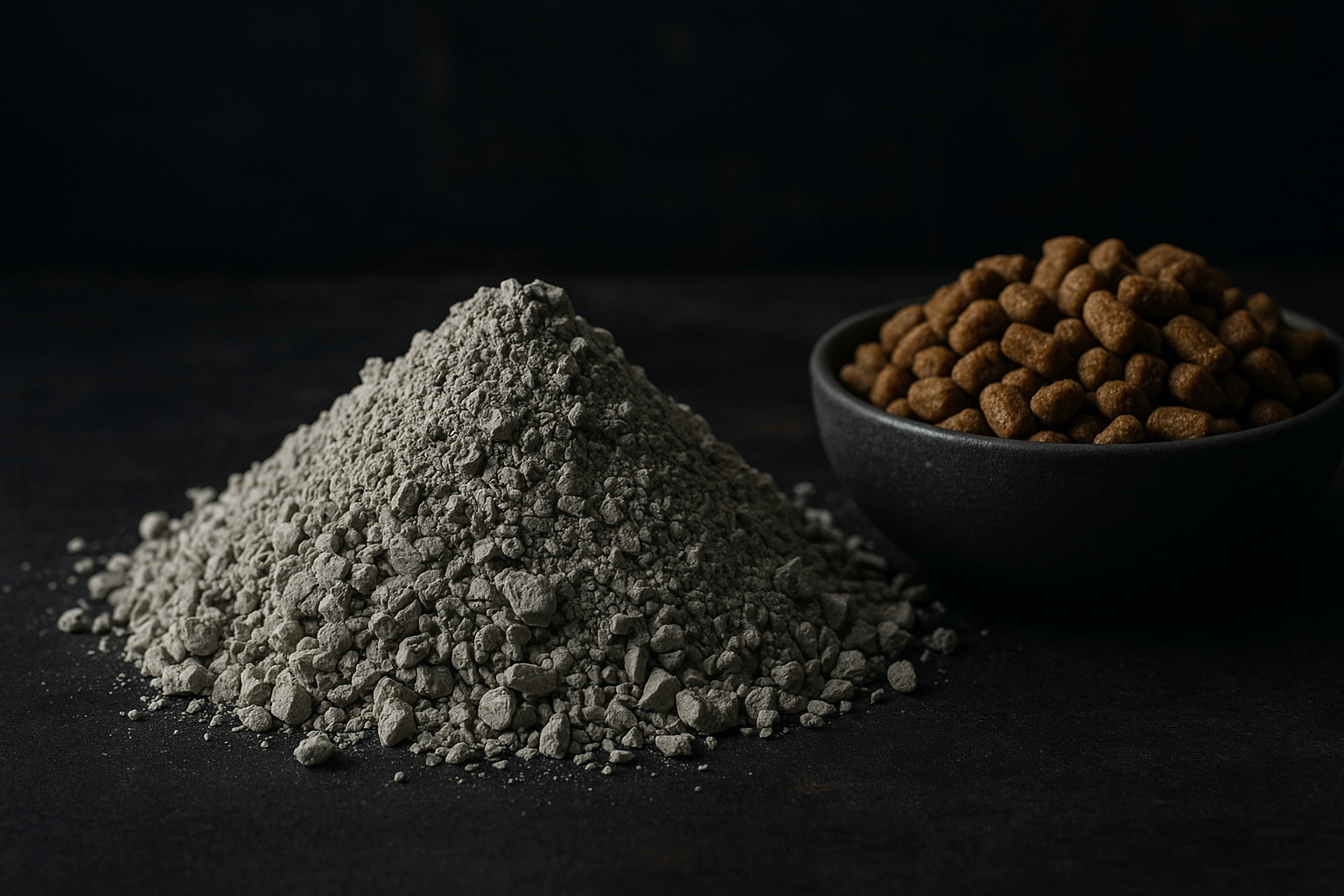
Natural Clinoptilolite Feed Anti-Caking Agent · Feed Additive Regulatory Compliance
Regulatory Basis for Zeolite in Feed
Using natural zeolite in livestock feed is grounded in the US FDA's GRAS (Generally Recognized As Safe) recognition. However, even for the same clinoptilolite, the applicable provision differs by use. Animal-feed intake use is treated under 21 CFR 582.2729 (Anticaking agents — animal feed), while other general (human food, etc.) uses are treated as GRAS for anti-caking under 21 CFR 182.2729. Both provisions limit zeolite's function to anti-caking, and functional claims such as growth promotion or treatment are not within the GRAS scope. KMIZEOLITE holds the following regulatory compliance:
Certification and Regulatory Status
| Certification/Regulation | Details |
|---|---|
| USFDA GRAS | Animal-feed intake use 21 CFR 582.2729 / other general use 21 CFR 182.2729 — recognized as GRAS as an anti-caking agent |
| FDA Feed Additive Standard | Permitted for anti-caking purposes only, 2% or less of the total feed mix |
| OMRI Listed | KMI-10365, NOP Allowed — permitted as an organic Livestock Feed Ingredient |
| TSCA | Compliant with the Toxic Substances Control Act |
| California Prop 65 | Compliant with carcinogen warning standards |
Key regulation: The FDA permits zeolite in feed for anti-caking purposes only, with a maximum addition of 2% or less of the total feed mix. Exceeding this ratio or labeling it for other functional purposes may constitute a regulatory violation.
Key Physical Property Data
| Item | Value | Significance for Feed Application |
|---|---|---|
| Clinoptilolite purity | 97.0% | Minimized impurities, consistent quality |
| CEC | 1.6-2.0 meq/g | Moisture and ammonium management capacity |
| Specific surface area | 40.0 m²/g | Secured adsorption surface |
| Pore diameter | 4.0-7.0 Å | Molecular-level selective adsorption |
| pH stability range | 3.0-10.0 | Stable within the digestive-tract environment range |
| Hardness | 4.0-5.0 Mohs | Structure maintained during grinding and mixing |
| Moisture content | Max 10% | Moisture management during blending |
Chemical Composition
| Component | Chemical Formula | Content |
|---|---|---|
| Silicon dioxide | SiO₂ | 66.7% |
| Aluminum oxide | Al₂O₃ | 11.48% |
| Potassium oxide | K₂O | 3.42% |
| Sodium oxide | Na₂O | 1.8% |
| Calcium oxide | CaO | 1.33% |
| Iron oxide | Fe₂O₃ | 0.9% |
| Magnesium oxide | MgO | 0.27% |
Why Zeolite Is Considered as a Feed Anti-Caking Agent
The most common field problem at compound-feed plants is moisture-induced caking of fine powdered ingredients and reduced flowability inside silos and mixers. Natural clinoptilolite is a negatively charged porous mineral that, through its cation-exchange capacity of CEC 1.6-2.0 meq/g and molecular-sized pores of 4.0-7.0 Å, selectively captures free water and ammonium (NH₄⁺) within the feed matrix, reducing such caking and agglomeration and maintaining flowability and storage stability — and is therefore considered as a feed anti-caking agent. This is precisely the original use the FDA permits as GRAS. This page focuses on anti-caking and feed-additive regulatory compliance; the gut-function and productivity perspective, such as intestinal ammonia/mycotoxin adsorption or weight gain and feed conversion ratio (FCR), is covered separately on the livestock zeolite feed aid material page.
- Improved dispersibility of blend ingredients: reduces agglomeration among fine powdered ingredients to support uniform mixing
- Moisture and odor management: manages moisture and ammonium in feed with the adsorption capacity of CEC 1.6-2.0 meq/g
- Storage stability: prevents moisture-induced caking — the FDA GRAS-recognized purpose
- Linkage with barn and manure environments: feed-barn-manure-compost can be approached as a single operational flow
Anti-Caking Mechanism — What Prevents Caking
Caking in compound feed is a process in which free water condenses on the surface of fine powders, forming liquid bridges between particles, which then dry and recrystallize into solid bridges. Clinoptilolite intervenes in this process via three pathways.
- (1) Free-water absorption (physical adsorption): the 4.0-7.0 Å channels and roughly 40 m²/g internal surface capture free water between particles via capillary condensation, reducing the very moisture that would form liquid bridges. Because it selectively handles only free water rather than bound water, it does not significantly disturb the feed's overall moisture specification (max 10%).
- (2) Ammonium (NH₄⁺) cation exchange: the negatively charged framework at CEC 1.6-2.0 meq/g exchanges NH₄⁺ generated during feed and decomposition with framework cations (Ca²⁺, K⁺, Na⁺) to adsorb it. Clinoptilolite is known as a natural mineral with particularly high selectivity for NH₄⁺.
- (3) Carrier/dispersion (solid lubrication): hard fine particles at a hardness of 4.0-5.0 Mohs coat the surfaces of sticky ingredients (containing molasses or fats), acting as an anti-tack carrier that reduces direct particle-to-particle contact and stickiness.
It is important that all three pathways are cation exchange and physical adsorption based on the negatively charged framework. That is, this use is not about capturing anions (phosphate, fluoride, nitrate, etc.) but about handling free water, ammonium, and sticky surfaces; unmodified clinoptilolite is not suitable for targeted anion removal (metal/surfactant modification is a prerequisite). Also, the smaller the particle size, the greater the exposed surface per unit mass and the higher the moisture-absorption/adsorption efficiency; the in-field study by Katsoulos et al. (2016) also reported that <0.15mm powder showed a greater adsorption effect than <0.8mm at the same dosage (a difference in porous surface area). This is the quantitative basis for setting the standard feed particle size at 100 mesh or finer (<150μm).
Feed-Grade Zeolite in the Research Literature
A comprehensive review in animal nutrition, Papaioannou et al. (2005, Microporous and Mesoporous Materials), summarizes that when clinoptilolite is added to feed at around 1.5-2.0% it plays a supportive role through adsorption of ammonia and toxins in the digestive tract and regulation of feed passage, reporting that natural zeolite is a mineral that has been extensively reviewed in livestock nutrition (DOI: 10.1016/j.micromeso.2005.01.013). The review by Ural (2014, Scientific Papers: Series D, Animal Science) likewise consolidates how the cation-exchange and adsorption properties of clinoptilolite have been used as a feed additive across livestock species (DOI: 10.15835/buasvmcn-asb:10341).
Regarding feed safety, Katsoulos et al. (2006, Microporous and Mesoporous Materials) report that natural clinoptilolite has been studied as a binder candidate for binding aflatoxin in feed, addressing adsorption function within the feed matrix (DOI: 10.1016/j.micromeso.2006.04.020). As a case quantitatively showing the relationship between particle size and adsorption, Katsoulos et al. (2016, Journal of Animal Science and Technology) reported that in an in-field trial across 15 commercial dairy farms, feeding clinoptilolite (CEC ≈ 160 meq/100g = 1.6 meq/g, clinoptilolite 85-87%) at 200 g/head per day (≈ 1% on a feed dry-matter basis) reduced aflatoxin M1 in milk from an average of 0.078 to 0.036 μg/kg — i.e., an average reduction of 56.2% — and that <0.15mm particles showed a significantly greater reduction than <0.8mm (a difference in porous surface area; DOI: 10.1186/s40781-016-0106-4). Meanwhile, the safety review by Pavelic et al. (2018, Frontiers in Pharmacology) comprehensively evaluates the in vivo safety and non-toxic profile of clinoptilolite (DOI: 10.3389/fphar.2018.01350). However, this page is for informational purposes only, and because the FDA permits zeolite in feed strictly for anti-caking purposes and at 2% or less (animal feed 21 CFR 582.2729), the mycotoxin/ammonia functions in the above studies cannot be used as advertising or labeling claims. The particle-size–adsorption relationship is cited on this page solely as quantitative grounds for selecting a fine particle size for anti-caking.
Suitable Particle Size for Feed
| Product Name | Mesh | Particle Size | Application Method |
|---|---|---|---|
| KMI 100- mesh (Powder) | 100 mesh or finer | <150μm, median 50μm | Compound-feed blending, premix, powder coating |
For feed blending, 100-mesh or finer powder (<150μm, median 50μm) is the standard. A fine powder is required to disperse uniformly with blend ingredients and deliver the anti-caking function effectively.
Application Examples
- Compound-feed anti-caking agent: dry-blend 100-mesh powder into compound feed for cattle, dairy, swine, and poultry for anti-caking purposes in the range of 0.5-2.0% (2% upper limit). Consider both the 1.5-2.0% range commonly reviewed in the research literature and the FDA upper limit
- Premix and mixing process: use as a carrier for vitamin/mineral premixes or powdered ingredients to support anti-agglomeration and uniform dispersion. Applied to dry-mixing lines such as ribbon mixers
- Silo and bulk storage: free-water (free-moisture adsorption) management to maintain storage flowability of high-fat, molasses-containing feeds prone to moisture-induced caking. Dry lots within the zeolite's own moisture-content specification (max 10%) should be used to prevent additional moisture ingress, and sealed storage after receiving secures moisture-absorption headroom
- Dosage and process-parameter guide: a practical anti-caking dosage is typically 0.5-1.0% dry-blended, with an upper limit of 2% (FDA). On a ribbon/paddle mixer, 60-120 seconds of dry mixing secures uniform dispersion, and for micro-ingredients, pre-blend at the premix stage and then dilute into the main mix. Dust management (100-mesh fines) is supplemented by dust collection and sealed feeding
- Integrated environmental management: combined with post-feeding manure moisture/odor management and barn-bedding zeolite, operate feed-barn-manure-compost as a single flow
Review Points
- FDA GRAS 2% rule: must not exceed 2% of the total feed mix
- OMRI KMI-10365: when used as an organic livestock feed ingredient, verify it is an OMRI-certified product
- Verify key specs per lot: even for the same zeolite, anti-caking performance and handling vary with clinoptilolite purity (97% target), particle size (100 mesh or finer, median 50μm), product moisture (≤10%), CEC (1.6-2.0 meq/g), and dust level, so verify via COA
- Not for anion removal: unmodified clinoptilolite has a negatively charged framework and is therefore weak at adsorbing anions/oxyanions such as phosphate, fluoride, and nitrate; targeting these requires metal/surfactant modification as a prerequisite. This use is limited to free-water, ammonium, and tackiness management (cation exchange, physical adsorption)
- Feeding ratios and blending methods by species are difficult to generalize without field trials — confirm flowability and caking improvement with a small pilot before scaling up
- Expressions such as treatment, prevention, or productivity guarantees cannot be used per regulation (GRAS is limited to anti-caking use)
Frequently Asked Questions
For what purpose and at what limit does the FDA permit zeolite in animal feed?
The US FDA recognizes natural clinoptilolite as GRAS under 21 CFR 182.2729 and 582.2729, but within compound feed it must be used for anti-caking purposes only, at 2% or less of the total feed mix. Exceeding this ratio or labeling it for other functional purposes such as growth promotion or treatment may constitute a regulatory violation.
What particle size should be used for zeolite in compound feed?
For compound-feed blending and premix coating, KMI 100-mesh or finer powder (<150μm, median 50μm) is the standard. A fine powder is required so it disperses uniformly with other feed ingredients and delivers the anti-caking function effectively. At a hardness of 4.0-5.0 Mohs, the structure is maintained through mixing and conveying processes.
What is the physical basis for zeolite acting as a feed anti-caking agent?
Clinoptilolite is a negatively charged porous mineral with a cation-exchange capacity of CEC 1.6-2.0 meq/g and pores of 4.0-7.0 Å. This structure adsorbs free water and ammonium (NH₄⁺) within the feed matrix, reducing moisture-induced caking of fine powdered ingredients and maintaining flowability and storage stability inside silos and mixers. This is consistent with the original anti-caking use the FDA permits as GRAS.
Can it also be used in organic livestock feed?
KMI natural zeolite is OMRI Listed (KMI-10365, NOP Allowed) and is permitted as an organic Livestock Feed Ingredient. However, when applying it to certified-organic feed, you must separately verify that the product used is an actual OMRI-certified lot and that it complies with local feed regulations and certification requirements.
Can zeolite also capture anions (phosphate, fluoride, etc.) in feed?
Unmodified natural clinoptilolite has a negatively charged framework and is therefore strong at cation exchange and physical adsorption, so it is suitable for free-water and ammonium (NH₄⁺) management and anti-caking, but weak at adsorbing anions/oxyanions such as phosphate, fluoride, and nitrate. To target anions, a metal-modified (e.g., iron, lanthanum) or surfactant-modified surface is a prerequisite, which is a different application from this feed anti-caking use. All adsorption descriptions on this page are based on cation exchange and physical adsorption.
Notice
This page is an informational page describing general directions for applying zeolite in feed. Actual feed application must be separately reviewed based on product specifications, FDA GRAS standards (2% or less, anti-caking purpose), OMRI certification requirements, local feed-related regulations, and veterinary/husbandry management standards.
Related pages: Poultry Feed Aid Material · Swine Feed Aid Material · Cattle & Dairy · Barn Bedding & Deodorization · Feed Pellet Flow Agent
science Related Research Papers
Academic papers covering zeolite application in this field. Refer to them when reviewing adoption.
- Zeolite as a natural feed additive for animal nutrition: A review
Papaioannou, D. et al. — Microporous and Mesoporous Materials, 2005 - Zeolites as feed additives in livestock: A review
Ural, D.A. — Scientific Papers: Series D, Animal Science, 2014 - Use of natural zeolite (clinoptilolite) in the reduction of ammonia from livestock environments
Mumpton, F.A. and Fishman, P.H. — Clays and Clay Minerals, 1977 - Natural clinoptilolite as aflatoxin binder in dairy cattle feed
Katsoulos, P.D. et al. — Microporous and Mesoporous Materials, 2006 - In-field evaluation of clinoptilolite feeding efficacy on the reduction of milk aflatoxin M1 concentration in dairy cattle
Katsoulos, P.D. et al. — Journal of Animal Science and Technology, 2016 - Critical Review on Zeolite Clinoptilolite Safety and Medical Applications in vivo
Pavelic, K. et al. — Frontiers in Pharmacology, 2018
The papers above are reference materials; actual application requires a separate review tailored to field conditions.