Barn Bedding & Litter
There are field cases where blending natural clinoptilolite into litter at 38% by weight reduced ammonia generation by about 44%. It is a granular auxiliary material for 14×40 and 8×14 mesh application, in which CEC 1.6-2.0 meq/g NH₄⁺ ion exchange and a 40 m²/g moisture-uptake surface operate at the same time.
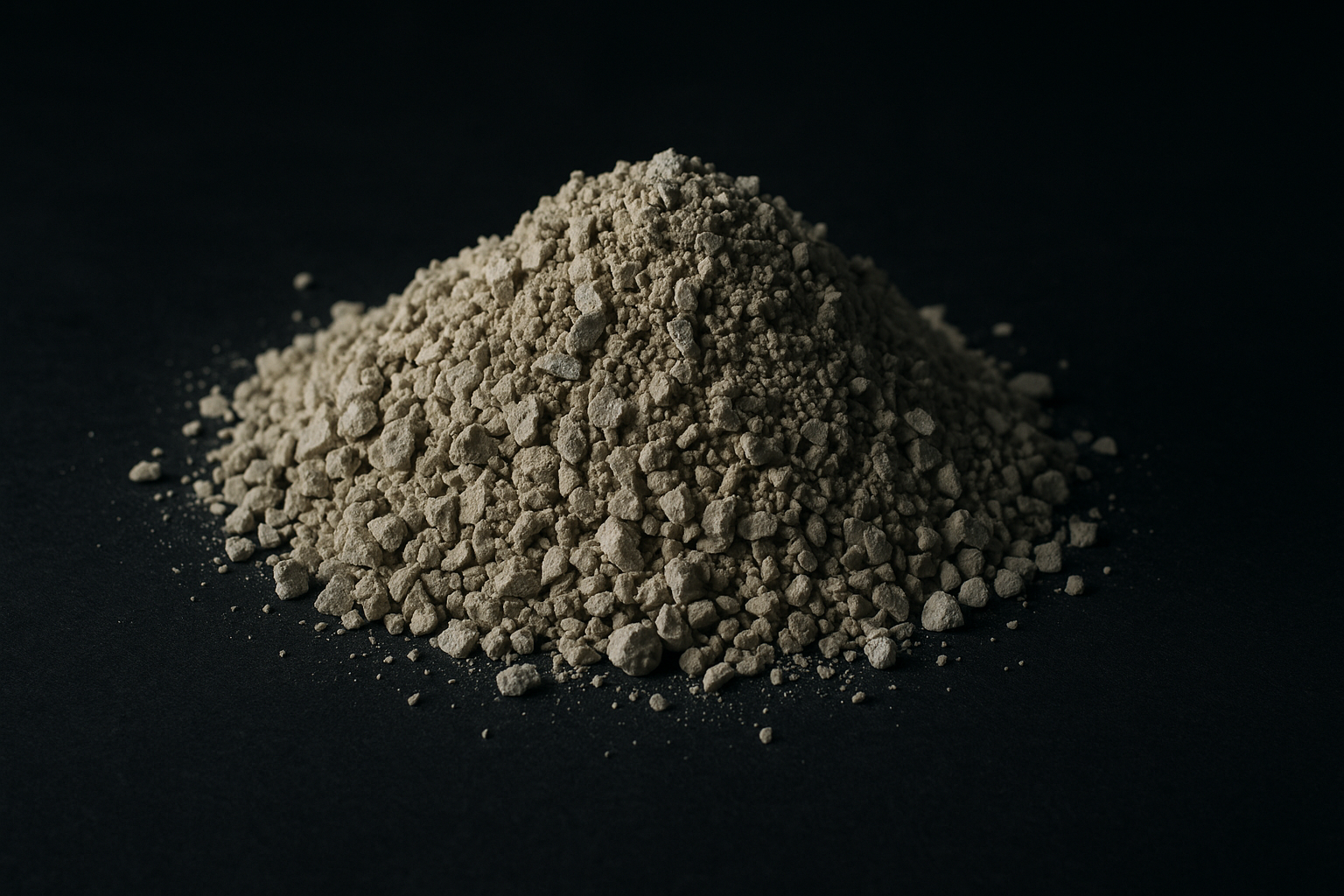
Natural Clinoptilolite Zeolite for Barn Bedding & Litter
The Core of Barn Environment Management: Ammonia and Moisture
The biggest problems arising from barn floors and litter are ammonia odor and excess moisture. When urea and uric acid in feces and urine are hydrolyzed by the urease and uric-acid-degrading activity of microbes, ammonium (NH₄⁺) is generated; as the litter pH rises above 7 and moisture increases, the equilibrium shifts toward volatile ammonia (NH₃), which escapes into the air. This NH₃ irritates the respiratory mucosa of livestock, reducing weight gain and feed efficiency in broilers, and directly affects the worker environment and nearby community complaints.
Natural clinoptilolite zeolite combines an ammonium ion-exchange capacity of CEC 1.6-2.0 meq/g with a moisture-adsorbing surface of 40.0 m²/g specific surface area, operating along two pathways at once: capturing NH₄⁺ on its framework just before it volatilizes, and lowering litter water activity. Its use as a bedding mineral is a long-standing research topic; Mumpton and Fishman early on summarized that clinoptilolite is effective at reducing ammonia in livestock environments (Mumpton & Fishman, 1977, Clays and Clay Minerals), and a 1981 broiler rearing trial also confirmed that clinoptilolite improves the poultry-house environment and litter condition (Nakaue & Koelliker, 1981, Poultry Science).
How Ammonium Is Captured (Ion Exchange + Moisture Uptake)
The clinoptilolite framework contains micropores of 4.0-7.0 Å and a negative charge created when Al³⁺ substitutes for Si⁴⁺ sites. The Na⁺, K⁺, and Ca²⁺ exchangeable cations that offset this negative charge swap places with the ammonium ions (NH₄⁺) generated as feces and urine decompose, selectively adsorbing NH₄⁺ through cation exchange. Owing to its hydrophilic, high-Si framework, clinoptilolite has high selectivity for NH₄⁺ and K⁺, so it fixes ammonium on its framework even in moisture-rich litter environments. Once NH₄⁺ is fixed, the pathway for conversion and diffusion to NH₃ is blocked, reducing odor; at the same time, the 40.0 m²/g adsorption surface captures surface moisture in the litter, suppressing floor wetting and the acceleration of microbial decomposition. The same NH₄⁺ adsorption and odor-control mechanism is quantitatively confirmed in cat litter research as well (Bernardi et al., 2019, Applied Clay Science).
Field performance tends to be proportional to the application rate. There is a reported case where blending clinoptilolite into litter at about 38% by weight reduced ammonia generation by about 44%, and broiler rearing studies have likewise confirmed that adding clinoptilolite lowers ammonia emission (Karamanlis et al., 2008, British Poultry Science; Poultry Science, 2024). A trial applying zeolite to stored laying-hen manure also showed significantly reduced ammonia volatilization, reporting that the same principle works not only in litter but also at the manure storage stage (Kithome et al. line of research, 2008, Journal of Applied Poultry Research). However, the degree of reduction depends heavily on ventilation rate, stocking density, and litter type and moisture, so adsorption and replacement operations must be designed together rather than relying on an absolute figure.
Key Properties
| Property | Value | Significance for Bedding Use |
|---|---|---|
| Clinoptilolite purity | 97.0% | Minimizes impurities |
| CEC | 1.6-2.0 meq/g | Ammonium adsorption and retention |
| Specific surface area | 40.0 m²/g | Moisture and odor adsorption surface |
| pH stability range | 3.0-10.0 | Handles a range of barn environments |
| Hardness | 4.0-5.0 Mohs | Minimizes crushing under foot traffic |
| Bulk density | 720-865 kg/m³ | Easy to apply and transport |
Suitable Particle Size for Barn Bedding
| Product Name | Mesh | Particle Size | Application Environment |
|---|---|---|---|
| KMI 14×40 | 14×40 mesh | 0.4-1.4mm | Poultry houses, small swine barns, stable floors |
| KMI 8×14 | 8×14 mesh | 1.4-2.4mm | Cattle barns, large swine barns, large-area floors |
For bedding use, a granular product that produces little dust and is easy to work with is suitable. If it breaks down under foot traffic, fines increase, clogging the adsorption surface and generating dust; a granular form with 4.0-5.0 Mohs hardness therefore retains its shape within the litter. Fines (finer than 100 mesh) are unsuitable for bedding due to dust issues, and this particle size is used separately for feed anti-caking purposes. The GRAS basis for feed use, which falls on the food and feed-intake pathway, is 21 CFR 582.2729 (clinoptilolite for animal feed); since bedding is not intended for ingestion, it is operated clearly separated from feed particle sizes and uses.
Usage Methods and Application Rate Guidelines
The application rate is directly linked to adsorption capacity. CEC 1.6-2.0 meq/g means that, in theory, 1 kg of zeolite can exchange and retain about 1.6-2.0 mol of NH₄⁺ (roughly 22-28 g N in nitrogen terms); in the field, however, because of competing cations (K⁺, Ca²⁺) and contact efficiency, it is safer to set the value lower than the theoretical one and operate with a generous application plus periodic replenishment. The methods below are combined and applied according to the rearing stage and the location of the problem.
Base Application (Floor Pre-spreading)
This method spreads zeolite on the floor surface first, then places existing litter such as hay, sawdust, or rice husks on top. The zeolite first adsorbs NH₄⁺ and moisture in the high-moisture, high-ammonium layer near the floor, slowing the caking in which the lower litter becomes wet and hardens.
Blended Application (Mixed into Litter)
This is a method whose effect has been confirmed in field- and barn-scale studies, mixing a certain proportion of the total litter weight as zeolite. Since a roughly 38% by-weight blend has been reported to reduce ammonia by about 44%, raise the blending ratio in zones with severe odor and dampness. However, if the ratio is excessive, the litter's insulation and cushioning may decline, so balance it with the litter's function.
Top Application (Top-dressing)
Apply the needed amount on top of litter that is in use, responding at the point when adsorption saturates and odor and dampness rise again. In zones where ammonia generation speeds up, such as the late rearing period or hot and humid weather, keep the replenishment cycle short.
Spot Application (Hot Spots)
Concentrate application in places where moisture and ammonia gather locally, such as entrances, around waterers, and excretion-concentrated zones. Compared with full-area application, this reduces material usage while suppressing volatilization at the most problematic spots.
Compost Integration (Reuse After Recovery)
The recovered zeolite-plus-litter mixture can be recycled as compost feedstock. The NH₄⁺ adsorbed on the zeolite holds nitrogen during composting, reducing nitrogen loss from ammonia volatilization and raising the nitrogen content of the final compost. A composting trial adding clinoptilolite to livestock manure reported nitrogen-conservation and fermentation-stabilization effects, making it possible to design a cycle in which the adsorption at the litter stage carries through to the compost stage (Awasthi line, 2021, Agriculture).
Review Points
- Particle-size separation — Separate by use: granular for bedding (14×40 or 8×14 mesh) and fines for feed anti-caking (100 mesh). Bedding is not intended for ingestion; the GRAS basis for feed-intake use is 21 CFR 582.2729.
- Replacement cycle — CEC-based adsorption saturates, so use the point when dampness and odor rise again as a signal, and incorporate the replenishment and replacement cycle into the operating plan.
- Pair with ventilation and cleaning — Zeolite is an auxiliary means of slowing volatilization; perceived effect grows when ventilation rate, cleaning, and existing litter quality all work together.
- Properties and safety — Check together for foot-traffic-induced fines and dust, floor slipperiness, and condensation, and confirm that the granular form is maintained (hardness 4.0-5.0 Mohs).
Notes
Bedding zeolite is an auxiliary material that helps manage odor and moisture; on its own it does not replace ventilation, cleaning, and husbandry management. Because the application amount and replacement cycle vary with barn structure, stocking density, ventilation, and litter type and moisture, the quantitative values cited (about 44% reduction at a 38% blend, CEC 1.6-2.0 meq/g) are reference ranges under research and trial conditions, not guaranteed field figures. Before adoption, we recommend validating the application rate and replacement cycle in a small area, then scaling up fully.
Related Pages: Manure & Compost Odor Management · Livestock Feed Auxiliary Material Overview · Zeolite for Composting
Frequently Asked Questions (FAQ)
How much does ammonia actually drop when zeolite is added to barn litter?
Field- and barn-scale studies report cases where blending clinoptilolite into litter at 38% by weight reduced ammonia generation by about 44%. The degree of reduction depends on stocking density, ventilation, litter type, and application rate, so it is more important to design adsorption and replacement operations together than to rely on an absolute figure. Karamanlis et al. (2008, British Poultry Science) and a 2024 Poultry Science study also reported that clinoptilolite lowers litter ammonia emission in broiler rearing environments.
Which particle size (mesh) should be used for bedding zeolite?
A granular product that produces little dust and resists crushing under foot traffic is suitable. For poultry houses, small swine barns, and stable floors, KMI 14×40 mesh (0.4-1.4mm) is recommended; for cattle barns, large swine barns, and large-area floors, KMI 8×14 mesh (1.4-2.4mm) is recommended. Fines finer than 100 mesh are unsuitable for bedding due to dust issues; fines are used separately for feed anti-caking purposes (GRAS basis for feed-intake use: 21 CFR 582.2729).
What is the mechanism for adsorbing ammonia?
Clinoptilolite is a natural mineral with micropores of 4.0-7.0 Å and a negatively charged framework that captures ammonium ions (NH₄⁺), formed as feces and urine decompose, through cation exchange (CEC 1.6-2.0 meq/g). The Na⁺, K⁺, and Ca²⁺ that filled the framework's negative charge swap places with NH₄⁺, and once NH₄⁺ is fixed, the pathway for conversion to volatile NH₃ is blocked. At the same time, the 40.0 m²/g specific surface area adsorbs moisture and odor molecules, jointly suppressing litter wetting and gas volatilization.
How do you set the application rate and replacement cycle?
CEC 1.6-2.0 meq/g corresponds to a theoretical adsorption capacity of about 1.6-2.0 mol NH₄⁺ per kg of zeolite (roughly 22-28 g N in nitrogen terms). In the field, however, competing cations and contact efficiency mean the value is set lower than the theoretical one, and additional application or replacement is triggered when odor and dampness rise again. The most reliable approach is to first validate a mixing ratio around 38% and a replenishment cycle in a small area, then scale up fully.
How do you dispose of used zeolite litter?
The saturated zeolite-and-litter mixture can be recycled as compost feedstock. The adsorbed ammonium holds nitrogen in the compost, helping to reduce nitrogen loss and ammonia volatilization during composting (livestock manure composting trial in Agriculture, 2021). Set the replacement cycle based on when dampness and odor concentrate, and incorporate the recovery and replacement schedule into your operating plan alongside the barn cleaning cycle.
science Related Papers
These are academic papers covering zeolite application in this field. Refer to them when reviewing adoption.
- Use of natural zeolite (clinoptilolite) in the reduction of ammonia from livestock environments
Mumpton, F.A. and Fishman, P.H. — Clays and Clay Minerals, 1977 - Studies with Clinoptilolite in Poultry: Effect on Broiler Performance and House Environment
Nakaue, H.S. and Koelliker, J.K. — Poultry Science, 1981 - Reduction of Ammonia Emissions from Stored Laying Hen Manure Through Zeolite
Journal of Applied Poultry Research, 2008 - Use of zeolites for cat litter: Ammonia adsorption and odor control
Bernardi, A. et al. — Applied Clay Science, 2019 - Farm-scale study on clinoptilolite zeolite for reducing odour and ammonia from broiler houses
Bioresource Technology, 1997 - Effects of clinoptilolite on broiler performance and ammonia emission
Karamanlis, X. et al. — British Poultry Science, 2008 - Impact of adding zeolite to broilers diet and litter on growth and ammonia emission
Poultry Science, 2024 - Amendment of Livestock Manure with Zeolite-Clinoptilolite and Effect on Composting
Agriculture, 2021
The papers above are reference materials; actual application requires separate review suited to field conditions.