Zeolite for Barn Moisture Control
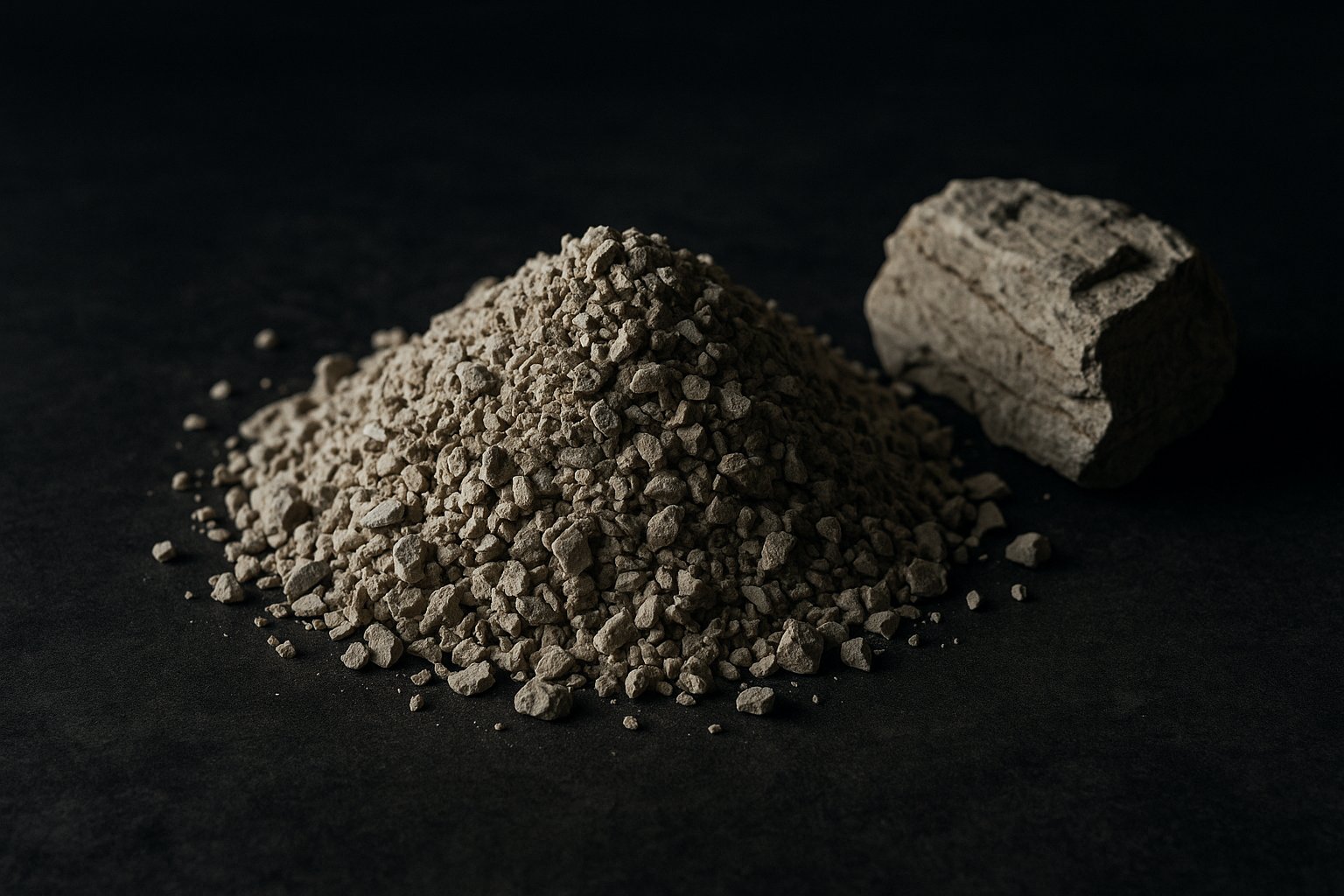
When natural clinoptilolite (97% purity, CEC 1.6-2.0 meq/g) is mixed into litter at 10-20% by weight, moisture adsorption by the 4.0-7.0 A micropores and NH4+ ion exchange operate simultaneously within the same material. Mumpton & Fishman (1977) reported a 44% reduction in ammonia loss when added to poultry litter at 38%. The 14x40 mesh granules resist crushing and dust, making them well suited as a litter additive, and zeolite is a moisture-adsorbing buffer material that does not replace ventilation.
Why barn floor moisture and litter condensation are a problem
In enclosed poultry, hog, and cattle houses, the respiration, excretion, and drinking behavior of animals introduce tens of liters of moisture into the litter and bedding each day. When ventilation is insufficient, or during winter when the temperature gap between outside and inside is large, ceiling and wall condensation appear together with floor caking, pushing litter moisture content past the appropriate 25-35% range to above 40%.
Wet litter is not merely a hygiene issue. As moisture rises, microbial decomposition of urea accelerates and ammonia (NH3) generation spikes, leading directly to footpad dermatitis, respiratory disease, and lower feed efficiency. In other words, "moisture management" and "ammonia and odor management" in a barn are an inseparable pair of tasks, calling for a moisture-adsorbing, adsorptive material that addresses both at once.
Why zeolite is considered for barn moisture management
Natural clinoptilolite is a hydrated aluminosilicate in which uniform 4.0-7.0 A micropores develop like a network inside the crystal. Because two functions operate simultaneously within the same crystal, the "moisture" and "ammonia" that are hard to separate in a barn can be handled with a single material.
- Physical moisture adsorption (capillary condensation in micropores): Because the pore openings are larger than a water molecule (about 2.8 A), they draw in free water and water vapor from the litter surface through capillary condensation. Moisture adsorption is reversible, exhibiting a buffering behavior that releases moisture again during ventilation and drying. In other words, it does not permanently remove moisture but is a material that "shaves off sudden moisture peaks."
- Chemical ion exchange (NH4+ fixation): The negative charge created by Al3+ substitution in the framework is neutralized by exchangeable cations (Ca2+, Na+, K+), and at these sites NH4+ is selectively exchanged and fixed. Clinoptilolite has high NH4+ selectivity in its cation affinity sequence (tending toward K+ ~ NH4+ > Na+ > Ca2+), so it preferentially captures ammonium dissolved in the litter moisture. The cation exchange capacity (CEC) of the KMIZEOLITE framework is 1.6-2.0 meq/g, and this value sets the theoretical upper limit of NH4+ that can be fixed per gram.
Ammonia volatilization occurs when urea and uric acid in the litter moisture are decomposed by microbes (urease). When clinoptilolite holds moisture to lower free-water activity and traps the resulting NH4+ in its framework, the amount escaping as gaseous NH3 itself decreases. The figure "44% reduction in ammonia loss at 38% litter addition" compiled by Mumpton & Fishman (1977) is a representative number for this coupled moisture-adsorption and ion-exchange behavior.
Note - scope of application: The mechanism above applies to the cation NH4+ (ammonium) and to water. Unmodified clinoptilolite carries a negative framework charge, so it barely adsorbs anions such as phosphate or nitrate, and such uses presuppose separate metal or surfactant modification. Barn moisture and ammonia management is a domain fully explained by cation exchange and moisture-adsorption mechanisms.
KMIZEOLITE's natural clinoptilolite has 97% purity and is mined and processed at a mine in Amargosa Valley, Nevada, USA. With a specific surface area of 40.0 m2/g, a specific gravity of 1.89, and a stable pH range of 3.0-10.0, the framework does not collapse even in the mildly alkaline (around pH 8) environment of manure, and at a hardness of 4.0-5.0 Mohs it does not crush easily even when animals walk over it, making it suitable as a litter additive. With thermal stability up to 700°C, the structure is maintained even in post-use drying and regeneration workflows.
KMIZEOLITE key properties
| Item | Value |
|---|---|
| Clinoptilolite purity | 97% |
| Cation exchange capacity (CEC) | 1.6-2.0 meq/g |
| Specific surface area | 40.0 m2/g |
| Pore diameter | 4.0-7.0 A |
| Stable pH range | 3.0-10.0 |
| Hardness | 4.0-5.0 Mohs |
| Thermal stability | 700°C |
| Specific gravity | 1.89 |
| Bulk density | 45-54 lbs/ft³ |
| Certifications | OMRI KMI-10365, FDA GRAS, TSCA, EN-71-3 |
Application examples of zeolite for barn moisture control
The representative ways to apply zeolite for litter and bedding moisture management in the barn are as follows.
- Initial litter mixing: Before placement (chick placement) or re-placement, pre-mix granular zeolite into rice-hull or sawdust litter at 10-20% by weight to absorb floor moisture from the early rearing stage and delay caking
- Localized top-dressing: Sprinkle powder or fine-granule zeolite onto spots prone to wetness, such as under the watering line or around feeders, to quickly dry wet litter
- Manure pit / slurry surface application: Apply to the surface of a hog slurry pit or manure storage tank to buffer moisture and ammonia volatilization
- Floor moisture-adsorbing layer: Lay a granular zeolite layer on cattle barn or calf pen floors to reduce manure moisture rising up into the litter
- Pilot test application: Apply first to a single house or single pen, comparatively measure changes in litter moisture content and ammonia concentration, then expand site-wide
Application guide by species (summary)
| Species / section | Main application method | Recommended particle size | Initial dosing basis |
|---|---|---|---|
| Broilers (litter-reared) | Initial mixing into rice-hull/sawdust litter + watering-line top-dressing | 14x40 mesh | 10-20% of litter by weight |
| Layers (cage/floor) | Surface application on manure belt/pit | 14x40 mesh / 100 mesh | 0.5-1 kg per 1 m² of wet area |
| Swine (slurry/sawdust) | Slurry pit surface application + sawdust litter mixing | 14x40 mesh | Observe conditions after surface application |
| Dairy / calves | Stall/pen floor moisture-adsorbing layer + top-up on wet spots | 14x40 mesh | Floor moisture-adsorbing layer + localized reinforcement |
The values above are a starting point and assume calibration with a single-pen pilot depending on litter type, ventilation, and season.
Recommended particle size and product specifications
For litter and bedding moisture management in barns, Medium Granule (14x40 mesh, 0.4-1.4mm), which resists crushing underfoot and produces little dust, is the standard. For localized top-dressing that quickly dries wet spots under the watering line, it is good to also use Powder (100 mesh) or Fine Granule, which have a large absorption surface area. Select the product group suited to your use from the table below.
| Product group | Mesh | Particle size | Typical use |
|---|---|---|---|
| Powder | 100 mesh or finer | <150μm | Pozzolan, feed, powder adsorption |
| Fine Granule | 30x50 mesh | 0.3-0.6mm | Water treatment, filtration, soil |
| Medium Granule | 14x40 mesh | 0.4-1.4mm | Filter media, litter, bedding |
| Coarse Granule | 8x14 mesh | 1.4-2.4mm | Swimming pools, de-icing, large-scale filtration |
| Extra Coarse | 4x8 mesh | 2.4-4.8mm | Packed beds, air scrubbers |
Recommended on-site dosing: Start at 10-20% by weight for initial litter mixing, and for localized top-dressing about 0.5-1 kg per 1 m² of wet area, then adjust while watching the litter condition.
→ View products by mesh size · Product selection guide by application
Research evidence: simultaneous reduction of litter moisture and ammonia
The effect of clinoptilolite in the barn floor environment has been reported many times since the 1970s. The application stages can be broadly divided into (1) direct litter mixing, (2) stored manure / slurry surfaces, and (3) reducing the nitrogen load of the manure itself through feed addition, and all three routes report a reduction in ammonia volatilization.
Direct litter mixing
Mumpton and Fishman (Clays and Clay Minerals, 1977) summarized natural clinoptilolite as a functional mineral that adsorbs and reduces ammonia generated from livestock manure, reporting that adding about 38% by weight to poultry litter reduced ammonia loss by 44% (DOI: 10.1346/CCMN.1977.0250509). Nakaue et al. (Poultry Science, 1981), an early environmental study, applied clinoptilolite to the broiler rearing environment and reported the potential to improve litter and poultry-house environmental indicators (DOI: 10.3382/ps.0601221), and more recently Karamanlis et al. (British Poultry Science, 2008) also reported that clinoptilolite mitigates poultry-house ammonia emissions without burdening broiler performance (DOI: 10.1080/00071660802235919). Because ammonia volatilization is a product of urea and uric acid decomposition occurring in the litter moisture, this reduction reflects moisture-adsorption and ion-exchange behavior that traps moisture-held nitrogen in the framework.
Stored manure / slurry surfaces
Li et al. (Journal of Applied Poultry Research, 2008) reported that applying zeolite to stored layer manure can reduce ammonia emissions (DOI: 10.3382/japr.2007-00076), and Lefcourt and Meisinger (Journal of Dairy Science, 2001) quantitatively compared how adding zeolite (or alum) to dairy slurry reduced ammonia volatilization (DOI: 10.3168/jds.s0022-0302(01)74620-6). For the post-use workflow, Šubová et al. (Agriculture, 2021) reported that composting livestock manure together with clinoptilolite improves nitrogen retention and compost properties (DOI: 10.3390/agriculture11100980), supporting the "litter moisture adsorption → nitrogen fixation → compost feedstock" cycle.
Feed addition (reducing the load of the manure itself)
Leung et al. (Bioresource Technology, 2007) reported that adding clinoptilolite to feed can lower the mineral and nitrogen load of manure (DOI: 10.1016/j.biortech.2006.07.010), and the review by Papaioannou et al. (Microporous and Mesoporous Materials, 2005) comprehensively summarizes the moisture-adsorption and adsorption functions of clinoptilolite as a supplementary means of livestock hygiene management (DOI: 10.1016/j.micromeso.2005.01.013). The feed route reduces the nitrogen entering the litter in the first place, lowering the upstream burden on moisture adsorption and ventilation.
* The figures above are values obtained under each study's test conditions (species, addition rate, ventilation, measurement method); on-site results vary with litter type, ventilation rate, and season. The quantitative values on this page are presented only within the range of the cited papers and KMIZEOLITE product specifications.
Pilot testing and on-site review points
When applying zeolite for barn moisture management, checking the following items together can reduce trial and error.
- Litter moisture baseline: Before application, measure litter moisture content (target 25-35%) and the degree of caking to establish a comparison baseline
- Design by species: Apply different particle sizes (14x40 mesh as the base) and mixing/spreading methods for poultry (litter-reared), swine (slurry/sawdust), and dairy (stalls/calf pens)
- Operating conditions: Check ammonia concentration inside the barn (target 25 ppm or below) and ventilation rate together. Zeolite is a supplementary material that does not replace ventilation
- Maintenance: Set the re-application cycle in line with the litter replacement cycle and the manure handling (e.g., composting) workflow
- Regulatory check: Litter and bedding moisture-adsorption use is not feed intake, so it falls under general GRAS (21 CFR 182.2729); when mixed directly into feed for feeding, manage it at 2% or less of the total formulation under the animal-feed GRAS (21 CFR 582.2729) standard. If organic livestock certification is required, also confirm OMRI (KMI-10365) compliance
- Post-use utilization: Spent zeolite that has held ammonia and moisture is rich in nitrogen and can be considered for reuse as a compost feedstock
→ View TDS (product data sheet) · View MSDS (safety data sheet)
Barn moisture FAQ
Does zeolite really reduce barn moisture and ammonia at the same time?
Yes, both functions work simultaneously within the same crystal. The 4.0-7.0 A micropores adsorb free water from the litter through capillary condensation, lowering water activity, while the negatively charged framework with a CEC of 1.6-2.0 meq/g captures dissolved ammonium (NH4+) by selective ion exchange, reducing NH3 volatilization. Mumpton and Fishman (1977) reported a 44% reduction in ammonia loss when added to poultry litter at 38% by weight. That said, zeolite is a moisture-adsorbing buffer material and does not replace ventilation, so it must be used alongside proper ventilation and replacement management.
How much zeolite and what particle size should be mixed into the litter?
The standard approach is to mix Medium Granule (14x40 mesh, 0.4-1.4mm), which resists crushing underfoot, into the litter at 10-20% by weight at the start. For wet spots such as under the watering line, locally top-dress with Powder (100 mesh) or Fine Granule. The exact ratio varies with species and ventilation conditions, so confirm it with a single-pen pilot.
How should the re-application (replacement) cycle be set?
Because zeolite is a buffer material that holds litter moisture and ammonia, it is generally re-applied in line with your existing litter replacement cycle. Wet spots around the watering line may need more frequent top-dressing. Monitor litter moisture content and ammonia concentration (target 25 ppm or below) and adjust the cycle accordingly.
Can the used litter be used as compost?
Spent zeolite that has adsorbed ammonia and nitrogen is rich in nitrogen, so it can be considered for reuse as a compost feedstock. Zeolite is OMRI Listed (KMI-10365), a natural mineral permitted for organic use, so it poses little burden in the composting workflow. Apply it in accordance with local manure and compost regulations.
Can I get livestock samples and certification documents?
Yes, KMIZEOLITE provides samples for evaluating litter applications. Please leave your animal species and desired particle size on the sample request page. Certifications include OMRI Listed (KMI-10365), FDA GRAS (general 21 CFR 182.2729 / animal feed 21 CFR 582.2729), TSCA compliant, and EN-71-3 PASS, which can be reviewed on the certifications page.
Inquiries and sample requests
If you are considering applying zeolite in the area of barn moisture control, please contact us through the channels below.
Notice
Whether the application is suitable may vary with on-site conditions, regulations, and test results. Before actual application, a test review tailored to on-site conditions must come first. Zeolite is best understood not as a universal solution for this field but as a material that supplements existing processes.
Related pages
science Related Papers
Academic papers covering zeolite applications in this field. Use them as reference when evaluating adoption.
- Zeolite as a natural feed additive for animal nutrition: A review
Papaioannou, D. et al. — Microporous and Mesoporous Materials, 2005 - Zeolites as feed additives in livestock: A review
Ural, D.A. — Scientific Papers: Series D, Animal Science, 2014 - Use of natural zeolite (clinoptilolite) in the reduction of ammonia from livestock environments
Mumpton, F.A. and Fishman, P.H. — Clays and Clay Minerals, 1977 - Effects of clinoptilolite on broiler performance and ammonia emission
Karamanlis, X. et al. — British Poultry Science, 2008 - Effect of Adding Alum or Zeolite to Dairy Slurry on Ammonia Volatilization
Lefcourt, A.M. and Meisinger, J.J. — Journal of Dairy Science, 2001 - Amendment of Livestock Manure with Zeolite-Clinoptilolite and Effect on Composting
Šubová, E. et al. — Agriculture, 2021 - Reduction of Ammonia Emissions from Stored Laying Hen Manure Through Zeolite
Li, H. et al. — Journal of Applied Poultry Research, 2008
The papers above are reference material; actual application requires a separate review tailored to on-site conditions.