Zeolite for Animal Bedding & Litter Aid
Natural clinoptilolite (CEC 1.6–2.0 meq/g) is a bedding aid that captures NH₄⁺ in bedding moisture by ion exchange to reduce ammonia volatilization. A reported case showed ammonia loss reduced by 44% when added at 38% by weight to poultry litter (Karamanlis 2008). It is positioned as a supplementary material that lowers the load in advance at the bedding stage without replacing ventilation.
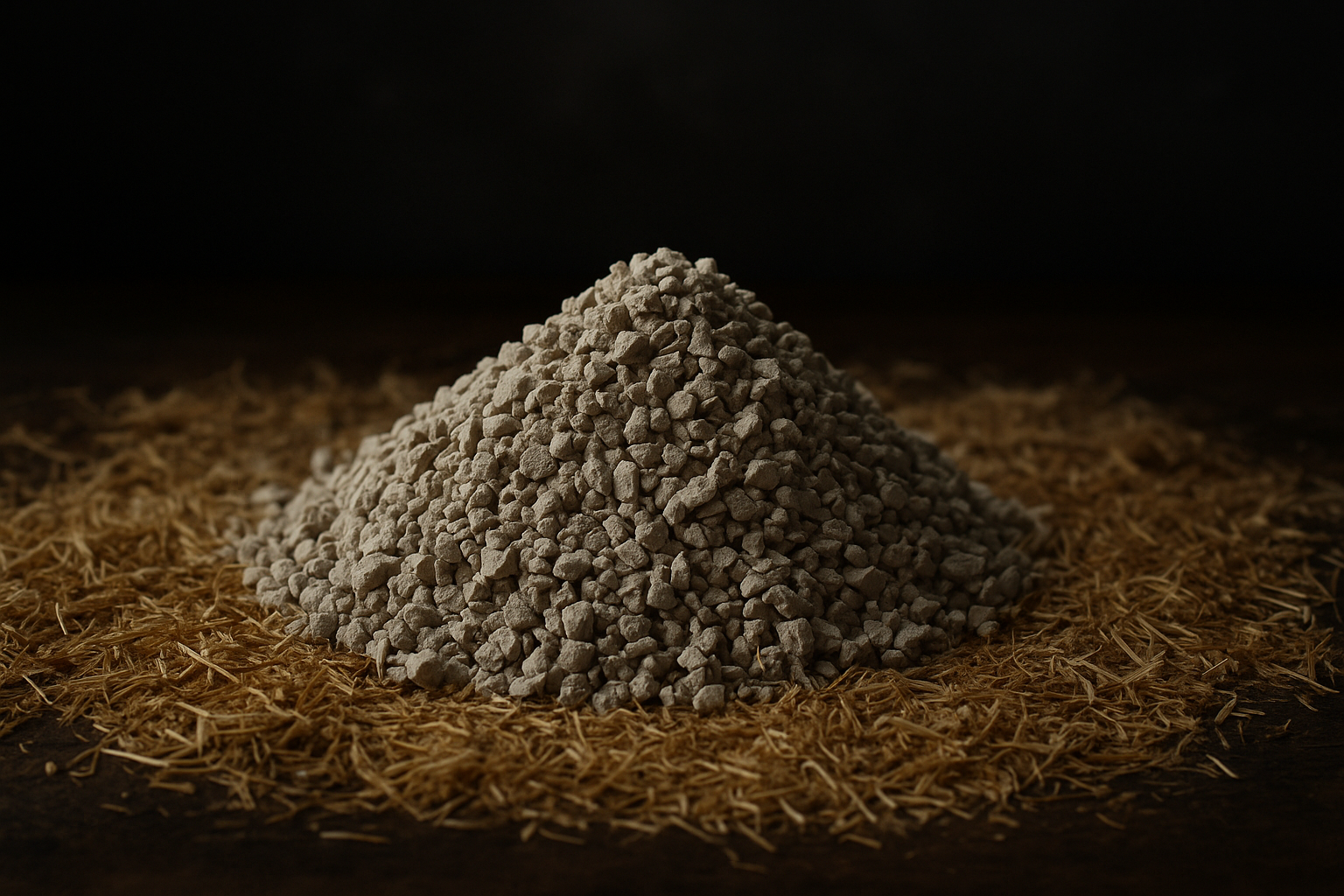
Why do ammonia and moisture problems occur in livestock bedding?
Bedding in poultry, pig, and cattle houses (rice hulls, sawdust, straw, etc.) quickly becomes wet as animal manure and drinking water fall on it, and the urea and uric acid within it are broken down by microbes and volatilized as ammonia (NH₃). The wetter the bedding becomes, the worse the ammonia generation and odor, leading to footpad dermatitis, respiratory irritation, and a deteriorating work environment. Particularly in enclosed windowless poultry houses, it is often difficult to keep ammonia concentration below 25 ppm by ventilation alone.
Bedding management goes beyond simply reducing odor; it is a core husbandry variable directly tied to stocking density, ventilation rate, replacement cycle, and manure handling cost. For this reason, mixing a certain proportion of an adsorptive mineral that traps moisture and ammonia into the bedding itself has long been studied.
Why is zeolite considered as a bedding aid?
In natural clinoptilolite zeolite, Al³⁺ substitutes for Si⁴⁺ positions within the framework, giving the lattice a permanent negative charge, and the exchangeable cations (Na⁺, K⁺, Ca²⁺, etc.) that offset this charge sit loosely within the pores. When positively charged ammonium ions (NH₄⁺) enter from the bedding moisture, they swap places with these exchangeable cations and become fixed in the lattice (cation exchange capacity CEC 1.6–2.0 meq/g). Clinoptilolite is a natural mineral with high selectivity for NH₄⁺ due to its hydrophilicity and ion-size compatibility, and to the extent that ammonia about to volatilize from the bedding is captured as NH₄⁺, airborne NH₃ release is reduced.
NH₄⁺ fixation is an equilibrium, reversible reaction, so the adsorbed amount varies with the bedding's pH, moisture, and ammonium concentration. The aqueous ammonium adsorption capacity of natural clinoptilolite is reported to range roughly 5–30 mg/g depending on conditions, and tends to decrease under alkaline conditions (around pH 8) as the NH₄⁺↔NH₃ equilibrium shifts toward NH₃ (De Gennaro et al. 2024, review). In other words, zeolite as a bedding aid is more accurately understood not as an "absorbent that completely eliminates ammonia," but as a buffering material that traps a certain amount at the NH₄⁺ stage and slows the rate of volatilization. At the same time, its micropores of 4.0–7.0 Å and specific surface area of 40.0 m²/g absorb excess moisture from the bedding to keep the floor dry, indirectly suppressing the uric-acid/urea decomposition (ammonia generation) that accelerates in wet bedding.
KMIZEOLITE's natural clinoptilolite has 97% purity and is mined and processed at the Amargosa Valley mine in Nevada, USA. With a specific gravity of 1.89 and bulk density of 45–54 lbs/ft³, it does not add excessive weight to the floor material when mixed with rice hulls or sawdust. With a stable pH range of 3.0–10.0 and thermal stability up to 700°C, its lattice structure does not collapse even in livestock-house environments where manure fluctuates between acidic and alkaline, and it can be transferred along with the bedding to replacement and composting while retaining ammonium.
In fact, Mumpton & Fishman (1977, Clays and Clay Minerals) documented that clinoptilolite can be used to adsorb ammonia in livestock environments to reduce manure odor and enable bedding recycling, and Nakaue et al. (1981, Poultry Science) reported in-house environmental improvement effects when clinoptilolite was applied to broiler litter. De Gennaro et al. (2024, Environmental Science and Pollution Research) comprehensively reviewed the CEC and ammonium adsorption characteristics of natural clinoptilolite and their pH dependence.
KMIZEOLITE key properties
| Item | Value |
|---|---|
| Clinoptilolite purity | 97% |
| Cation exchange capacity (CEC) | 1.6–2.0 meq/g |
| Specific surface area | 40.0 m²/g |
| Pore diameter | 4.0–7.0 Å |
| Stable pH range | 3.0–10.0 |
| Hardness | 4.0–5.0 Mohs |
| Thermal stability | 700°C |
| Specific gravity | 1.89 |
| Bulk density | 45–54 lbs/ft³ |
| Certifications | OMRI KMI-10365, FDA GRAS, TSCA, EN-71-3 |
Bedding/floor-material application examples and dosing
Below are representative ways zeolite is considered for livestock bedding and floor material, along with the specific dosing conditions used in studies.
- Top-of-bedding broadcasting: Before/during placement, broadcast Medium Granule (14×40 mesh) over rice-hull/sawdust bedding at about 0.5–1.0 kg per m² of floor area to capture moisture and ammonia in wet spots
- Bedding-mixed type: At the bedding-laying stage, pre-mix zeolite into the bedding at a set proportion of bedding weight. In the Karamanlis et al. (2008) study, adding at 38% by weight to poultry litter reduced ammonia loss by 44%
- Manure storage/composting aid: Mix into stacked layer-hen manure or bedding waste to reduce ammonia volatilization during storage and composting
- Drying aid: Additionally broadcast powder (100 mesh) in locally wet-prone zones such as around drinkers and in ventilation blind spots to suppress caking (hardening) and wetness
- Pilot application: First apply a small amount at the house or section level and verify ammonia concentration, footpad condition, and bedding moisture against control sections
Li et al. (2008, Journal of Applied Poultry Research) reported that applying zeolite to stored layer-hen manure can reduce ammonia emissions, and Subova et al. (2021, Agriculture) reported that amending livestock manure with clinoptilolite for composting reduces nitrogen loss (ammonia volatilization) and improves nitrogen retention in the final compost. In other words, the ammonium captured at the bedding stage can be carried through to the replacement and composting stages and recovered as a nitrogen resource. However, since the appropriate addition ratio varies with bedding type, stocking density, and ventilation conditions, it is best to confirm it through control trials like the table below.
| Application stage | Recommended particle size | Reference dosing range | Main action |
|---|---|---|---|
| Initial broadcast before placement | 14×40 mesh | 0.5–1.0 kg per m² of floor | Initial moisture/ammonia buffering |
| Bedding-mixed type | 14×40 mesh | A few to a few tens of % of bedding weight (up to 38% in study cases) | NH₄⁺ fixation throughout the rearing period |
| Local supplemental broadcast | 100 mesh (powder) | Surface application on wet zones | Caking/wetness suppression |
| Manure storage/composting | 14×40 mesh / powder | A set proportion of manure weight | Nitrogen-loss reduction during storage/composting |
The figures above are reference ranges used in research and field cases, not absolute recommendations. Since bedding aid is not feed that animals ingest directly, it is designed on a bedding-weight basis, separate from the FDA feed-addition limit (the 2% basis of 21 CFR 582.2729 for ingestion use).
Recommended particle size and product specifications
For bedding/floor-material use, Medium Granule (14×40 mesh), which produces little dust and mixes well into bedding, is the key product. For local drying and caking suppression around drinkers and similar areas, powder (100 mesh) is sometimes used as a supplement. Refer to the table below to select the product group suited to your use.
| Product group | Mesh | Particle size | Typical use |
|---|---|---|---|
| Powder | 100 mesh or finer | <150μm | Pozzolan, feed, powder adsorption |
| Fine Granule | 30×50 mesh | 0.3–0.6mm | Water treatment, filtration, soil |
| Medium Granule | 14×40 mesh | 0.4–1.4mm | Filter media, bedding, floor material |
| Coarse Granule | 8×14 mesh | 1.4–2.4mm | Pools, de-icing, large-scale filtration |
| Extra Coarse | 4×8 mesh | 2.4–4.8mm | Packed beds, air scrubbers |
→ View products by mesh size · Product selection guide by application
Pilot testing and field review points
When applying zeolite to bedding/floor material, be sure to check the following items together. (Unlike feed additives, bedding aid is not for direct ingestion by animals, so the ratio is designed relative to bedding weight, separate from the 2% feed-limit regulation.)
- Assess site conditions: First measure the ammonia concentration in the house (target preferably below 25 ppm) and establish a baseline for bedding moisture content and pH. If bedding pH is high at 8 or above, NH₄⁺ rapidly converts to NH₃ and zeolite's NH₄⁺-fixation effect weakens, so also consider whether to combine an acidifying agent
- Design basis: Determine the bedding type, addition ratio, and 14×40 mesh granular broadcasting method by species (broiler/layer, swine, dairy)
- Dosing timing: Split dosing—after the initial broadcast before placement, additional broadcasting during the periods when bedding gets wet (mid/late)—is effective
- Maintenance: Since zeolite-mixed bedding adsorbs and retains ammonium, after bedding replacement it can be utilized as a compost/fertilizer resource
- Regulatory check: If organic-livestock certification is required, verify OMRI Listed (KMI-10365) compliance. Zeolite is classified as non-toxic by IARC and is a material approved for use in the EU poultry and swine industries
- Supporting figures: In Karamanlis et al. (2008), adding 38% by weight to poultry litter reduced ammonia loss by 44%, and Li et al. (2008) reported reduced ammonia emissions from stored manure
→ Check the TDS (Technical Data Sheet) · Check the MSDS (Material Safety Data Sheet)
Zeolite for bedding/floor material FAQ
How much does mixing zeolite into bedding reduce ammonia?
In the broiler study by Karamanlis et al. (2008, British Poultry Science), adding clinoptilolite at 38% by weight to poultry litter reduced ammonia loss by 44%. However, the actual reduction varies with litter type, stocking density, ventilation rate, and addition ratio, so a house-level pilot trial is recommended before adoption.
Which particle size (mesh) is suitable for bedding?
Medium Granule (14×40 mesh, 0.4–1.4mm), which blends well into bedding and produces little dust, is the standard. For caking and moisture control in locally wet zones such as around drinkers, powder (100 mesh) is sometimes used as a supplement. Refer to the product selection guide by application.
How much should be added to bedding? Is it the same as the 2% feed limit?
Bedding aid is not feed that animals ingest directly, so it is separate from the FDA 2% feed limit. Studies report use ranging from a few to a few tens of percent relative to bedding weight, but the appropriate ratio is best determined by on-site trials based on bedding moisture and ammonia load. Split dosing—an initial application before placement followed by additional application to wet zones—is effective.
What is the mechanism by which zeolite captures ammonia?
The clinoptilolite lattice carries a permanent negative charge, attracting and fixing positively charged ammonium ions (NH₄⁺) by cation exchange (CEC 1.6–2.0 meq/g). By trapping ammonium in the bedding moisture, airborne NH₃ volatilization is reduced. However, because it is an equilibrium and reversible reaction, when bedding pH rises above 8 the NH₄⁺ converts to NH₃ and the adsorption effect weakens; the ammonium adsorption capacity of natural clinoptilolite is also not unlimited, ranging roughly 5–30 mg/g depending on conditions. It is more accurate to view it as a material that supports, rather than replaces, ventilation and replacement cycles.
Do you just discard used zeolite bedding?
Because zeolite adsorbs and retains ammonium in its lattice, replaced bedding can be utilized as a manure/compost resource. Li et al. (2008) reported reduced ammonia emissions from stored manure, and Mumpton & Fishman (1977) reported the recyclability of bedding. Check disposal and land-application methods in line with local environmental regulations.
Do you have organic livestock / certification materials?
KMIZEOLITE natural clinoptilolite is OMRI Listed (KMI-10365), permitting use in organic livestock, and holds FDA GRAS (21 CFR 182.2729), TSCA compliance, EN-71-3 PASS, and IARC non-toxic classification. Check the certifications page.
Inquiries and sample requests
If you are considering zeolite application in the animal bedding and litter aid field, please reach out through the channels below.
Notice
Applicability may vary depending on site conditions, regulations, and test results. Before actual application, a test review suited to the site conditions must always come first. Zeolite is appropriately understood not as a universal solution for this field, but as a material that supports existing processes.
Related pages
science Related Papers
Academic papers covering zeolite application in this field. Refer to them when reviewing adoption.
- Effects of clinoptilolite on broiler performance and ammonia emission
Karamanlis, X. et al. — British Poultry Science, 2008 - Use of natural zeolite (clinoptilolite) in the reduction of ammonia from livestock environments
Mumpton, F.A. and Fishman, P.H. — Clays and Clay Minerals, 1977 - Reduction of Ammonia Emissions from Stored Laying Hen Manure Through Zeolite
Li, H. et al. — Journal of Applied Poultry Research, 2008 - Studies with Clinoptilolite in Poultry: Effect on Broiler Performance and House Environment
Nakaue, H.S. et al. — Poultry Science, 1981 - Amendment of Livestock Manure with Zeolite-Clinoptilolite and Effect on Composting
Subova, E. et al. — Agriculture, 2021 - Fundamental properties and sustainable applications of natural zeolite clinoptilolite
De Gennaro, B. et al. — Environmental Science and Pollution Research, 2024
The papers above are reference materials; actual application requires a separate review suited to site conditions.