Zeolite for Chicken Bedding Aid
Natural clinoptilolite is a bedding aid that, through cation exchange of CEC 1.6–2.0 meq/g, preferentially fixes ammonium (NH₄⁺) in the bedding just before it volatilizes, and with about 40 m²/g of porosity captures excess moisture to lower the risk of caking and footpad lesions. It is spread as 14×40 mesh granules, applied in stages starting from a few percent of bedding weight, and poultry field studies report that increasing the addition rate tends to reduce ammonia loss.
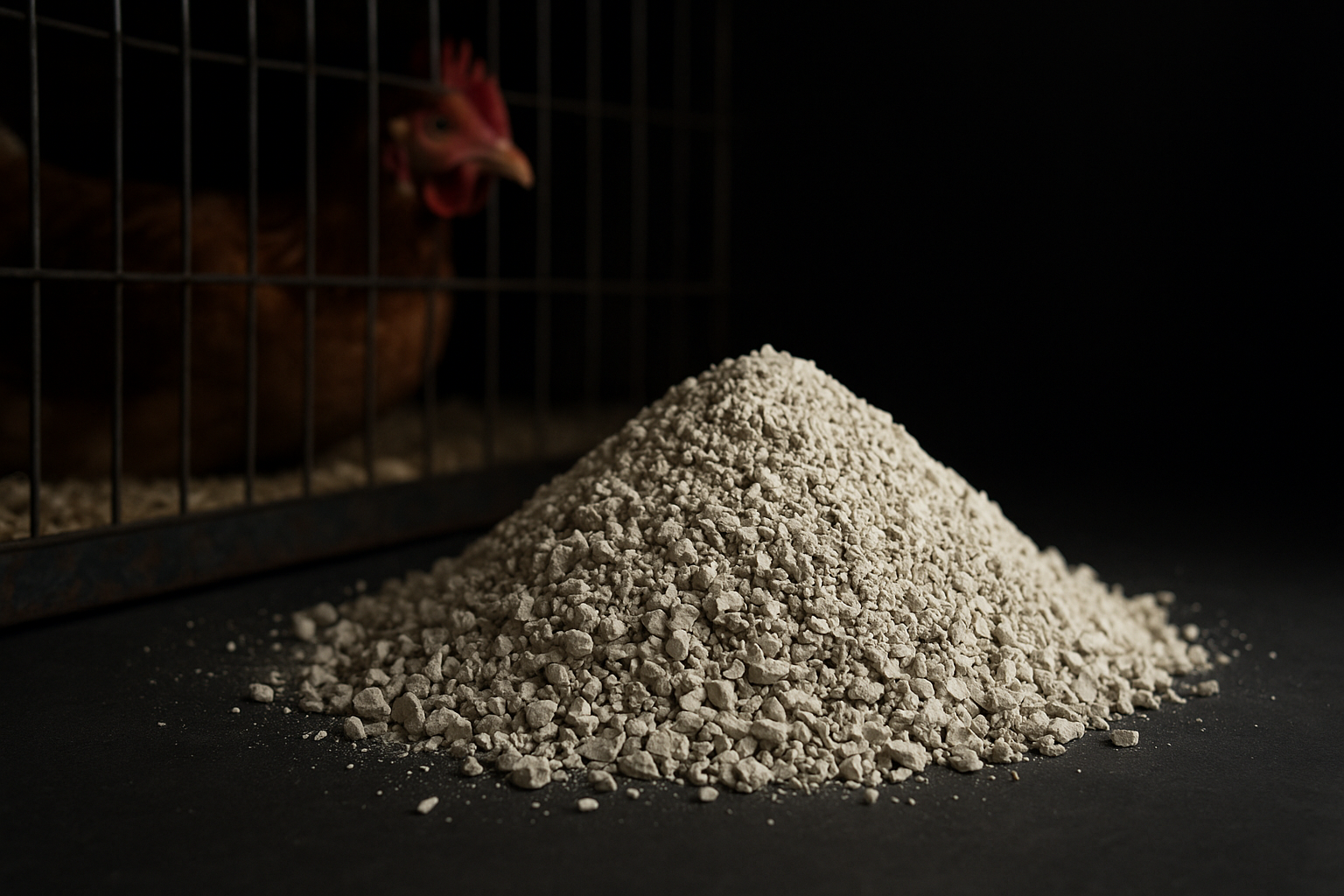
Why do ammonia and moisture problems occur in chicken bedding?
In broiler and layer rearing, bedding (rice hulls, sawdust, rice straw, etc.) absorbs manure and residual feed moisture and over time hardens (caking), while uric acid and urea in the manure are broken down by microbes with uricase and urease activity, passing through ammonium (NH₄⁺) and volatilizing as ammonia (NH₃) gas. This equilibrium is heavily governed by pH and moisture: as bedding pH rises above 8 and moisture increases, the NH₄⁺ → NH₃ conversion and volatilization accelerate. Toward the later rearing period, once bedding moisture exceeds 25%, caking and ammonia generation rise sharply, leading to respiratory irritation in birds, footpad dermatitis, worsened feed conversion ratio, and a poorer working environment for staff.
In densely stocked poultry houses in particular, it is difficult to control ammonia concentration by ventilation alone (typically recommended below 25 ppm, with stricter standards for long-term exposure), and as the number of antibiotic-free and animal-welfare-certified farms grows, demand for reviewing natural bedding aids instead of chemical treatment is increasing. The key point is that a single material targets two actions at once — (1) physically absorbing excess moisture to suppress caking and microbial activity, and (2) the chemical property of trapping already-formed NH₄⁺ within the crystal interior via cation exchange, thereby blocking NH₃ volatilization itself. Simple moisture-absorbing materials (quicklime, diatomaceous earth, etc.) provide only (1); it is mechanism (2), the direct fixation of ammonium, that sets clinoptilolite apart.
Why is zeolite considered for chicken bedding?
Natural clinoptilolite is a crystalline aluminosilicate whose Si–Al framework carries a negative charge due to Al³⁺ substitution, with exchangeable cations (Na⁺, K⁺, Ca²⁺, etc.) offsetting that charge held within 4.0–7.0 Å micropore channels. The core mechanism is that it traps ammonium ions (NH₄⁺) just before they volatilize from the bedding inside the framework via cation exchange (CEC 1.6–2.0 meq/g), reducing NH₃ gas generation. Importantly, clinoptilolite shows high exchange selectivity for NH₄⁺; in the selectivity sequence compiled by De Gennaro et al. (2024), NH₄⁺ ranks ahead of many competing cations such as Na⁺, Mn²⁺, Cu²⁺, and Zn²⁺, and thanks to this selectivity ammonium is fixed preferentially even when calcium and magnesium from the bedding matrix coexist.
At the same time, its porous structure of about 40 m²/g absorbs excess moisture from the bedding to keep the surface dry, playing a supporting role in lowering the risk of caking and footpad lesions. By suppressing both bedding moisture and pH rise through moisture absorption, the NH₄⁺ → NH₃ conversion equilibrium itself shifts unfavorably for volatilization, so ion exchange and moisture absorption mutually reinforce each other. However, because cation exchange is reversible and saturable, in the bedding environment clinoptilolite does not permanently remove ammonia but acts as a temporary reservoir that delays and buffers the timing of volatilization, and it must be designed on the premise that the nitrogen ultimately migrates into the soil (slow-release nitrogen) along with the discharged bedding and manure.
KMIZEOLITE's natural clinoptilolite has a purity of 97% and is mined and processed at the Amargosa Valley mine in Nevada, USA. With a pH stability range of 3.0–10.0 and hardness of 4.0–5.0 Mohs, it does not easily break down during bedding stirring and cleaning. For bedding spreading (unintended ingestion), we treat FDA GRAS 21 CFR 182.2729 as the applicable basis, while for blending into feed for intentional ingestion we treat the animal feed item 21 CFR 582.2729. Listed as OMRI Listed (KMI-10365), it can also be considered for organic poultry houses after confirming the certification specification.
KMIZEOLITE Key Properties
| Item | Value |
|---|---|
| Clinoptilolite purity | 97% |
| Cation Exchange Capacity (CEC) | 1.6–2.0 meq/g |
| Specific surface area | 40.0 m²/g |
| Pore diameter | 4.0–7.0 Å |
| pH stability range | 3.0–10.0 |
| Hardness | 4.0–5.0 Mohs |
| Thermal stability | 700°C |
| Specific gravity | 1.89 |
| Bulk density | 45–54 lbs/ft³ |
| Certifications | OMRI KMI-10365, FDA GRAS, TSCA, EN-71-3 |
Chicken Bedding Application Examples
Below are representative scenarios in which zeolite is considered for broiler and layer poultry house bedding. Depending on which stage of the rearing cycle (broilers about 5–6 weeks) it is introduced, the targeted effect and the optimal particle size differ.
- Floor spreading before bird placement (process position: cycle start): Before laying new bedding, spread a thin layer of granular zeolite on the floor to buffer the initial moisture and ammonia load and delay localized caking caused by condensation and pooled water beneath the bedding
- Bedding surface top-dressing (process position: later rearing): From week 3 of rearing onward, when caking and odor worsen, apply additional spreading on the bedding surface to keep the surface dry and lower the moisture at the foot-contact area. Directly targets the interval where ammonia and moisture rise fastest
- Bedding-mix type (process position: bedding composition): Mix zeolite into existing bedding materials such as rice hulls and sawdust at a certain weight ratio (starting from a few percent) to uniformly support the moisture absorption and ammonium fixation capacity of the entire bedding
- Manure-handling aid after bedding removal (process position: after cycle end): Mix into discharged broiler litter piles and compost heaps to reduce ammonia loss during the storage and composting stages and raise the nitrogen retention rate of the compost. Subova et al. (2021) reported the effect of adding clinoptilolite to livestock manure composting on nitrogen retention and maturation behavior
- Trial/pilot application: Apply a small amount to one house (or one section) to verify changes in ammonia concentration and bedding moisture in advance. Because effect variability is large, this is essential before full adoption
Recommended Particle Size and Dosage
For chicken bedding, Medium Granule (14×40 mesh, 0.4–1.4mm) is most suitable for spreading on bedding and floor material, as it withstands stirring, cleaning, and foot traffic and produces little fines scattering. The granules retain their shape among the bedding, making separation and recovery easy during cleaning and stirring, and the risk of dust inhalation is also low. Conversely, for the composting and manure-mixing stage of discharged manure, also consider Powder (100 mesh, <150μm), which has a larger exchange surface area per unit mass and therefore faster adsorption. Even for the same mineral, the smaller the particle size the larger the external surface area and reaction rate, whereas using it directly in bedding increases dust and loss, so particle-size selection is a trade-off between adsorption speed and handling.
The recommended practice is to start dosing at a level of a few percent of bedding weight (e.g., 2–5%) and raise it step by step while watching changes in ammonia concentration and bedding moisture. That said, in research settings, high-dose test cases adding up to 38% by weight (master data) on a poultry bedding basis have been reported to strongly confirm the effect — this is an upper-bound reference value, not a recommended farm application rate, and considering real cost, handling, and cleaning burden, the optimal point should be found starting from a low dose. Refer to the table below to select the product family that suits your use.
| Product family | Mesh | Particle size | Representative use |
|---|---|---|---|
| Powder | 100 mesh or finer | <150μm | Pozzolan, feed, powder adsorption |
| Fine Granule | 30×50 mesh | 0.3–0.6mm | Water treatment, filtration, soil |
| Medium Granule | 14×40 mesh | 0.4–1.4mm | Filter media, bedding, floor material |
| Coarse Granule | 8×14 mesh | 1.4–2.4mm | Swimming pools, snow removal, large-scale filtration |
| Extra Coarse | 4×8 mesh | 2.4–4.8mm | Packed beds, air scrubbers |
→ View products by mesh size · Product selection guide by application
Research Basis
The ammonia-reduction effect of clinoptilolite in poultry bedding and poultry house environments has been addressed in numerous academic studies from the 1970s to the present. The starting point of the mechanism is Mumpton & Fishman (1977), Clays and Clay Minerals, which organized the principle of how natural zeolite (clinoptilolite) reduces ammonia in livestock environments via cation exchange, providing the foundation for bedding and feed applications. This NH₄⁺-selective exchange property is also confirmed in the materials review of De Gennaro et al. (2024), Environmental Science and Pollution Research, which reports that clinoptilolite's NH₄⁺ exchange selectivity is higher than that of many competing cations such as Na⁺, Cu²⁺, and Zn²⁺.
On the poultry application side, the early field study Nakaue et al. (1981), Poultry Science examined the effect of applying clinoptilolite in poultry houses on broiler performance and the in-house environment (bedding condition and ammonia). Karamanlis et al. (2008), British Poultry Science evaluated ammonia emission and growth performance when clinoptilolite was applied to bedding and feed in broiler rearing, reporting that increasing the bedding weight ratio tends to reduce ammonia loss (a case of about 44% reduction at a 38% weight ratio on a master-data basis). Li et al. (2008), Journal of Applied Poultry Research reported reduced ammonia emission when zeolite was applied to stored layer manure, and a more recent Poultry Science (2024) study comprehensively addressed broiler growth and ammonia emission when zeolite was added to both feed and bedding.
At the review level, Papaioannou et al. (2005), Microporous and Mesoporous Materials synthesized the feed-additive and environmental-improvement applications of natural zeolite, and for the post-discharge stage, Subova et al. (2021), Agriculture reported reduced ammonia loss and nitrogen retention when clinoptilolite was added to livestock manure composting. However, the quantitative effects in these studies vary widely with bedding type, moisture, ventilation, and addition rate, so the figures above should be understood as values observed under specific conditions in the primary sources and reconfirmed through your own pilot.
Pilot Testing and Field Review Points
When applying zeolite to chicken bedding, the following items must be confirmed together.
- Baseline measurement: Before application, measure bedding moisture (aim to keep below 25%) and the in-house ammonia concentration (recommended below 25 ppm) to secure a basis for comparing the effect. If possible, also measure bedding pH to track changes in the volatilization equilibrium
- Particle size and application method: 14×40 mesh granules are suitable for bedding spreading; choose among floor spreading before placement, surface top-dressing, and bedding mixing according to the farm operation. Use granules to avoid dust scattering, or powder when compost mixing speed matters
- Dosage design: Increase step by step from 2–5% of bedding weight, comparing the degree of ammonia and caking improvement against added cost and cleaning burden to find the optimal point
- Consider saturation and replacement cycle: Because cation exchange is saturable, design the top-dressing replenishment timing and bedding replacement cycle together according to the rearing-cycle length and manure load
- Footpad lesion monitoring: Track the bedding moisture-management effect together with the incidence and grade of footpad dermatitis
- Link bedding and manure handling: Review zeolite use (nitrogen retention) in connection with the bedding replacement cycle and the composting stage of discharged manure
- Regulatory check: When antibiotic-free or organic livestock certification is required, confirm OMRI Listed (KMI-10365) compatibility. Bedding spreading (unintended ingestion) is treated within the FDA GRAS 21 CFR 182.2729 scope, while when added to feed for intentional ingestion, comply with no more than 2% of the total blend per the animal feed item 21 CFR 582.2729
→ View TDS (Technical Data Sheet) · View MSDS (Safety Data Sheet)
Chicken Bedding FAQ
Does adding zeolite to chicken bedding reduce ammonia?
Clinoptilolite works by capturing ammonium ions (NH₄⁺) in the bedding just before they volatilize, using cation exchange (CEC 1.6–2.0 meq/g), thereby reducing ammonia (NH₃) generation. Its high exchange selectivity for NH₄⁺ means ammonium is fixed preferentially even when calcium and magnesium are present in the bedding matrix (De Gennaro et al., 2024). Poultry studies such as Karamanlis et al. (2008, British Poultry Science) report that increasing the bedding addition rate tends to reduce ammonia loss, and our master data records a case of about 44% reduction at a 38% weight ratio. Because actual results vary with bedding type, moisture, and ventilation conditions, a single-house pilot is recommended before adoption.
Is the effect permanent, and what are its limits?
No. Cation exchange is reversible and saturable, so clinoptilolite does not permanently decompose or remove ammonia; it acts as a temporary reservoir that delays and buffers the timing of volatilization. Once the exchange sites are saturated, additional fixation capacity declines, so top-dressing replenishment timing and the bedding replacement cycle must be designed together according to the rearing cycle and manure load. In addition, the fixed nitrogen migrates into the soil along with the discharged bedding and manure (slow-release nitrogen), so it is best to consider the composting stage as well. It should be understood as a material that supplements, not replaces, existing operations such as ventilation and moisture management.
Which particle size (mesh) is suitable for chicken bedding?
For spreading and mixing into bedding, Medium Granule (14×40 mesh, 0.4–1.4mm) is most suitable, as it withstands stirring, cleaning, and foot traffic and produces little dust scattering. For mixing into the composting stage of discharged manure, also consider Powder (100 mesh, <150μm), which has a larger exchange surface area per unit mass and therefore faster adsorption. The smaller the particle size the faster the reaction, but using it directly in bedding increases dust and loss, creating a trade-off with handling. Please refer to the product selection guide by application.
How much should be added to bedding, and how?
Choose the method that fits your farm operation: floor spreading before bird placement, surface top-dressing in the later rearing period, or mixing with the bedding material. It is advisable to start dosing at a few percent of bedding weight (e.g., 2–5%) and adjust step by step while watching changes in ammonia concentration and bedding moisture. High doses reported in research, such as 38%, are upper-bound reference values for confirming the effect, not recommended farm application rates.
Can it be used in antibiotic-free or organic poultry houses?
Natural clinoptilolite is OMRI Listed (KMI-10365) and permitted in organic livestock farming. Bedding spreading (unintended ingestion) is treated under FDA GRAS 21 CFR 182.2729, while blending into feed for intentional ingestion is treated under the animal feed item 21 CFR 582.2729. However, certification requirements differ according to the certification standard the farm has obtained, so please confirm compatibility with the relevant certification specification before adoption. Check it on the certifications page.
Can I receive a sample for testing?
Yes. KMIZEOLITE supports sample provision for evaluating chicken bedding applications. On the sample request page, please leave your rearing species (broiler/layer), poultry house scale, and desired particle size.
Inquiries and Sample Requests
If you are considering applying zeolite to the chicken bedding aid field, please contact us through the channels below.
Notice
Whether the application is suitable may vary with site conditions, regulations, and test results. Before actual application, testing and review tailored to site conditions must always be carried out first. Zeolite is not a universal solution for this field but should be understood as a material that supplements existing processes.
Related Pages
science Related Research Papers
These are academic papers addressing zeolite application in this field. Refer to them when reviewing adoption.
- Zeolite as a natural feed additive for animal nutrition: A review
Papaioannou, D. et al. — Microporous and Mesoporous Materials, 2005 - Effects of clinoptilolite on broiler performance and ammonia emission
Karamanlis, X. et al. — British Poultry Science, 2008 - Zeolites as feed additives in livestock: A review
Ural, D.A. — Scientific Papers: Series D, Animal Science, 2014 - Use of natural zeolite (clinoptilolite) in the reduction of ammonia from livestock environments
Mumpton, F.A. and Fishman, P.H. — Clays and Clay Minerals, 1977 - Studies with Clinoptilolite in Poultry: Effect on Broiler Performance and House Environment
Nakaue, H.S. et al. — Poultry Science, 1981
The papers above are reference materials, and actual application requires separate review tailored to site conditions.