Zeolite for Cattle Barn Floor Deodorizing
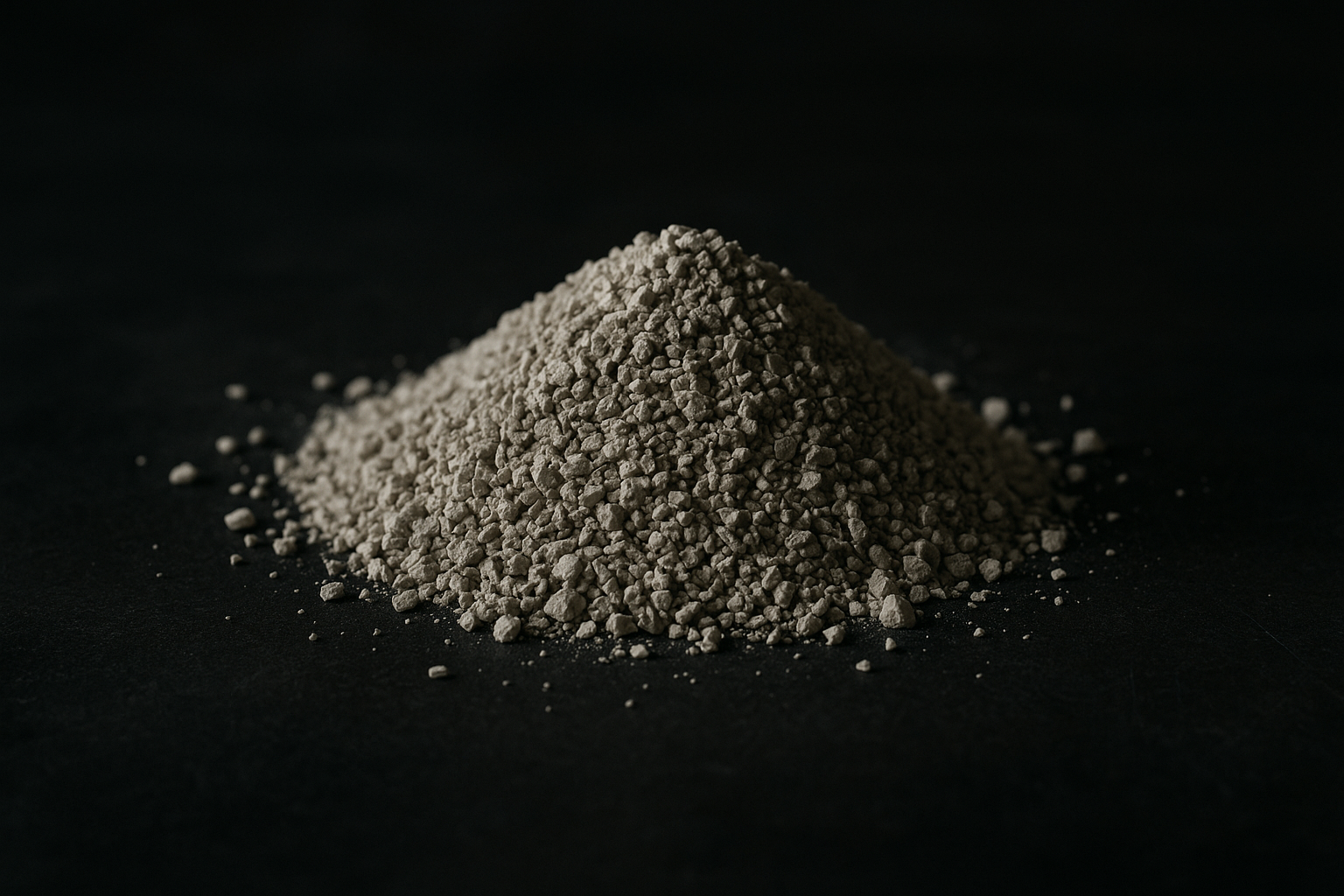
Natural clinoptilolite is a cation adsorbent that, through NH4+ ion exchange with a CEC of 1.6-2.0 meq/g, fixes the ammonium generated in bedding before it volatilizes as gas (NH3). On the cattle barn floor, 14×40 mesh is mixed into sawdust/rice-hull bedding at 5-10% to reduce volatilization hotspots, and the used bedding is returned to composting as a nitrogen-retention material.
Why does ammonia odor arise on the cattle barn floor
Odor on the cattle barn floor mostly originates from ammonia (NH3). When the urea and undecomposed protein in cattle manure meet the urease enzyme on the bedding, they rapidly hydrolyze to produce ammonium (NH4+), and this ammonium moves within the bedding moisture along the equilibrium of dissolved NH4+ ⇌ dissolved NH3 ⇌ gaseous NH3. This equilibrium is strongly governed by pH and temperature, and as pH rises above about 7 to 8-9, the NH3 fraction increases sharply and volatilization accelerates. When fresh manure accumulates and the bedding becomes wet, the local pH skews alkaline, and when stocking density and inadequate ventilation are added on top, the ammonia concentration inside the barn rises rapidly.
High ammonia concentrations inside a barn go beyond a mere odor problem, leading to respiratory stress in cattle, hoof disease, and reduced feed efficiency, and they also impose a direct burden on the worker environment and on handling nearby complaints and environmental regulations. The key is capturing ammonium (NH4+) at the stage before it crosses over into gas (NH3). Once NH3 has volatilized into the gas phase it is difficult to recover, so cattle barn floor management is generally approached by bundling an adsorbent aid that fixes ammonium in the liquid and solid phases together with bedding-replacement cycles and moisture management.
Why zeolite is considered for cattle barn floor deodorizing
The core reason natural clinoptilolite is used for cattle barn deodorizing is its ion-exchange selectivity for NH4+. The crystal framework (aluminosilicate) carries a negative charge from Al substitution, and to offset that negative charge it holds exchangeable cations (Ca²⁺, K⁺, Na⁺, Mg²⁺, etc.) within its pores. The ammonium generated in the bedding swaps places with these cations (ion exchange) and is held to the framework, and as a result the dissolved NH4+ concentration drops so that the equilibrium that volatilizes it as NH3 is itself suppressed. In clinoptilolite's ion-selectivity series, NH4+ ranks higher than Ca²⁺ and Mg²⁺, so it selectively captures ammonium even in a matrix where calcium and magnesium coexist, like cattle manure.
A cation exchange capacity (CEC) of 1.6-2.0 meq/g means it can exchange and retain 1.6-2.0 milliequivalents of ammonium per gram (i.e., theoretically about 29-36 mg NH4+/g), which is the direct basis for suppressing ammonia volatilization per unit weight of bedding. The actual field retention is lower than the theoretical value depending on competing cations, contact time, and moisture, but the higher the CEC, the more ammonium is captured at the same spread amount. The pore diameter of 4.0-7.0 Å is suitable for ammonium and ammonia molecules of about 2.6 Å in diameter to pass in and out, so adsorption works not only at the surface but inside the pores, and the specific surface area of 40.0 m²/g increases the contact area. In addition, the pH stability range of 3.0-10.0 allows the framework to maintain its adsorption function without collapsing even in a barn environment where the bedding pH rises to alkaline from manure.
Adsorption is not one-time; you must also consider the possibility of regeneration and re-release. If the bedding goes to strong alkalinity (high pH) or high temperature, some of the captured ammonium can be released again as NH3, so zeolite is an aid used together with "moisture, ventilation, and replacement-cycle" management, not a standalone solution. Meanwhile, once adsorption is complete the bedding holds ammonium, so adding it to composting converts it into a nitrogen-retention material, allowing you to design a nitrogen flow that runs from barn to compost.
KMIZEOLITE's natural clinoptilolite is 97% pure, mined and processed at the Amargosa Valley mine in Nevada, USA. With a hardness of 4.0-5.0 Mohs, it does not easily pulverize even when trampled by hooves, and being OMRI Listed (KMI-10365) and FDA GRAS grade (general use 21 CFR 182.2729, animal feed intake use 21 CFR 582.2729), its suitability can be reviewed even for organic livestock bedding management.
KMIZEOLITE Key Properties
| Item | Value |
|---|---|
| Clinoptilolite purity | 97% |
| Cation exchange capacity (CEC) | 1.6-2.0 meq/g |
| Specific surface area | 40.0 m²/g |
| Pore diameter | 4.0-7.0 Å |
| pH stability range | 3.0-10.0 |
| Hardness | 4.0-5.0 Mohs |
| Thermal stability | 700°C |
| Specific gravity | 1.89 |
| Bulk density | 45-54 lbs/ft³ |
| Certifications | OMRI KMI-10365, FDA GRAS, TSCA, EN-71-3 |
Ammonium adsorption and volatilization reduction in quantitative data
Below are quantitative values reported in cited studies, used as a reference to get a feel for the expected range and variables when applying to cattle barn bedding. Because the matrix (aqueous solution, manure, bedding) and conditions differ, do not transfer the absolute values directly to a cattle barn; calibrate with a pilot.
| Metric | Reported value (range) | Conditions / Source |
|---|---|---|
| Cation exchange capacity (CEC) | 1.6-2.0 meq/g | KMIZEOLITE natural clinoptilolite spec |
| Theoretical NH4+ retention | about 29-36 mg/g equivalent | Upper-bound estimate from CEC × NH4+ equivalent (18) |
| NH4+ removal efficiency | 72-86% | 0.315-0.63mm particle size, water filtration (Mažeikienė 2008) |
| NH3 loss reduction with bedding addition | up to about 44% | Poultry bedding 38% by-weight case (do not apply directly to cattle barns with different manure/ventilation) |
| Slurry NH3 volatilization reduction | significant reduction reported | Dairy slurry addition (Lefcourt & Meisinger 2001) |
The key point is that the smaller the particle size, the greater the specific surface area and contact, raising removal efficiency, but for bedding use the granular form is practical because of dust and scattering. The 72-86% from the water-filtration experiment is an equilibrium-adsorption result in water, and because bedding is a solid matrix with uneven contact and moisture distribution, the measured reduction range is usually set more conservatively than this.
Cattle barn floor deodorizing application examples
Below are representative ways to use zeolite on the cattle barn floor. They are combined and applied according to the cattle-raising format (tie-stall/free-stall, sawdust/rice-hull bedding, etc.).
- Direct bedding blend: Mix granular zeolite (14×40 mesh) into sawdust/rice-hull bedding at 5-10% and spread it, adsorbing and fixing the ammonium generated from manure at the floor stage. It must be evenly dispersed throughout the bedding for hotspots to be reduced
- Floor surface spreading: Apply additional zeolite around walkways, feeding stations, and water troughs where manure concentrates, suppressing volatilization in locally high-concentration zones
- Wet-spot remediation material: Spread it on flooded/damp zones to capture moisture and ease ammonia-generation hotspots (as moisture drops, the NH3 volatilization equilibrium also slows)
- Manure stacking / composting linkage: Add the bedding after adsorption is complete to the compost pile together with manure to reuse it as a nitrogen-retention material, in a direction that reduces ammonia loss during composting and raises the nitrogen content of the final compost (Subova 2021)
- Pilot application: Apply first to only some stalls and compare the ammonia concentration (ppm) and odor change of the treated group versus the control group under the same ventilation and density conditions
Recommended particle size and product specifications
Medium Granule (14×40 mesh, 0.4-1.4mm) is the standard for cattle barn floor bedding blends. Being granular, it mixes evenly with sawdust and rice hulls, generates little dust even when trampled by hooves, and separates easily during cleaning and replacement. To strengthen dust adsorption, Powder (100 mesh) can be used partially alongside it, but used alone it increases scattering, so the granular form is taken as the default for bedding.
| Product group | Mesh | Particle size | Typical use |
|---|---|---|---|
| Powder | 100 mesh or finer | <150μm | Pozzolan, feed, powder adsorption |
| Fine Granule | 30×50 mesh | 0.3-0.6mm | Water treatment, filtration, soil |
| Medium Granule | 14×40 mesh | 0.4-1.4mm | Filter media, bedding, flooring material |
| Coarse Granule | 8×14 mesh | 1.4-2.4mm | Pools, snow melting, large filtration |
| Extra Coarse | 4×8 mesh | 2.4-4.8mm | Packed beds, air scrubbers |
→ View products by mesh size · Product selection guide by application
Research basis
An early study applying natural clinoptilolite to ammonia reduction in barn environments is Mumpton & Fishman (1977), Clays and Clay Minerals. This study summarized how zeolite's NH4+ ion exchange suppresses ammonia volatilization in bedding and manure matrices, and it later became the theoretical foundation for managing bedding in cattle, poultry, and pig barns.
The most direct basis for cattle (barns) is Lefcourt & Meisinger (2001), Journal of Dairy Science. It reported that adding clinoptilolite (or alum) to dairy slurry reduces ammonia volatilization and alters the slurry's chemical composition, showing that zeolite's NH4+ fixation in a cattle manure matrix actually leads to reduced volatilization. The effect at the manure-storage stage is also confirmed in Li et al. (2008), Journal of Applied Poultry Research. It reported that applying zeolite to stored manure reduces ammonia emission, suggesting the same adsorption mechanism works on cattle barn floors where manure accumulates.
As a quantitative basis for particle size and removal efficiency, there is Mažeikienė et al. (2008), J. Environmental Engineering and Landscape Management. It reported that natural zeolite of 0.315-0.63 mm particle size removes 72-86% of NH4+ in water, quantitatively supporting the trend that smaller particle size improves contact and removal (bedding is a solid matrix, so measured values should be interpreted conservatively). On the recycling side of used zeolite bedding, Subova et al. (2021), Agriculture reported that adding clinoptilolite to livestock manure reduces ammonia loss during composting and improves the nitrogen content of the final compost. As for the adsorption of odor (smell) components itself, Cataldo et al. (2024), Materials summarized the odor-molecule adsorption of zeolites including natural clinoptilolite.
* The figures above are reported values from the cited papers, and field results may vary with the cattle barn's stocking density, bedding moisture, and ventilation conditions. Aqueous-solution experimental values such as those from water treatment and slurry are not reproduced as-is when applied to bedding (solid phase).
Field review points
When applying zeolite to a cattle barn floor, review the following items together.
- Baseline measurement: Before application, measure the in-barn ammonia concentration (ppm) and bedding moisture to secure a comparison baseline
- Particle-size selection: Use Medium Granule (14×40 mesh) as the default for bedding blends, with some Powder added when reinforcing dust adsorption
- Spread-amount setting: Start at about 5-10% by weight of the bedding and adjust while watching the change in ammonia concentration
- Moisture and ventilation management: Adsorption is an auxiliary measure, and bedding-replacement cycles and ventilation must accompany it for the effect to last
- Manure-treatment linkage: Design the flow all the way through to feeding used bedding into composting
- Certification check: For organic livestock applications, confirm OMRI Listed (KMI-10365) compliance
→ View TDS (Technical Data Sheet) · View MSDS (Safety Data Sheet)
Cattle barn floor deodorizing FAQ
Does mixing zeolite into cattle barn floor bedding really reduce ammonia odor?
Clinoptilolite has an ion-exchange property (CEC 1.6-2.0 meq/g) that selectively captures NH4+ cations, holding ammonium in the bedding moisture to lower its dissolved concentration and consequently suppressing the equilibrium that volatilizes it as gas (NH3). Lefcourt & Meisinger (2001, Journal of Dairy Science) reported that adding zeolite to dairy cattle slurry reduces ammonia volatilization, and Mumpton & Fishman (1977, Clays and Clay Minerals) summarized the volatilization-suppression effect in barn bedding and manure matrices. However, the magnitude of the effect varies with stocking density, bedding moisture, and ventilation conditions, and under strong alkalinity or high temperature some ammonium can be released again, so a small-scale pilot is recommended before adoption.
Which particle size (mesh) should be mixed into bedding for a cattle barn?
Medium Granule (14×40 mesh, 0.4-1.4mm) is the standard for cattle barn floor bedding blends. Being granular, it mixes well with sawdust and rice hulls, generates little dust even when trampled by hooves, and separates easily during cleaning and replacement. If you want stronger dust adsorption, Powder (100 mesh) can be used partially alongside it, but used alone it can increase scattering, so the granular form is taken as the default for bedding. See the product selection guide by application.
How much should be spread on the cattle barn floor?
In the field, mixing in about 5-10% by weight of the bedding and applying it to the floor is commonly considered. Poultry bedding studies have reported cases where high ratios such as 38% by weight reduced ammonia loss by about 44%, but cattle barns differ in manure volume, floor area, and ventilation, so rather than applying the same ratio directly, it is preferable to set a spread amount per barn floor area and adjust it while measuring ammonia concentration every 1-2 weeks.
Is used zeolite bedding simply discarded, or can it be used as compost?
Zeolite bedding that has adsorbed ammonium can be added to composting together with manure and reused as a nitrogen-retention material. Subova et al. (2021, Agriculture) reported that adding clinoptilolite to livestock manure reduces ammonia loss during composting and improves the nitrogen content of the final compost. The OMRI Listed (KMI-10365) grade is also permitted as a raw material for organic livestock farming and organic compost.
Can I receive samples and certification documents?
Yes. KMIZEOLITE provides 14×40 mesh samples (1kg/22kg) for evaluating cattle barn bedding applications; leave your barn scale and desired particle size on the sample request page and we will guide you. Certifications include OMRI Listed (KMI-10365), FDA GRAS (21 CFR 182.2729), TSCA compliance, and EN-71-3 PASS. Check them on the certifications page.
Inquiries and sample requests
If you are considering applying zeolite in the field of cattle barn floor deodorizing, please reach out through the channels below.
Notice
Whether application is suitable may vary depending on field conditions, regulations, and test results. Before actual application, a test review tailored to the field conditions must always be carried out first. Zeolite is best understood not as a cure-all for the field, but as a material that supports existing processes.
Related pages
science Related Papers
These are academic papers covering zeolite application in this field. Refer to them when evaluating adoption.
- Use of natural zeolite (clinoptilolite) in the reduction of ammonia from livestock environments
Mumpton, F.A. and Fishman, P.H. — Clays and Clay Minerals, 1977 - Reduction of Ammonia Emissions from Stored Manure Through Zeolite
Li, H. et al. — Journal of Applied Poultry Research, 2008 - Amendment of Livestock Manure with Zeolite-Clinoptilolite and Effect on Composting
Subova, E. et al. — Agriculture, 2021 - Odors Adsorption in Zeolites Including Natural Clinoptilolite
Cataldo, E. et al. — Materials, 2024 - Effect of Adding Alum or Zeolite to Dairy Slurry on Ammonia Volatilization and Chemical Composition
Lefcourt, A.M. and Meisinger, J.J. — Journal of Dairy Science, 2001 - Removal of nitrates and ammonium ions from water using natural sorbent zeolite
Mažeikienė, A. et al. — J. Environmental Engineering and Landscape Management, 2008
The papers above are reference material, and actual application requires a separate review tailored to field conditions.