Zeolite for Feed Pellet & Powder Processing
Natural clinoptilolite with a 40 m²/g specific surface area and 4.0–7.0 Å micropores adsorbs free water on the powder surface to break the moisture bridges between particles. Dosed as 100-mesh powder at 0.5–2.0% of the total blend (FDA GRAS 21 CFR 582.2729 cap of 2%), it works as a flow agent that reduces caking and fines in blending and pelleting processes. Here we organize the moisture-adsorption anti-caking action and the PDI/fines verification points against quantitative benchmarks.
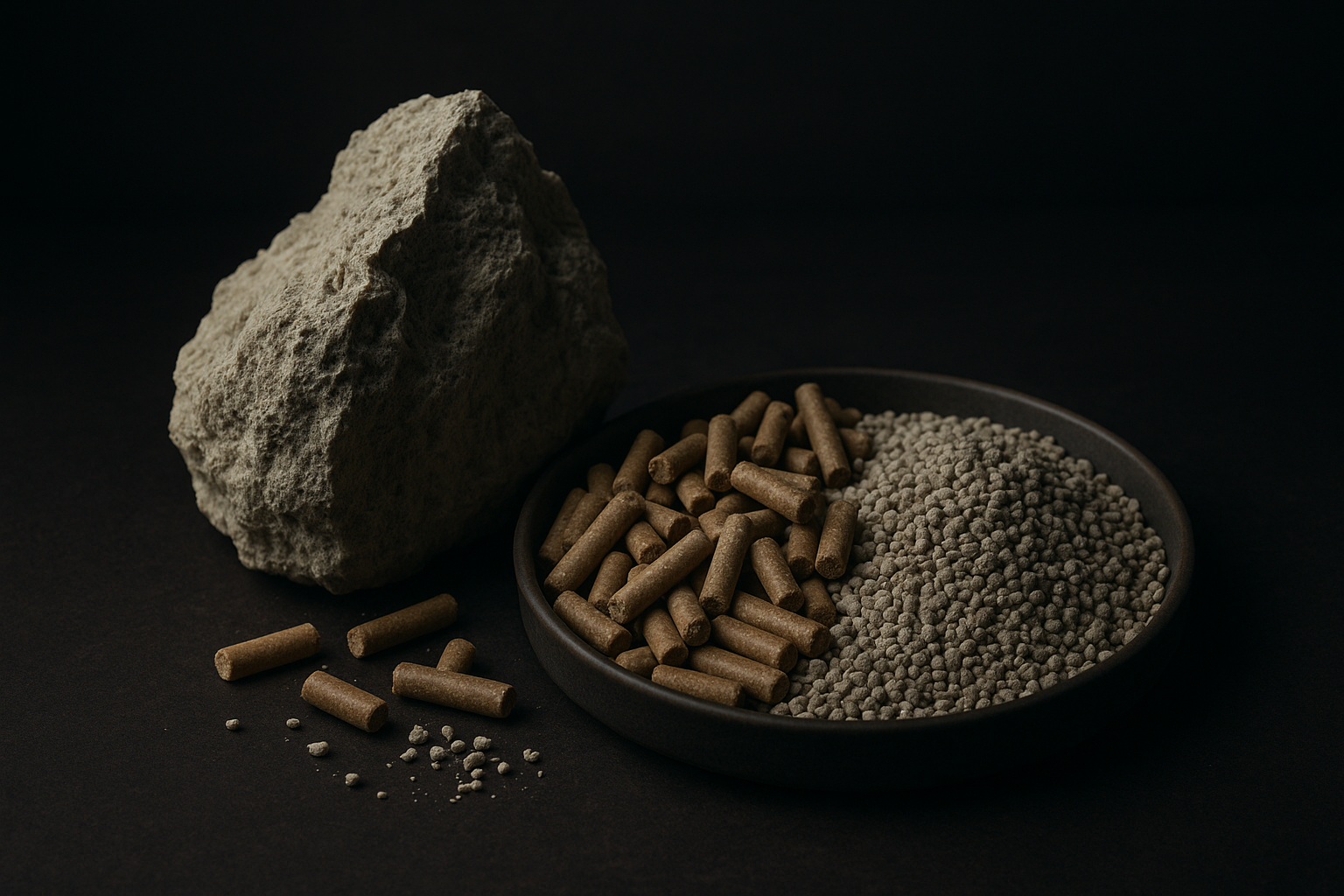
Why do "caking and flowability" problems occur in feed pellet & powder processing?
In compound-feed plants, powder raw materials and finished pellets repeatedly cause caking, bridging, rat-holing, and dust problems during storage in silos, screw conveyors, bins, and tote-bag transport. The core cause is the free water on particle surfaces. As relative humidity rises, water condenses at the contact points of adjacent particles to form liquid capillary bridges, and the surface tension of these bridges pulls particles together into lumps (cakes). Feeds blended with molasses, fats/oils, and mineral premixes are highly tacky, so this phenomenon is especially severe; after moisture uptake the lumps slump and block bin outlets, breaking down metered discharge (mass flow).
Powder flowability is usually quantified by the angle of repose, the Carr Compressibility Index, and the Hausner ratio. Free-flowing powder has an angle of repose of 25–30° and a Carr index of about 15% or less, whereas caking powder deteriorates to an angle of repose of 45° or more and a Carr index of 25% or more. On the pellet side, fines are generated by friction during transport and handling, leading to feed loss and workplace dust as well as a drop in the Pellet Durability Index (PDI).
These problems vary greatly with storage temperature/humidity, raw-material moisture (typically 12–14% for powder and 15–17% after pellet conditioning), fat content, and particle distribution, so simple drying or packaging changes have their limits. That is why mineral aids that adsorb surface free water and wedge between particles to act as a lubricating spacer have long been studied in feed processing as anti-caking agents and flow agents.
Why is zeolite considered as a feed anti-caking agent — the moisture-adsorption mechanism
The anti-caking action of natural clinoptilolite is explained by two physical mechanisms. First, porous physisorption. The 4.0–7.0 Å micropores and 40.0 m²/g specific surface area within the framework draw in free water from particle surfaces by capillary condensation, preventing water from pooling at the contact points of adjacent particles. In other words, it works by stealing the "water" of the liquid bridge into the mineral interior, blocking the capillary attraction itself. Second, the spacer/lubrication action. The hard (4.0–5.0 Mohs hardness) fine particles wedge between sticky feed particles, reducing direct contact area and agglomeration so the powder rolls more smoothly.
That the moisture behavior of clinoptilolite is reversible is important for an anti-caking agent. Unlike ordinary desiccants, the zeolite channel water — not structural water — desorbs and re-adsorbs in stages up to 700°C, so the crystal framework does not collapse even after moisture uptake, and it recovers its moisture-buffering capacity again after conditioning. At the same time, the cation-exchange capacity of CEC 1.6–2.0 meq/g is also studied for the added functions of ammonium (NH₄⁺) binding in the digestive tract and mycotoxin adsorption, so it is evaluated as a multifunctional additive beyond a simple lubricant.
The feed-additive review by Papaioannou et al. (2005, Microporous and Mesoporous Materials) summarized that clinoptilolite contributes to pellet binding and anti-caking aid as well as improving livestock feed efficiency (FCR), and the classic review by Mumpton (1999, PNAS 'La roca magica') describes that zeolite has been industrially used as a carrier and anti-caking material that increases the binding and durability of feed pellets. Poulsen et al. (1995, Animal Feed Science and Technology), a feeding trial in growing piglets, reported that dietary clinoptilolite affects feed efficiency and digestive-tract passage (faecal viscosity), and Shurson et al. (1984, Journal of Animal Science) summarized the growth and feed-intake responses when zeolite A/clinoptilolite was added to growing pig feed, showing that mineral addition is feasible in pelleted feed. KMIZEOLITE's natural clinoptilolite has 97% purity, mined and processed at the Amargosa Valley mine in Nevada, USA, and with a pH stability range of 3.0–10.0 and thermal stability of 700°C it maintains its crystal structure and moisture-adsorption performance even in pellet conditioning (steam, usually 80–90°C) environments.
KMIZEOLITE key properties
| Item | Value |
|---|---|
| Clinoptilolite purity | 97% |
| Cation exchange capacity (CEC) | 1.6–2.0 meq/g |
| Specific surface area | 40.0 m²/g |
| Pore diameter | 4.0–7.0 Å |
| pH stability range | 3.0–10.0 |
| Hardness | 4.0–5.0 Mohs |
| Thermal stability | 700°C |
| Specific gravity | 1.89 |
| Bulk density | 45–54 lbs/ft³ |
| Certifications | OMRI KMI-10365, FDA GRAS, TSCA, EN-71-3 |
Flowability & process parameter reference benchmarks
It is advisable to quantitatively verify the anti-caking effect by the before/after changes in the flowability indicators below. The values below are general powder-engineering classification benchmarks and must be calibrated by pilot measurements tailored to your own feed blend.
| Indicator | Free-flowing (good) | Caking (poor) | Note |
|---|---|---|---|
| Angle of repose | 25–30° | ≥45° | Lower is better flow |
| Carr Compressibility Index | ≤15% | ≥25% | Tapped/bulk density gap |
| Hausner ratio | ≤1.18 | ≥1.34 | Closer to 1 is better |
| Raw-material moisture (powder) | 12–14% | ≥16% | Adsorption target range |
| Dosage (total blend) | 0.5–2.0% (cap 2%) | 21 CFR 582.2729 | |
Application by process location — blending, pelleting & storage lines
Depending on where the zeolite anti-caking agent enters the feed process, the purpose and dosage differ. Below are representative application scenarios and recommended parameters by line location.
- Anti-caking agent at the blending (mixing) stage: Dose 0.5–2.0% of the total blend (FDA GRAS 21 CFR 582.2729 cap of 2%) as 100-mesh powder in the latter part of the micro/main mixer. Improves powder flowability (angle of repose, Carr index) and bin discharge (mass flow), and adding it late in mixing suppresses segregation
- Premix/mineral carrier: Use as a carrier that absorbs and holds micro-additives, molasses, and fats/oils, leveraging the 40 m²/g specific surface area and microporous structure. Mitigates agglomeration/clumping and coating non-uniformity of liquid coatings
- Pellet conditioning / die aid: Acts as a moisture buffer during steam conditioning (80–90°C) to stabilize frictional heat and slippage during die passage, and review the reduction of pellet durability (PDI)/hardness variation and fines. Typically test the powder form at the 0.5–1.5% level
- Storage/transport anti-caking: During silo, bin, and tote-bag storage, moisture uptake reduces bridging, caking, and rat-holing to secure long-term storage stability
- Trial/pilot application: With small samples, verify flowability indicators and pellet quality in advance under your own raw-material moisture, fat content, and line conditions
Recommended particle size and product specifications
For feed anti-caking/carrier applications, Powder (100 mesh, <150μm) that mixes uniformly with the powder and smooths the surface during pelleting is the standard. Granular products are unsuitable for powder mixing, so choose the powder form for anti-caking purposes.
| Product group | Mesh | Particle size | Typical use |
|---|---|---|---|
| Powder | 100 mesh or finer | <150μm | Pozzolan, feed, powder adsorption |
| Fine Granule | 30×50 mesh | 0.3–0.6mm | Water treatment, filtration, soil |
| Medium Granule | 14×40 mesh | 0.4–1.4mm | Filter media, litter, bedding |
| Coarse Granule | 8×14 mesh | 1.4–2.4mm | Pools, de-icing, large filtration |
| Extra Coarse | 4×8 mesh | 2.4–4.8mm | Packed beds, air scrubbers |
→ View products by mesh size · Product selection guide by application
Pilot test and on-site review points
When applying zeolite as a feed anti-caking agent / flow aid, the following items must always be checked together.
- Dosage cap: Anti-caking agents intended for animal feed consumption are used at 2% or less of the total blend per FDA GRAS 21 CFR 582.2729 (Animal Drugs, Feeds — clinoptilolite/zeolite). To prevent nutrient dilution (lower energy and amino-acid concentration), the 0.5–2.0% range is typically evaluated together with flowability effect and cost
- Particle size & mixing uniformity: Check whether 100-mesh (<150μm) powder, dosed in the latter part of the mixer, disperses uniformly without segregation, and whether the mixing uniformity (CV, coefficient of variation) is within target (usually <10%)
- Pellet quality indicators: Measure pellet durability (PDI, %), hardness (kg), fines ratio, productivity (throughput t/h), and die-current change before and after application. Mineral addition can shake PDI through mineral volume, so a quantitative comparison is essential
- Storage conditions: Set raw-material moisture (powder 12–14%) and silo temperature/humidity as a baseline and compare the frequency of caking, bridging, and rat-holing
- Regulatory check: If an organic livestock feed ingredient is required, verify OMRI Listed (KMI-10365, NOP Allowed) compliance
- Research basis: Poulsen et al. (1995, Animal Feed Science and Technology), a growing-piglet trial, reported that dietary clinoptilolite affects feed efficiency and faecal viscosity (digestive-tract passage); Shurson et al. (1984, Journal of Animal Science) summarized the response to zeolite A/clinoptilolite addition in growing pig feed; and the review by Ural (2014, Scientific Papers: Series D, Animal Science) summarizes that clinoptilolite, in addition to feed anti-caking and carrier functions, may have productivity-supporting effects in swine and dairy farming
→ Check the TDS (Technical Data Sheet) · Check the MSDS (Safety Data Sheet)
Feed anti-caking agent / flow aid FAQ
Does using zeolite as a feed anti-caking agent actually reduce caking and dust?
With its 4.0–7.0 Å micropores and 40.0 m²/g specific surface area, natural clinoptilolite adsorbs free water on the powder surface, breaking the liquid capillary bridges that form at particle contact points and improving flowability (angle of repose, Carr index). At the same time, the hard fine particles act as spacers wedged between sticky feed particles, reducing agglomeration. The feed-additive review by Papaioannou et al. (2005) notes that clinoptilolite is used to improve anti-caking and pellet quality. However, the effect varies with raw-material moisture, fat content, and line conditions, so a small pilot trial is recommended before adoption.
How much should be added, and is nutrient dilution a concern?
For anti-caking agents intended for animal feed consumption, use up to 2% of the total blend per FDA GRAS 21 CFR 582.2729. Typically the 0.5–2.0% range is evaluated together for flowability/anti-caking improvement, nutrient dilution (lower energy and amino-acid concentration), and cost. It is advisable to measure pellet durability (PDI) and fines before and after application to determine the optimal ratio.
Which particle size (mesh) should I use?
To mix uniformly with the powder and smooth the pellet surface, Powder (100 mesh or finer, <150μm) is the standard. Granule products are unsuitable for powder mixing and anti-caking applications. Please refer to the product selection guide by application.
Does it withstand steam pellet conditioning temperatures?
KMIZEOLITE clinoptilolite has a thermal stability of 700°C and a pH stability range of 3.0–10.0, so it maintains its crystal structure and moisture-adsorption performance at typical steam conditioning (80–90°C) temperatures. When applying it in pelleting processes, we recommend adjusting it together with the conditioner moisture level.
Can it be used in organic livestock feed?
Yes. KMIZEOLITE is OMRI Listed (KMI-10365, NOP Allowed), permitted as an organic livestock feed ingredient, and holds FDA GRAS and TSCA compliance certifications. Please check the certifications page.
Inquiries and sample requests
If you are considering applying zeolite in the field of zeolite for feed pellet & powder processing, please contact us through the channels below.
Notice
Whether the application is suitable may vary depending on site conditions, regulations, and test results. Before actual application, a test review tailored to site conditions must always be conducted first. Zeolite should be understood not as a universal solution for this field, but as a material that supports existing processes.
Related pages
science Related Research Papers
These are academic papers covering zeolite application in this field. Please refer to them when reviewing adoption.
- Zeolite as a natural feed additive for animal nutrition: A review
Papaioannou, D. et al. — Microporous and Mesoporous Materials, 2005 - Zeolites as feed additives in livestock: A review
Ural, D.A. — Scientific Papers: Series D, Animal Science, 2014 - Natural clinoptilolite as aflatoxin binder in dairy cattle feed
Katsoulos, P.D. et al. — Microporous and Mesoporous Materials, 2006 - La roca magica: Uses of natural zeolites in agriculture and industry
Mumpton, F.A. — PNAS, 1999 - Effects of dietary clinoptilolite on performance of young growing pigs
Poulsen, H.D. et al. — Animal Feed Science and Technology, 1995 - Effects of Zeolite A or Clinoptilolite in Diets of Growing Swine
Shurson, G.C. et al. — Journal of Animal Science, 1984
The papers above are reference materials, and actual application requires a separate review tailored to site conditions.