Particle Size Selection Guide for Zeolite
The cation exchange capacity (CEC 1.6–2.0 meq/g) is an intrinsic mineral property independent of particle size, but the adsorption rate at which that capacity is reached is strongly governed by particle size. From powder (100 mesh, <150μm) to Extra Coarse (4×8 mesh, 2.4–4.8mm), this guide quantitatively explains how to back-calculate particle size from the application method, EBCT, and pressure drop to minimize channeling and fines carryover.
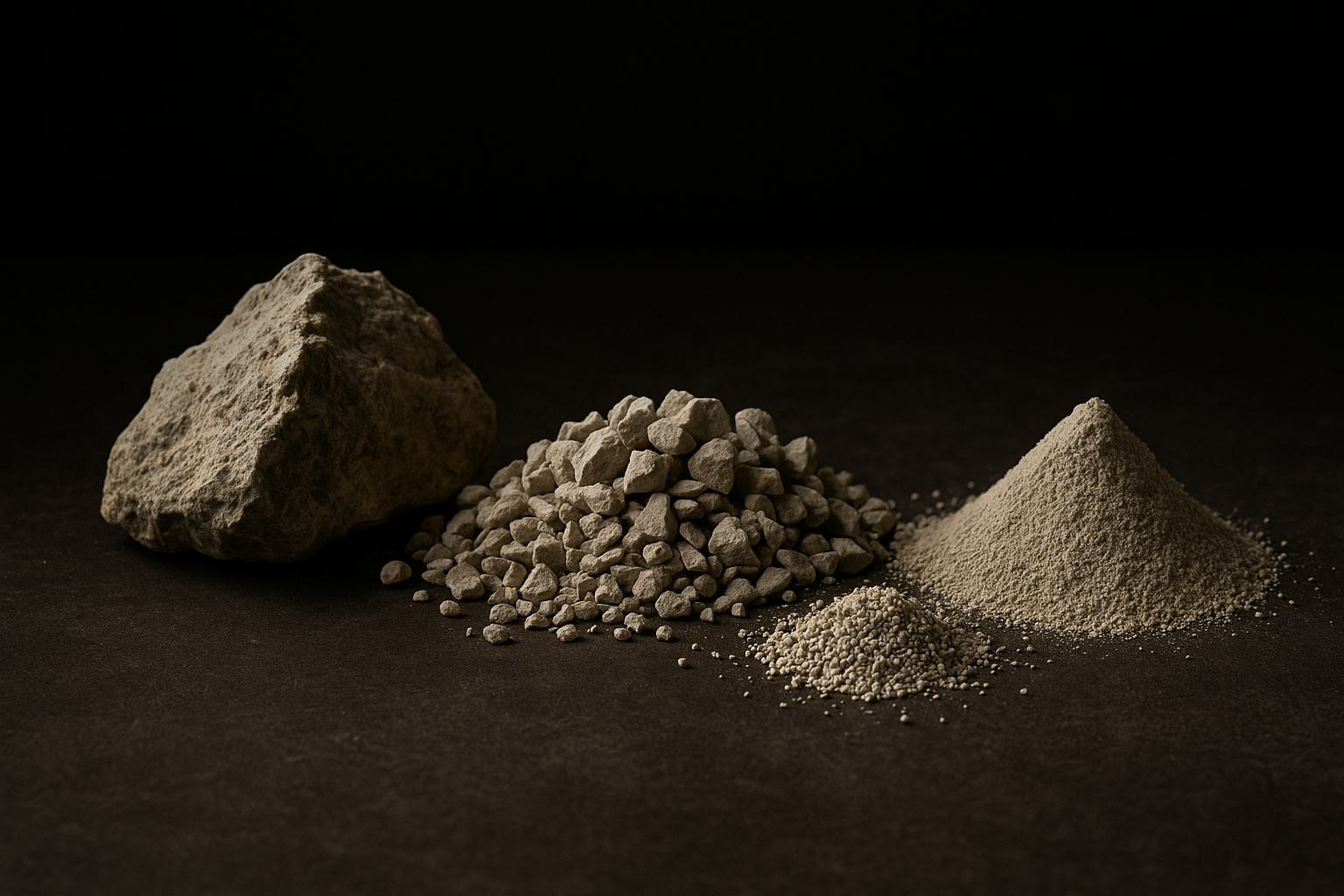
Why "particle size (mesh) selection" governs performance
The most common mistake in zeolite field deployments is not the choice of material but choosing the wrong particle size. Even with the same clinoptilolite, powder and granule differ completely in adsorption rate, pressure drop (headloss), backwash behavior, and the amount of fines generated. Powder has a large specific surface area, so adsorption and ion exchange per unit time are fast, but when used as-is in a packed bed it clogs flow; coarse granule passes through the column well but has lower contact efficiency. Many cases of "we used zeolite for water treatment but the effect was weak" stem from a mismatch between application and particle size.
Therefore, particle size selection must be decided by considering four factors together: (1) application method (dosing/mixing vs. packed bed/filtration), (2) operating flow rate (EBCT, empty bed contact time), (3) allowable pressure drop, and (4) whether fines are acceptable. Even for the same target substance, powder is advantageous in a batch stirred tank, while Fine to Coarse Granule is advantageous in a continuous flow-through column.
The mechanism by which particle size affects adsorption and ion-exchange performance
Ion exchange and adsorption in natural clinoptilolite occur in two stages. First, it happens quickly on the external surface (specific surface area 40.0 m²/g), then it slowly diffuses into the 4.0–7.0 Å micropores. The smaller the particle, the greater the external surface ratio and the shorter the internal diffusion distance, so equilibrium is reached faster. In other words, the total capacity called cation exchange capacity (CEC 1.6–2.0 meq/g) is maintained regardless of particle size, but the rate at which that capacity is reached depends strongly on particle size.
Sprynskyy et al. (2005, Journal of Colloid and Interface Science) reported that in the ammonium adsorption of Transcarpathian natural clinoptilolite, reducing particle size increased both the adsorption rate and equilibrium adsorption capacity, suggesting that adsorption is rate-controlled by intraparticle diffusion (DOI: 10.1016/j.jcis.2004.10.058). Wang and Peng (2010, Chemical Engineering Journal), in their review of natural zeolite for water treatment, likewise summarized that particle size, crystallinity, and pretreatment are key variables governing adsorption capacity (DOI: 10.1016/j.cej.2009.10.029).
In actual packed-bed (column) design, particle size directly becomes an operating parameter. Howden et al. (2018, Journal of Radioanalytical and Nuclear Chemistry) adopted a standardized particle size by pre-sieving the feedstock to a 420–500μm range in cesium/strontium removal clinoptilolite breakthrough column tests, in order to manage intraparticle diffusion and reproduce and predict breakthrough behavior (DOI: 10.1007/s10967-018-6329-8). The key takeaway is that narrowing the particle size range reduces channeling within the column and interparticle diffusion variance, making the breakthrough curve steeper and increasing the usable bed fraction. Even with the same mineral, a wide particle size distribution can cause large particles to reach equilibrium late, triggering early breakthrough.
KMIZEOLITE's natural clinoptilolite has 97% purity and is mined and processed at the Amargosa Valley mine in Nevada, USA. With a pH stability range of 3.0–10.0 and a hardness of 4.0–5.0 Mohs, it produces few residual fractures (fines generation) even in granular form. Thanks to these properties, it can be supplied from powder to 4×8 mesh coarse granule with only the particle size varied while maintaining the same mineral characteristics.
KMIZEOLITE key properties
| Property | Value |
|---|---|
| Clinoptilolite purity | 97% |
| Cation exchange capacity (CEC) | 1.6–2.0 meq/g |
| Specific surface area | 40.0 m²/g |
| Pore diameter | 4.0–7.0 Å |
| pH stability range | 3.0–10.0 |
| Hardness | 4.0–5.0 Mohs |
| Thermal stability | 700°C |
| Specific gravity | 1.89 |
| Bulk density | 45–54 lbs/ft³ |
| Certifications | OMRI KMI-10365, FDA GRAS, TSCA, EN-71-3 |
Particle size selection examples by application method
Below are representative scenarios for determining particle size (mesh) along with recommended particle sizes and dosing criteria.
- Batch stirring/mixing adsorption: Use powder (100 mesh or finer, <150μm, median 50μm) to maximize contact area. For soil/compost mixing, pozzolan, and feed anti-caking applications. For feed, limit to 2% or less of the total formulation per FDA GRAS standards.
- Continuous flow-through filter bed/column: Fine Granule (30×50 mesh, 0.3–0.6mm) to Medium Granule (14×40 mesh, 0.4–1.4mm). Targeting an empty bed contact time (EBCT) of 5–15 minutes and a linear velocity of 5–15 m/h, narrowly select the particle size to suppress channeling and fines carryover. To keep the breakthrough curve steep, using a grade with a narrow particle size distribution is advantageous, and in precision test/validation columns, a narrow pre-sieved particle size such as 420–500μm is used as a standard (Howden et al., 2018).
- Large packed beds/swimming pools/systems with frequent backwashing: Use Coarse Granule (8×14 mesh, 1.4–2.4mm) to lower pressure drop and secure backwash efficiency. Suitable for replacing or supplementing sand filter media.
- Large packed towers/air scrubbers: Use Extra Coarse (4×8 mesh, 2.4–4.8mm) to minimize gas/liquid flow resistance. For processes that prioritize flow-through/air passage over contact efficiency.
- Pilot comparison testing: Run two adjacent particle sizes (e.g., 30×50 and 14×40) in parallel under identical conditions to identify the break-even point between treatment performance and pressure drop.
Recommended particle sizes and product specifications
The table below summarizes mesh specifications, particle sizes, and representative applications. If adsorption rate is important, choose the upper rows (finer particle size); if flow-through and low pressure drop are important, choose the lower rows (coarser particle size).
| Product group | Mesh | Particle size | Representative applications |
|---|---|---|---|
| Powder | 100 mesh or finer | <150μm | Pozzolan, feed, powder adsorption |
| Fine Granule | 30×50 mesh | 0.3–0.6mm | Water treatment, filtration, soil |
| Medium Granule | 14×40 mesh | 0.4–1.4mm | Filter beds, bedding, flooring material |
| Coarse Granule | 8×14 mesh | 1.4–2.4mm | Swimming pools, de-icing, large-scale filtration |
| Extra Coarse | 4×8 mesh | 2.4–4.8mm | Packed beds, air scrubbers |
Particle size caution: In US mesh, the larger the number, the smaller the particle (100 mesh < 4×8 mesh). A notation with two numbers such as 30×50 indicates a particle size range bounded by upper and lower mesh limits.
→ View products by mesh size · Product selection guide by application
Field review points when selecting particle size
Reviewing the items below before finalizing the particle size (mesh) can reduce rework and repurchasing.
- Confirm the application method: Whether it is batch stirring/mixing or a continuous flow-through column/filter bed determines powder vs. granule.
- Flow rate/contact time (EBCT): For flow-through processes, first set the target EBCT and linear velocity, then back-calculate the particle size whose pressure drop falls within the allowable range.
- Pressure drop/backwash: The finer the particle size, the faster the adsorption but the greater the pressure drop and backwash load. Coarse particle size is the opposite.
- Whether fines are acceptable: For drinking water/precision filtration, choose granule with a narrow particle size distribution to prevent fines carryover; for soil mixing, choose powder where fines are harmless.
- Parallel particle-size pilot: Compare two adjacent particle sizes at the same raw water and same flow rate to confirm the break-even point between treatment performance and operating cost.
- Required quantity/packaging: For granule, convert the packing volume based on a bulk density of 45–54 lbs/ft³ to calculate the order quantity in 1-metric-ton super sacks or pallet units.
→ View TDS (Technical Data Sheet) · View MSDS (Material Safety Data Sheet)
Particle size (mesh) selection FAQ
Which particle size is better for adsorption: powder or granule?
Both adsorption rate and equilibrium adsorption capacity per unit weight improve as the particle gets smaller. The ammonium adsorption study by Sprynskyy et al. (2005) reported that reducing particle size increases both adsorption rate and capacity (intraparticle diffusion control). However, powder used as-is in a packed bed causes clogging, so powder is suitable for batch stirring and mixing, while Fine to Coarse Granule is suitable for continuous flow-through columns.
Which mesh should be used for a continuous flow-through filter bed?
Generally, Fine Granule (30×50 mesh, 0.3–0.6mm) to Medium Granule (14×40 mesh, 0.4–1.4mm) is used. The key is to first define the target empty bed contact time (EBCT) and allowable pressure drop, then narrowly select the particle size within that range to reduce channeling and fines carryover. For systems with frequent backwashing such as large packed beds or swimming pools, Coarse Granule (8×14 mesh) is advantageous.
Is the total adsorption capacity (CEC) the same regardless of particle size?
Yes. The cation exchange capacity (CEC 1.6–2.0 meq/g) is an intrinsic property of the mineral, so it is maintained regardless of particle size. What particle size changes is the 'rate' at which that capacity is reached; the smaller the particle, the larger the external surface ratio and the faster equilibrium is reached (Wang & Peng, 2010).
Can I receive a sample for testing?
Yes, KMIZEOLITE supports providing samples for particle size comparison studies. On the sample request page, please specify your application method and the mesh sizes you want to compare (e.g., 30×50, 14×40).
Inquiries and sample requests
If you are considering applying zeolite in the area of particle size selection for zeolite, please contact us through the channels below.
Notice
Applicability may vary depending on field conditions, regulations, and test results. Before actual application, a test review suited to the site conditions must always be conducted first. Zeolite should be understood not as an all-purpose solution in this field, but as a material that supports existing processes.
Related pages
science Related Papers
Academic papers covering zeolite applications in this field. Please refer to them when evaluating adoption.
- Ammonium sorption from aqueous solutions by natural zeolite Transcarpathian clinoptilolite
Sprynskyy, M. et al. — Journal of Colloid and Interface Science, 2005 - Natural zeolites as effective adsorbents in water and wastewater treatment
Wang, S. and Peng, Y. — Chemical Engineering Journal, 2010 - Cation Exchange of Natural Zeolites: Worldwide Research
Various — Sustainability, 2021 - Ion Exchange in Natural Clinoptilolite: Structure and Applications
Various — Minerals, 2022 - Natural Zeolites in Water Treatment — How Effective is Their Use
Margeta, K. et al. — IntechOpen, 2013 - Use of columns of zeolite clinoptilolite in remediation of aqueous nuclear waste streams
Howden, M. et al. — Journal of Radioanalytical and Nuclear Chemistry, 2018
The papers above are reference materials, and a separate review suited to field conditions is required for actual application.