Natural Pozzolan
A high-purity clinoptilolite with SiO₂+Al₂O₃+Fe₂O₃ 79.08%, reactive SiO₂ 66.7% and a 40 m²/g specific surface area, processed into a 100 mesh fine powder (median 50μm). It satisfies the ASTM C618 Class N composition requirement and, at 10-30% cement replacement, generates additional Ca(OH)₂-consuming C-S-H, making it an SCM raw material. The exact replacement ratio is finalized through Strength Activity Index (SAI) trial mixing.
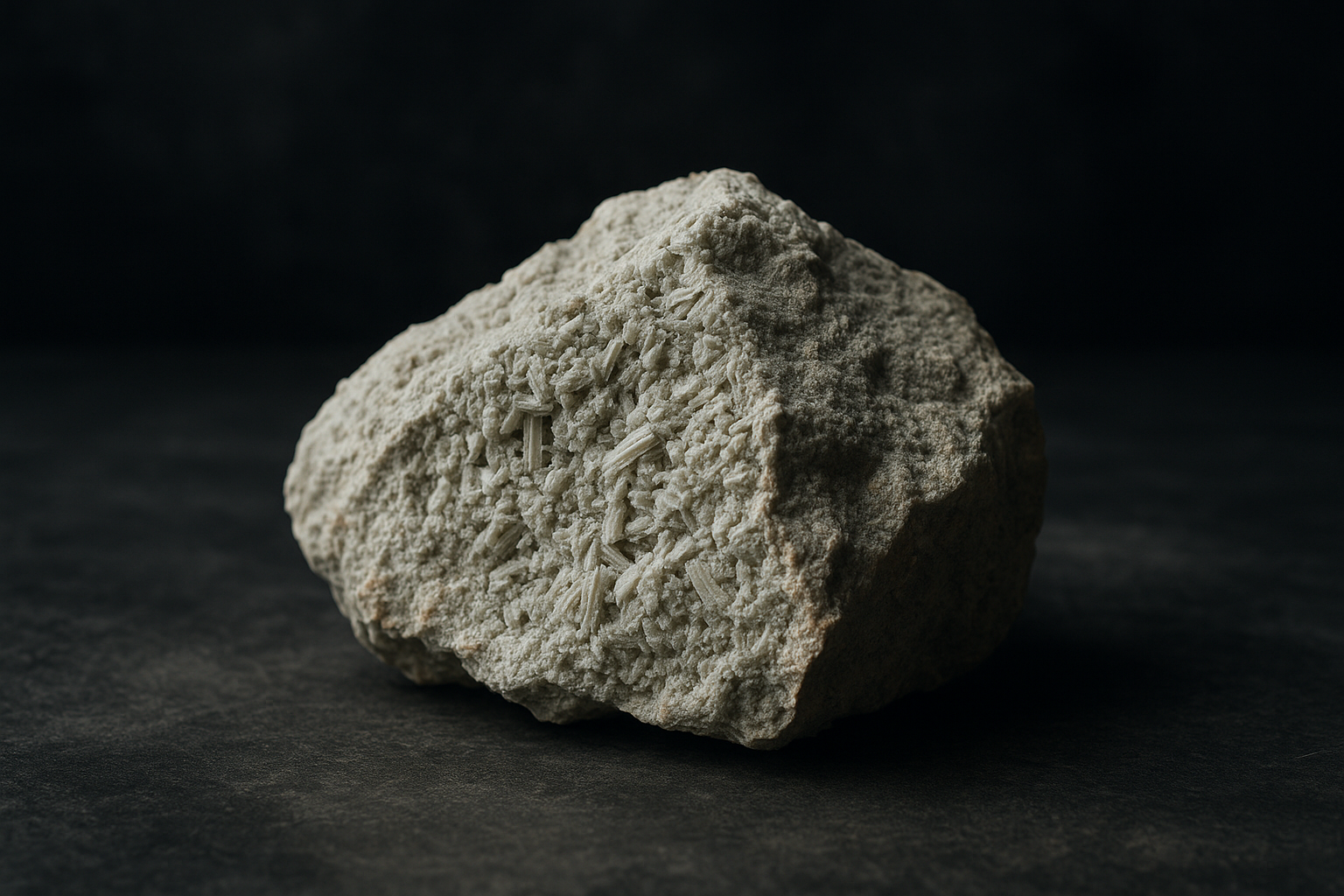
Natural Pozzolan Zeolite — A Supplementary Cementitious Material Based on ASTM C618
Zeolite is one of the representative mineral materials evaluated as a natural pozzolan supplementary material in the construction and cement industries. The natural clinoptilolite produced by KMIZEOLITE is mined from the Amargosa Valley deposit in Nevada, USA, and has a high purity with a clinoptilolite content of 97.0%.
A pozzolan is a material that has little cementitious value in itself but, when finely divided and in the presence of moisture, reacts with the calcium hydroxide (Ca(OH)₂, portlandite) generated by cement hydration to form additional binding products such as C-S-H and C-A-S-H gels (ASTM C125 definition). Zeolite is not a material that fully replaces cement; it should be applied from the perspective of a supplementary cementitious material (SCM) that partially replaces or supplements Portland cement.
The Pozzolanic Reaction Mechanism — What Creates Strength
The pozzolanic activity of clinoptilolite arises as part of the crystalline framework becomes amorphous and dissolves in an alkaline environment. When cement reacts with water (C₃S and C₂S hydration), a strongly alkaline pore solution at pH 12.5-13.5 and a large amount of Ca(OH)₂ are generated; in this environment the reactive SiO₂ (and some Al₂O₃) of the zeolite framework is hydrolyzed and leached out as silicate and aluminate ions.
The secondary reaction in which the leached silica combines with Ca(OH)₂ is the essence of the pozzolanic reaction. It can be roughly expressed as reactive SiO₂ + Ca(OH)₂ + H₂O → C-S-H, and the secondary C-S-H thus formed, together with the primary C-S-H produced by cement hydration, fills the capillary pores and densifies the microstructure. As a result, (1) the total amount of cohesive C-S-H increases, (2) the weak Ca(OH)₂ crystal phase is consumed, and (3) porosity and connectivity decrease all at once, acting to improve long-term strength and resistance to permeability and ion penetration.
This reaction is essentially diffusion- and dissolution-rate-limited, so it is slower than cement clinker hydration. Accordingly, a zeolite SCM mix shows early (3-7 day) strength that is lower than or similar to the unreplaced mix, while beyond 28 days and at long-term ages it exhibits the typical behavior of catching up or overtaking. The reaction rate depends strongly on fineness (specific surface area), curing temperature and humidity, and alkalinity. Recent research reports that clinoptilolite can act not merely as a diluent but as a substrate that regulates and buffers the alkalinity of the pore solution and thereby promotes cement hydration itself (Islam, Biernacki & Mohr, Cement and Concrete Research, 2026).
Key Pozzolanic Composition Data
The chemical composition of KMIZEOLITE has a profile favorable for ASTM C618 natural pozzolan (Class N) evaluation.
| Component | Formula | Content | Pozzolan-Related Role |
|---|---|---|---|
| Silicon dioxide | SiO₂ | 66.7% | Reactive silica — the core component of the pozzolanic reaction |
| Aluminum oxide | Al₂O₃ | 11.48% | Forms the aluminosilicate framework, assists the pozzolanic reaction |
| Potassium oxide | K₂O | 3.42% | Cation exchange capability |
| Sodium oxide | Na₂O | 1.8% | Cation exchange capability |
| Calcium oxide | CaO | 1.33% | Trace lime component |
| Iron oxide | Fe₂O₃ | 0.9% | Trace |
| Magnesium oxide | MgO | 0.27% | Trace |
| Titanium dioxide | TiO₂ | 0.13% | Trace |
| Manganese oxide | MnO | 0.025% | Trace |
For the SiO₂ + Al₂O₃ + Fe₂O₃ ≥ 70% condition required by the ASTM C618 Class N criteria, KMIZEOLITE shows a composition where the sum of these three components is about 79.08%, satisfying the requirement.
In particular, SiO₂ at 66.7% is reactive silica, a core component that can react with the calcium hydroxide generated during cement hydration to contribute to the formation of additional C-S-H gel.
Physical Properties and Pozzolanic Applicability
| Property | Value | Meaning for Pozzolan Use |
|---|---|---|
| Cation exchange capacity (CEC) | 1.6-2.0 meq/g | Ion exchange activity |
| Pore diameter | 4.0-7.0 Å | Factor affecting microstructure |
| Specific gravity | 1.89 | Characteristic as a lightweight admixture |
| Specific surface area | 40.0 m²/g | Favorable for securing reaction area |
| Bulk density | 720-865 kg/m³ | Basis for calculating weight ratios in mix design |
| pH stability range | 3.0-10.0 | Compatible with alkaline environments |
| Hardness | 4.0-5.0 Mohs | Facilitates grinding and classification processes |
Why Zeolite Is Evaluated as a Natural Pozzolan
Cement manufacturing is regarded as one of the largest carbon emission sources in the construction industry. Worldwide, there is growing interest in alternative and supplementary materials that can reduce cement usage while still securing the required performance.
When natural zeolite is finely ground to 100 mesh or finer (median 50μm), it takes a form that can effectively participate in the pozzolanic reaction. Under appropriate mix conditions it acts to densify the microstructure, and it is a material for which research has steadily accumulated in terms of durability, permeability and long-term performance.
Industrial by-product SCMs such as fly ash and blast-furnace slag have supplies tied to the operating rates of the power and steel industries, so their availability fluctuates greatly by region and period. Amid the trend of declining Class F fly ash supply driven by decarbonization, natural zeolite — which is mine-based with a consistent composition and a mining volume that can be secured in a planned manner — is being evaluated as an option for diversifying the SCM portfolio. Since about 0.6-0.9 tons of CO₂ is emitted per ton of cement produced, replacing 10-30% of clinker leads directly to reducing the embodied carbon of the mix unit by that proportion.
SCM Replacement Effects Seen in Research
The pozzolanic activity of natural zeolite originates from its porous aluminosilicate structure. The review by Ahmadi and Shekarchi (Ahmadi & Shekarchi, Cement and Concrete Composites, 2010) summarizes that natural zeolite is used as a pozzolanic material in a replacement range of about 15-30% by cement mass, and that its fine porous structure with a large specific surface area rapidly consumes calcium hydroxide to contribute to additional C-S-H formation. This review reports that at appropriate replacement (10-20%), compressive strength beyond 28 days recovers to equal or exceed the unreplaced mix, and that permeability coefficient and chloride-ion diffusion tend to decrease due to refinement of the pore structure. This product's CEC of 1.6-2.0 meq/g, pore openings of 4.0-7.0 Å and a 40 m²/g specific surface area connect directly to such reactive-silica behavior.
Najimi et al. reported that when natural zeolite was used to replace 15% and 30% of cement in high-performance concrete, durability indicators such as rapid chloride penetration (RCPT) and absorption improved at the appropriate replacement (15%), whereas at the high 30% replacement the water-demand and workability management and early-strength loss became more pronounced (Najimi et al., Construction and Building Materials, 2012). This shows that the replacement ratio does not equal performance and that an optimal replacement point (sweet spot) exists.
On the durability side, Feng et al. reported that concrete containing natural zeolite improved surface scaling and salt-attack resistance in a deicing-salt environment (Feng et al., Cement and Concrete Research, 2005). The latest review by Shekarchi et al. (Shekarchi et al., Construction and Building Materials, 2023) treats natural zeolite as an SCM and jointly examines the potential and limitations of alkali-silica reaction (ASR) mitigation, sulfate resistance and long-term strength development. ASR mitigation is explained by a mechanism in which the zeolite partly fixes the available alkalis (Na⁺ and K⁺) in the pore solution through cation exchange and consumes reactive silica to suppress the formation of the expansive gel.
As a high-dosage application case, it has been reported that eco-friendly concrete using large amounts of zeolitic SCM can secure structurally acceptable strength and durability under appropriate mixing and curing (Scientific Reports, 2023), and research is also underway to predict and optimize the compressive strength of binary SCM mixes using machine learning with replacement ratio, water-to-binder ratio and age as inputs (Moradi et al., Materials, 2022).
In other words, the strength of zeolite pozzolan lies not in a single strength boost but in durability enhancement and cement reduction under appropriate replacement, fineness and curing conditions, and the exact replacement ratio must be finalized through on-site trial mixing, as the above studies commonly emphasize.
Mix and Process Parameter Guide
The key variables that govern performance when introducing zeolite pozzolan as an SCM are as follows. Absolute values vary with the combination of cement type, aggregate and admixtures, so they are finalized through trial mixing.
| Parameter | Range to Consider | Effect |
|---|---|---|
| Cement replacement ratio | 10-30% (optimal 15±5%) | Higher = better long-term durability and carbon reduction↑, lower early strength and workability↓ |
| Fineness (particle size) | 100 mesh or finer, median ~50μm | Finer = faster pozzolanic reaction and higher SAI↑, higher water demand↑ |
| Water-to-binder ratio (w/b) | Adjusted to target slump | Effective w/b varies due to zeolite absorptivity; combined use of a water reducer is recommended |
| Superplasticizer (SP) | Increased in proportion to replacement ratio | Compensates for porosity and high specific surface area, secures workability |
| Curing | Moist and long-term curing favorable | Since the pozzolanic reaction is rate-limited, moist curing of 7 days or more increases long-term strength development↑ |
| Evaluation age | 7 / 28 / 56 / 90 days | Do not judge by 28 days alone; confirm SCM effect by long-term strength at 56 and 90 days |
Pozzolanic activity is quantitatively evaluated by the Strength Activity Index (SAI) of ASTM C311. C618 requires the 7-day or 28-day SAI to be at least 75% of the control mortar, and since this value varies with fineness and reactivity, it must be tested on the actual lot. The water requirement and loss on ignition (LOI) items are also confirmed together.
Recommended Product Specifications
| Product Name | Mesh | Particle Size | Suitability for Pozzolan Use |
|---|---|---|---|
| KMI 100- US MESH (Powder) | 100 mesh or finer | <150μm, median 50μm | Optimal for pozzolan use — maximum fineness and reaction area |
In pozzolan applications, particle size is very important. A powder of 100 mesh or finer is most suitable in terms of reaction area and dispersibility, and since early strength, setting characteristics and workability can change as the replacement ratio increases, trial mixing is essential.
Application Points You Can Expect
- Evaluation of partial Portland cement replacement (generally studied in the 10-25% replacement range)
- Support for low-carbon mix design
- Evaluation toward alkali-silica reaction (ASR) reduction
- Evaluation of potential long-term durability enhancement
- Support for microstructure improvement of cementitious mixes
Comparison Reference with Other SCMs
| Comparison Item | Natural Zeolite | Fly Ash (Class F) | Blast-Furnace Slag |
|---|---|---|---|
| Raw material | Natural mineral | Coal combustion by-product | Steelmaking by-product |
| Supply stability | Stable mine-based supply | Dependent on coal-fired power plants | Dependent on steel mills |
| SiO₂ content | 66.7% | 40-60% | 30-40% |
| Pozzolanic reaction | Based on active silica | Based on glassy silica | Latent hydraulicity |
| Environmental profile | Natural mineral (mined) | Industrial by-product recycling | Industrial by-product recycling |
This comparison table is for reference based on general characteristics, and actual performance may vary depending on mix conditions.
Application Examples
Cement Blending
At the cement manufacturing or mixing stage, fine zeolite of 100 mesh or finer can be incorporated and evaluated as a natural pozzolan raw material.
Precast and General Concrete Mixes
Its applicability as a partial replacement can be evaluated while adjusting the mix proportions according to the required levels of strength development, durability and workability.
Development of Low-Carbon Construction Materials
In projects where environmental indicators are important, it can become a candidate for comparative evaluation alongside fly ash, slag and other SCMs.
Points to Consider
- For pozzolan raw materials, particle size and reactivity are very important.
- As the replacement ratio increases, early strength, setting characteristics and workability can change.
- It must be designed comprehensively together with cement type, aggregate, admixtures and curing conditions.
- It is important to view zeolite by its role within the overall mix design rather than by its standalone performance.
- ASTM C618 compliance must be finally confirmed by actual test results.
Frequently Asked Questions (FAQ)
Does natural zeolite meet the ASTM C618 Class N natural pozzolan requirements?
ASTM C618 Class N requires the sum of SiO₂+Al₂O₃+Fe₂O₃ to be at least 70%. KMIZEOLITE clinoptilolite has SiO₂ 66.7%, Al₂O₃ 11.48% and Fe₂O₃ 0.9%, giving a combined total of about 79.08%, which satisfies this compositional requirement. However, the remaining items such as loss on ignition and the strength activity index must be finally confirmed by actual testing.
How does the pozzolanic reaction of zeolite work?
The reactive SiO₂ (66.7%) of clinoptilolite reacts with the calcium hydroxide Ca(OH)₂ generated during cement hydration to form additional C-S-H gel. A CEC of 1.6-2.0 meq/g, pore openings of 4.0-7.0 Å and a 40 m²/g specific surface area secure the dissolution and reaction area in the alkaline environment, acting to densify the microstructure.
What range of cement replacement should be considered?
The literature mainly studies a replacement range of 10-25% of Portland cement. As the replacement ratio increases, early strength, setting and workability change and the water demand may rise, so the principle is to use a fine powder of 100 mesh or finer (median 50μm) and to determine the ratio by trial mixing tuned to the target performance.
Why use natural zeolite instead of fly ash or ground granulated blast-furnace slag?
Fly ash is tied to coal-fired power generation and blast-furnace slag to steelmaking by-products, so their supply fluctuates significantly. Natural zeolite is mine-based, with stable composition and supply and a high SiO₂ content (66.7%), making it a candidate as a reactive silica source for replacement or combined use. However, its environmental profile as a naturally mined mineral should be evaluated comparatively alongside by-product-recycling SCMs.
Does replacement reduce early strength? How is it compensated for?
Because the pozzolanic reaction is a dissolution and diffusion rate-limited reaction slower than cement hydration, replacing cement with zeolite typically gives 3-7 day early strength that is lower than or similar to the unreplaced mix. However, beyond 28 days and at long-term ages (56 and 90 days), secondary C-S-H accumulates and strength often catches up or overtakes. Remedies include increasing fineness (expanding the reaction area), providing sufficient moist curing of 7 days or more, and using a water reducer to lower the effective water-to-binder ratio. Performance should therefore be evaluated at long-term ages, not at 28 days alone.
How is pozzolanic activity verified quantitatively?
It is assessed by the Strength Activity Index (SAI) following the ASTM C311 procedure. ASTM C618 Class N requires the 7-day or 28-day SAI to be at least 75% of the control mortar. In addition, the water requirement (115% or less), loss on ignition (LOI) and the SiO₂+Al₂O₃+Fe₂O₃ total (70% or more) items must be tested on the actual delivered lot to confirm final compliance. This product's compositional total of 79.08% is a starting point that satisfies the chemical composition requirement; performance items such as SAI are finalized through trial mixing.
Related Pages
- Zeolite for Concrete Admixture and Incorporation — Application within concrete mixes
- Zeolite for Stucco and Mortar — Application in finishing material mixes
- Powder-Type Zeolite Products — Product specifications for pozzolan use
- TDS / Technical Data — Check detailed properties
- Certifications, Registrations and Designations — ASTM-related reference
Notice
The results of natural pozzolan application may vary depending on raw material purity, fineness, replacement ratio, mix conditions, curing method and the required performance criteria. Before actual application, please confirm suitability through trial mixing and property verification. The chemical composition and property data on this page are based on KMI's public technical documents; please check the latest TDS at the time of actual delivery.
[Inquire about particle size, powder specifications and bulk supply of zeolite for natural pozzolan use →]
science Related Research Papers
Academic papers covering zeolite application in this field. Use them as a reference when evaluating adoption.
- Natural zeolite as pozzolanic material: A review
Ahmadi, B. and Shekarchi, M. — Cement and Concrete Composites, 2010 - Natural zeolite as supplementary cementitious material: A holistic review
Shekarchi, M. et al. — Construction and Building Materials, 2023 - Properties of high-performance concrete incorporating natural zeolite
Najimi, M. et al. — Construction and Building Materials, 2012 - Effect of natural zeolite on durability of concrete against deicing salt
Feng, N. et al. — Cement and Concrete Research, 2005 - Clinoptilolite zeolite as a substrate for alkali-boosting cement hydration
Islam, M. S., Biernacki, J. J. and Mohr, B. J. — Cement and Concrete Research, 2026 - Eco-friendly concrete with high-volume zeolitic supplementary cementitious materials
Scientific Reports, 2023 - Predicting the Compressive Strength of Concrete Containing Binary Supplementary Cementitious Material
Moradi, N. et al. — Materials, 2022
The papers above are for reference, and actual application requires separate evaluation tailored to on-site conditions.