Zeolite as a Deicing Aid
Replacing 10–20% of cement with 97%-purity natural clinoptilolite (reactive SiO₂ 66.7%) as a 100 mesh pozzolan refines the capillary pores of deicing-salt-exposed (NaCl·CaCl₂) concrete with secondary C-S-H, lowering the chloride diffusion coefficient and freeze-thaw / scaling damage. Chloride resistance is achieved through matrix densification rather than cation exchange, and must be verified with RCPT·ASTM C666/C672 control testing.
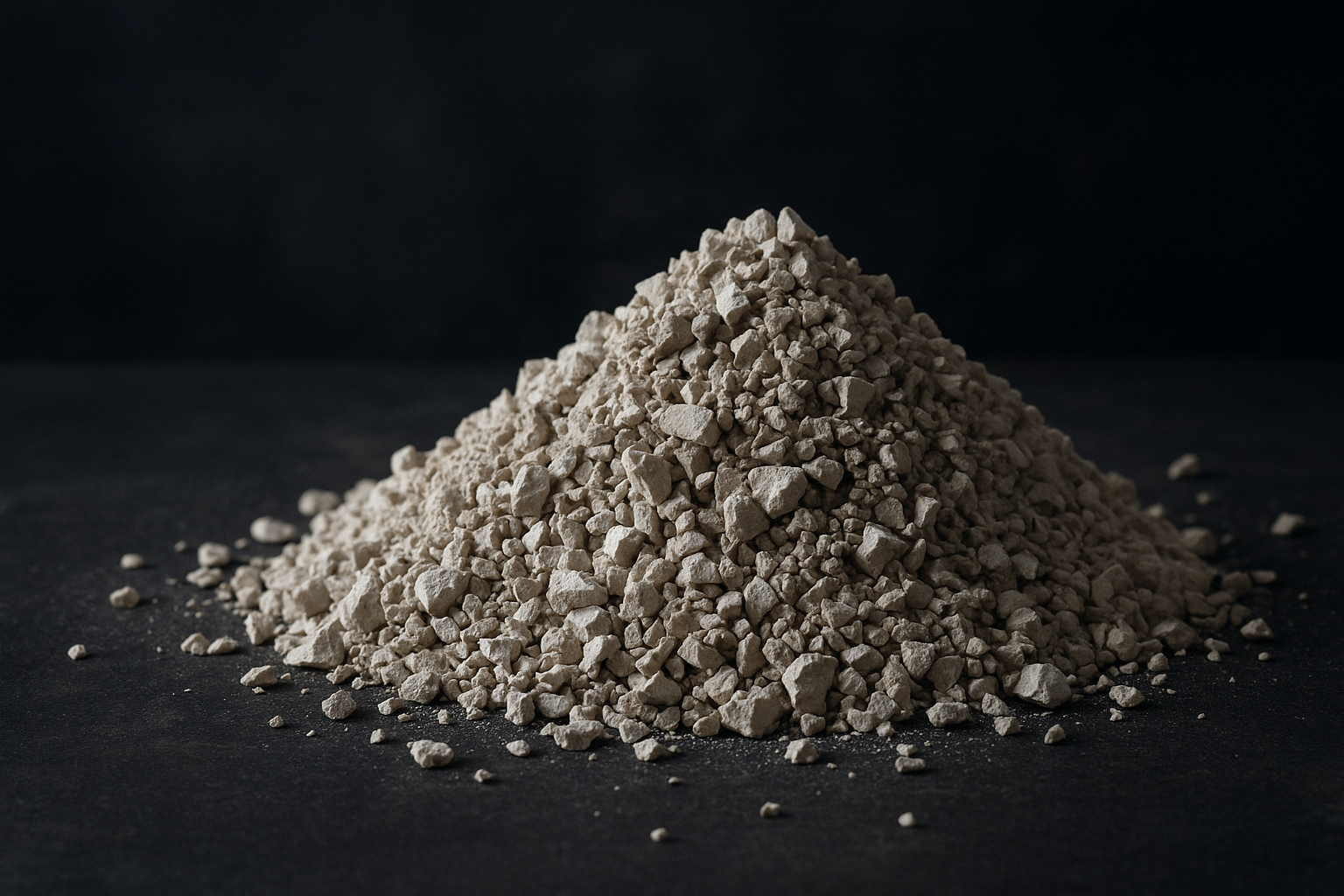
Why winter deicing salts damage highway concrete
Highway mainlines, bridge decks, on/off ramps, and tollgate sections are repeatedly sprayed each winter with sodium chloride (NaCl) and calcium chloride (CaCl₂) based deicers. The resulting damage proceeds along two paths. First, dissolved chloride ions (Cl⁻) penetrate (by diffusion and suction) through the concrete's pores and microcracks, destroying the passive film on the reinforcing steel; once the critical chloride concentration is exceeded, they induce rebar corrosion, expansion, and cover spalling. Second, meltwater repeatedly freezes and thaws (freeze-thaw) in the surface-layer pores, and the hygroscopicity of CaCl₂ raises the degree of saturation toward critical levels, accelerating surface scaling and pop-outs.
Both mechanisms depend directly on the pore structure of the surface-layer concrete. The coarser and more connected the capillary pores, the larger the chloride diffusion coefficient and absorption rate, and the more free water available to saturate and freeze. Therefore, for road structures in a deicing environment, the key approach is to secure the density and low permeability of the concrete matrix itself at the mix-design stage, in addition to applying surface protectants. Natural zeolite pozzolan is exactly the supplementary material that targets this matrix densification.
The mechanism of natural zeolite — pozzolanic densification (not cation exchange)
Natural clinoptilolite is a pozzolanically active mineral (within the ASTM C618 Class N category) that reacts with the calcium hydroxide (Ca(OH)₂, portlandite) produced by Portland cement hydration. The reactive silica SiO₂ 66.7% and Al₂O₃ 11.48% of KMIZEOLITE powder form secondary C-S-H/C-A-S-H gel through the following pozzolanic reaction: SiO₂ (amorphous) + Ca(OH)₂ + H₂O → C-S-H. This secondary gel fills the spaces between particles and the capillary pores, causing pore refinement and discontinuity, so the diffusion path through which chloride must pass becomes longer and narrower. In other words, the key contribution in a deicing environment is the reduction of the chloride diffusion coefficient and permeability through matrix densification.
It is important not to confuse the mechanism here. The clinoptilolite framework carries a negative charge due to Al substitution, and holds exchangeable cations (Na⁺·K⁺·Ca²⁺, etc.) that balance that charge. Therefore it cannot electrostatically adsorb and hold the anionic free chloride (Cl⁻) directly. A CEC of 1.6–2.0 meq/g is meaningful for alkali-cation binding and mitigation of alkali-silica reaction, but it must be made clear that the primary mechanism of chloride resistance in a deicing environment is not cation exchange but physical pore blocking by the pozzolanic reaction.
KMIZEOLITE's natural clinoptilolite has 97% purity and is mined and processed at the Amargosa Valley mine in Nevada, USA. With a specific surface area of 40.0 m²/g, a specific gravity of 1.89, and a stable mineral phase over a pH range of 3.0–10.0, its mineral framework is maintained even in the cement-alkaline (pH 12–13) environment. Its 100 mesh fine-powder form has a large specific surface area, so the pozzolanic reaction with Ca(OH)₂ proceeds sufficiently fast.
For academic support, Feng et al. (2005) reported in Cement and Concrete Research that concrete with natural zeolite replacing part of the cement showed improved scaling resistance and residual strength against deicing-salt freeze-thaw cycles compared with the control (Feng et al., 2005). Najimi et al. (2012) reported improved chloride penetration resistance (RCPT) and reduced absorption in high-performance concrete incorporating natural zeolite (Najimi et al., 2012), and Ahmadi & Shekarchi (2010) summarized that natural zeolite meets the ASTM C618 pozzolan requirements and contributes to the activity index and pore-structure improvement (Ahmadi & Shekarchi, 2010). The comprehensive supplementary cementitious material (SCM) review by Shekarchi et al. (2023) broadly summarizes late-age durability behavior depending on replacement ratio and curing (Shekarchi et al., 2023).
KMIZEOLITE key properties
| Item | Value |
|---|---|
| Clinoptilolite purity | 97% |
| Reactive silica (SiO₂) | 66.7% |
| Aluminum oxide (Al₂O₃) | 11.48% |
| Cation exchange capacity (CEC) | 1.6–2.0 meq/g |
| Specific surface area | 40.0 m²/g |
| Pore diameter | 4.0–7.0 Å |
| pH stability range | 3.0–10.0 |
| Hardness | 4.0–5.0 Mohs |
| Thermal stability | 700°C |
| Specific gravity | 1.89 |
| Bulk density | 45–54 lbs/ft³ |
| Certifications | OMRI KMI-10365, FDA GRAS, TSCA, EN-71-3 |
Application examples in deicing-environment concrete
These are representative scenarios in which natural zeolite is considered for road and bridge structures exposed to deicing salts.
- Bridge-deck pavement and deck concrete: replacing 10–20% of the cement with zeolite powder (100 mesh) to raise chloride penetration resistance
- Road mainline and on/off-ramp slabs: incorporating it as a pozzolan into surface-layer concrete where freeze-thaw and scaling are concentrated, to reinforce durability
- Curbs, median barriers, and retaining walls: adding it to the mix to densify the surface of areas in direct contact with deicers
- Repair mortars: partially replacing the binder with salt-resistant mortar when repairing existing scaling-damaged areas
- Test / pilot application: pre-checking RCPT and freeze-thaw tests by replacement ratio using small 100 mesh samples
Recommended particle size and product specifications
In deicing-environment concrete, fine powder that governs the pozzolanic reaction rate is essential, so Powder (100 mesh, <150μm) is the standard. Reactive silica SiO₂ 66.7% combines with Ca(OH)₂ to refine pores, and the finer the particles, the more stable the early strength development and chloride-blocking effect. Please refer to the table below.
| Product family | Mesh | Particle size | Typical use |
|---|---|---|---|
| Powder | 100 mesh or finer | <150μm | Pozzolan, feed, powder adsorption |
| Fine Granule | 30×50 mesh | 0.3–0.6mm | Water treatment, filtration, soil |
| Medium Granule | 14×40 mesh | 0.4–1.4mm | Filter media, bedding, flooring |
| Coarse Granule | 8×14 mesh | 1.4–2.4mm | Swimming pools, deicing, large-scale filtration |
| Extra Coarse | 4×8 mesh | 2.4–4.8mm | Packed beds, air scrubbers |
→ View products by mesh size · Product selection guide by application
Mix design and field review points
When applying zeolite to road and bridge concrete exposed to deicing salts, the following items should be checked together. The key is to correct, through curing and mix design, the trade-off that "higher replacement → higher late-age durability, lower early strength."
- Confirm pozzolan specifications: Review the ASTM C618 (natural pozzolan, Class N) requirements of SiO₂+Al₂O₃+Fe₂O₃ ≥ 70%, loss on ignition, and strength activity index (28-day ≥75%). KMIZEOLITE has reactive SiO₂ 66.7% and Al₂O₃ 11.48%, giving a high sum of active oxides.
- Replacement-ratio design: Base the mix on a 10–20% replacement of cement mass; higher replacement favors late-age chloride resistance, but early (7-day) strength and workability are affected, so readjust the water-reducer dosage and the W/B ratio.
- Chloride penetration test: Quantitatively compare free-chloride diffusion resistance against an unmodified control of identical W/B and identical curing using ASTM C1202 (RCPT, charge passed in Coulombs) or NT Build 492 (non-steady-state diffusion coefficient Dnssm).
- Freeze-thaw and scaling tests: Evaluate mass loss and surface rating after the prescribed cycles using ASTM C666 (freeze-thaw durability index) and C672 (deicing-salt scaling surface rating 0–5). C672 is especially important in a deicing environment.
- Curing conditions: Because the pozzolanic reaction develops largely at later ages, secure sufficient moist curing (28–90 days). With insufficient curing, the pozzolanic effect does not develop and the durability benefit may disappear.
- Evidence: Feng et al. (2005) reported improved deicing-salt freeze-thaw durability of natural-zeolite-replaced concrete (Cement and Concrete Research, 2005), Ahmadi & Shekarchi (2010) reported ASTM pozzolan suitability (Cement and Concrete Composites, 2010), and Najimi et al. (2012) reported RCPT-based chloride resistance improvement (Construction and Building Materials, 2012).
→ View TDS (Technical Data Sheet) · View MSDS (Safety Data Sheet)
Deicing-environment concrete FAQ
Does adding zeolite to concrete exposed to deicing salts improve durability?
Natural clinoptilolite is a pozzolan (ASTM C618 Class N) that reacts with the Ca(OH)₂ produced by cement hydration, forming secondary C-S-H gel that refines capillary pores and blocks chloride diffusion paths. Feng et al. (2005, Cement and Concrete Research) reported that concrete with natural-zeolite replacement showed improved scaling resistance and residual strength against deicing-salt freeze-thaw cycles compared with the control, and Najimi et al. (2012) reported improved chloride penetration resistance and reduced absorption. However, the effect depends on replacement ratio, aggregate, and curing conditions, so it should be verified by comparing against a control mix using RCPT (ASTM C1202) and freeze-thaw (C666) testing before adoption.
What percentage of cement is typically replaced with zeolite?
In deicing-environment concrete, replacing 10–20% of the cement mass is the common range under consideration. Higher replacement favors late-age chloride resistance and density but slows early strength development, so a 28–90 day moist-curing period should be secured and the strength activity index and mix workability should be verified together. High replacement (above 20%) is also treated in the SCM review (Shekarchi et al. 2023) only on the premise of curing and mix adjustment.
Does zeolite directly adsorb and hold anionic chloride ions?
No. Unmodified clinoptilolite has a negatively charged framework and therefore cannot electrostatically adsorb anionic free chloride (Cl⁻) directly. In a deicing environment, the main contribution is not cation exchange but pore refinement from the pozzolanic reaction, a physical barrier effect that lowers the chloride diffusion coefficient of the concrete matrix itself. Some alkali-cation binding is explained by the CEC (1.6–2.0 meq/g), but the primary mechanism for chloride resistance is densification.
Which particle size (mesh) is suitable?
Because the pozzolanic reaction rate is proportional to specific surface area, a single Powder (100 mesh, <150μm) grade is the standard. The finer the particles, the faster the reaction with Ca(OH)₂, giving stable early strength development and chloride blocking. Granular products for filtration/packing (e.g., 8×14 mesh) are not used for this pozzolan application. Please refer to the product selection guide by application.
Which tests confirm the application effect?
Chloride resistance is evaluated by ASTM C1202 (RCPT, charge passed in Coulombs) or NT Build 492 (non-steady-state diffusion coefficient), and deicing-salt exposure damage by ASTM C666 (freeze-thaw durability index) and C672 (deicing-salt scaling surface rating). Pozzolanic suitability is confirmed by ASTM C618 (Class N) and the strength activity index, and all tests should preferably be compared against an unmodified control of identical mix and identical curing.
Can I get test samples and certification documents?
Yes, KMIZEOLITE supports the supply of 100 mesh powder samples for mix evaluation and holds certifications including OMRI Listed (KMI-10365), FDA GRAS (general use 21 CFR 182.2729), TSCA compliant, and EN-71-3 PASS. Please check the sample request page and the certifications page.
Inquiries and sample requests
If you are considering applying natural zeolite pozzolan to road and bridge concrete in a deicing-salt-exposed environment, please contact us through the channels below.
Notice
Applicability and performance may vary depending on the replacement ratio, aggregate and cement type, curing conditions, and applicable specifications. Before an actual mix, testing review suited to the field conditions—such as RCPT and freeze-thaw—must come first. Zeolite should be understood not as a cure-all for deicing-salt damage, but as a natural pozzolan that supports concrete durability.
Related pages
science Related Research Papers
Academic papers addressing zeolite application in this field. Refer to them when reviewing adoption.
- Effect of natural zeolite on durability of concrete against deicing salt
Feng, N. et al. — Cement and Concrete Research, 2005 - Properties of high-performance concrete incorporating natural zeolite
Najimi, M. et al. — Construction and Building Materials, 2012 - Natural zeolite as pozzolanic material: A review
Ahmadi, B. and Shekarchi, M. — Cement and Concrete Composites, 2010 - Natural zeolite as supplementary cementitious material: A holistic review
Shekarchi, M. et al. — Construction and Building Materials, 2023 - Effect of Partial Clinoptilolite Zeolite Replacement on Soil Subjected to Freezing–Thawing Cycles
Shirmohammadi, S. et al. — Coatings, 2021
The papers above are reference material; actual application requires a separate review suited to the field conditions.