De-icing & Anti-Slip
Natural clinoptilolite is not an ice-melting chemical de-icer but a non-corrosive physical traction material that removes the surface water film through 4.0–5.0 Mohs particle friction and adsorption via a 40 m²/g surface area and 4.0–7.0 Å pores. It is evaluated for use alongside or in place of chlorides, positioned to address residual water-film slip after the de-icing process.
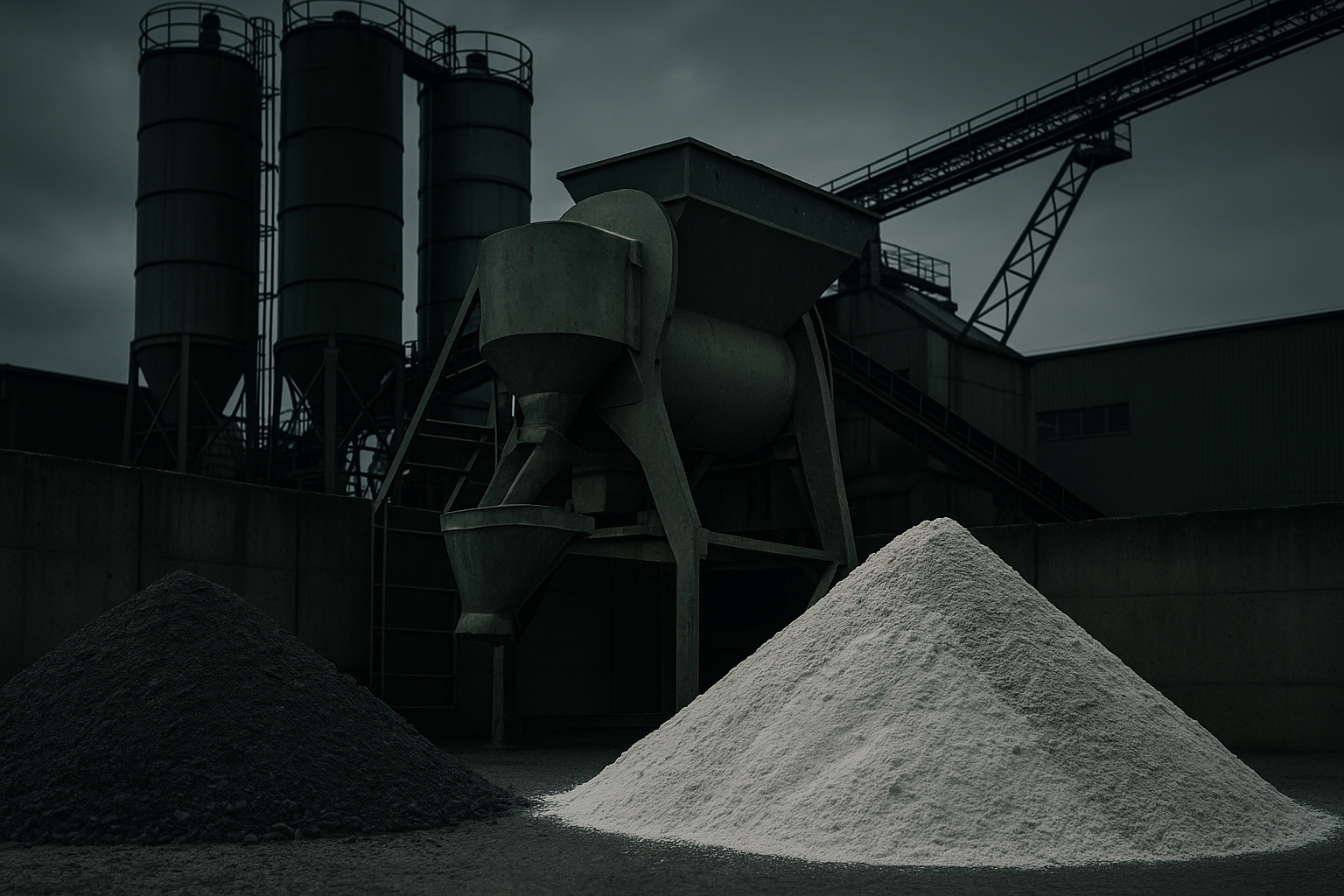
Zeolite for De-icing & Anti-Slip — An Eco-Friendly Physical Traction Material
In winter facility management, the most frequent safety incidents are falls and vehicle slips on icy surfaces. Facility managers must constantly balance fast de-icing against the side effects of chlorides (calcium chloride and sodium chloride) such as concrete scaling, rebar corrosion, roadside vegetation die-off, and groundwater salinization. Natural clinoptilolite is an inorganic mineral evaluated as a granular traction material for de-icing support and slip prevention on winter roads, walkways, parking lots, bridge approaches, and industrial sites.
Zeolite works not through chemical de-icing but through physical slip reduction. Its hard particles, at 4.0–5.0 Mohs hardness, create friction on the ice surface, while its porous structure—40.0 m²/g surface area and 4.0–7.0 Å pore diameter—absorbs the surface water film and liquids to reduce slipping. Beyond snow and ice conditions, it can also be expected to provide simultaneous slip prevention and adsorption/recovery in liquid-spill situations involving oil, fuel, coolant, paint and the like, making it useful as an industrial safety material as well. In zones where the burden of chloride side effects is high, it has drawn interest as a chloride-substitute or co-use anti-slip material.
Key Properties Relevant to De-icing & Anti-Slip Applications
| Property | Value | Significance for De-icing |
|---|---|---|
| Hardness | 4.0–5.0 Mohs | Secures particle friction, resists crushing |
| Bulk density | 720–865 kg/m³ | Ease of spreading and handling |
| Specific gravity | 1.89 | Resistance to wind-driven scattering |
| Specific surface area | 40.0 m²/g | Aids water and oil adsorption |
| Stable pH range | 3.0–10.0 | Environmental compatibility |
| Pore diameter | 4.0–7.0 Å | Microstructure for water adsorption |
Recommended Product Specifications for De-icing & Anti-Slip
| Product Name | Mesh | Particle Size | Recommended Use |
|---|---|---|---|
| KMI 8X14 US MESH (Coarse Granule) | 8×14 mesh | 1.4–2.4mm | Optimal — road/walkway spreading, friction |
| KMI 4X8 US MESH (Extra Coarse) | 4×8 mesh | 2.4–4.8mm | Large-area, high-load section spreading |
| KMI 14X40 US MESH (Medium Granule) | 14×40 mesh | 0.4–1.4mm | Fine spreading on walkways and ramps |
De-icing Material Comparison Reference
| Comparison Item | Natural Zeolite | Calcium Chloride | Sand |
|---|---|---|---|
| Working principle | Friction + water adsorption | Chemical de-icing | Friction |
| Concrete corrosion | None | Yes | None |
| Metal corrosion | None | Yes | None |
| Soil/water impact | Very low | High | Low |
| Adsorption function | Water/oil adsorption | None | Limited |
| Reusability | Reuse after recovery can be considered | Not possible | Limited |
| Vegetation damage | None | Yes | None |
Why Zeolite Is Used for De-icing & Anti-Slip
Zeolite is suitable as a traction material because three properties act at once. First, particles at 4.0–5.0 Mohs hardness form a friction surface on ice without being crushed. Although lower than sand (quartz) at 7.0 Mohs, they are sufficiently harder than ice (about 1.5 Mohs) and packed-snow ice, so even when pressed by vehicle tires and pedestrian loads they embed into the ice surface and act as an anti-slip aggregate that raises the friction coefficient. Second, the 40.0 m²/g surface area and 4.0–7.0 Å pores draw in the road water film and spilled liquids through capillary and adsorptive forces, reducing the lubricating film that is the primary cause of slipping. Third, with a specific gravity (true density) of 1.89 and bulk density of 720–865 kg/m³, the particles are more porous yet heavier than the same volume of sand, so they scatter less under wind and vehicle draft and stay longer at the spreading location.
Durability in icing conditions is also an important operating factor. Because clinoptilolite is a hydrous mineral that reversibly holds water inside its crystal framework, it does not readily crumble into fines like sand or weathered aggregate even after repeated freeze-thaw cycles in a water-laden state. As a result, a single application can maintain a friction surface through a season even in repeatedly icing sections, lowering the frequency of re-application.
Another benefit in de-icing environments is structural durability. Feng et al. (2005), in a study published in Cement and Concrete Research, reported that concrete incorporating natural zeolite showed improved surface scaling resistance and durability under deicing-salt freeze-thaw conditions (Feng N. et al., Cement and Concrete Research, 2005). This is because zeolite's pozzolanic reaction densifies the pore structure of the cement matrix, reducing salt penetration and freezing pressure, which means that applying it on the pavement/structure side also works to mitigate salt-environment damage. Quantitative data on pozzolan/admixture applications are covered on a separate page.
There is also evidence for industrial spill response. Szala et al. (2015), in Fuel Processing Technology, reported that clinoptilolite is an effective adsorbent for cleaning up spilled petroleum compounds (Szala B. et al., Fuel Processing Technology, 2015), and Anagnostopoulos et al. (2019) reported that natural clinoptilolite can be used to absorb and remove crude oil spills in seawater (Anagnostopoulos V.A. et al., Natural Resources, 2019). This supports the idea that spreading zeolite on a slippery floor coated with oil or fuel can provide adsorption and traction recovery together. However, the uptake of non-polar hydrocarbons depends heavily on the degree of surface hydrophobic modification (e.g., treatment with quaternary ammonium surfactants), so for uses requiring precise oil-recovery efficiency, a modified grade should be evaluated separately.
In short, it is more appropriate to understand zeolite not as a strong chemical de-icer but as a physical anti-slip material that leverages particle friction, water/oil adsorption and surface stability. Cation exchange capacity (CEC) is a key indicator in water-treatment uses such as removing ammonium and heavy-metal cations, but in de-icing/traction uses it is not a direct working factor; particle size, hardness, porosity and scatter resistance are the primary design variables.
Expected Application Points
- Supplementary slip prevention on walkways and ramps
- Evaluation as a road de-icing aid or chloride co-use material
- Evaluation as a safety-management material for parking lots and industrial sites
- Adsorption and slip reduction aid during oil, fuel and liquid spills
- Evaluation as a substitute in zones where concrete/metal damage is a major concern
- Compliance with eco-friendly de-icing policies
Application Examples
Winter Roads and Walkways
KMI 8×14 mesh (1.4–2.4mm) can be evaluated for spreading on its own, or partially mixed with existing chlorides, as a traction material that catches slip on the water film remaining after de-icing. For general walkways, start at roughly 100–200 g/m² and adjust according to icing severity and traffic volume; for roadway sections that also require de-icing, co-use with chlorides is recommended. It is easiest to picture the process position as "primary de-icing with chlorides → spread zeolite traction on residual water-film and re-icing sections." Compared with chloride-only operation, adding zeolite as a supplement can reduce chloride usage at the same safety level, lowering the burden of concrete/metal damage and roadside vegetation harm.
Facility Entrances, Slopes and Stairs
For slopes and stairs requiring immediate slip reduction, KMI 14×40 mesh (0.4–1.4mm), which allows fine spreading, is suitable. On sections with steps, operate at a slightly higher spreading density—about 1.5 times the walkway baseline (roughly 150–300 g/m²)—so that particles stay on step edges and create friction. Fine particles settle well into steps and gaps but scatter easily in strong winds, so for outdoor-exposed slopes, mixing 14×40 with 8×14 to secure both persistence and immediate friction is also worth considering.
Large-Area, High-Load Sections
For sections with high vehicle loads and wind scattering—such as parking-lot ramps, logistics yards and bridge approaches—KMI 4×8 mesh (2.4–4.8mm) coarse particles are advantageous for persistence and securing a friction surface. With a specific gravity of 1.89, they have more scatter resistance than ordinary sand, with less drift from the spreading location.
Industrial Spill Response
It is used as a supplementary adsorbent to reduce surface slipperiness and aid recovery when oil, fuel, coolant, paints and the like are spilled. After spreading enough that particles fully cover the spilled liquid over the affected area and allowing adsorption to proceed for several minutes, the material is recovered with a broom or vacuum; thanks to a stable pH range of 3.0–10.0, it can be applied without framework collapse even in varied liquid environments where acidic and alkaline conditions are mixed. When full-scale recovery of non-polar oils is required, unmodified natural zeolite has limited oil uptake due to its hydrophilic surface, so using a surface-modified hydrophobic grade is more effective. Recovered particles are considered for disposal or, depending on the nature of the oil, regeneration and reuse.
Points to Consider
- Zeolite works differently from typical strong-salt de-icers. In sections where thick ice that has dropped deep below freezing must be melted quickly, standalone use may be unsuitable.
- Since friction and water management matter more than an immediate melting effect, consider co-use with chlorides when de-icing is needed.
- The appropriate particle size (8×14 / 4×8 / 14×40 mesh) and spreading amount vary with the use environment (temperature, snowfall, traffic, slope).
- Plan recovery and cleaning routes so that residual particles after spreading cause less scattering and storm-drain inflow, and also evaluate the reusability of recovered material.
- Where there are public procurement or facility-management standards, on-site criteria and material suitability must be reviewed together.
Frequently Asked Questions (FAQ)
Does zeolite melt ice directly like calcium chloride?
No. Natural clinoptilolite is not a chemical de-icer but a physical traction material. Its hard particles, at 4.0–5.0 Mohs hardness, create friction on ice, while its porous structure—40.0 m²/g surface area and 4.0–7.0 Å pore diameter—absorbs the surface water film to reduce slipperiness. In areas requiring immediate ice melt, it is used together with chlorides, and it is evaluated as a substitute or supplementary material in zones where corrosion or vegetation damage is a concern.
Which particle size (mesh) should be spread for de-icing use?
For general spreading on roads and walkways, KMI 8×14 mesh (particle size 1.4–2.4mm) is the most suitable as it offers a good balance of friction and persistence. For large-area or high-load sections, or where strong winds raise scattering concerns, use KMI 4×8 mesh (2.4–4.8mm); for ramps, stairs and other areas requiring fine spreading, use KMI 14×40 mesh (0.4–1.4mm). With a specific gravity of 1.89, it has more scatter resistance than ordinary sand.
When spread on roads, does it corrode concrete or vehicle metal?
Natural zeolite is a neutral inorganic mineral that is non-corrosive to concrete and metal and has very low impact on soil and water. Whereas calcium chloride can cause concrete surface scaling, corrosion of rebar and vehicle undersides, and roadside vegetation damage, zeolite is evaluated as a chloride substitute or reduction material for bridge approaches, parking lots and facility entrances where such damage is a major concern.
Do the particles break down under repeated freeze-thaw? Can it be used for spill incidents too?
Clinoptilolite is a hydrous mineral that reversibly holds water within its crystal framework, so even after repeated freeze-thaw cycles in a water-saturated state, the particle structure does not readily degrade into fines, maintaining its friction function through a season. Thanks to its porous structure, it also reduces surface slipperiness while aiding adsorption and recovery when liquids such as oil, fuel, coolant or paint are spilled. However, unmodified natural zeolite has a hydrophilic surface, so its uptake of non-polar oils is limited; if full-scale oil recovery is the goal, using a surface-modified hydrophobic grade is more effective.
Related Pages
- Coarse Granule Zeolite Products — 8×14, 4×8 product specifications
- Medium Granule Zeolite Products — 14×40 product specifications
- Household Spill Adsorption — related to spill response
Notice
De-icing and anti-slip performance may vary depending on temperature, snowfall, surface condition, spreading amount, particle size, and whether chlorides are already in use. Before actual application, a trial application tailored to the seasonal conditions and operating standards of the target site is recommended.
[Inquire about particle size and bulk supply conditions for de-icing & anti-slip zeolite →]
science Related Research Papers
Academic papers covering zeolite applications in this field. Please refer to them when evaluating adoption.
- Effect of natural zeolite on durability of concrete against deicing salt
Feng, N. et al. — Cement and Concrete Research, 2005 - Organically modified zeolites in petroleum compounds spill cleanup
Szala, B. et al. — Fuel Processing Technology, 2015 - The Potential Use of Natural Clinoptilolite Zeolite for Crude Oil Spill Removal from Sea Water
Anagnostopoulos, V.A. et al. — Natural Resources, 2019 - Zeolites in Adsorption Processes: State of the Art and Future Prospects
Various — Chemical Reviews, 2022 - Natural zeolite as pozzolanic material: A review
Ahmadi, B. and Shekarchi, M. — Cement and Concrete Composites, 2010 - Properties of high-performance concrete incorporating natural zeolite
Najimi, M. et al. — Construction and Building Materials, 2012 - Natural zeolite as supplementary cementitious material: A holistic review
Shekarchi, M. et al. — Construction and Building Materials, 2023
The papers above are reference material; actual application requires separate review suited to on-site conditions.