Household Spill Absorption
A dry, apply-and-recover absorbent that captures water and detergent through 4-7Å capillary absorption, holds ammonium in pet waste fluid via CEC 1.6-2.0 meq/g ion exchange, and draws in viscous oil with coarse 8×14 mesh particles. Note that maximizing absorption capacity for petroleum-based oils requires surfactant organo-modification.
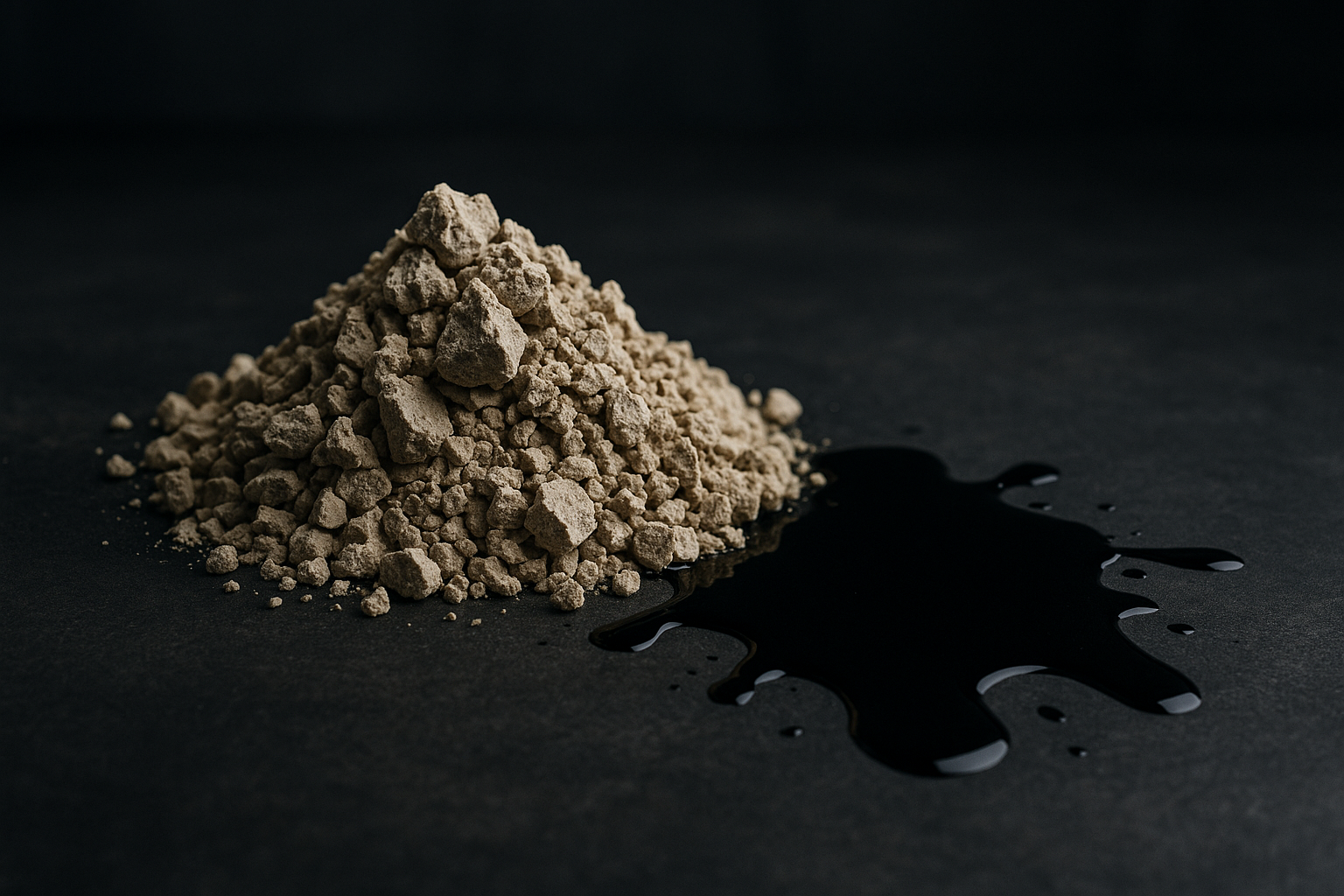
Why zeolite is used for household spill absorption and cleanup
Engine oil dripped onto a garage floor, detergent or cooking-oil spills in a utility room, accidental pet waste fluid — homes and small work spaces constantly see liquid spills that vary in viscosity and character. Wiping with tissue or a rag smears an oily residue film across the surface, water leaves an odor behind even after wiping, and unabsorbed liquid clings to the soles of shoes, easily carrying contamination into other spaces. In these situations a dry absorbent that you can sprinkle over the spill to draw the liquid into the granules and then sweep up with a broom helps cut cleanup time and prevent the spread of contamination.
KMI natural clinoptilolite zeolite (97.0% purity) is a porous inorganic material with fine pores developed inside the particles, and is evaluated in domestic settings as a granular absorbent for cleaning up oil, water and detergent spills or as an aid for simultaneous absorption and odor management of pet waste fluid. Because it is inorganic it does not decompose or rot on its own, and because it works by apply-and-recover it can respond immediately without any special equipment — strengths that make it well suited as a household absorbent.
Key properties relevant to household absorption
| Property | Value | Significance for absorption |
|---|---|---|
| Specific surface area | 40.0 m²/g | Large adsorption surface |
| Pore diameter | 4.0–7.0 Å | Absorbs moisture and organic components |
| CEC | 1.6–2.0 meq/g | Adsorbs ammonium and odor components |
| Bulk density | 720–865 kg/m³ | Easy to apply and recover |
| Hardness | 4.0–5.0 Mohs | Prevents floor surface damage |
| pH stability range | 3.0–10.0 | Compatible with various liquid types |
Safety certifications
| Certification/Registration | Details |
|---|---|
| EN-71-3 | European toy safety standard — PASS |
| California Prop 65 | Compliant with California carcinogen warning requirements |
| TSCA | Compliant with the Toxic Substances Control Act |
| USFDA GRAS | Recognized as Generally Recognized As Safe (21 CFR 182.2729) |
Absorbents used in the home may come into contact with children and pets, so it is important to choose a material with confirmed safety certifications. KMI natural clinoptilolite is classified under general-use criteria as USFDA GRAS (21 CFR 182.2729); when used for ingestion as animal feed, 21 CFR 582.2729 applies separately. Household spill cleanup is a general absorbent use rather than an ingestion use, so it is evaluated under the former criterion (182.2729). Additional safety standards such as EN-71-3 PASS, California Prop 65 compliance and TSCA registration are also confirmed.
How spills are drawn in — absorption and ion exchange are different mechanisms
In household spill cleanup, clinoptilolite uses two independent mechanisms at the same time. Distinguishing between them is the key to choosing particle size and judging the application.
① Physical capillary absorption (capturing liquid volume). Clinoptilolite has a porous framework with a specific surface area of 40.0 m²/g, combining 4.0-7.0 Å (angstrom) channels with macropores between particles. When sprinkled over a spill, capillary pressure draws water, detergent and oil molecules into the particle interior and the voids between particles, trapping them, while only dry, non-flowing granules remain on the floor to be swept up with a broom. Because this action is physical absorption unrelated to charge, the liquid's volume, viscosity and exposed surface area govern the absorption rate. For the same mass, coarser particles have larger inter-particle voids and take in viscous oil faster, while fine grades have more contact points per unit area and quickly absorb small-volume, low-viscosity liquids.
② Cation exchange (chemically capturing odor components). Exchangeable cations (Na⁺, K⁺, Ca²⁺) that offset the negative charge created by Al³⁺ substitution in the framework swap places with odor-causing cations such as ammonium (NH₄⁺) in pet waste fluid and household contaminant liquids, binding NH₄⁺ to the framework. CEC 1.6-2.0 meq/g is the indicator of this exchange capacity; the literature reports the NH₄⁺ adsorption capacity of natural clinoptilolite to be roughly in the range of 15-31 mg NH₄⁺/g under aqueous conditions. In other words, unlike a simple absorbent, it reduces both liquid volume (①) and volatile ammonia precursors (②) at the same time, lowering residual floor odor. However, since this ion exchange works only on cations, it must be noted that, given the negatively charged framework, anionic contamination (e.g., the anionic surfactants in some synthetic detergents) is reduced only in volume through physical absorption rather than by ion exchange.
Petroleum-based oils require surface modification. The surface of natural clinoptilolite is hydrophilic, so while it readily takes up water, its absorption capacity for non-polar petroleum-based oils such as diesel and gasoline is limited. To genuinely raise oil absorption capacity, a pretreatment that organo-modifies the surface with quaternary ammonium surfactants and the like to make it oleophilic is required. For household use cleaning up a small amount of oil on a garage floor while also providing slip resistance, bulk absorption is possible even with unmodified granules, but it should be reflected at the evaluation stage that a dedicated oil absorbent with maximized absorption efficiency presupposes a modified grade.
The mechanisms above are also supported by academic research. Szala et al. (2015, Fuel Processing Technology) reported that organo-modifying clinoptilolite with surfactants turns the hydrophilic natural surface oleophilic, greatly improving absorption capacity for petroleum-based compounds such as diesel and gasoline (DOI). Asgharzadeh et al. (2025, MethodsX) showed that clinoptilolite modified with a cationic surfactant is effective for adsorbing kerosene-derived volatile organic compounds (VOCs), reconfirming that modification is essential for petroleum cleanup (DOI). Fidan et al. (2022, Journal of Applied Polymer Science) presented results showing that silicone composite foams filled with clinoptilolite maintain their oil absorption capacity through repeated use (DOI), and Anagnostopoulos et al. (2019, Natural Resources) demonstrated that natural clinoptilolite can be used to remove crude oil from the water surface (DOI). For odor-accompanying spills, Cataldo et al. (2024, Materials) confirmed that natural clinoptilolite effectively adsorbs ammonia and volatile odor components (DOI).
Why absorbent materials are needed even in living spaces
Wiping with tissue or a rag merely moves the liquid across the surface without reducing its volume, spreading an oily residue film widely or leaving odor precursors in fine floor crevices. An apply-and-recover dry absorbent traps the liquid within the particle volume and then sweeps it up all at once, reducing both the spread of contamination and residual odor.
- Simultaneous liquid + odor: for pet waste fluid and household contaminant liquids, residual odor disappears only when both volume (physical absorption) and ammonium precursors (ion exchange) are reduced together
- Fast initial containment: for pet accidents, trapping the liquid within 5-10 minutes prevents floor penetration and spread, reducing the burden of subsequent cleaning
- Recovering oily residue film: viscous oil is hard to remove completely with tissue, and absorbing it with coarse particles and then recovering them also provides slip prevention
- Repeated-spill environments: garages, utility rooms and storerooms see frequent spills, so an inorganic absorbent that can be stored at room temperature and does not rot is well suited as a stockpiled supply
Recommended product specifications by use
| Usage environment | Recommended product | Mesh | Particle size | Reason |
|---|---|---|---|---|
| Pet waste accidents | KMI 14X40 US MESH | 14×40 mesh | 0.4–1.4mm | Fast adsorption, easy to recover |
| Garage/workshop oil spills | KMI 8X14 US MESH | 8×14 mesh | 1.4–2.4mm | Oil adsorption, doubles as slip prevention |
| Small liquid spills | KMI 30X50 US MESH | 30×50 mesh | 0.3–0.6mm | Fine, precise adsorption |
Commonly considered usage environments
1. Pet living spaces — cleaning up waste accidents
For contamination where liquid and odor occur together, such as toileting accidents or vomiting, we recommend KMI 14X40 US MESH (0.4-1.4mm). Cover the spill area with a 1-2mm layer thickness (about 0.7-0.9 g/cm² ≒ based on bulk density 720-865 kg/m³) so the spill is no longer visible, let it absorb for 5-10 minutes, then sweep it up; porous absorption (①) and CEC 1.6-2.0 meq/g-based ammonium adsorption (②) work together to reduce residual floor odor. For accidents with a large liquid volume, a two-stage application — first sprinkling to trap the surface liquid, then lightly applying a second layer to absorb residual moisture — gives higher recovery efficiency. The 0.4-1.4mm medium grade also produces less dust than fine grades, which has the advantage of reducing concerns about respiratory exposure for pets.
2. Utility rooms, storerooms, garages — oil and detergent spills
For high-viscosity engine oil and lubricant spills, KMI 8X14 US MESH (1.4-2.4mm) is suitable. The coarse particles have large inter-particle voids that quickly take in viscous oil while remaining on the floor to reduce slipping, doubling as slip prevention until recovery. Cover until no liquid is visible, let it stand for 10-15 minutes (adjust for viscosity and temperature), then recover it; if a residue film remains, scrub once more with the same particle size to wipe it off. With a hardness of 4.0-5.0 Mohs, applying and recovering it on concrete or tile floors causes almost no surface damage. However, to maximize absorption capacity for non-polar oils such as diesel and gasoline, the surfactant organo-modified grade described earlier is a prerequisite; unmodified granules are suitable for temporary cleanup at the level of bulk absorption and slip prevention.
3. Around the workbench — small liquid and detergent spills
In environments where small amounts of water, detergent and household solutions frequently spill, the fine grade KMI 30X50 US MESH (0.3-0.6mm) absorbs them quickly. Fine grades have more contact points per unit area, giving a fast absorption rate for low-viscosity, small-volume liquids and making them well suited for precise application over a small area. With a pH stability range of 3.0-10.0 it is compatible with both acidic and alkaline household solutions (excluding strong acids, strong alkalis and organic solvents), and with a bulk density of 720-865 kg/m³ it is easy to apply and recover. However, fine grades produce dust more readily than medium or coarse grades, so in poorly ventilated indoor spaces it is best to apply close to the floor to reduce scattering.
Points to review when applying
- Type of target liquid: water/detergent (hydrophilic, physical absorption) / pet waste fluid (absorption + ammonium ion exchange) / petroleum-based oil (modified grade recommended) have different mechanisms
- Spill volume scale: convert the dosage per area based on a 1-2mm layer thickness (applying bulk density 720-865 kg/m³)
- Particle size and absorption rate: for higher viscosity / larger area use coarse 8×14, for low-viscosity, small volume use fine 30×50, and for general-purpose, low-dust use the medium 14×40 grade
- Whether modification is needed: to raise the absorption efficiency of non-polar oils such as diesel and gasoline, surfactant organo-modification is a prerequisite
- Dust and recovery convenience: choose medium or coarse grades in environments with respiratory exposure concerns; recovery is possible by broom or vacuum
- Packaging and storage: as a room-temperature-storable, non-perishable inorganic material, it can be kept in small packages as a standing supply or placed in bulk
For household products in particular, not only performance but also ease of use, dust generation, storability and the recovery method matter. Let us know the target liquid and usage environment and we will organize the particle size, modification needs and dosing criteria together with you.
Frequently Asked Questions (FAQ)
Which particle size is best for engine oil or lubricant spills in a garage or workshop?
For oily spills we recommend KMI 8×14 US MESH (particles 1.4-2.4mm). The coarse particles have large inter-particle voids that quickly draw in viscous oil, are easy to sweep up with a broom after application, and double as a slip-resistant layer while they remain on the floor. Cover the spill area evenly until no liquid is visible, let it absorb for 10-15 minutes, then sweep it up. Note that the surface of natural clinoptilolite is hydrophilic, so to maximize the absorption efficiency of non-polar petroleum-based oils such as diesel and gasoline, a surfactant organo-modified grade is a prerequisite; unmodified granules are suitable for temporary cleanup at the level of bulk absorption and slip prevention.
Can it also handle spills with odor, such as pet waste fluids?
Yes. Natural clinoptilolite combines porous absorption with a cation-exchange capacity of CEC 1.6-2.0 meq/g, capturing ammonium (NH₄⁺) ions in pet waste fluid to handle absorption and odor reduction at the same time. Cover the affected area with KMI 14X40 US MESH (0.4-1.4mm) to absorb the liquid and then recover it, which reduces residual floor odor.
Can I use the same product for light liquids like water and detergent and for oily liquids?
It is more efficient to choose the particle size by spill type. Low-viscosity, small-volume water and detergent spills are quickly absorbed by the fine grade KMI 30X50 US MESH (0.3-0.6mm), while high-viscosity oil is better handled by the coarse 8×14 mesh. The zeolite's pH stability range is wide at 3.0-10.0, so it is compatible with both acidic and alkaline household solutions.
Can it be used directly on hazardous chemical spills?
We do not recommend it. This material is intended for use as a cleanup aid for general household spills such as water, oil, detergent and pet waste; for spills of strong acids, strong alkalis, organic solvents or toxic chemicals, you should first follow dedicated absorbents and safety response procedures for the substance in question. Let us know your usage environment and the target liquid and we will review suitability together.
Related pages
- Pet odor management — managing waste-related odor
- Indoor deodorization & moisture control — the indoor environment as a whole
- De-icing & slip prevention — handling spills at industrial sites
- Medium-grade zeolite product — 14×40 mesh specification
Items worth checking before inquiry
- Usage environment: home / pet space / garage / storeroom / workshop
- Target contamination: water / household contaminant liquid / oily liquid / mixed contamination
- Desired product form: small package / bulk / OEM raw material
- Expected frequency of use and storage method
Notice
Zeolite can be used as an aid in the fields of household contaminant adsorption and small-scale spill cleanup, but actual applicability may vary depending on the type of liquid, spill volume, surface material, amount used and recovery method. In the case of hazardous chemicals or special substance spills, you should first confirm the dedicated response procedures appropriate to the substance in question.
[Inquire about household absorbent zeolite samples & OEM raw material →]
Example common CTA copy
Consultation prompt copy
From indoor deodorization, pet odor management, cat litter raw material and home gardening to household absorbents, if you would like to know the particle size and product form suited to your use, please contact KMIZEOLITE.
All products are EN-71-3 (European toy safety) PASS, California Prop 65 compliant and USFDA GRAS recognized materials.
Example button copy
- Request a sample
- Get household zeolite consultation
- Inquire about OEM & raw material
- Request application consultation
science Related Research Papers
Academic papers covering zeolite applications in this field. Please refer to them when evaluating adoption.
- Organically modified zeolites in petroleum compounds spill cleanup
Szala, B. et al. — Fuel Processing Technology, 2015 - Oil spill remediation: sorption capacity of silicone composite foams filled with clinoptilolite
Fidan, T. et al. — Journal of Applied Polymer Science, 2022 - The Potential Use of Natural Clinoptilolite Zeolite for Crude Oil Spill Removal from Sea Water
Anagnostopoulos, V.A. et al. — Natural Resources, 2019 - Odors Adsorption in Zeolites Including Natural Clinoptilolite
Cataldo, E. et al. — Materials, 2024 - Adsorption of VOCs from kerosene using clinoptilolite modified by cationic surfactant
Asgharzadeh, F. et al. — MethodsX, 2025
The papers above are reference materials; separate review suited to on-site conditions is required for actual application.