Chemical & Oil Spill Cleanup
Hard particles with a specific gravity of 1.89 and Mohs 4.0–5.0 keep their shape after absorbing oil, making broom and shovel recovery easy. The hydrophilic natural surface can be made hydrophobic through cationic-surfactant (e.g., HDTMA) organic modification to improve diesel and petroleum-based oil uptake — a supplementary material for the primary absorption and spread-suppression stage of a spill.
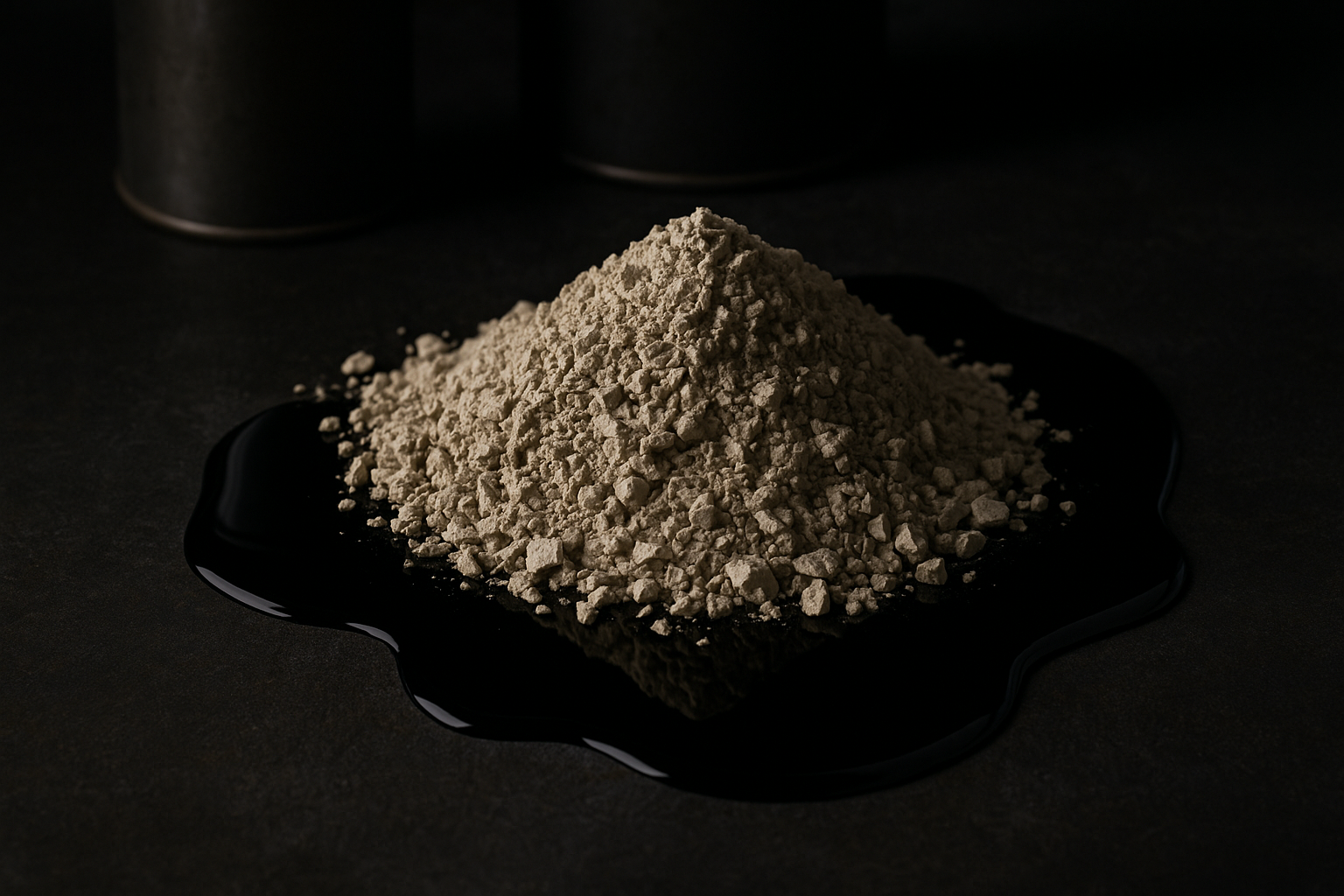
Natural Zeolite for Oil and Chemical Spill Cleanup — A Supplementary On-Site Absorption and Spread-Suppression Material
In workplaces, workshops, logistics warehouses, factory floors, gas stations, and outdoor sites, spills of oil, lubricants, fuel, coolant, cleaning agents, paint, and various liquid chemicals can occur. In these situations the most urgent response is to block the spread and quickly absorb the liquid remaining on the surface to prevent secondary contamination and safety accidents.
Natural clinoptilolite zeolite is considered at such spill sites as a liquid sorbent, a supplementary material for suppressing contamination spread, and an on-site material for floor cleanup. KMIZEOLITE offers structural stability with a specific gravity of 1.89 and a Mohs hardness of 4.0–5.0, giving it the practical advantage of not blowing away in the wind or breaking apart easily compared with lightweight sorbents (perlite, sawdust, etc.).
The Importance of Spill Incident Management
Chemical and oil spills are not a simple cleaning issue.
- Safety accident risk: Oil on the floor is a direct cause of slip accidents.
- Soil and groundwater contamination: In outdoor spills, it spreads into the soil and sewers along with rainwater.
- Fire and explosion risk: When flammable liquids spill, contact with an ignition source creates a fire hazard.
- Environmental regulation violations: There is potential for administrative penalties under hazardous-chemical-management and water-pollution-prevention laws.
- Waste disposal costs: The wider the contamination spreads, the more exponentially remediation costs increase.
Therefore, rapidly absorbing and recovering the spill in its early stage is key to minimizing total management costs and environmental damage.
Why Zeolite Is Used for Spill Cleanup
1. Fast Liquid Absorption and Spread Suppression
In spill cleanup, the primary mechanism by which zeolite works is not molecular-sieve adsorption but capillary uptake between particles and within pores. The crystal channels of clinoptilolite (about 4.0–7.0 Å) and the roughly 50% total pore volume created by the inter-particle gaps draw the liquid in by surface tension, trapping the spilled material inside the particles before it can spread sideways. Spreading it in a band around the spill point allows the absorbent particle layer to act as a kind of physical berm, limiting the spread area. Since oil-uptake capacity varies with particle size and the viscosity of the spilled material, it is safer to verify the quantitative absorption limit with a small on-site test.
Surface chemistry is the key variable. The surface of natural clinoptilolite is hydrophilic because of the framework oxygen, silanols, and exchangeable cations, so its affinity for water is greater than for non-polar hydrocarbons. That is, in an environment where water is also present (a wet floor, the sea surface), unmodified zeolite may absorb water preferentially over oil. Szala et al. (2015, Fuel Processing Technology) reported that organically modifying clinoptilolite with a cationic surfactant such as HDTMA converts the surface to organophilic, clearly improving the oil-uptake performance for diesel and petroleum-based compounds. Therefore, if selective oil uptake is needed at a site where water and oil coexist, an organically modified or hydrophobic-coated form must be assumed.
Asgharzadeh et al. (2025, MethodsX) confirmed that clinoptilolite modified with a cationic surfactant effectively adsorbs the VOCs evaporating from kerosene, suggesting that at a spill site one can pursue both liquid absorption and vapor reduction together. For crude oil on the sea surface, Anagnostopoulos et al. (2019, Natural Resources) reported the potential for floating recovery and oil uptake by natural clinoptilolite, and Fidan et al. (2022, Journal of Applied Polymer Science) showed that silicone composite foam filled with clinoptilolite raises oil-uptake capacity and recoverability above the powder alone, supporting the idea that processing the particles into mat or foam forms makes floating recovery easier.
2. Structural Stability — Shape Retention Even After Saturation
With a specific gravity of 1.89 and a Mohs hardness of 4.0–5.0, the particles are hard, so they do not become mushy or fall apart like mud after absorbing oil. Because the particles retain their shape during recovery, they are easy to sweep up in one pass with a broom, shovel, or industrial vacuum, with little dust generation. In addition, with a bulk density of 720–865 kg/m³ they are heavier than lightweight materials such as sawdust or perlite (typically in the 100–200 kg/m³ range), so a practical strength is that they scatter less in the wind outdoors or in blowing environments.
3. Supplementary Odor and Vapor Reduction
Zeolite can partially adsorb the volatile vapors and odors generated from the spilled material, offering a supplementary effect that improves the working environment. Cataldo et al. (2024, Materials) summarized the odor-molecule adsorption behavior of zeolites including natural clinoptilolite, and the aforementioned Asgharzadeh et al. (2025) confirmed kerosene-VOC adsorption by modified clinoptilolite. However, the non-polar VOC adsorption capacity of hydrophilic unmodified zeolite is lower than that of activated carbon, so if vapor reduction is the main purpose, consider combining it with activated carbon or using a modified form.
4. Non-Reactivity and Safety
As a natural aluminosilicate mineral, it does not chemically react with the oil, fuel, and coolant common in industrial settings, and its framework is stable across a pH range of 3.0–10.0. Being non-combustible, it is more favorable than combustible sorbents like sawdust in terms of fire risk when absorbing flammable liquids. Natural zeolite is a substance listed on the TSCA (Toxic Substances Control Act) inventory, and food-grade clinoptilolite is regulated under FDA GRAS standard 21 CFR 182.2729 for general use and 21 CFR 582.2729 for animal-feed additive use. However, spill cleanup is not a food or feed application, so when applying on site, the product's MSDS and waste-disposal criteria take precedence.
Spill Cleanup Material Comparison Table
| Comparison Item | Natural Zeolite | Sawdust / Cellulose | Clay Sorbent (Kitty Litter) | Synthetic Absorbent Pad |
|---|---|---|---|---|
| Absorption speed | Good | Fast | Moderate | Fast |
| Shape stability after absorption | Excellent (retains hard particles) | Weak (falls apart) | Moderate (clay characteristics) | Good |
| Wind / movement resistance | Excellent (specific gravity 1.89) | Weak (lightweight) | Good | Good |
| Odor reduction | Good (ion exchange + adsorption) | Limited | Moderate | Limited |
| Fire safety | Non-combustible mineral | Combustible | Non-combustible | Varies by product |
| Reusability | Limited (depends on contaminant type) | Not possible | Not possible | Not possible |
| Environmental friendliness | Natural mineral | Natural organic matter | Natural mineral | Synthetic material |
| Cost | Low to medium | Low | Low | Medium to high |
Key takeaway: Zeolite simultaneously offers a combination of advantages — structural stability, scatter prevention, non-combustibility, and odor reduction — giving it especially high practical value at outdoor workplaces, windy environments, and sites where slip prevention is important.
KMIZEOLITE Properties Relevant to Spill Cleanup
| Item | Value |
|---|---|
| Clinoptilolite content | 97.0% |
| Specific gravity | 1.89 |
| Bulk density | 720–865 kg/m³ |
| Hardness | 4.0–5.0 Mohs |
| pH stability range | 3.0–10.0 |
| Appearance | Granules and Powders |
On-Site Application Procedure Guide
The recommended usage flow in an actual spill situation is as follows. The key process variables are particle size (spread blocking = coarse, fine absorption = fine), dosing ratio (proportional to the viscosity and thickness of the spilled material), and contact time (typically 5–15 minutes).
Step 1: Identify the spilled material — Quickly determine the type, hazard level, and quantity of the spilled material. First determine whether it is a strong acid, strong alkali, reactive, or legally hazardous material, and for hazardous materials always check the relevant MSDS before wearing appropriate protective equipment. Also check at this stage whether water is pooled along with it (the hydrophilic surface may absorb water preferentially).
Step 2: Block the spread — First spread zeolite in a band/berm shape around the spill point to block the flow and prevent spread toward drains and cracks. Heavy coarse forms (8×14, 4×8 mesh) are suitable for this purpose because the berm does not collapse easily.
Step 3: Apply the sorbent — Spread it evenly across the entire spill area. Where a thick liquid film has formed, add more until the surface is covered with mineral and the sheen disappears, then wait 5–15 minutes for the particles to absorb sufficiently. Highly viscous lubricants and heavy oils may require a longer contact time and a larger dosing amount.
Step 4: Recovery — Recover the saturated zeolite with a broom, shovel, or industrial vacuum. Because the particles are hard and retain their shape, they are easy to sweep up in one pass with little dust. If a residual film remains, finish the absorption with a fine grade (14×40, 30×50 mesh) and recover again.
Step 5: Follow-up treatment — Recovered contaminated zeolite is classified according to the hazard of the absorbed spilled material, so dispose of it appropriately according to that material's waste-classification criteria. Zeolite that has absorbed oil is typically treated as oily waste.
Recommended Products by Application Site
| Site | Recommended Product | Particle Size |
|---|---|---|
| Small leaks on factory floors | KMI 14×40 mesh | 0.4–1.4 mm |
| Oil spills at workshops and gas stations | KMI 8×14 mesh | 1.4–2.4 mm |
| Large outdoor spills, berm construction | KMI 4×8 mesh | 2.4–4.8 mm |
| Penetration absorption into narrow gaps and cracks | KMI 30×50 mesh | 0.3–0.6 mm |
| Floor powder coating (preventive) | KMI 100 mesh (Powder) | <150 μm |
Pre-Inquiry Checklist
- Spilled material: oil / fuel / coolant / paint / cleaning agent / other
- Spill environment: indoor floor / outdoor soil / concrete / asphalt
- Expected spill scale and frequency
- Sorbent currently in use
- Desired packaging unit: small pack (2.2 kg) / 22 kg / bulk supply
Notice
Zeolite is a useful supplementary sorbent in the cleanup of oil and some liquid chemical spills. Actual applicability may vary depending on the type and hazardous-material classification of the spilled material, on-site safety standards, and waste-disposal regulations. Strong acids, strong alkalis, reactive substances, and legally regulated hazardous materials must always be handled according to the relevant safety guidelines and professional procedures, and spreading zeolite alone does not complete the legal remediation obligation. Please check the product safety information on the MSDS page.
Frequently Asked Questions (FAQ)
Why is zeolite better than sawdust or synthetic absorbent pads for oil spill cleanup?
Natural clinoptilolite is a hard mineral particle with a specific gravity of 1.89 and a Mohs hardness of 4.0–5.0, so it does not break apart after absorbing oil. This makes it easy to recover with a broom or shovel, and unlike sawdust it does not blow away in the wind or catch fire. Its 4.0–7.0 Å pores and roughly 50% pore volume absorb liquids quickly and suppress surface spreading, giving it strong practical value outdoors, in windy environments, or in workplaces where slip prevention is important.
Is there research evidence that zeolite is effective for oil and petroleum-compound spills?
Szala et al. (2015, Fuel Processing Technology) reported that organically modifying natural zeolite with a cationic surfactant turns the surface hydrophobic, greatly improving the adsorption efficiency for diesel and petroleum-based compounds. Asgharzadeh et al. (2025, MethodsX) confirmed that clinoptilolite modified with a cationic surfactant effectively adsorbs the VOCs generated from kerosene, and Anagnostopoulos et al. (2019, Natural Resources) reported that natural clinoptilolite can be used to remove crude oil from the sea surface.
On a floor where water is also pooled, does it selectively absorb only the oil?
The surface of unmodified natural clinoptilolite is hydrophilic, so it has a greater affinity for water than for non-polar hydrocarbons. As a result, on a floor where water is also pooled or on the sea surface, it is difficult to selectively absorb oil, and water may be absorbed preferentially. If selective oil uptake is needed in an environment where water and oil coexist, you must assume a product whose surface has been organically modified to be hydrophobic (organophilic) with a cationic surfactant such as HDTMA — as reported by Szala et al. (2015) — or a hydrophobic-coated or composite-foam form. For simple oil-spill absorption on a dry floor, unmodified particles are practically sufficient.
Which particle size should be used for each type of spill site?
For small leaks on factory floors, KMI 14×40 mesh (0.4–1.4 mm) is suitable; for oil spills at workshops and gas stations, KMI 8×14 mesh (1.4–2.4 mm); and for large outdoor spills or spread-blocking berm construction, KMI 4×8 mesh (2.4–4.8 mm). For penetration into narrow gaps and cracks, use KMI 30×50 mesh (0.3–0.6 mm), and for preventive floor coating, use KMI 100 mesh powder (under 150 μm). After application, wait 5–15 minutes for absorption before recovery.
Does spreading zeolite alone complete the legal remediation obligation?
No. Zeolite is a supplementary sorbent for oil and some liquid chemical spills, and strong acids, strong alkalis, reactive substances, and legally regulated hazardous materials must always be handled according to their MSDS and professional procedures. Recovered contaminated zeolite must also be disposed of appropriately according to the waste-classification criteria of the spilled material, so spreading zeolite alone does not complete the remediation obligations under hazardous-chemical-management and water-pollution-prevention laws.
science Related Papers
Academic papers covering zeolite applications in this field. Refer to them when evaluating adoption.
- Organically modified zeolites in petroleum compounds spill cleanup
Szala, B. et al. — Fuel Processing Technology, 2015 - Oil spill remediation: sorption capacity of silicone composite foams filled with clinoptilolite
Fidan, T. et al. — Journal of Applied Polymer Science, 2022 - The Potential Use of Natural Clinoptilolite Zeolite for Crude Oil Spill Removal from Sea Water
Anagnostopoulos, V.A. et al. — Natural Resources, 2019 - Adsorption of VOCs from kerosene using clinoptilolite modified by cationic surfactant
Asgharzadeh, F. et al. — MethodsX, 2025 - Odors Adsorption in Zeolites Including Natural Clinoptilolite
Cataldo, E. et al. — Materials, 2024
The papers above are reference material; actual application requires separate evaluation suited to on-site conditions.