Zeolite for Disaster-Response Sorbents
Natural clinoptilolite is an inorganic ion-exchange material that, within its narrow channels (3.5–3.9 Å pores close to the size of the hydrated Cs⁺ ion), exchanges and fixes Cs⁺·Sr²⁺ selectively over other cations; at Sellafield SIXEP it has removed ¹³⁴/¹³⁷Cs and ⁹⁰Sr for 30 years — but because the framework is negatively charged, oil and anion sorption is weak in the unmodified state and requires hydrophobic modification or compositing as a prerequisite.
Why are emergency sorbents needed at disaster sites?
Crude-oil spills from a grounded tanker, soil and offshore oil slicks from a pipeline rupture, cesium (Cs-137, half-life about 30 years) and strontium (Sr-90, half-life about 29 years) leakage water following a nuclear-facility accident, leachate from an overturned chemical-transport vehicle — the common challenge at a disaster site is "to capture and hold the contaminant with available materials, within a limited time, before spreading begins." The emergency sorbent used at this stage must be deployable immediately, recoverable and solidifiable in a stable manner after sorption, and clearly classifiable as waste after use.
Radioactive leakage water in particular makes treatment time itself a measure of risk, because of the half-lives of the radionuclides and the worker exposure limits; oil spills emulsify and spread quickly, so the response in the first 1–2 hours governs the recovery rate. Therefore, at the sorbent-selection stage, the ionic form of the target radionuclide/contaminant (cation/anion/non-polar organic), seawater salinity (Na⁺ concentration), pH, competition from coexisting ions (Ca²⁺·Mg²⁺·K⁺), and the recovery/solidification method must all be examined together. This page distinguishes, with quantitative data, that among these natural clinoptilolite has the clearest evidence for ion-exchange fixation of cationic radionuclides (Cs⁺·Sr²⁺), while for oil and non-polar contaminants it can be considered only on the premise of modification.
Why is zeolite considered as a disaster-response sorbent?
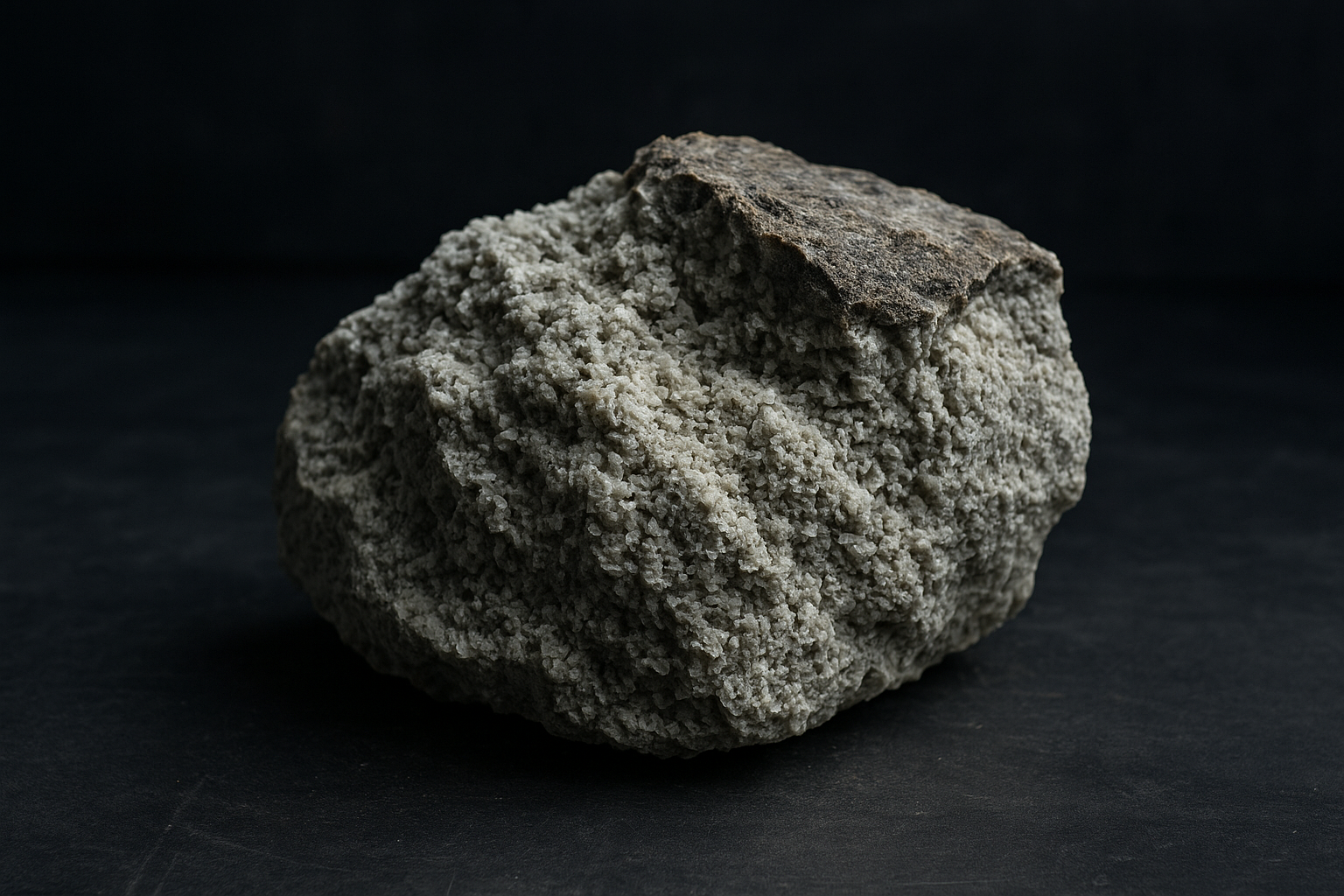
Natural clinoptilolite has a negatively charged microporous structure within its framework (pore diameter 4.0–7.0 Å, narrow channels 3.5–3.9 Å) and a cation-exchange capacity (CEC 1.6–2.0 meq/g). Based on the ideal formula Na₆Al₆Si₃₀O₇₂·24H₂O, the theoretical CEC is about 2.2 meq/g, but in real natural minerals Ca²⁺·Mg²⁺·Sr²⁺ are already occupying the framework, so the effective CEC is lower than this (Dyer et al., 2018). The core reason these properties matter in disaster response is the selective ion exchange of cationic radionuclides. The size of the hydrated Cs⁺ ion matches the 3.5–3.9 Å channels of clinoptilolite, so it is held more strongly than other monovalent ions, and once exchanged it is trapped within the framework, suppressing re-leaching.
The selectivity order, on an ion-exchange isotherm basis, is reported as Cs⁺ > K⁺ > Sr²⁺ = Ba²⁺ > Ca²⁺ ≫ Na⁺ > Li⁺ (Dyer et al., 2018). That is, it exchanges Cs⁺·Sr²⁺ preferentially over the Na⁺ present in large amounts in seawater and highly alkaline effluent. The Sellafield SIXEP operating data show that even under conditions where 7.5×10⁵ mol of Na⁺, 6.5×10³ mol of Mg²⁺, and 5×10³ mol of Ca²⁺ coexist, 1 mol of Sr²⁺ and 20 mol of Cs⁺ can be selectively extracted, providing a basis for application to high-salinity emergency leakage water. However, as competing cations increase (Ca²⁺·Mg²⁺·K⁺), breakthrough occurs earlier, so quantification of coexisting ions must come first.
According to the review by Jimenez-Reyes et al. (2021, Journal of Environmental Radioactivity) on radioactive effluent treatment, clinoptilolite maintains high selectivity for Cs⁺ and Sr²⁺ even when other cations coexist, and has been used as one of the standard sorption materials in nuclear-accident effluent treatment (DOI: 10.1016/j.jenvrad.2021.106610). Faghihian et al. (1999, Applied Radiation and Isotopes) reported that natural clinoptilolite also removes Pb²⁺·Ni²⁺·Cd²⁺·Ba²⁺ along with radioactive Cs·Sr (DOI: 10.1016/S0969-8043(98)00134-1).
The situation is different for oil and non-polar contaminants. The clinoptilolite surface is hydrophilic, so in the unmodified state its capacity to absorb crude or light oil is limited. Anagnostopoulos et al. (2019, Natural Resources), dealing with marine crude oil, demonstrated the feasibility of sorption and recovery by natural clinoptilolite (DOI: 10.4236/nr.2019.1010020), and Fidan et al. (2022, Journal of Applied Polymer Science) showed that it must be processed into a silicone composite foam filled with clinoptilolite to secure oil sorption and buoyancy (DOI: 10.1002/app.52637). In other words, oil applications can be considered only on the premise of hydrophobic surface modification or compositing onto a porous carrier, and this product (an unmodified mineral) is not guaranteed for use as an oil sorbent as-is.
KMIZEOLITE's natural clinoptilolite has a purity of 97%, mined and processed at the Amargosa Valley mine in Nevada, USA, with a specific surface area of 40.0 m²/g, a pH stability range of 3.0–10.0, thermal stability of 700°C, and a hardness of 4.0–5.0 Mohs, so the framework does not collapse even in acidic leachate or high-temperature environments, meeting emergency-response conditions. Being an aluminosilicate, it is compatible with cement/geopolymer encapsulation (solidification) after sorption, making final-disposal route design easier.
KMIZEOLITE Key Properties
| Item | Value |
|---|---|
| Clinoptilolite purity | 97% |
| Cation-exchange capacity (CEC) | 1.6–2.0 meq/g |
| Specific surface area | 40.0 m²/g |
| Pore diameter | 4.0–7.0 Å |
| pH stability range | 3.0–10.0 |
| Hardness | 4.0–5.0 Mohs |
| Thermal stability | 700°C |
| Specific gravity | 1.89 |
| Bulk density | 45–54 lbs/ft³ |
| Certifications | OMRI KMI-10365, FDA GRAS, TSCA, EN-71-3 |
Application Examples of Zeolite for Disaster-Response Sorbents
Below are representative emergency-response scenarios in which zeolite is considered, by disaster type. Each scenario calls for a different particle size, dosing method, and operating condition.
- Column treatment of radioactive leakage water: Cs·Sr-bearing effluent is passed through a fixed-bed column packed with 8×14 to 14×40 mesh granular zeolite to exchange and fix the radionuclides. The Sellafield SIXEP operating reference reported by Dyer et al. (2018) is about 8 min contact time and a surface linear velocity of about 22 m³/m²·h (≈20 BV/hr), with columns operated in a two-stage lead–lag series so that when the lead bed saturates it is replaced and the lag bed is promoted to lead (DOI: 10.1007/s10967-018-6329-8). Managing the empty-bed contact time (EBCT) and the breakthrough point is key.
- Spreading type for contaminated soil and offshore crude oil (modification prerequisite): Powder to Fine Granule is spread over oil slicks or contaminated soil to absorb hydrocarbons and aggregate them into recoverable lumps. However, the unmodified mineral is hydrophilic and absorbs oil poorly, so, as in Fidan et al. (2022), it must be processed into a silicone composite foam or similar to secure hydrophobicity and buoyancy for it to be effective.
- Emergency cutoff / containment layer: A granular-zeolite cutoff layer is laid along the leachate pathway as primary protection that retards downstream spreading of cations such as heavy metals and ammonium. Its effect on anions and non-polar contaminants is limited.
- Pre-treatment for solidification of decontamination waste: Saturated zeolite after sorption is encapsulated in cement/geopolymer for final disposal — leveraging the fact that the aluminosilicate framework is compatible with encapsulation and the ion-exchanged radionuclides are trapped within the framework, suppressing leaching.
- Test/pilot application: Pre-confirm the adsorption isotherm and breakthrough curve with a small amount of actual effluent/contaminated soil, and quantify the effective-CEC loss by coexisting ions and pH.
Recommended Particle Size and Product Specifications
Particle-size selection diverges with the disaster type. For spreading over contaminated soil and absorbing crude oil, Powder to Fine Granule with high specific surface area is considered; for column treatment of Cs·Sr effluent, Coarse to Medium Granule (8×14 to 14×40 mesh) with low pressure loss and good permeability is considered. Refer to the table below to select the product group suited to your application.
| Product group | Mesh | Particle size | Typical use |
|---|---|---|---|
| Powder | 100 mesh or finer | <150μm | Pozzolan, feed, powder sorption |
| Fine Granule | 30×50 mesh | 0.3–0.6mm | Water treatment, filtration, soil |
| Medium Granule | 14×40 mesh | 0.4–1.4mm | Filter beds, bedding, litter |
| Coarse Granule | 8×14 mesh | 1.4–2.4mm | Pools, deicing, large filtration |
| Extra Coarse | 4×8 mesh | 2.4–4.8mm | Packed beds, air scrubbers |
→ View products by mesh size · Product selection guide by application
Pilot Testing and On-Site Review Points
When applying zeolite to disaster response, unlike ordinary water treatment, the time constraints, exposure/contamination risk, and waste classification are the key variables. The following items must always be checked together.
- Identify the target radionuclide/contaminant: Determine the type and activity of radionuclides such as Cs-137·Sr-90, or the spilled oil type (crude/light oil) and concentration. Coexisting ions (Na⁺·Ca²⁺·seawater salinity) cause ion-exchange competition, so measure them together.
- Design the operating conditions: For column treatment, predetermine the empty-bed contact time (EBCT), flow linear velocity, and breakthrough point through batch and column testing. Use the SIXEP operation (~8 min contact, ~20 BV/hr) as a reference and calibrate to the on-site effluent composition. Clinoptilolite suffers framework damage under high alkalinity (pH 11 or above), so SIXEP lowers the pH to ~7 with a carbonation tower before passing it through the column. It is stable under acidic leaching (pH 3 or above), but applications below pH 3 should be reconsidered.
- Recovery/solidification plan: Pre-design the recovery method for the saturated zeolite after sorption and the cement/geopolymer encapsulation (solidification) procedure.
- Estimate the required amount: Estimate the initial required amount from CEC 1.6–2.0 meq/g (the effective CEC is even lower due to coexisting-ion occupancy) and the target contamination load, and determine the emergency stockpile with a safety margin.
- Waste classification/regulations: After sorbing radionuclides, the zeolite may be classified as radioactive waste, so confirm the disposal route in accordance with IAEA and domestic nuclear-safety regulations.
- Field-specific notes: In the radioactive-waste field, high selectivity for Cs⁺·Sr²⁺ is widely reported, and there are cases of use in nuclear-accident response such as Fukushima. However, this product is an unmodified natural mineral, so oil sorption and offshore application require separate hydrophobic modification. All disaster applications must be preceded by professional engineering and radiation-safety review.
→ View the TDS (Technical Data Sheet) · View the MSDS (Material Safety Data Sheet)
Disaster-Response FAQ
Can zeolite remove cesium and strontium from radioactive leakage water?
Thanks to channels of 3.5–3.9 Å that closely match the size of the hydrated Cs⁺ ion, natural clinoptilolite fixes Cs⁺·Sr²⁺ by ion exchange selectively over other cations (order Cs>K>Sr=Ba>Ca≫Na), and once exchanged the ions are trapped within the framework so re-leaching is suppressed. Dyer et al. (2018) reported that the Sellafield SIXEP columns have removed ¹³⁴/¹³⁷Cs and ⁹⁰Sr for 30 years under conditions of about 8 min contact time and about 20 BV/hr, and that Cs and Sr are selectively extracted even when Na⁺ coexists at 7.5×10⁵ times the concentration. Jimenez-Reyes et al. (2021) likewise reported that selectivity is maintained in the presence of coexisting ions, so it has been used as a standard material for nuclear-accident effluent. However, as competing ions such as Ca²⁺·Mg²⁺·K⁺ increase, breakthrough occurs earlier, so batch and column testing and a radiation-safety review must come first.
Can it also be used to sorb spilled oil (crude oil)?
Because the surface of natural zeolite is hydrophilic, its oil-absorption capacity is limited in the unmodified state. Anagnostopoulos et al. (2019) demonstrated the feasibility of marine crude-oil sorption and recovery, and Fidan et al. (2022) reported the oil-sorption performance of silicone composite foams filled with clinoptilolite. In other words, with hydrophobic modification or compositing onto a porous carrier it can be considered as an oil sorbent, but this product is an unmodified mineral, so that application requires separate processing design.
Which particle size (mesh) should be used for each disaster type?
For spreading over contaminated soil and absorbing crude oil, Powder to Fine Granule (30×50 to 100 mesh) with high specific surface area is generally considered; for column treatment of Cs·Sr effluent, Medium to Coarse Granule (8×14 to 14×40 mesh) with low pressure loss and good permeability is generally considered. Please refer to the product selection guide by application.
How much should be stockpiled and dosed for emergency response?
The required amount depends on the target contamination load, the ion-exchange capacity based on CEC (1.6–2.0 meq/g), and the contact method (column/spreading). It is advisable to obtain the adsorption isotherm through batch testing and then size the emergency stockpile with a safety margin. Determine the exact design quantity through on-site testing.
Do you have certification documents?
KMIZEOLITE holds numerous certifications, including OMRI Listed (KMI-10365), FDA GRAS (21 CFR 182.2729), TSCA compliance, and EN-71-3 PASS. Please check the certifications page.
Inquiries and Sample Requests
If you are considering applying zeolite in the disaster-response sorbent field, please contact us through the channels below.
Notice
Applicability may vary depending on site conditions, regulations, and test results. Before actual application, a test review tailored to the site conditions must always be conducted first. Zeolite should be understood not as a universal solution in this field, but as a material that supplements existing processes.
Related Pages
science Related Research Papers
These are academic papers addressing zeolite application in this field. Please refer to them when evaluating adoption.
- Radioactive waste treatments by using zeolites. A short review
Jimenez-Reyes, M. et al. — Journal of Environmental Radioactivity, 2021 - Use of columns of zeolite clinoptilolite in remediation of aqueous nuclear waste
Dyer, A. et al. — Journal of Radioanalytical and Nuclear Chemistry, 2018 - The Potential Use of Natural Clinoptilolite Zeolite for Crude Oil Spill Removal from Sea Water
Anagnostopoulos, V.A. et al. — Natural Resources, 2019 - Oil spill remediation: sorption capacity of silicone composite foams filled with clinoptilolite
Fidan, T. et al. — Journal of Applied Polymer Science, 2022 - Use of clinoptilolite for removal of radioactive cesium, strontium and Pb2+, Ni2+, Cd2+, Ba2+
Faghihian, H. et al. — Applied Radiation and Isotopes, 1999
The papers above are reference material; actual application requires a separate review tailored to site conditions.