Zeolite for Onsite Chemical Spill Absorption
Untreated natural clinoptilolite has a hydrophilic framework, so for non-polar oils hydrophobic modification with surfactants or silanes is a prerequisite; it is not a standalone absorbent but a primary broadcast and solidification aid and a post-recovery filtration medium. Conversely, for dissolved heavy metals in pH 3-10 acid and alkaline waste, its CEC 1.6-2.0 meq/g cation exchange works directly as a strength.
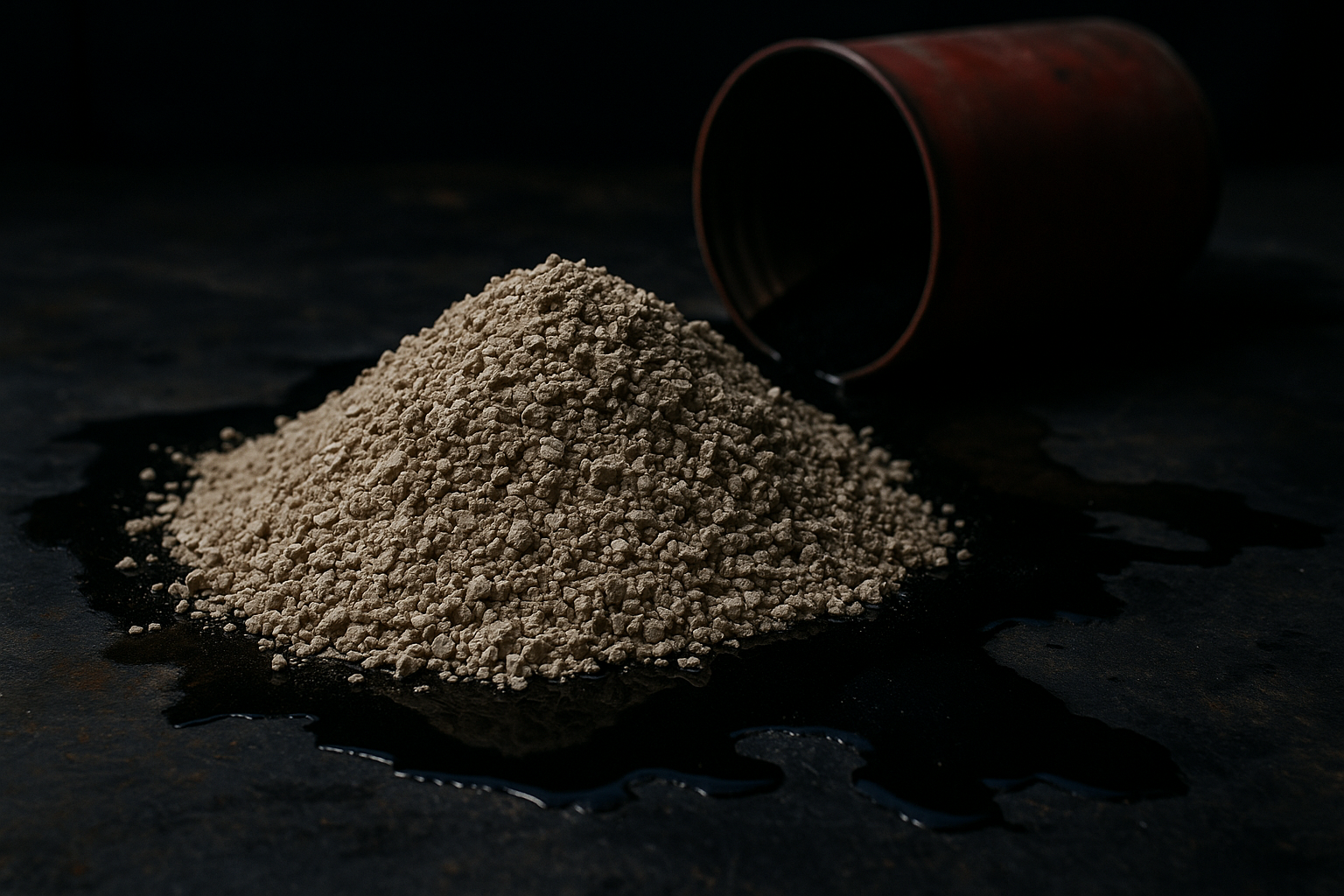
What Actually Happens at a Chemical Spill Site
The moment a chemical flows out onto a road surface or into the soil, as in a tanker truck rollover, drum rupture, pipeline leak, or in-plant piping burst, the core of the primary response is containment and solidification (removal of fluidity). Before the spill reaches a storm drain (catch basin) or a waterway, within a matter of minutes you must spread absorbent to solidify the liquid and prevent further spread. The conditions a field responder weighs when choosing an absorbent are simple: whether it is in a granular or powder form that can be applied immediately, whether it quickly soaks up oil-based substances such as diesel, gasoline, and solvents, whether its framework holds up under low- or high-pH acid and alkaline spills, and finally how it will be handled as designated waste at the end.
The tricky part of this site is that the spill is not a single substance. A diesel spill carries non-polar hydrocarbons (including volatile organics such as BTEX), and an acidic-waste spill carries dissolved heavy metals (Pb²⁺, Cd²⁺, Cu²⁺). Conventional nonwoven pads or sawdust may catch oil but barely capture volatile vapors (VOCs) or ionic contaminants, and they have the limitation of releasing the spill again when wrung out after absorption. It is at this point that a porous mineral absorbent is considered as a supplementary option.
Why Clinoptilolite Is Considered for Spill Absorption
Natural clinoptilolite carries two different mechanisms together within one mineral, which makes it well suited in certain respects to mixed-spill response. The first is physical absorption and porous adsorption. A specific surface area of 40.0 m²/g and a pore volume reaching 50% draw in non-polar liquids such as oils and solvents by capillary force, quickly reducing fluidity on the road surface. The second is cation exchange (CEC 1.6-2.0 meq/g), which swaps heavy-metal cations dissolved into the acidic waste with the framework's exchangeable cations (Na⁺, K⁺, Ca²⁺), fixing them from the liquid phase into the solid phase.
In particular, the molecular-sieve structure with pore diameters of 4.0-7.0 Å is advantageous for trapping small volatile organic molecules such as BTEX and kerosene-type compounds inside the framework. In addition, with a wide pH stability range of 3.0-10.0, the adsorption framework is maintained even in acid and alkaline environments where nonwovens deform or sawdust decomposes. KMIZEOLITE's natural clinoptilolite has 97% purity (mined at the Amargosa Valley mine in Nevada, USA), a hardness of 4.0-5.0 Mohs, and thermal stability to 700°C, so it tends to generate little dust and crush little under compression when broadcast.
However, these two mechanisms demand exactly opposite surface chemistries. Non-polar, hydrophobic contaminants such as oil and VOCs have low affinity for the hydrophilic silanol surface of untreated clinoptilolite, so the external surface must be covered with a quaternary ammonium surfactant such as hexadecyltrimethylammonium (HDTMA) or with a silane to be modified to be hydrophobic and oleophilic for absorption capacity to rise meaningfully. By contrast, the dissolved heavy-metal cations (Pb²⁺, Cd²⁺, Cu²⁺, Zn²⁺) of acid and alkaline waste actually benefit from the hydrophilic surface and negatively charged framework, so cation exchange works even in the untreated state. In other words, even for the same mineral, the "modified material for oil" and the "untreated material for heavy metals" must in practice be operated as different products, and this distinction is the starting point for field stockpiling and ordering.
Spill Absorption Performance Confirmed by Research
Spill absorption is a relatively actively studied topic even within the natural zeolite field. Anagnostopoulos et al. (2019, Natural Resources) quantitatively reported the adsorption behavior when applying natural clinoptilolite to remove crude oil spills from seawater (DOI: 10.4236/nr.2019.1010020). Szala et al. (2015, Fuel Processing Technology) showed that organically modified zeolite greatly raises the adsorption capacity of petroleum-based compounds compared with untreated zeolite (DOI: 10.1016/j.fuproc.2016.04.015). This means that because the natural clinoptilolite surface is hydrophilic, surfactant or silane modification is effective for increasing oil affinity, while the hydrophilic surface itself works favorably for the absorption of acid and alkaline water-soluble spills.
Fidan et al. (2022, Journal of Applied Polymer Science) evaluated the oil-absorption capacity of an absorbent that fills silicone composite foam with clinoptilolite and reported that mineral filling improves the foam's recoverability, reusability, and absorption capacity (DOI: 10.1002/app.52637). On the volatile-organics side, Asgharzadeh et al. (2025, MethodsX) presented a method for adsorbing kerosene-derived VOCs using clinoptilolite modified with a cationic surfactant (DOI: 10.1016/j.mex.2025.103200). These studies all support that natural zeolite can supplementarily adsorb oil, VOCs, and ionic contamination, and at the same time give the common implication that for oil targets surface modification governs performance.
Reading these references together yields two principles that apply directly to field operation. First, for oil and VOC targets, surface modification is the governing variable of performance. Szala (2015) and Asgharzadeh (2025) show a consistent direction in which organically modified zeolite, whose external surface has been made oleophilic with a surfactant, markedly raises the adsorption capacity of petroleum-based and volatile organics over untreated material, making it clear that you must not design standalone oil response with untreated natural material alone. Second, for ionic contamination, the cation exchange of untreated material is the primary mechanism. Apart from the marine crude-oil and composite-foam cases addressed by Anagnostopoulos (2019) and Fidan (2022), the dissolved heavy metals of acidic waste are fixed within clinoptilolite's CEC range (1.6-2.0 meq/g) by exchange with Na⁺/K⁺/Ca²⁺, so it works without modification. Because the quantitative values vary greatly with the nature, concentration, temperature, and contact time of the spill, the figures in this text must always be field-calibrated with a batch absorption test on the target material.
KMIZEOLITE Key Properties
| Property | Value |
|---|---|
| Clinoptilolite purity | 97% |
| Cation exchange capacity (CEC) | 1.6–2.0 meq/g |
| Specific surface area | 40.0 m²/g |
| Pore diameter | 4.0–7.0 Å |
| pH stability range | 3.0–10.0 |
| Hardness | 4.0–5.0 Mohs |
| Thermal stability | 700°C |
| Specific gravity | 1.89 |
| Bulk density | 45–54 lbs/ft³ |
| Certifications | OMRI KMI-10365, FDA GRAS, TSCA, EN-71-3 |
Application Examples for Onsite Chemical Spill Absorption
In spill absorption, zeolite is reviewed not as a standalone solution but as a primary broadcast material, a solidification aid, and a post-treatment filtration medium. The application method varies with the type of spill.
- Direct broadcast on the road surface (solidification): Broadcast granular zeolite over a diesel or solvent spill on the road surface to solidify the fluid liquid by capillary absorption and block its spread. Used in parallel with porous foam and nonwoven pads
- Absorption of acid and alkaline waste: Add powder to fine-grained zeolite to acidic or alkaline leakage in the pH 3-10 range for liquid fixation and capture of dissolved heavy-metal cations by exchange
- Catch basin / drain barrier: A granular-zeolite berm in front of a catch basin to initially delay contaminated water from flowing into the storm drain or waterway
- Post-treatment filtration layer: Pass recovered contaminated water through a column or filtration tank to adsorb residual ammonium, heavy metals, and VOCs (filled with Fine to Coarse Granule)
- Pilot absorption-capacity test: First run a small-scale batch test with the target spill to confirm the absorption capacity per gram and the saturation point, then calculate the stockpile quantity
Recommended Particle Size and Dosing Conditions
Spill absorption has a clear purpose. For rapid broadcast and solidification, fast-absorbing powder (100 mesh) to fine grain (30×50 mesh) is considered, while for catch-basin berms and post-treatment filtration layers, medium to coarse grain (8×14 to 14×40 mesh) that secures permeability is considered. For primary broadcast on a road surface, apply enough to fully cover the spill area (until the visible liquid sheen disappears), and recover the saturated absorbent and dispose of it according to designated-waste procedures. Refer to the table below to select the product line suited to your purpose.
| Product Line | Mesh | Particle Size | Typical Use |
|---|---|---|---|
| Powder | 100 mesh or finer | <150μm | Pozzolan, feed, powder adsorption |
| Fine Granule | 30×50 mesh | 0.3–0.6mm | Water treatment, filtration, soil |
| Medium Granule | 14×40 mesh | 0.4–1.4mm | Filtration layer, bedding, litter |
| Coarse Granule | 8×14 mesh | 1.4–2.4mm | Swimming pools, deicing, large-scale filtration |
| Extra Coarse | 4×8 mesh | 2.4–4.8mm | Packed beds, air scrubbers |
→ View products by mesh size · Product selection guide by use
Pilot Test and Field Review Points
When applying zeolite in the chemical spill field, be sure to verify the following items together.
- Understand site conditions: Confirm the type and concentration of the contaminant and the legal management standards
- Design criteria: Review in advance the regulations and permitting requirements of the application site
- Operating conditions: First run a small-scale laboratory batch test
- Maintenance: Estimate the project scale and required quantity
- Regulatory check: Determine the waste classification and disposal method for the spent zeolite
- Field-specific notes: For oil targets, whether the surface is modified (hydrophobic) governs adsorption performance, so review on the premise of the limits of untreated natural material; for acid and alkaline spills, consider applying after neutralization if outside the pH 3-10 stability range. A batch absorption test with the target spill must precede broadcasting.
→ Check the TDS (Technical Data Sheet) · Check the MSDS (Safety Data Sheet)
Chemical Spill Absorption FAQ
Is natural zeolite alone sufficient for an oil spill?
The surface of natural clinoptilolite is hydrophilic, so its affinity for non-polar oils is lower than that of nonwoven or polypropylene pads. As shown by studies from Szala et al. (2015) and Asgharzadeh et al. (2025), for oil and VOC targets, modifying the surface to be hydrophobic with surfactants or silanes greatly improves adsorption capacity. Therefore, untreated natural zeolite is more accurately viewed as a solidification and containment aid or a post-treatment filtration medium rather than a standalone absorbent for oil spills. Conversely, for ionic and water-soluble contamination such as dissolved heavy metals in acidic waste, the hydrophilic surface and cation exchange (CEC 1.6-2.0 meq/g) remain a direct strength.
Does the framework withstand acid and alkaline spills?
Clinoptilolite has a pH stability range of 3.0-10.0, so its crystal framework is maintained in acidic and alkaline leakage within this range. However, in strong acids below pH 3 (e.g., concentrated sulfuric or hydrochloric acid) or strong alkalis, dealumination and dissolution of the aluminosilicate framework can occur. Therefore, for strong-acid or strong-alkali spills, separate neutralization and dedicated absorbents take priority, and it is safer to consider zeolite at the residue-treatment stage after neutralization.
How is saturated absorbent disposed of?
Zeolite that has absorbed and fixed a spill is classified according to the nature of the adsorbed contaminant. If it has absorbed oil or organic solvents, it may be classified as flammable or combustible designated waste; if it has exchanged and captured heavy metals, it may be classified as heavy-metal-containing waste. Because adsorption does not destroy the contaminant but fixes it in the solid phase, after recovery it must be classified and consigned for treatment in accordance with waste-related regulations. We recommend calculating stockpile quantities that also account for disposal costs.
How is the absorption capacity for field deployment estimated?
Because the absorption capacity per gram varies greatly with the type, viscosity, and temperature of the spill, first perform a small-scale batch absorption test with the actual target material to measure the saturation absorption capacity, then multiply by a safety factor against the expected spill volume to set the stockpile quantity. KMIZEOLITE provides application-review samples (100 mesh to 8×14 mesh, 1 kg / 22 kg), so please leave the spill type and desired particle size on the sample request page.
Is certification documentation available?
KMIZEOLITE holds numerous certifications, including OMRI Listed (KMI-10365), FDA GRAS (21 CFR 182.2729), TSCA compliance, and EN-71-3 PASS. Please check the certifications page.
Inquiries and Sample Requests
If you are considering applying zeolite in the field of onsite chemical spill absorption, please reach out through the channels below.
Notice
Whether the material can be applied may vary depending on site conditions, regulations, and test results. Before actual application, a test review suited to the site conditions must always be conducted first. Zeolite should be understood not as a cure-all for the field but as a material that supplements existing processes.
Related Pages
science Related Research Papers
These are academic papers addressing zeolite application in this field. Please refer to them when reviewing adoption.
- Oil spill remediation: sorption capacity of silicone composite foams filled with clinoptilolite
Fidan, T. et al. — Journal of Applied Polymer Science, 2022 - Zeolites in Adsorption Processes: State of the Art and Future Prospects
Various — Chemical Reviews, 2022 - Adsorption of heavy metals on natural zeolites: A review
Kubra, K.T. et al. — Chemosphere, 2023 - Organically modified zeolites in petroleum compounds spill cleanup
Szala, B. et al. — Fuel Processing Technology, 2015 - The Potential Use of Natural Clinoptilolite Zeolite for Crude Oil Spill Removal from Sea Water
Anagnostopoulos, V.A. et al. — Natural Resources, 2019
The papers above are reference material, and actual application requires separate review suited to site conditions.