Spill Response Zeolite
Unmodified natural clinoptilolite has a hydrophilic surface that draws in oil and water together, so to selectively absorb only the oil fraction, an organozeolite hydrophobically modified with HDTMA, CTAB, PEG, and the like is a prerequisite. This page quantifies operating parameters such as floor dosing (1–3 kg/m²), contact time, and recovery/disposal, along with oil-sorption research evidence, addressing how to position zeolite as a first-response supplementary material that is easy to contain and recover.
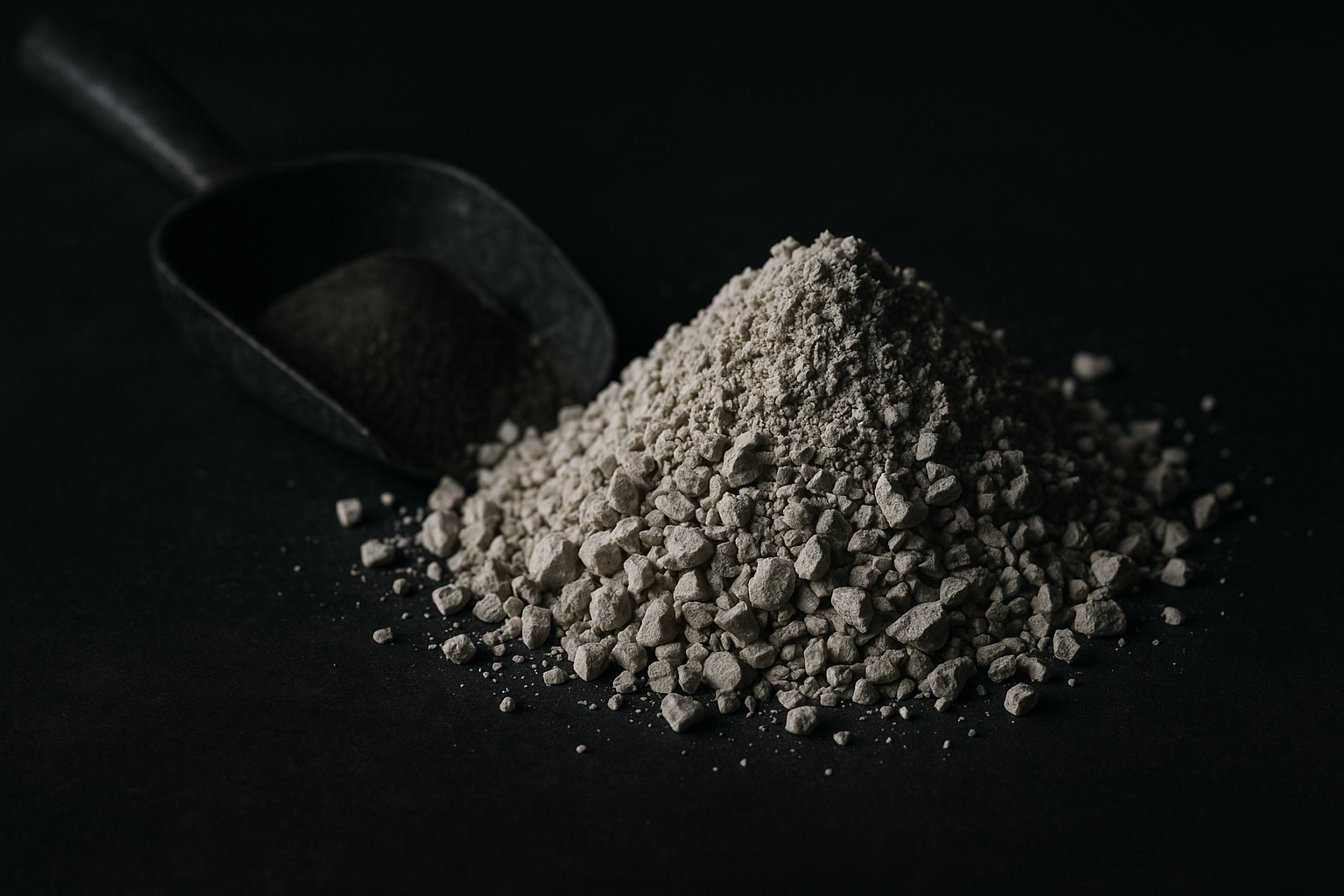
What is the challenge at an oil spill site?
Lubricating oil, diesel, cutting oil, and crude oil leaks at gas stations, refineries, logistics warehouses, and factory floors lead directly to worker slip accidents, soil and groundwater infiltration, fire risk, and environmental-law violations. When an incident occurs, the first requirements are containment to stop the fluid from spreading and absorption of the residual oil, and the speed of these two stages determines the scale of the damage. If spreading is not stopped within the first 5–15 minutes, the area and penetration depth that must be absorbed grow nonlinearly, so in practice it matters more whether the sorbent can be "spread immediately and recovered immediately" than its "maximum oil capacity."
Field sorbents are evaluated on four criteria: (1) oil-sorption capacity relative to their own weight (g/g), (2) hydrophobicity and oil/water selectivity that distinguishes water from oil, (3) ease of recovery after spreading, and (4) ignition and leaching stability at disposal. For aquatic (marine/river) spills, an additional criterion is buoyancy—the sorbent staying afloat while holding oil rather than sinking. Natural zeolite has a lower oil-sorption capacity itself than nonwoven or polypropylene sorbent pads, but its evaluation axis differs in that, being inorganic, it does not ignite and is simple to spread and recover.
Why is natural clinoptilolite considered as a sorbent?
Natural clinoptilolite is a porous aluminosilicate with micropores of 4.0–7.0 Å and a specific surface area of about 40.0 m²/g, and oil capture occurs through two pathways. The first is physical retention, in which oil is trapped by capillary forces on the external particle surface and in inter-particle voids (macro/meso); the second is weak adsorption at the 4–7 Å micropore openings. However, since diesel and crude oil molecules (carbon number C12 and above, kinetic diameter generally exceeding 7 Å) can barely enter the micropores, most of the actual oil capacity is determined by the external surface and inter-particle voids. For this reason, even for the same mineral, how the particle size, pore structure, and surface chemistry are processed governs performance.
Being an inorganic mineral, it does not ignite or biodegrade and retains its structure up to 700°C, making it relatively safe around flammable fluids. There is, however, a decisive limitation. The clinoptilolite framework is negatively charged and has a hydrophilic surface due to Al substitution, so in the unmodified state it absorbs both water and oil and, at sites where water is present, takes up water in preference to oil. Therefore, to selectively absorb only the oil, modification that makes the surface hydrophobic is effectively a prerequisite. Cationic surfactants (HDTMA, CTAB) bind electrostatically to the negatively charged surface to create an external alkyl hydrophobic layer, and PEG (polyethylene glycol) mechanochemical modification covers the surface hydrophilic groups to raise oil affinity (Dabizha 2025). The modified zeolite is commonly called an organozeolite.
KMIZEOLITE's natural clinoptilolite, with 97% purity, specific gravity 1.89, and a stable pH range of 3.0–10.0, is mined and processed at the Amargosa Valley mine in Nevada, USA, and its framework remains stable even in acidic or alkaline effluents. The practical distinction is to use the raw, unmodified granular form for berm formation, slip prevention, and dry sweep of solid-surface leaks, and the hydrophobically modified material for surface oil films and sites where water coexists.
Oil-sorption performance and modification effects confirmed by research
Several studies consistently show that "modification determines performance." Szala et al. (2015, Fuel Processing Technology) confirmed that zeolite subjected to organic modification (HDTMA and the like) greatly increases the adsorption of petroleum compounds such as diesel and BTEX compared with unmodified material (DOI: 10.1016/j.fuproc.2016.04.015). Anagnostopoulos et al. (2019, Natural Resources) reported that natural clinoptilolite can be used for crude oil spill removal from sea water and showed that the smaller the particle size (increasing surface area), the higher the removal efficiency for a given contact time (DOI: 10.4236/nr.2019.1010020).
Compositing the mineral into a matrix, rather than spreading it alone, also boosts performance. Fidan et al. (2022, Journal of Applied Polymer Science) reported that silicone composite foam filled with clinoptilolite improves oil-sorption capacity and reusability (DOI: 10.1002/app.52637), demonstrating application potential beyond spreadable forms into sorbent pad and boom materials. Dabizha (2025, Nanosystems: Physics, Chemistry, Mathematics) presented a route for manufacturing an oil sorbent from clinoptilolite mechanochemically modified with PEG (DOI: 10.17586/2220-8054-2025-16-5-640-649), reinforcing polymer modification options beyond surfactants. Meanwhile, Asgharzadeh et al. (2025, MethodsX) showed that clinoptilolite modified with a cationic surfactant adsorbs kerosene-derived VOCs (DOI: 10.1016/j.mex.2025.103200), suggesting that the same modification principle applies even to managing volatile vapors at spill sites. The common conclusion of these studies is clear: natural zeolite is not a stand-alone, do-it-all sorbent, but a supplementary material that gains oil selectivity only through hydrophobic modification and compositing.
KMIZEOLITE key properties
| Item | Value |
|---|---|
| Clinoptilolite purity | 97% |
| Cation exchange capacity (CEC) | 1.6–2.0 meq/g |
| Specific surface area | 40.0 m²/g |
| Pore diameter | 4.0–7.0 Å |
| pH stability range | 3.0–10.0 |
| Hardness | 4.0–5.0 Mohs |
| Thermal stability | 700°C |
| Specific gravity | 1.89 |
| Bulk density | 45–54 lbs/ft³ |
| Certifications | OMRI KMI-10365, FDA GRAS (21 CFR 182.2729), TSCA, EN-71-3 |
FDA GRAS notation note: For general (non-food) industrial uses, 21 CFR 182.2729 applies, while for ingestion uses mixed directly into animal feed, 21 CFR 582.2729 applies separately. An oil spill sorbent is a non-food use, so it should be understood under the 182.2729 standard.
Oil spill response application examples and operating conditions
Below are representative scenarios in which natural clinoptilolite sorbent is considered at oil spill sites, along with quantitative operating conditions. Dosing and contact time vary with the oil type's viscosity and leak thickness, so they are calibrated through field testing.
- Floor dry sweep: Apply unmodified granular zeolite directly to lubricating-oil or diesel leaks on factory or gas-station floors to prevent slipping and absorb the oil. Apply 1–3 kg of granular form per 1 m² of leak area, leave for 5–15 minutes of contact, then recover with a broom or vacuum. Since it is a dry floor with no water, unmodified material is fine.
- Containment berm assist: Build a berm of granular zeolite around drains and manholes to primarily contain oil spread, then recover. An 8×14–14×40 mesh that scatters little is suitable.
- Sorbent pad/boom filler: Fill pads and booms with hydrophobically modified powder/fines to selectively absorb floating surface oil (see Fidan et al. 2022 composite foam, Dabizha 2025 PEG modification). Since water coexists, unmodified material is unsuitable.
- Surface oil film treatment: For marine/river oil films, modified powder with small particle size and large surface area has high removal efficiency (Anagnostopoulos et al. 2019). Used in conjunction with recovery vessels and skimmers.
- Volatile vapor (VOC) management: For kerosene or light-oil leaks, cationic-surfactant-modified material can be used for volatile-vapor adsorption (Asgharzadeh et al. 2025).
- Kit-type emergency response (spill kit): Keep a powder/granular mixed zeolite in vehicles and workplaces for use in first response.
- Test/pilot application: With small samples under the target oil type (crude oil, diesel, cutting oil) and temperature conditions, verify oil-sorption capacity (g/g), oil selectivity in the presence of water, and recovery rate in advance.
Recommended particle size and product specifications
In oil spill response, a granular form (Coarse–Medium Granule) that is easy to recover and scatters little is considered for floor spreading and berm formation, while a powder form (Powder, 100 mesh) with large surface area is considered for sorbent pad filling or fine oil film treatment. For aquatic spills requiring hydrophobic modification, fines and powder that are easy to modify are advantageous. Refer to the table below to select the product group that suits your application.
| Product group | Mesh | Particle size | Typical use |
|---|---|---|---|
| Powder | 100 mesh and finer | <150μm | Pozzolan, feed, powder adsorption |
| Fine Granule | 30×50 mesh | 0.3–0.6mm | Water treatment, filtration, soil |
| Medium Granule | 14×40 mesh | 0.4–1.4mm | Filter media, bedding, flooring |
| Coarse Granule | 8×14 mesh | 1.4–2.4mm | Swimming pools, de-icing, large filtration |
| Extra Coarse | 4×8 mesh | 2.4–4.8mm | Packed beds, air scrubbers |
→ View products by mesh size · Product selection guide by application
Pilot testing and on-site review points
When applying a zeolite sorbent to oil spill response, the following items must always be checked together. The key is to confirm "whether water coexists → need for modification" and the "recovery/disposal route" before adoption.
- Whether water coexists (first of all): In an aquatic/wet environment where water and oil coexist, unmodified natural zeolite has a negatively charged, hydrophilic surface and preferentially absorbs water, so its oil selectivity is poor. In that case, HDTMA/CTAB/PEG hydrophobic modification (organozeolite) is a prerequisite (Szala et al. 2015, Dabizha 2025). For dry floor leaks, unmodified material is sufficient.
- Check oil type and temperature: Since the oil-sorption rate and capacity vary with the viscosity of the target fluid (crude oil, diesel, lubricating oil, cutting oil) and the on-site temperature, measure them in advance. High-viscosity heavy oils require longer contact times.
- Particle size selection: Powder and fines with large surface area are favorable for oil-sorption capacity and reaction rate per unit weight, but scattering and recovery become harder (see the particle-size-efficiency relationship in Anagnostopoulos et al. 2019). Granular form is reasonable for dry spreading and berms, and modified fines/powder for surface oil films.
- Dosage and contact time: Set the dosing (e.g., 1–3 kg per 1 m²) and contact time (5–15 minutes) based on leak area and thickness, and test the absorption rate and recovery rate.
- Recovery and disposal: Since used zeolite holding oil is classified as waste-oil-containing waste, confirm the recovery method and incineration/designated-landfill regulations. For composite foam/pad forms (Fidan et al. 2022), also evaluate the possibility of reuse after squeezing.
- Safety and regulations: Check static-electricity and ignition risks around flammable fluids and worker protective-equipment (MSDS) standards. For sulfur-containing oil, the desulfurization adsorption of clinoptilolite (Özkan et al. 2022) is reported as an added effect, but since this is a process separate from spill absorption, it requires separate verification.
→ View TDS (Technical Data Sheet) · View MSDS (Material Safety Data Sheet)
Oil spill response FAQ
Can natural zeolite absorb an oil spill?
Yes, but conditionally. It physically captures oil through 4.0–7.0 Å micropores and inter-particle voids, but because the surface is negatively charged and hydrophilic, in the unmodified state it absorbs both water and oil and will preferentially take up water where water is present. So for dry floor leaks with no water, unmodified granular material is sufficient, but at aquatic or wet sites where water and oil coexist, an organozeolite hydrophobically modified with HDTMA/CTAB/PEG is a prerequisite. Szala et al. (2015) reported that organically modified zeolite greatly increases the adsorption of petroleum compounds compared with unmodified material.
Does it selectively absorb only the oil at sites where water and oil are both present?
With unmodified material this is difficult. The clinoptilolite framework carries a negative charge from Al substitution, making the surface hydrophilic, so left as-is it absorbs water alongside or in preference to oil. To gain oil selectivity, the surface must be made hydrophobic via cationic surfactants (HDTMA/CTAB) or PEG mechanochemical modification (Dabizha 2025). For removing surface oil films, a modified material with smaller particle size and larger surface area is more efficient (Anagnostopoulos et al. 2019).
Why use zeolite instead of activated carbon or nonwoven sorbent pads?
Zeolite is an inorganic mineral that does not ignite or biodegrade up to 700°C, so it is stable around flammable fluids, and after spreading it is easy to recover with a broom or vacuum, making it suitable for first-response to floor leaks. However, its oil-sorption capacity per unit weight (g/g) can be lower than dedicated polypropylene sorbent pads, so it is best understood as a supplementary material for containment, slip prevention, and easy recovery.
Which particle size (mesh) is suitable?
For floor spreading and berm formation, a granular form (8×14–14×40 mesh) that scatters little and is easy to recover is appropriate; for sorbent pad filling or fine oil films and aquatic treatment, a powder form (100 mesh and finer) with large surface area is considered. The smaller the particle size, the more favorable the oil-sorption rate and capacity, but the harder it is to manage scattering and recovery. Please refer to the product selection guide by application.
How is used zeolite that has absorbed oil disposed of?
Oil-laden sorbent is classified as waste-oil-containing waste, so it is incinerated or sent to designated landfill in accordance with local regulations. Silicone composite foam/pad forms (Fidan et al. 2022) may also be evaluated for reuse after squeezing. For recovery and disposal procedures, please check the MSDS and on-site regulations together before adoption.
Can I receive a sample for testing?
Yes, KMIZEOLITE supports sample provision for real application evaluation. On the sample request page, please tell us the target oil type (crude oil, diesel, cutting oil), whether water coexists, and your desired particle size.
Inquiries and sample requests
If you are considering applying natural clinoptilolite as a sorbent for oil spill response, please contact us through the channels below.
Notice
Applicability may vary depending on site conditions, regulations, and test results. Before actual application, testing and review suited to the site conditions must always be carried out first. Zeolite should be understood not as a do-it-all solution in this field, but as a material that supplements existing processes.
Related pages
science Related Papers
These are academic papers covering zeolite application in this field. Please refer to them when evaluating adoption.
- Organically modified zeolites in petroleum compounds spill cleanup
Szala, B. et al. — Fuel Processing Technology, 2015 - The Potential Use of Natural Clinoptilolite Zeolite for Crude Oil Spill Removal from Sea Water
Anagnostopoulos, V.A. et al. — Natural Resources, 2019 - Oil spill remediation: sorption capacity of silicone composite foams filled with clinoptilolite
Fidan, T. et al. — Journal of Applied Polymer Science, 2022 - Clinoptilolite zeolite mechanochemically modified with polyethylene glycol for the preparation of oil sorbents
Dabizha, O. N. — Nanosystems: Physics, Chemistry, Mathematics, 2025 - Adsorption of VOCs from kerosene using clinoptilolite modified by cationic surfactant
Asgharzadeh, F. et al. — MethodsX, 2025 - Adsorptive Desulfurization of Crude Oil with Clinoptilolite Zeolite
Özkan, V. & Özkan, A. — Natural and Engineering Sciences, 2022
The papers above are reference material, and actual application requires separate review suited to the site conditions.