Zeolite for Waste Oil Adsorption
Natural clinoptilolite has a hydrophilic surface, so on its own it also draws in water; for waste-oil and hydrocarbon recovery, performance is governed by the organo-zeolite premise of making the CEC 1.6-2.0 meq/g surface hydrophobic with a cationic surfactant (such as HDTMA). The oil uptake of the modified material is typically reported in the 0.3-0.9 g oil/g range, and this page organizes process positions from land application (about 0.5-1.0 kg/m2) to packed beds downstream of oil-water separation, together with quantitative criteria.
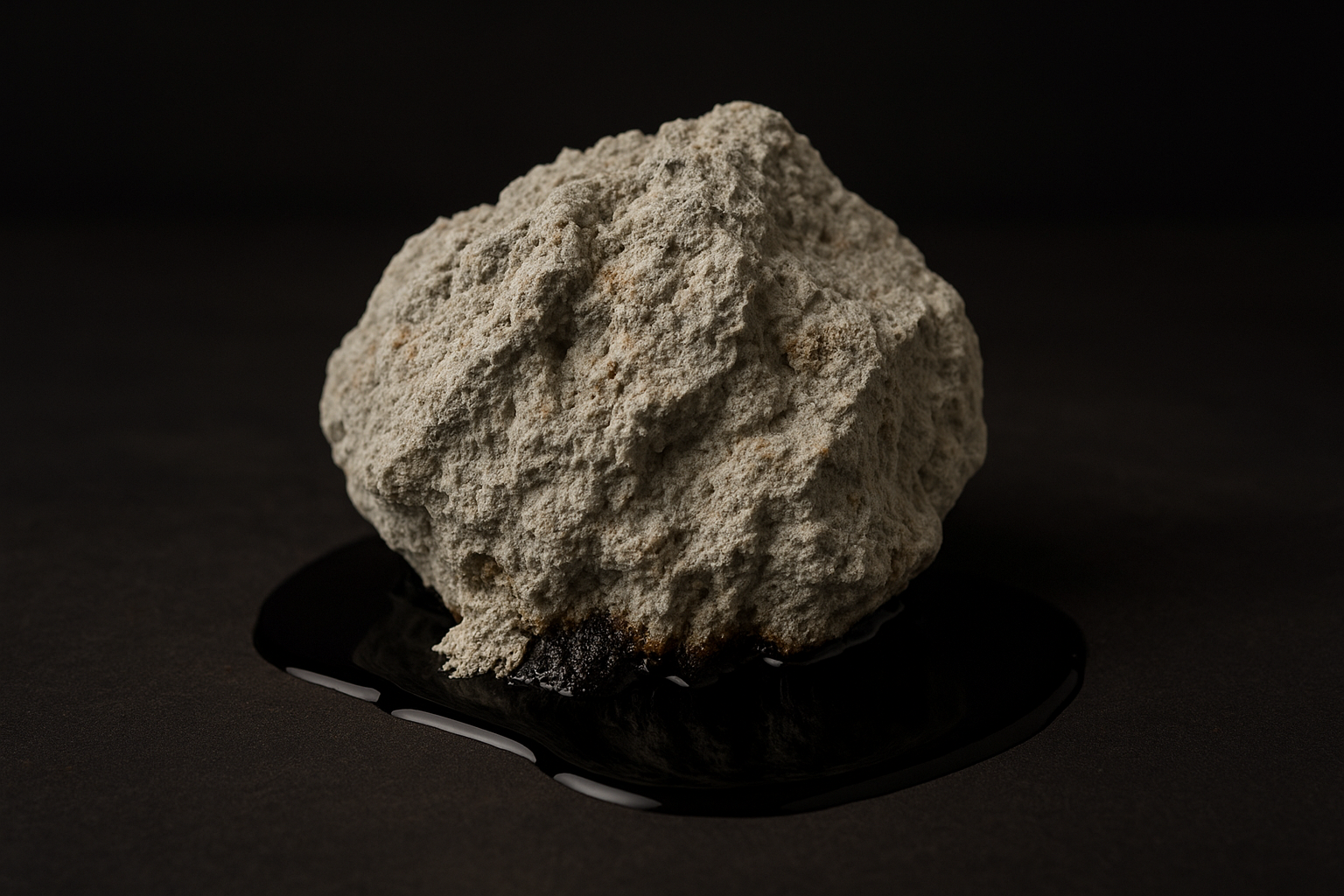
Waste Oil and Oil-Spill Adsorption: What Is the Problem in the Field
From workshop waste-oil trays, transformer and machine-room leaks, harbor and ship bilges, to oil sheen on the surface of industrial wastewater — oil-spill response sites face the conflicting demands of rapid recovery alongside minimizing post-recovery waste volume and secondary contamination. Conventional polypropylene oil sorbent pads impose a heavy incineration and landfill burden after sorption, while sawdust and perlite-type materials draw in water (being hydrophilic) and suffer from reduced recovery efficiency.
This is where natural clinoptilolite-based granular sorbents come into consideration. However, because natural zeolite inherently has a hydrophilic surface, whether or not the surface is made hydrophobic (organic modification, organo-zeolite) governs performance when raising the adsorption capacity for hydrocarbons (waste oil, diesel, crude oil). Therefore, it is important to define the oil type (light oil, heavy oil, crude oil), whether the application is on water or land, and the recovery method together at the material-selection stage.
Why Zeolite Is Considered for Waste Oil Adsorption
Natural clinoptilolite has 4.0-7.0 Å micropores, a 40.0 m²/g specific surface area, and surface silanol (Si-OH) functional groups, making it weakly hydrophilic in itself. The micropores (sub-nanometer) are smaller than the hydrocarbon molecules of diesel and crude oil (typically 0.5-to-several-nm chains and clusters), so rather than adsorption within the pores, the main mechanisms of oil uptake are capillary retention in the particle outer surface and inter-particle voids, together with surface adsorption. The hydrophilic/hydrophobic character of the unit surface and the packing porosity of the particles therefore determine the oil uptake.
The key is surface hydrophobization. By using the cation exchange capacity (CEC 1.6-2.0 meq/g) to replace the surface exchange sites with a cationic surfactant such as HDTMA (hexadecyltrimethylammonium), at concentrations above the CEC the surfactant forms a bilayer (admicelle) and the surface is converted to hydrophobic. This organo-zeolite selectively captures the oil film on water, retains less water after recovery, and shows a substantially increased hydrocarbon adsorption capacity compared with the unmodified material (Szala et al., 2015). Conversely, the unmodified natural material absorbs both water and oil, resulting in a high moisture content of the waste after recovery.
KMIZEOLITE's natural clinoptilolite is 97% pure, mined and processed at the Amargosa Valley mine in Nevada, USA, with a specific gravity of 1.89, hardness of 4.0-5.0 Mohs, and a pH stability range of 3.0-10.0, so its structure remains stable even under the rough handling and mixed acidic/alkaline conditions of spill sites. Thermal stability is secured up to 700°C, so thermal regeneration (desorption of adsorbed oil) can be considered without structural collapse, and as an inorganic mineral it has a low risk of heating and spontaneous combustion even after oil sorption, making temporary storage and disposal management simpler than sawdust and cellulose-based oil sorbents.
Waste Oil Adsorption Performance from Research
Effect of surface modification — Szala et al. (2015, Fuel Processing Technology) reported that clinoptilolite modified with the HDTMA surfactant substantially increased the adsorption of petroleum compounds such as diesel and crude oil compared with unmodified zeolite (Szala et al., Fuel Processing Technology, 2015). This is the direct basis on which this page recommends hydrophobic modification as the premise rather than the unmodified natural material.
Crude oil recovery on water and buoyancy — Anagnostopoulos et al. (2019, Natural Resources) applied natural clinoptilolite to crude oil spill recovery on the sea surface and evaluated the floating oil-sorption behavior and reuse potential (Anagnostopoulos et al., Natural Resources, 2019). It shows that the floating duration of the granular material is the key variable for application on water.
Composite oil-sorbent filler — Fidan et al. (2022, Journal of Applied Polymer Science) confirmed that silicone composite foam filled with clinoptilolite improved the sorption capacity of oil-sorbent materials for spill cleanup (Fidan et al., J. Applied Polymer Science, 2022). This means zeolite can be considered both as a standalone oil sorbent and as a reinforcing filler for foams and mats.
Hydrocarbon vapor (VOC) treatment — Asgharzadeh et al. (2025, MethodsX) reported that clinoptilolite modified with a cationic surfactant is effective at adsorbing kerosene-derived VOCs, showing that the scope of application extends not only to liquid oil but also to volatile hydrocarbon vapor control (Asgharzadeh et al., MethodsX, 2025). The mechanisms and isotherms across adsorption processes are summarized in a Chemical Reviews review article (Zeolites in Adsorption Processes, 2022).
KMIZEOLITE Key Properties
| Item | Value |
|---|---|
| Clinoptilolite purity | 97% |
| Cation exchange capacity (CEC) | 1.6–2.0 meq/g |
| Specific surface area | 40.0 m²/g |
| Pore diameter | 4.0–7.0 Å |
| pH stability range | 3.0–10.0 |
| Hardness | 4.0–5.0 Mohs |
| Thermal stability | 700°C |
| Specific gravity | 1.89 |
| Bulk density | 45–54 lbs/ft³ |
| Certifications | OMRI KMI-10365, FDA GRAS (21 CFR 182.2729), TSCA, EN-71-3 |
※ The FDA GRAS designation is based on 21 CFR 182.2729 for general use. When applied to animal feed ingestion use, the basis is the separate provision 21 CFR 582.2729. Waste oil adsorption is a non-ingestion industrial use, so 182.2729 applies.
Oil Sorbent Media Comparison — Why Modified Zeolite
| Oil sorbent medium | Hydrocarbon selectivity | Water co-absorption | Post-recovery behavior |
|---|---|---|---|
| PP sorbent pads/foams | High (hydrophobic) | Low | Incineration/landfill burden, bulky |
| Sawdust/cellulose | Low | High (hydrophilic) | High moisture content, spontaneous combustion risk |
| Unmodified natural zeolite | Low to medium | Medium to high | Higher moisture content from water co-absorption |
| organo-zeolite (modified) | High (hydrophobized) | Low | Inorganic, low combustion risk, thermal regeneration can be considered |
Modified zeolite is a compromise that targets both the hydrocarbon selectivity of PP-type materials and the storage safety of an inorganic mineral. However, since the oil uptake (g oil/g) varies with the medium, oil type and particle size, the principle is to measure and compare it directly with the target oil type.
Application Examples of Zeolite for Waste Oil Adsorption
Below are representative application scenarios and operating criteria where zeolite is considered at oil-spill response and waste-oil treatment sites.
- Land-applied sorbent: A method of applying 4x8-8x14 mesh granular zeolite at about 0.5-1.0 kg/m2 per spill area on workshop waste oil and machine-room/transformer leak floors, allowing 5-15 minutes of contact, then recovering with a broom or vacuum. The thicker the oil film, the higher the application rate (back-calculated from an oil uptake of 0.3-0.9 g oil/g).
- Recovery of oil films on water: A method of applying hydrophobically modified (organo-zeolite) granular material to oil films on the surface of bilges and sumps, then collecting the floating, oil-laden material with a skimmer or dip net. Since zeolite with a specific gravity of 1.89 sinks as-is, securing buoyancy (floating on the surface tension through hydrophobization, or filling it into foams/mats) is the key consideration.
- Packed bed / oil-water separation support: A method of filling 4x8 mesh Extra Coarse into a column or downstream of an oil-water separator (API/CPI separator) to finish-adsorb residual oil (oil sheen). In column operation, secure a sufficient empty bed contact time (EBCT) (typically several minutes or more) and replace upon pressure-drop rise or breakthrough.
- Oil-sorbent composite filler: A method of filling powder to fine granular (14x40 mesh or finer) zeolite inside oil-sorbent foams and filter mats to reinforce sorption capacity (Fidan et al., 2022).
- Hydrocarbon vapor / odor auxiliary treatment: A method of auxiliary adsorption of volatile hydrocarbon (VOC) vapor in oil-handling zones with modified-zeolite cartridges (Asgharzadeh et al., 2025).
- Test/pilot application: A method of pre-measuring the oil uptake (g oil/g), water separation degree, and floating duration of small samples by target oil type (light oil, heavy oil, crude oil).
Recommended Particle Size and Product Specifications
In waste-oil and oil-spill adsorption, the balance between recoverability and oil-sorbing surface area is important. For land application and packed beds, easy-to-recover 4x8 mesh (Extra Coarse) and 8x14 mesh (Coarse) granular material is suitable, while for oil-sorbent foam/mat fillers or fine oil-film treatment, 14x40 mesh and powder grades with large surface area are suitable. Refer to the table below to select the product group that fits your use.
| Product group | Mesh | Particle size | Typical use |
|---|---|---|---|
| Powder | 100 mesh or finer | <150μm | Pozzolan, feed, powder adsorption |
| Fine Granule | 30×50 mesh | 0.3–0.6mm | Water treatment, filtration, soil |
| Medium Granule | 14×40 mesh | 0.4–1.4mm | Filter beds, bedding, flooring |
| Coarse Granule | 8×14 mesh | 1.4–2.4mm | Pools, de-icing, large filtration |
| Extra Coarse | 4×8 mesh | 2.4–4.8mm | Packed beds, air scrubbers |
→ View products by mesh size · Product selection guide by application
Pilot Test and Field Review Points
When applying zeolite to waste-oil and oil-spill adsorption, be sure to check the following items together.
- Identify oil type and surface characteristics: Confirm whether the target is light oil, machine oil, heavy oil or crude oil, and whether the hydrophilic natural zeolite is sufficient or hydrophobic modification is needed.
- Oil uptake test: Measure the oil uptake per unit weight (g oil/g) and the water co-absorption rate to estimate the moisture content of the waste after recovery.
- Operating conditions: Check the contact time (typically 5-15 minutes), application rate (land about 0.5-1.0 kg/m2), and the floating duration for application on water.
- Recovery and reuse: Evaluate the recovery method after application (broom, vacuum, skimmer) and the number of reuses possible after heating/washing.
- Confirm disposal regulations: After oil sorption, the zeolite is handled according to hazardous or designated waste standards, and the low risk of spontaneous combustion as an inorganic material is reflected in the safety plan.
- Field-specific notes: Since natural clinoptilolite has a hydrophilic surface, research has reported that hydrophobic surface modification using a cationic surfactant (organo-zeolite) is effective at raising the hydrocarbon adsorption capacity.
→ View TDS (Technical Data Sheet) · View MSDS (Safety Data Sheet)
Waste Oil Adsorption FAQ
Does natural zeolite alone adsorb oil well, or is surface modification required?
Natural clinoptilolite has a weakly hydrophilic surface, so it tends to absorb water along with the oil. To boost hydrocarbon adsorption for diesel, crude oil and similar fuels, an organo-zeolite whose surface has been made hydrophobic with a cationic surfactant is effective, and Szala et al. (2015) reported that modified zeolite substantially increased the adsorption of petroleum compounds compared with the unmodified material. Light floor-leak recovery can be considered with the natural granular material, but for surface oil films on water and precise recovery, hydrophobic modification is recommended.
Which particle size (mesh) is suitable?
It depends on the recovery method. For land application and packed beds collected with brooms or vacuums, 4x8 mesh (Extra Coarse) and 8x14 mesh (Coarse) granular material is generally considered, while for filling oil-sorbent foams/mats or treating fine oil films, 14x40 mesh through powder grades are typical. Refer to the product selection guide by application.
How much should be applied?
For land floor spills, roughly 0.5-1.0 kg/m2 is typically applied per spill area, left in contact for 5-15 minutes and then recovered, but the unit oil uptake varies with oil type, spill thickness and temperature. It is advisable to determine the exact application rate by measuring the oil uptake (g oil/g) in advance with the target oil type.
How much oil does it adsorb per unit weight?
The oil uptake of modified (organo-zeolite) granular material is generally reported in the range of about 0.3-0.9 g oil/g depending on oil type, particle size and degree of modification. However, because this value is sensitive to the medium and oil type, it is recommended to measure the oil uptake directly with the target oil when sizing application rates and replacement intervals. Unit oil uptake may be lower than dedicated hydrophobic materials such as PP oil-sorbent pads, but as an inorganic mineral it offers advantages in storage and disposal safety and in suppressing water co-absorption (when modified).
Can the zeolite be reused after oil sorption, or how should it be disposed of?
Reuse can be considered by partially desorbing the adsorbed oil through heating or washing, but in the field it is often discarded after a single use. After oil sorption, the zeolite is handled according to hazardous or designated waste standards, and as an inorganic mineral it has a lower risk of spontaneous combustion than sawdust-type materials, making temporary storage comparatively safe.
Can I get a sample for testing?
Yes. KMIZEOLITE supports providing samples for real-world application evaluation. On the sample request page, please leave the target oil type and desired particle size (e.g., 4x8 mesh).
Inquiries and Sample Requests
If you are considering applying zeolite to the waste-oil adsorption field, please get in touch through the channels below.
Notice
Whether the application is appropriate may vary depending on field conditions, regulations, and test results. Before actual application, testing and review suited to the field conditions must always come first. Zeolite should be understood not as a cure-all for this field but as a material that supports existing processes.
Related Pages
science Related Research Papers
These are academic papers addressing zeolite application in this field. Please refer to them when evaluating adoption.
- Organically modified zeolites in petroleum compounds spill cleanup
Szala, B. et al. — Fuel Processing Technology, 2015 - The Potential Use of Natural Clinoptilolite Zeolite for Crude Oil Spill Removal from Sea Water
Anagnostopoulos, V.A. et al. — Natural Resources, 2019 - Oil spill remediation: sorption capacity of silicone composite foams filled with clinoptilolite
Fidan, T. et al. — Journal of Applied Polymer Science, 2022 - Adsorption of VOCs from kerosene using clinoptilolite modified by cationic surfactant
Asgharzadeh, F. et al. — MethodsX, 2025 - Zeolites in Adsorption Processes: State of the Art and Future Prospects
Various — Chemical Reviews, 2022
The papers above are reference materials, and actual application requires separate review suited to field conditions.