Pervious Pavement & LID Filter Block
An LID filter-layer material that captures ammonium and heavy metals from stormwater runoff in the filter media through cation exchange with a CEC of 1.6-2.0 meq/g — while reduction of phosphate and nitrate anions must be designed on the premise of SMZ (HDTMA) modification.
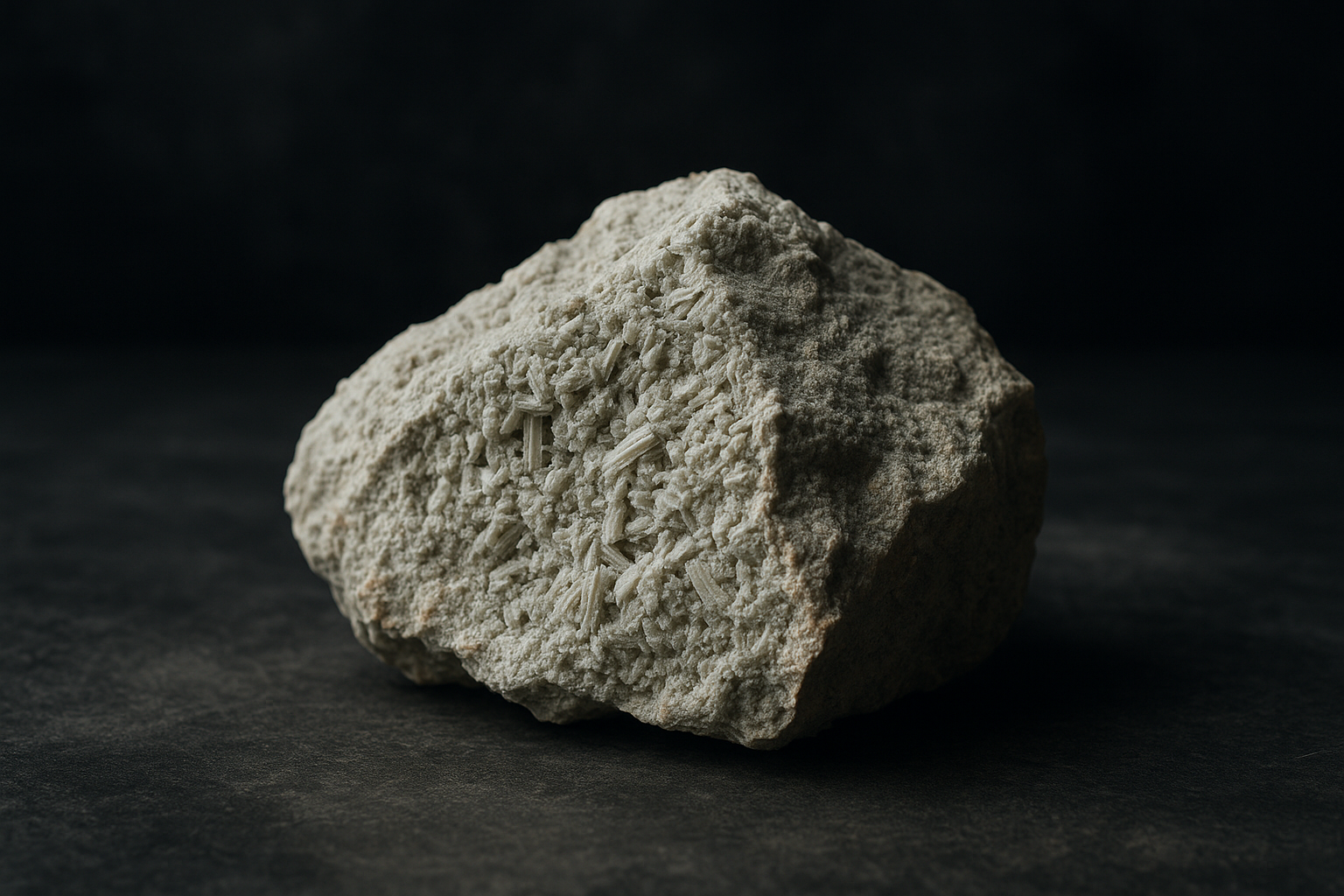
Zeolite for Pervious Pavement & LID Filter Blocks — Non-Point Source Reduction Media for Stormwater Runoff
Permeable pavers, infiltration pavements, and Low Impact Development (LID) infiltration facilities aim to reduce stormwater runoff volume while also reducing the non-point source pollution washed off from roads, parking lots, and plazas. The natural clinoptilolite supplied by KMIZEOLITE is a high-purity mineral with a clinoptilolite content of 97.0%, mined at the Amargosa Valley deposit in Nevada, USA, and is evaluated as a filter / reactive media material for these infiltration facilities.
The core of zeolite is the cation exchange capacity (CEC) that arises because the aluminosilicate framework carries a negative charge. Ammonium (NH₄⁺) and heavy-metal cations such as lead, copper, cadmium, and zinc — commonly present in stormwater runoff — are captured as they pass through the filter media by exchanging with the framework's exchangeable cations (Na⁺, K⁺, Ca²⁺). However, anions such as phosphate and nitrate nitrogen are barely captured by unmodified zeolite, and this point is addressed separately later on this page along with the modification (SMZ) premise.
Key Properties That Govern Filter-Media Adsorption
What determines zeolite's behavior in an LID filter layer is its ion-exchange and pore-related properties rather than its chemical composition.
| Property | Value | Significance for Filter-Layer Use |
|---|---|---|
| Cation exchange capacity (CEC) | 1.6–2.0 meq/g | Primary driver of ammonium / heavy-metal cation adsorption |
| Pore diameter | 4.0–7.0 Å | Determines selectivity by hydrated ion size |
| Specific surface area | 40.0 m²/g | Secures contact adsorption area |
| Specific gravity | 1.89 | Basis for packing density / scour-resistance calculation |
| Bulk density | 720–865 kg/m³ | Basis for filter-media volume / weight design |
| Hardness | 4.0–5.0 Mohs | Resistance to flow abrasion and dust generation |
| pH stability range | 3.0–10.0 | Compatible with acid rain and road runoff environments |
A CEC of 1.6–2.0 meq/g is the most important indicator governing the filter media's cumulative adsorption capacity (the total amount of cations that can be captured before breakthrough). The uniform 4.0–7.0 Å micropores impart selectivity toward ions with a small hydrated radius such as ammonium, cesium, and lead.
What It Captures and What It Doesn't — Cations vs. Anions
The most common misconception in LID filter-layer design is the assumption that "zeolite adsorbs all pollutants." In reality the behavior splits in the opposite direction depending on the charge sign of the pollutant.
| Runoff Pollutant | Charge | Unmodified Clinoptilolite | Requirement |
|---|---|---|---|
| Ammonium NH₄⁺ | Cation | Effective (cation exchange) | No modification needed |
| Heavy metals Pb²⁺, Cu²⁺, Cd²⁺, Zn²⁺ | Cation | Effective (cation exchange) | No modification needed |
| Phosphate PO₄³⁻ | Anion | Barely works (electrostatic repulsion) | Metal (Ca/La/Fe·Al) or SMZ modification required |
| Nitrate nitrogen NO₃⁻ | Anion | Barely works (electrostatic repulsion) | Surfactant (e.g., HDTMA) modification (SMZ) required |
Because unmodified clinoptilolite has a negatively charged framework, anion adsorption is weak, and to remove anions/oxyanions such as phosphate, nitrate nitrogen, and fluoride, a surfactant-modified zeolite (SMZ) — with the surface charge reversed by metal (Ca, La, Fe, Al) loading or by a cationic surfactant (e.g., HDTMA) — is effectively a prerequisite. Explaining anion adsorption with cation-exchange logic is a clear error, so if the dominant pollutant in the catchment is phosphorus or nitrate nitrogen, the filter-media specification must be set as modified zeolite from the outset.
Stormwater Runoff Reduction Performance From the Research
Studies applying zeolite to pervious pavement and bioretention quantitatively show the difference in cation/anion behavior. A review applying a variety of materials including clinoptilolite to pervious concrete (Alimohammadi et al., Sustainability, 2021) summarizes that pervious pavement is itself a platform that physically and chemically reduces heavy metals and nutrients in stormwater runoff, and that combining adsorptive media strengthens the water-quality improvement effect.
That incorporating zeolite into a bioretention filter media improves removal of cationic nitrogen (ammonium) is also confirmed in field-scale studies (Sweeney et al., Agricultural & Environmental Letters, 2022). A study targeting urban runoff compares natural zeolite with magnetite-modified zeolite and reports that modification broadens the removal range for specific pollutant groups (Water Conservation Science and Engineering, 2024).
The premise for anion reduction emerges quantitatively in HDTMA-modification research. In a column experiment applying HDTMA-modified zeolite (MZ) as a bioretention filter media, nitrate-nitrogen (NO₃⁻-N) removal improved by up to about 38.2 times and total phosphorus (TP) removal by up to about 17.5 times versus unmodified natural zeolite (NZ), while runoff volume was reduced by up to 32.9% and peak flow by up to 29.9% (Frontiers in Environmental Science, 2022). This backs up the principle that "anions require modification" with numbers.
The quantitative adsorption behavior and breakthrough curves of ammonium and phosphate can be found in dedicated adsorption studies. A study measuring ammonium/phosphate isotherms and breakthrough for natural and modified clinoptilolite (Stepova et al., Water, 2023) provides the adsorption-capacity and contact-time data needed for filter-media design, and shows that phosphate adsorption becomes meaningful in the modified samples — consistent with the anion-modification principle above. For heavy metals, a fixed-bed column study (Medvidović et al., Separation and Purification Technology, 2006) quantifies how the breakthrough point for lead (Pb²⁺) removal varies with influent concentration and flow rate, providing the basis for designing the replacement/regeneration interval.
Filter-Media Structure — A Functional Layer, Not Surface Paving
The key is to place zeolite not as structural aggregate of the pervious pavement but as an adsorption functional layer through which the infiltrating water passes. A granular zeolite layer is placed beneath surface permeable pavers / pervious concrete, or inside an infiltration trench or catch-basin cartridge, so that the rainwater contacts it as it passes through.
- Use granular grades: 4×8 mesh / 8×14 mesh maintain voids to minimize reduction of the permeability coefficient
- Avoid powder grades: fines lower permeability, so limit them to lower cartridge / reactive layers rather than the surface
- Clogging management: place a coarse aggregate / pretreatment layer on top to distribute the suspended-solids load
- Modularization: configuring as cartridges allows selective replacement of only the saturated layer
Recommended Product Specifications
| Product Name | Mesh | Particle Size | Suitability for Filter-Layer Use |
|---|---|---|---|
| KMI 4×8 US MESH (Granular) | 4×8 mesh | 2.36–4.75 mm | Optimal for permeable filter layers — high voids, low pressure loss |
| KMI 8×14 US MESH (Granular) | 8×14 mesh | 1.40–2.36 mm | Balance of adsorption area and flow capacity, for cartridges |
| KMI 14×40 US MESH (Granular) | 14×40 mesh | 0.42–1.40 mm | Prioritizes adsorption efficiency; pressure-loss management required |
In a filter layer, particle size simultaneously governs both permeability and adsorption efficiency. Coarse grades have good flow capacity and resist clogging but offer less adsorption area per unit volume, while fine grades are the opposite. Particle size must be selected by considering the target infiltration rate, the catchment pollutant load, and the replacement interval together.
Application Examples
Adsorption Layer Beneath Permeable Pavers / Pervious Concrete
A granular zeolite reactive layer is placed beneath permeable pavement on sidewalks, parking lots, and plazas so that the infiltrating water captures ammonium and heavy-metal cations as it passes through.
LID Infiltration Facility / Bioretention Media
Zeolite is incorporated into infiltration trench or bioretention media to reinforce cation removal. If reduction of phosphorus or nitrate nitrogen is the goal, SMZ-modified zeolite is applied as a separate specification.
Catch-Basin / Manhole Cartridge Module
It can be packed into replaceable cartridges to apply an operating scheme where, once saturated, the unit is replaced/regenerated module by module.
Review Points
- Whether the catchment's dominant pollutant is a cation (ammonium / heavy metal) or an anion (phosphate / nitrate nitrogen) must be defined first, as this determines the material specification (unmodified vs. SMZ).
- Because the filter media relies on reversible adsorption, the breakthrough and the replacement/regeneration interval must be calculated based on the runoff load.
- To maintain permeability, the surface uses granular grades while fines are limited to the lower functional layer.
- A pretreatment layer and inspection interval for clogging management are designed together.
- The final specification is verified with a column test reflecting site influent water quality, temperature, and flow variation.
Regulatory & Safety Notes
Natural clinoptilolite is a mineral listed under the US FDA's GRAS-related regulation 21 CFR 182.2729 (clinoptilolite as a general-use anticaking agent) and has high chemical stability even in environmental and civil-engineering media applications. However, LID and stormwater-treatment facilities must comply with the performance criteria and test methods for non-point source reduction facilities set by local authorities and the project owner, so permitting requirements must be checked alongside the product specification.
Frequently Asked Questions (FAQ)
When zeolite is added to a permeable paver or LID filter layer, which pollutants are reduced?
Natural clinoptilolite uses the cation exchange capacity (CEC) of 1.6~2.0 meq/g that arises from its negatively charged framework to preferentially adsorb cationic pollutants in stormwater runoff. The primary targets are ammonium (NH₄⁺) and heavy-metal cations such as lead (Pb²⁺), copper (Cu²⁺), and cadmium (Cd²⁺); the filter media captures these constituents — common in runoff from roads, parking lots, and plazas — as the water passes through. However, anions such as phosphate and nitrate nitrogen are barely removed by unmodified zeolite.
Can zeolite also capture anions such as phosphate and nitrate nitrogen?
Because unmodified clinoptilolite has a negatively charged aluminosilicate framework, it electrostatically repels anions, so adsorption of anions such as phosphate (PO₄³⁻), nitrate (NO₃⁻), and fluoride is effectively weak. To also reduce anions, a surfactant-modified zeolite (SMZ) — produced by metal (Ca, La, Fe, Al) loading or by modifying the surface with a cationic surfactant such as HDTMA — is a prerequisite. In column studies that applied HDTMA-modified zeolite to a bioretention filter media, nitrate-nitrogen removal improved by up to about 38 times and total phosphorus by up to about 17 times versus the unmodified material. Anion adsorption cannot be explained by cation-exchange logic.
Does the zeolite filter media block the infiltration and drainage performance of pervious pavement?
The filter media should be designed as a filtration/adsorption functional layer, not as a fill that clogs the voids of the permeable structure. Using granular particle sizes such as 4×8 mesh or 8×14 mesh maintains inter-particle voids, so contact adsorption area is gained without significantly lowering the permeability coefficient. Powder grades reduce permeability, so as a principle they are limited to lower filter cartridge / reactive-layer uses rather than surface paving material, and the target infiltration rate and the clogging management interval must be designed together.
How is the filter media managed once its adsorption capacity is saturated?
Because cation exchange is reversible, the filter media does not operate indefinitely and a breakthrough point exists. Fixed-bed column studies report that the breakthrough curve varies with influent concentration, contact time (EBCT), and particle size, so the replacement/regeneration interval must be calculated based on the catchment area and annual runoff load. Modularizing into cartridge form allows only the saturated layer to be replaced, and the literature also examines recovering the adsorbed ammonium for reuse as a slow-release nitrogen source.
Related Pages
- Construction & Industrial Materials Applications — view the full category
- Filter Cartridge Media — cartridge-type packing / filtration use
- Natural Pozzolan — cement / concrete applications
- Granular Zeolite Products — 4×8 / 8×14 mesh grades
- TDS / Technical Data — check detailed properties
Notice
The reduction performance of pervious pavement / LID filter layers may vary with the catchment pollutant characteristics (cation/anion proportion), particle size, filter-media thickness, contact time, influent water quality and temperature, the clogging management method, and whether the zeolite is modified. In particular, if reduction of phosphate or nitrate nitrogen is the goal, an SMZ-modified specification rather than unmodified zeolite is the prerequisite, and before actual application we recommend verifying the adsorption capacity and breakthrough point with a column test using site influent water. The property data on this page are based on KMI's published technical data; please confirm the latest TDS at the time of actual delivery.
[Inquire about particle sizes, modification specifications, and bulk supply of zeolite for pervious pavement & LID filter blocks →]
science Related Research Papers
Academic papers covering zeolite applications in this field. Please refer to them when evaluating adoption.
- Stormwater Runoff Treatment Using Pervious Concrete Modified with Various Nanomaterials: A Comprehensive Review
Alimohammadi, V. et al. — Sustainability, 2021 - Runoff regulation and nitrogen removal of bioretention with HDTMA-modified zeolite
Frontiers in Environmental Science, 2022 - Zeolite amended bioretention media improves nitrogen removal from stormwater
Sweeney, M. et al. — Agricultural & Environmental Letters, 2022 - Urban Runoff Treatment by Natural and Magnetite-Modified Zeolites
Water Conservation Science and Engineering, 2024 - Adsorption of Ammonium Ions and Phosphates on Natural and Modified Clinoptilolite: Isotherm and Breakthrough Curve Measurements
Stepova, K. et al. — Water, 2023 - Column performance in lead removal from aqueous solutions by fixed bed of natural zeolite–clinoptilolite
Medvidović, N. et al. — Separation and Purification Technology, 2006
The papers above are reference materials; actual application requires a separate review suited to site conditions.