Lightweight Concrete Aggregate (Zeolite)
Porous clinoptilolite (specific gravity 1.89, bulk density 720–865 kg/m³) is lighter than typical natural aggregate (specific gravity 2.6–2.7), and is reviewed both as a raw material for artificial lightweight aggregate produced through a calcination/expansion process and as a lightweight filler to reduce the self-weight of concrete.
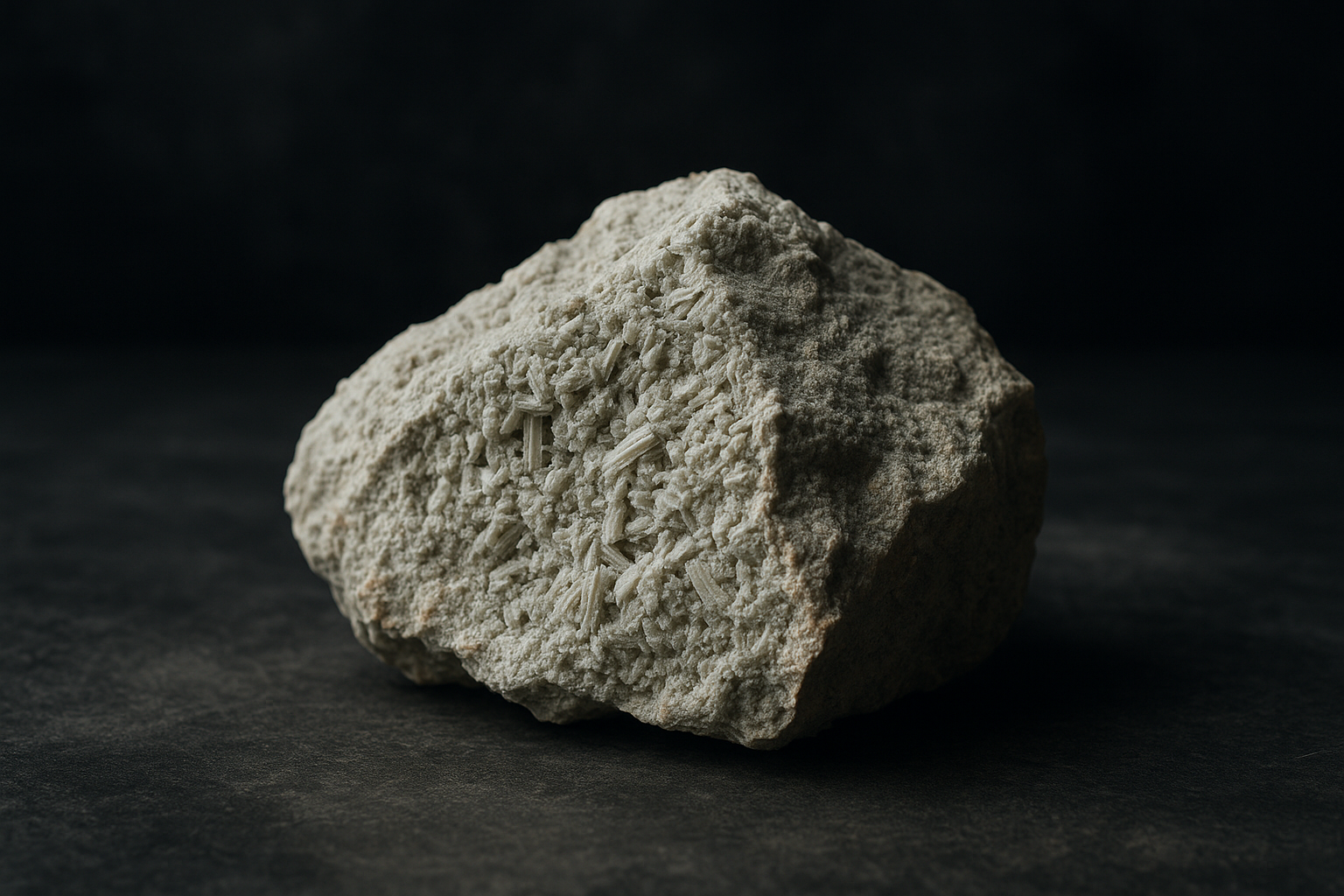
Natural Zeolite for Lightweight Concrete Aggregate — A Unit-Weight-Reducing Material Based on a Porous Framework
Reducing the self-weight of concrete makes it possible to reduce the cross-sections of structural members and foundation loads, so lightweight concrete is a field that is consistently reviewed for high-rise and long-span structures as well as insulating and fire-resistant members. The core of lightweight concrete lies in using lightweight aggregate with a low unit weight instead of ordinary natural aggregate.
The natural clinoptilolite supplied by KMIZEOLITE is a high-purity (clinoptilolite 97.0%) zeolite mined from the Amargosa Valley deposit in Nevada, USA, and is a porous aluminosilicate with a specific gravity of 1.89 and a bulk density of 720–865 kg/m³. This porous structure provides the physical basis for lowering unit weight relative to ordinary aggregate, and at the same time, because it contains reactive silica (SiO₂ 66.7%), pozzolanic reactivity can also be expected at the interface with the cement matrix — a feature that distinguishes it from ordinary inert lightweight aggregate.
There is, however, an important premise. Feeding raw natural zeolite directly as a structural lightweight aggregate is not common. Structural lightweight aggregate is usually produced by calcining and expanding zeolite-bearing tuff into artificial lightweight aggregate (e.g., expanded/sintered aggregate), or used as a fine-powder lightweight filler / supplementary cementitious material (SCM). This page covers these two branches separately.
Key Physical Data as a Lightweight Aggregate
The most important factors in evaluating a lightweight aggregate are density, porosity, and water absorption. The properties of KMIZEOLITE clinoptilolite are as follows.
| Property | Value | Meaning for Lightweight Aggregate Use |
|---|---|---|
| Specific gravity | 1.89 | Lower than ordinary natural aggregate (about 2.6–2.7) — basis for self-weight reduction |
| Bulk density | 720–865 kg/m³ | Basis for lightweight filler and mix weight-ratio calculation |
| Specific surface area | 40.0 m²/g | High porosity — lightness combined with the need for water-absorption management |
| Pore diameter | 4.0–7.0 Å | Fine pores within the crystal (lightness works together with inter-particle porosity) |
| Hardness | 4.0–5.0 Mohs | Easy to crush, classify, and process by calcination |
| pH stability range | 3.0–10.0 | Compatible with the alkaline cement environment |
| Cation exchange capacity (CEC) | 1.6–2.0 meq/g | Indicator of aggregate–matrix interface reactivity |
A specific gravity of 1.89 is about 30% lighter than granite/limestone-based natural aggregate (about 2.6–2.7), directly providing the basis for lowering concrete self-weight when the same volume of aggregate is used. However, the fact that porous aggregate has a high water absorption rate is a double-edged sword. It provides lightness but greatly affects the unit water content and workability of the mix, so water-absorption correction and pre-wetting management are essential.
Chemical Composition — A Lightweight Yet Reactive Aggregate
What distinguishes zeolite lightweight aggregate from a simple inert filler lies in its chemical composition. Its reactive silica content is high, so uncalcined lightweight filler/fines undergo some bonding reactions with the matrix in an alkaline environment.
| Component | Formula | Content | Role Related to the Aggregate |
|---|---|---|---|
| Silicon dioxide | SiO₂ | 66.7% | Reactive silica — contributes to interfacial pozzolanic reaction |
| Aluminum oxide | Al₂O₃ | 11.48% | Aluminosilicate framework — involved in fusion behavior during calcination |
| Potassium oxide | K₂O | 3.42% | Can act as a flux during calcination |
| Sodium oxide | Na₂O | 1.8% | Affects calcination/foaming behavior |
| Calcium oxide | CaO | 1.33% | Trace lime component |
| Iron oxide | Fe₂O₃ | 0.9% | Trace |
| Magnesium oxide | MgO | 0.27% | Trace |
| Titanium dioxide | TiO₂ | 0.13% | Trace |
Alkaline components such as K₂O and Na₂O can act as a flux when the tuff is calcined, partially melting and foaming the particle surfaces. This becomes a factor governing the density and strength of the aggregate in the artificial lightweight aggregate manufacturing process (calcination/expansion).
Zeolite Lightweight Aggregate Through Research — Key Evidence
The most direct primary evidence on this topic is the research by de Gennaro et al. de Gennaro et al. (de Gennaro et al., Applied Clay Science, 2007) experimentally reported that artificial lightweight aggregate for structural lightweight concrete can be produced from zeolite-rich volcanic tuff (zeolite-rich rocks) and waste materials through a calcination/expansion process. This study showed that the particle density and compressive strength of the aggregate vary significantly depending on the calcination temperature (roughly around 1150–1300°C), raw-material composition, and foaming behavior, clarifying the process sensitivity when zeolite raw material is processed into lightweight aggregate.
The effect of zeolite incorporation on the thermal and mechanical behavior of concrete was addressed by Bayiit (Bayiit, International Journal of the Physical Sciences, 2010), who reported that as the zeolite content increases, unit weight together with thermal conductivity and strength characteristics change. This is evidence that lightweight/insulating objectives and strength objectives may conflict.
For the behavior when partially replacing cement in fine-powder form, the review by Ahmadi & Shekarchi (Ahmadi & Shekarchi, Cement and Concrete Composites, 2010), which synthesized the pozzolanic activity of natural zeolite, and the study by Najimi et al. (Najimi et al., Construction and Building Materials, 2012), which replaced 15% and 30% of cement with natural zeolite in high-performance concrete, are useful references. Both studies commonly emphasize that durability indicators improve at appropriate replacement levels, while managing unit water content and workability becomes more important as the replacement ratio increases.
In summary, the strength of zeolite lightweight aggregate lies in combining self-weight reduction, thermal insulation, and interfacial reactivity, and as the studies above commonly emphasize, the exact balance point of density, strength, and water absorption must be confirmed through testing according to the raw-material composition and the process/mix conditions.
Two Application Branches — Artificial Lightweight Aggregate vs. Lightweight Filler
| Category | Artificial Lightweight Aggregate (calcination/expansion) | Lightweight Filler/Fines (uncalcined) |
|---|---|---|
| Role of zeolite | Tuff raw material → calcination processing | Crushed powder → combined lightweight filling / SCM |
| Unit-weight reduction | Large — foaming further reduces particle density | Moderate — based on specific gravity 1.89 |
| Pozzolanic reactivity | Changes when the crystal collapses during calcination | Retained — uses reactive silica |
| Relevant standards | ASTM C330 (structural lightweight aggregate), etc. | ASTM C618 (natural pozzolan), etc. |
| KMI product position | Raw-material supply for the calcination process | Direct supply of 100 mesh powder |
What KMI can supply immediately is the latter (powder/granular raw material); manufacturing artificial lightweight aggregate presupposes a processing line equipped with separate calcination facilities. Therefore, direct use as structural lightweight aggregate is most accurately reviewed from a "raw-material supply + processing" perspective.
Application Points You Can Expect
- Concrete self-weight reduction — reviewing lightweight filler based on specific gravity 1.89
- Supply of tuff raw material for manufacturing artificial lightweight aggregate (calcination/expansion)
- Aiding lightweight mortar/panel mixes for insulating and fire-resistant members
- Combining lightness with interfacial pozzolanic reactivity (when using uncalcined fines)
- Reviewing low-density non-structural fill
Recommended Product Specifications
| Product Name | Mesh | Particle Size | Suitability for Lightweight Aggregate Use |
|---|---|---|---|
| KMI 100- US MESH (Powder) | 100 mesh or finer | <150μm, median 50μm | Combined lightweight filler / SCM — fine-powder filling |
| Coarse/granular raw material | Granular | Per process specification | Raw material for calcined/expanded aggregate manufacturing |
Particle size and water absorption are decisive in lightweight aggregate use. Fine-powder filler affects dispersibility and the interfacial reaction, while granular raw material affects calcination processability, so specifications suited to the intended use must be discussed.
Application Examples
Lightweight Filler / Lightweight Mortar
In non-structural lightweight fill or insulating mortar, specific-gravity-1.89 fines/granules can be reviewed as a partial aggregate/filler. Water-absorption correction and pre-wetting management are key.
Raw Material for Artificial Lightweight Aggregate Manufacturing
In a processing line equipped with calcination/expansion facilities, supply can be reviewed as a raw material for lines that manufacture structural lightweight aggregate (ASTM C330 series) from zeolite tuff.
Development of Low-Carbon, Lightweight Construction Materials
In the development of eco-friendly lightweight concrete that aims for both self-weight reduction and cement reduction (combined SCM use), it can be a target for comparison and combined use.
Review Points
- Porous aggregate has a high water absorption rate, so unit-water-content and workability management is key (pre-wetting recommended).
- Lightness and strength generally conflict, so the target unit weight and strength must be verified simultaneously.
- For direct structural use, artificial lightweight aggregate produced through calcination/expansion processing is common.
- For calcined aggregate, density and strength vary greatly with calcination temperature and foaming agent.
- Compliance with relevant standards such as ASTM C330 (structural lightweight aggregate) must be confirmed through actual testing.
Frequently Asked Questions (FAQ)
What is the basis for using natural zeolite as a lightweight concrete aggregate?
Natural clinoptilolite is a porous aluminosilicate with a specific gravity of 1.89, a bulk density of 720–865 kg/m³, and a specific surface area of 40 m²/g, making it lighter than typical natural aggregate (specific gravity about 2.6–2.7). de Gennaro et al. (2007) reported that zeolite-bearing tuff can be calcined and expanded to produce artificial lightweight aggregate for structural lightweight concrete. However, rather than being used directly as a natural lightweight aggregate on its own, zeolite is generally reviewed as a raw material for artificial lightweight aggregate produced through a calcination/expansion process, or as a fine-powder lightweight filler/SCM.
What happens to concrete unit weight and strength when zeolite lightweight aggregate is used?
The porous framework lowers the aggregate's unit weight, which works to reduce the overall self-weight of the concrete. In general, lightweight aggregate involves a trade-off in which compressive strength decreases along with unit weight, so in structural lightweight concrete the mix point that simultaneously satisfies the target strength and unit weight must be found through testing. de Gennaro et al. (2007) reported that aggregate density and strength vary significantly depending on the calcination conditions (roughly around 1150–1300°C) and the raw-material composition.
What is the difference between zeolite for lightweight aggregate and zeolite for pozzolan (SCM)?
The lightweight-aggregate use focuses on self-weight reduction and thermal insulation as a granular aggregate, while the pozzolan (SCM) use focuses on partially replacing cement with fine powder of 100 mesh or finer and reacting it with Ca(OH)₂. Because it is the same clinoptilolite framework, however, uncalcined lightweight aggregate/filler also retains some pozzolanic reactivity in an alkaline environment. For the fine-powder SCM use, please refer to the natural pozzolan page.
What is the most important review item when applying zeolite lightweight aggregate?
Porous aggregate has a high water absorption rate, which greatly affects the unit water content and workability of the mix. Therefore, aggregate pre-wetting management, water-absorption correction, and simultaneous verification of target unit weight and strength are key. In addition, for calcined lightweight aggregate, density and strength vary with the calcination temperature and the type of foaming agent, so the raw tuff composition and process conditions must be managed together, and final confirmation must be made through testing in accordance with relevant standards such as ASTM C330 (structural lightweight aggregate).
Related Pages
- Natural Pozzolan Zeolite — fine-powder SCM / partial cement replacement
- Zeolite for Concrete Admixture/Incorporation — application within the concrete mix
- Zeolite for Stucco/Mortar — lightweight finishing material mixes
- Marine Concrete Durability Admixture — durability reinforcement perspective
- View All Construction & Industrial Materials — category hub
Notes
The results of lightweight concrete aggregate application may vary depending on raw-material purity, particle size, water absorption, calcination process conditions, the mix/curing method, and the required unit-weight/strength criteria. In particular, direct use as structural lightweight aggregate presupposes calcination/expansion processing, so before actual application, please confirm suitability through trial mixes and property verification. The chemical composition and property data on this page are based on KMI public technical documentation; please confirm the latest TDS at the time of actual supply.
[Inquire about particle sizes, raw-material specifications, and bulk supply of zeolite for lightweight concrete aggregate / lightweight filler →]
science Related Research Papers
These are academic papers addressing zeolite application in this field. Please refer to them when evaluating adoption.
- Use of zeolite-rich rocks and waste materials for the production of structural lightweight concretes
de Gennaro, R. et al. — Applied Clay Science, 2007 - The effect of zeolite rate on the thermo-mechanical properties of concrete
Bayiit, C. — International Journal of the Physical Sciences, 2010 - Natural zeolite as pozzolanic material: A review
Ahmadi, B. and Shekarchi, M. — Cement and Concrete Composites, 2010 - Properties of high-performance concrete incorporating natural zeolite
Najimi, M. et al. — Construction and Building Materials, 2012 - Natural zeolite as supplementary cementitious material: A holistic review
Shekarchi, M. et al. — Construction and Building Materials, 2023
The papers above are reference materials; actual application requires separate review suited to on-site conditions.