Zeolite for Cement Additive
An overview of using natural clinoptilolite (97% purity) with 66.7% SiO₂ and a 40.0 m²/g specific surface area as an ASTM C618 Class N natural pozzolan—replacing 10–15% (up to 30%) of Portland cement with 100-mesh powder as an SCM—centered on quantitative data, the pozzolanic reaction mechanism, and mix-design review points.
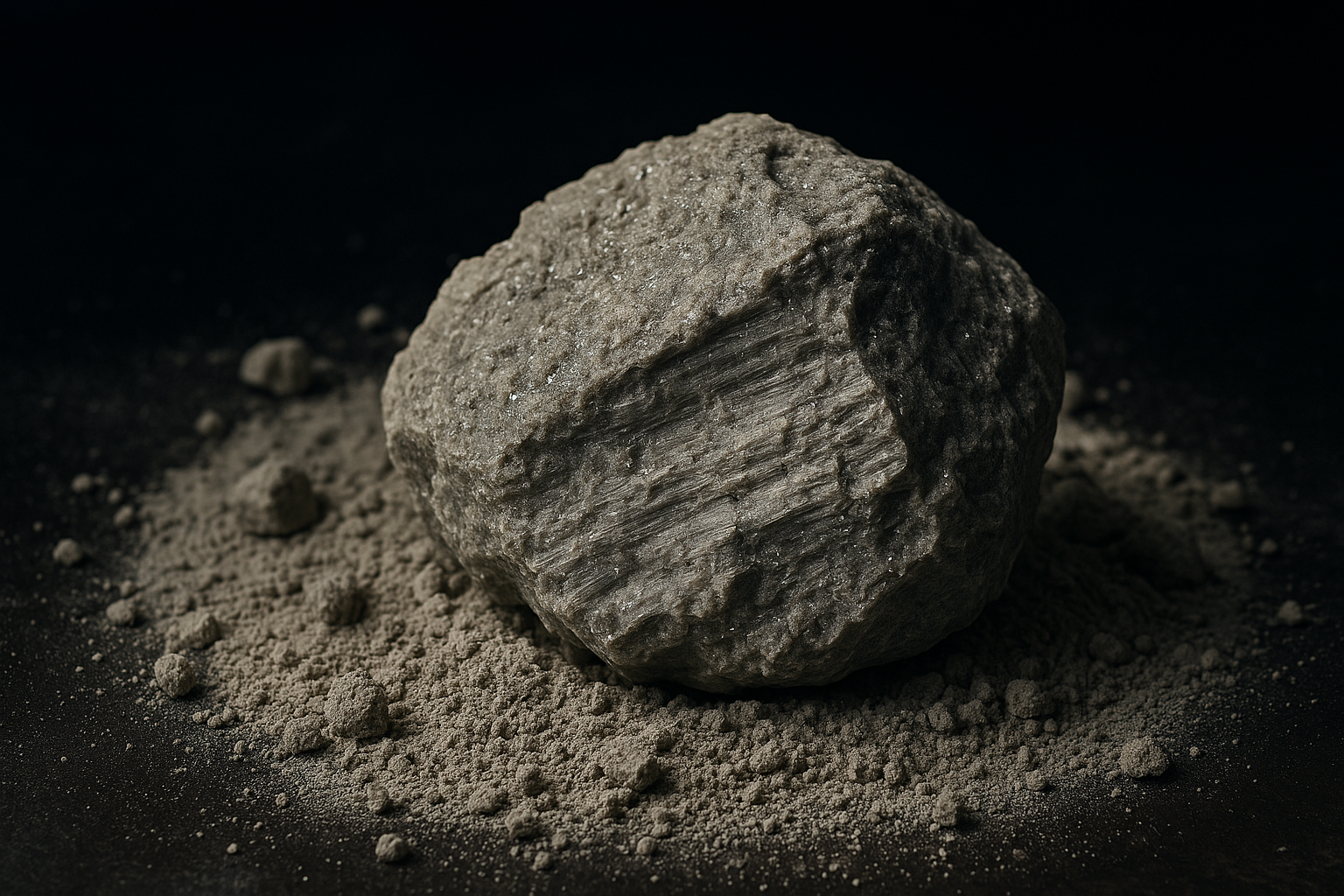
Why natural zeolite is needed as a cement additive
Producing one ton of Portland cement (OPC) emits roughly 0.8–0.9 tons of CO₂, with the clinker calcination process accounting for most of it. To cut carbon and reduce costs, the construction and ready-mix industries have partially replaced clinker with supplementary cementitious materials (SCMs) such as fly ash and ground granulated blast-furnace slag. However, the reduction of coal-fired power generation and changes in steelmaking processes are making the stable supply of these by-products increasingly difficult.
The alternative drawing attention to fill this gap is clinoptilolite zeolite, a natural pozzolan. Mined directly from a quarry rather than relying on by-products, it offers consistent quality and is evaluated under the ASTM C618 Class N (natural pozzolan) category. That said, the reactivity, water demand, and workability of natural pozzolans vary by deposit, so the replacement ratio, water-to-binder ratio (W/B), and curing conditions must be reviewed together during mix design.
The pozzolanic reaction mechanism and its link to material properties
The key to clinoptilolite functioning as a cement additive is the pozzolanic reaction. The calcium hydroxide (Ca(OH)₂, portlandite) generated during cement hydration does not contribute to strength and reduces durability; the amorphous, reactive silica of zeolite reacts with this Ca(OH)₂ to form additional C-S-H (calcium silicate hydrate) gel. KMIZEOLITE clinoptilolite has an aluminosilicate composition of 66.7% SiO₂ and 11.48% Al₂O₃, making it a source of silica and alumina for this reaction.
The zeolite's 40.0 m²/g specific surface area and 4.0–7.0 Å micropore structure provide a broad reactive surface unavailable in ordinary aggregate, accelerating the pozzolanic reaction while filling fine pores within the hardened body to densify the pore structure (pore refinement). In addition, the cation-exchange property of 1.6–2.0 meq/g CEC partially fixes free alkali and chloride ions, making it worth reviewing for alkali-silica reaction (ASR) suppression and resistance to chloride attack.
Ahmadi and Shekarchi (2010, Cement and Concrete Composites) comprehensively reviewed natural zeolite as a pozzolanic material, noting that clinoptilolite consumes Ca(OH)₂ to generate additional C-S-H, thereby improving later-age strength and durability, while early-age strength and workability may be affected by increased water demand (DOI: 10.1016/j.cemconcomp.2009.10.006). The comprehensive SCM review by Shekarchi et al. (2023, Construction and Building Materials) likewise reports that natural zeolite is effective as a partial replacement for Portland cement in terms of eco-friendliness and durability (DOI: 10.1016/j.conbuildmat.2023.133766).
Najimi et al. (2012, Construction and Building Materials) reported that in high-performance concrete with 15% and 30% natural zeolite replacement, the 28-day compressive strength is somewhat lower than OPC but recovers by 90 days, and that durability indicators such as rapid chloride penetration (RCPT) resistance and absorption are markedly improved (DOI: 10.1016/j.conbuildmat.2011.12.034). This simultaneously demonstrates that the pozzolanic reaction is a later-age reaction and that ion-diffusion resistance improves through pore refinement. Meanwhile, Islam et al. (2026, Cement and Concrete Research) propose that the framework alkalis (Na⁺/K⁺) of clinoptilolite can act as an "alkali-boosting" substrate that raises the pH and alkalinity of early hydration to promote C-S-H nucleation, suggesting that natural zeolite is not a mere diluent but actively participates in hydration chemistry (DOI: 10.1016/j.cemconres.2025.108057).
KMIZEOLITE's natural clinoptilolite is mined and processed at the Amargosa Valley mine in Nevada, USA, at 97% purity. With a specific gravity of 1.89, a stable pH range of 3.0–10.0, and thermal stability up to 700°C, it is evaluated as stable in the strongly alkaline environment of cement (pH 12–13) and under curing-heat conditions.
KMIZEOLITE key properties
| Item | Value |
|---|---|
| Clinoptilolite purity | 97% |
| Cation exchange capacity (CEC) | 1.6–2.0 meq/g |
| Specific surface area | 40.0 m²/g |
| Pore diameter | 4.0–7.0 Å |
| pH stability range | 3.0–10.0 |
| Hardness | 4.0–5.0 Mohs |
| Thermal stability | 700°C |
| Specific gravity | 1.89 |
| Bulk density | 45–54 lbs/ft³ |
| Certifications | OMRI KMI-10365, FDA GRAS, TSCA, EN-71-3 |
Application examples of zeolite for cement additive
Below are representative scenarios in which natural zeolite (100-mesh powder) is reviewed as an SCM / pozzolan in cement and concrete mixes. All assume the powder form (Powder).
- Partial clinker replacement (low-carbon cement): A common mix replacing 10–15% of cement weight with zeolite powder to lower unit CO₂. Favorable for later-age strength and durability.
- High-durability concrete (HPC): Densifying the pore structure with 5–15% replacement to reduce chloride penetration (RCPT) and absorption. Najimi et al. (2012) confirmed 90-day strength recovery along with improved durability indicators in HPC with 15–30% replacement.
- Heat-of-hydration reduction in mass concrete: Dam and foundation-mat mixes that lower the early hydration heat peak through clinker replacement to reduce the risk of thermal cracking.
- Alkali-silica reaction (ASR) / chloride attack mitigation aid: An admixture for durability reinforcement through fixation of free alkali and chloride.
- Mortar and grout supplementary material: Adding a small amount to plaster mortar or stucco to adjust water retention and workability.
Recommended particle size and product specifications
For cement-additive use, Powder (100 mesh, <150μm, median approx. 50μm) is effectively essential. Because the pozzolanic reaction occurs at particle surfaces, finer powder yields higher reactivity, and the 66.7% SiO₂ reactive silica must secure sufficient surface area to react with Ca(OH)₂. The granular form (Granule) has lower reactivity as a binder and is therefore not suitable for cement replacement. The table below lists the full product range; for this use, simply select the first row (Powder).
| Product group | Mesh | Particle size | Typical use |
|---|---|---|---|
| Powder | 100 mesh or finer | <150μm | Pozzolan, feed, powder adsorption |
| Fine Granule | 30×50 mesh | 0.3–0.6mm | Water treatment, filtration, soil |
| Medium Granule | 14×40 mesh | 0.4–1.4mm | Filter media, bedding, litter |
| Coarse Granule | 8×14 mesh | 1.4–2.4mm | Pools, deicing, large-scale filtration |
| Extra Coarse | 4×8 mesh | 2.4–4.8mm | Packed beds, air scrubbers |
→ View products by mesh size · Product selection guide by application
Pilot testing and on-site review points
When applying zeolite as an SCM in cement and concrete mixes, be sure to check the following items together.
- Standard conformity: Verify the loss on ignition, SiO₂+Al₂O₃+Fe₂O₃ sum, and strength activity index (SAI) of the relevant pozzolan standard, such as ASTM C618 Class N (natural pozzolan) or KS L 5405.
- Replacement-ratio design: The later-age strength and durability benefits are generally greatest at 10–15% replacement, and Feng et al. (2005) reported that natural zeolite addition improves durability in freeze-thaw and deicing-salt environments. High replacement of 30% or more involves early-age strength loss and increased water demand, so separate verification is required.
- Water-to-binder ratio (W/B) / workability: Because of its micropores, zeolite absorbs more water, reducing slump. Adjust the dosage of the water reducer (high-range AE water reducer) accordingly.
- Curing conditions: Since the pozzolanic reaction is a later-age reaction, strength development after 28 days is important. Establish a curing plan that secures sufficient temperature, humidity, and age.
- Durability testing: Plan standard tests for freeze-thaw, chloride penetration (permeation resistance), sulfate attack, and ASR suppression.
- Field-specific considerations: Natural zeolite is reviewed as a natural pozzolan capable of replacing up to 30% of Portland cement, with unit CO₂ reduction through clinker replacement being the main driver. However, since reactivity depends on the deposit and fineness, the replacement ratio must be confirmed with actual SAI test values.
→ View TDS (Technical Data Sheet) · View MSDS (Material Safety Data Sheet)
Cement additive FAQ
How does natural zeolite work as a cement additive?
Clinoptilolite is a natural pozzolan (SCM): its reactive silica (66.7% SiO₂) reacts with the calcium hydroxide (Ca(OH)₂) generated by cement hydration in a pozzolanic reaction that forms additional C-S-H gel, contributing to strength and durability. At the same time, it fills micropores to densify the pore structure. Ahmadi and Shekarchi (2010) reported that this mechanism improves later-age strength and durability.
What percentage of Portland cement can be replaced?
Natural zeolite is evaluated as a pozzolan that can replace up to 30% of Portland cement. However, the typical range delivering significant later-age strength and durability benefits is 10–15%; at higher replacement levels, early-age strength loss and increased water demand occur. The actual replacement ratio should be confirmed using the strength activity index (SAI) test value of ASTM C618.
Which particle size (mesh) should I use?
For cement replacement, the Powder form (100 mesh, <150μm) is essential. Because the pozzolanic reaction occurs at particle surfaces, higher fineness means greater reactivity, whereas the granular form (Granule) has low binder reactivity and is not suitable. Please refer to the product selection guide by application.
Which standards and certifications does it meet?
As a cement additive, loss on ignition, oxide sum, and SAI are evaluated against the ASTM C618 Class N (natural pozzolan) criteria. KMIZEOLITE products hold safety certifications such as OMRI Listed (KMI-10365), FDA GRAS (21 CFR 182.2729), TSCA compliance, and EN-71-3 PASS, and a separate ASTM C618 conformity test is recommended before mix application. Please check the certifications page.
Inquiries and sample requests
If you are considering applying zeolite in the cement-additive field, please contact us through the channels below.
Notice
Applicability may vary depending on site conditions, regulations, and test results. Before actual application, testing and review appropriate to the site conditions must always come first. Zeolite should be understood not as a universal solution for this field, but as a material that supports existing processes.
Related pages
science Related Papers
Academic papers addressing zeolite applications in this field. Please refer to them when reviewing adoption.
- Natural zeolite as pozzolanic material: A review
Ahmadi, B. and Shekarchi, M. — Cement and Concrete Composites, 2010 - Natural zeolite as supplementary cementitious material: A holistic review
Shekarchi, M. et al. — Construction and Building Materials, 2023 - Properties of high-performance concrete incorporating natural zeolite
Najimi, M. et al. — Construction and Building Materials, 2012 - Effect of natural zeolite on durability of concrete against deicing salt
Feng, N. et al. — Cement and Concrete Research, 2005 - Eco-friendly concrete with high-volume zeolitic supplementary cementitious materials
Various — Scientific Reports, 2023 - Clinoptilolite zeolite as a substrate for alkali-boosting cement hydration
Islam, M. S., Biernacki, J. J. and Mohr, B. J. — Cement and Concrete Research, 2026
The papers above are reference material; actual application requires separate review appropriate to site conditions.