Marine & Port Concrete Durability Admixture (Chloride & Sulfate Resistance)
Natural clinoptilolite reinforces the durability of concrete in chloride and sulfate environments by consuming Ca(OH)₂ through the pozzolanic reaction of its reactive SiO₂ (66.7%), densifying the pore structure and slowing chloride ingress. The core mechanism is delayed ingress and lime consumption — not direct chloride binding.
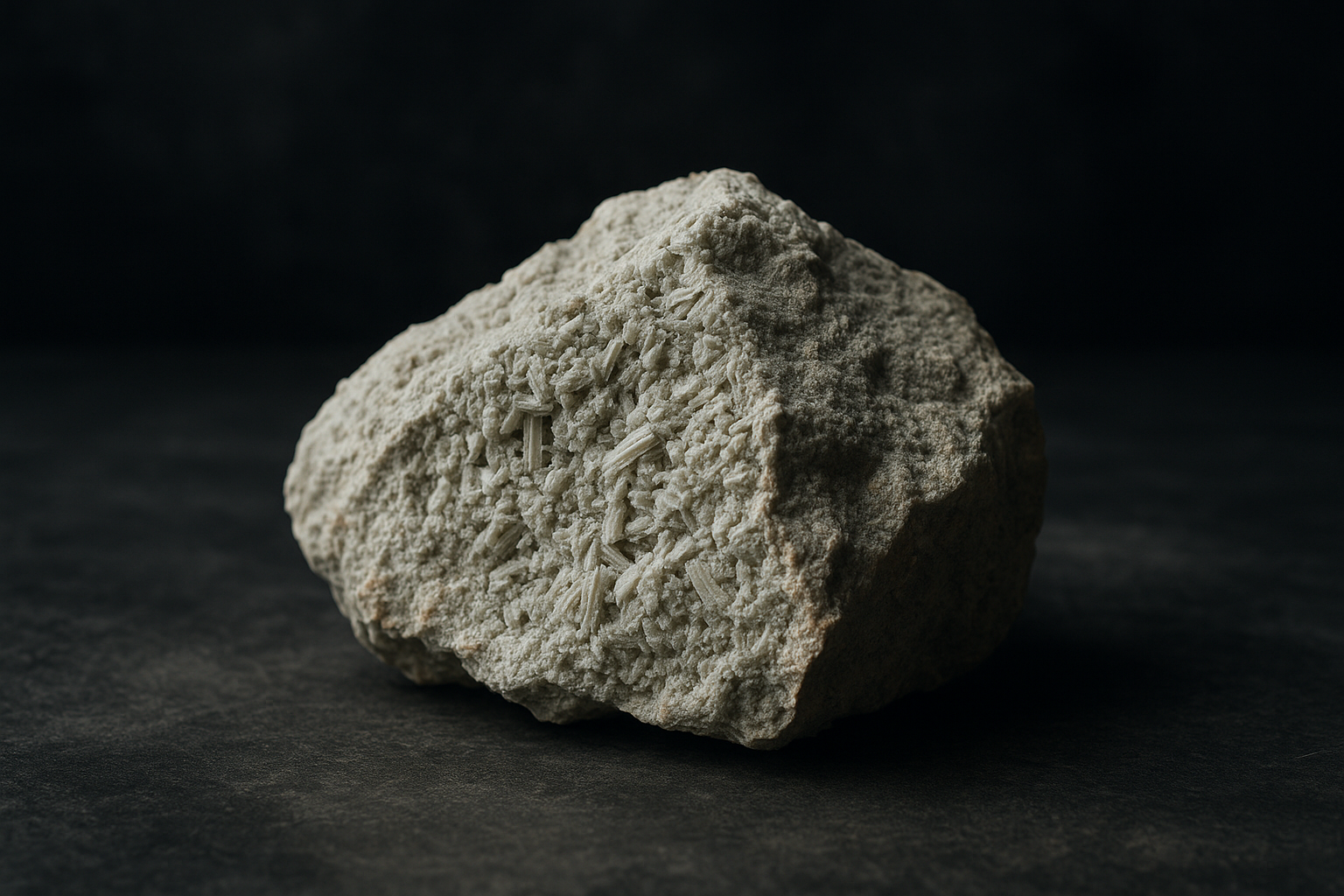
Marine & Port Concrete Durability Admixture — Natural Zeolite SCM to Reinforce Chloride & Sulfate Resistance
Concrete structures in marine, port, seawater intake, and wastewater environments are exposed to two representative deterioration mechanisms: rebar corrosion from chloride ion (Cl⁻) ingress and sulfate (SO₄²⁻) attack. The natural clinoptilolite supplied by KMIZEOLITE is a natural pozzolan reviewed in such environments as a supplementary cementitious material (SCM) that replaces part of the cement, and as a durability admixture.
Let us first make an important premise clear. Zeolite's durability contribution is centered on pore densification (matrix densification) by the pozzolanic reaction, not on the framework directly capturing and removing chloride ions. Unmodified clinoptilolite has a negatively charged aluminosilicate framework, so it exchanges cations but only weakly adsorbs the anionic Cl⁻. The chemical binding of free chloride ions is mainly handled by Friedel's salt formed by the aluminate phases of cement, while zeolite acts to slow the ingress rate of chloride and sulfate ions themselves by reducing capillary pores.
Key Pozzolanic Component Data
The starting point for chloride and sulfate resistance is the reactive silica content. The chemical composition of KMIZEOLITE shows a high-silica makeup that is favorable for durability SCM review.
| Component | Formula | Content | Durability-Related Role |
|---|---|---|---|
| Silicon dioxide | SiO₂ | 66.7% | Reactive silica; core of pore densification and ingress resistance by consuming Ca(OH)₂ |
| Aluminum oxide | Al₂O₃ | 11.48% | Aluminosilicate framework; contributes to forming aluminate-based chloride-binding phases |
| Potassium oxide | K₂O | 3.42% | Exchangeable cation (alkali) |
| Sodium oxide | Na₂O | 1.8% | Exchangeable cation (alkali) |
| Calcium oxide | CaO | 1.33% | Trace lime component |
| Iron oxide | Fe₂O₃ | 0.9% | Trace |
| Magnesium oxide | MgO | 0.27% | Trace |
| Titanium dioxide | TiO₂ | 0.13% | Trace |
| Manganese oxide | MnO | 0.025% | Trace |
The combined total of SiO₂ + Al₂O₃ + Fe₂O₃ is about 79.08%, satisfying the composition criterion (≥70%) for ASTM C618 Class N natural pozzolans. In particular, the reactive silica of SiO₂ 66.7% is the starting point of the durability mechanism: it reacts with Ca(OH)₂ in the alkaline environment to form additional C-S-H and densify the pore structure.
Physical Properties and Durability Applicability
| Property | Value | Meaning for Durability Admixture Use |
|---|---|---|
| Cation exchange capacity (CEC) | 1.6–2.0 meq/g | Cation exchange activity (not an indicator of anionic Cl⁻ adsorption) |
| Pore diameter | 4.0–7.0 Å | Microporous structure; involved in dissolution/reaction in alkaline environments |
| Specific gravity | 1.89 | Lightweight admixture characteristic; weight ratio calculation for mix design |
| Specific surface area | 40.0 m²/g | Large reaction area promotes Ca(OH)₂ consumption and the pozzolanic reaction |
| Bulk density | 720–865 kg/m³ | Basis for weight ratio calculation in mix design |
| pH stability range | 3.0–10.0 | Compatible with the alkaline concrete environment |
| Hardness | 4.0–5.0 Mohs | Eases grinding and classification processes |
The CEC of 1.6–2.0 meq/g in the table is an indicator of cation exchange capacity. In the marine concrete context, this relates only to alkali cation behavior and pozzolanic reactivity; we re-emphasize that it does not mean the framework directly adsorbs the anionic chloride ion.
Chloride & Sulfate Resistance Mechanisms — What Actually Works
1) Pore densification by the pozzolanic reaction (primary mechanism)
When reactive SiO₂ consumes the cement hydration by-product Ca(OH)₂ to generate additional C-S-H, capillary pores decrease and permeability drops. As a result, the diffusion path of chloride and sulfate ions lengthens and the ingress rate slows — this is the most direct principle of durability improvement.
2) Sulfate resistance by lime (Ca(OH)₂) consumption
Sulfate attack occurs when penetrated SO₄²⁻ reacts with Ca(OH)₂ and aluminate phases to form gypsum and ettringite, causing expansion and cracking. When the pozzolanic reaction reduces the Ca(OH)₂ surplus, the amount of lime available to react with sulfate decreases, while pore densification simultaneously slows ingress — so sulfate resistance improves together.
3) Chloride binding is handled by cement chemistry (zeolite does not capture it directly)
The chemical fixation of free chloride ions is mainly carried out by Friedel's salt formed by aluminate phases such as C₃A. The negatively charged framework of unmodified clinoptilolite finds it difficult to adsorb Cl⁻ directly. If a function to actively capture chloride as an anion is desired, metal (La/Fe·Al) or surfactant modification (SMZ, surfactant-modified zeolite) is effectively a prerequisite, and this is a separate modified-material domain distinct from ordinary SCM replacement.
Durability & Chloride Resistance Effects from Research
Najimi et al. reported that in high-performance concrete with natural zeolite replacing 15% and 30% of cement, durability indicators such as rapid chloride penetration (RCPT) resistance and water absorption improved at appropriate replacement, while management of water content and workability becomes more important as the replacement ratio rises (Najimi et al., Construction and Building Materials, 2012). This directly aligns with the primary mechanism of this page — pore densification and delayed ingress.
Feng et al. evaluated the durability of concrete incorporating natural zeolite in a deicing-salt (chloride) environment and reported that resistance behavior against chloride exposure improved at appropriate mixes (Feng et al., Cement and Concrete Research, 2005). Marine chloride attack and deicing salt are mechanistically connected in that chloride ingress is central to both.
The review by Ahmadi and Shekarchi summarizes that natural zeolite is used as a pozzolanic material in a replacement range of about 15–30% by cement mass, and that its microporous structure with a large specific surface area consumes Ca(OH)₂ to contribute to additional C-S-H formation and chemical attack (e.g., sulfate) resistance (Ahmadi & Shekarchi, Cement and Concrete Composites, 2010). This product's specific surface area of 40 m²/g and pores of 4.0–7.0 Å are the physical basis for this behavior.
The recent review by Shekarchi et al. (Shekarchi et al., Construction and Building Materials, 2023) treats natural zeolite as an SCM and examines both the potential and limits of alkali-silica reaction (ASR) mitigation and long-term durability, and applications of high-volume zeolite SCM to eco-friendly concrete have also been reported (Scientific Reports, 2023). In other words, the strength of a zeolite durability admixture lies not in single-property strength gain but in reinforcing ingress resistance and reducing cement under appropriate replacement, fineness, and curing conditions — and the exact replacement ratio and durability effect must be finalized through field trial mixes, as these studies commonly emphasize.
Recommended Product Specification
| Product Name | Mesh | Particle Size | Suitability as Durability Admixture |
|---|---|---|---|
| KMI 100- US MESH (Powder) | Finer than 100 mesh | <150μm, median 50μm | Optimal for durability SCM — fineness and pozzolanic reaction area maximized |
In durability admixture applications, particle size is decisive. Powder finer than 100 mesh is most suitable in terms of reaction area and dispersibility, and because early strength, setting, and workability vary with the chloride/sulfate exposure class and replacement ratio, trial mixes are essential.
Application Points You Can Expect
- Reinforcing chloride ingress resistance of marine and port concrete (based on pore densification)
- Reviewing chemical attack resistance through Ca(OH)₂ consumption in sulfate exposure environments
- 10–25% Portland cement replacement (15–30% range reviewed for durability purposes)
- Reviewing a direction toward alkali-silica reaction (ASR) reduction
- Supplementary use alongside sulfate-resistant cement and low-permeability mix design
How It Differs from Ordinary SCM Replacement
Even for the same natural zeolite, the intent of application differs. While ordinary natural pozzolan SCM replacement focuses on cement reduction and basic pozzolanic effect, the durability admixture perspective on this page sets ingress resistance performance responding to chloride/sulfate exposure classes as an explicit goal. Therefore, beyond replacement ratio and fineness, the exposure class, cement type (C₃A content), cover thickness, and curing conditions must be designed together.
Application Examples
Marine and port structures
For members directly exposed to seawater, such as breakwaters, piers, and marine foundations, a low-permeability, high-durability mix is reviewed through partial cement replacement.
Wastewater and seawater treatment structures
For tanks and conduits in wastewater/seawater environments where sulfate and chloride coexist, it is reviewed as a supplementary material for chemical attack resistance.
Precast and durable concrete products
In precast products that can be factory-cured, fine zeolite can be incorporated to achieve a homogeneous durability mix.
Review Points
- Zeolite's durability contribution is pore densification and delayed ingress, not direct chloride adsorption.
- If an anion (Cl⁻) capture function is needed, metal/surfactant modification (SMZ) is a prerequisite.
- As the replacement ratio rises, early strength, setting, workability, and water content may change.
- Sulfate resistance must be designed together with the overall mix, such as selecting sulfate-resistant cement (low C₃A).
- Target durability per exposure class must be finalized through actual testing such as RCPT and diffusion coefficient.
Frequently Asked Questions (FAQ)
How does natural zeolite improve the chloride resistance of marine and port concrete?
The main contribution is pore densification through the pozzolanic reaction. The reactive SiO₂ (66.7%) in clinoptilolite consumes the calcium hydroxide Ca(OH)₂ generated by cement hydration to form additional C-S-H, reducing capillary pores and lengthening the chloride diffusion path. Najimi et al. (2012) reported that high-performance concrete with natural zeolite replacing 15% and 30% of cement showed improved durability indicators such as rapid chloride penetration (RCPT) resistance and water absorption. However, the exact effect varies with replacement ratio, fineness, and curing conditions, so it must be confirmed through trial mixes.
Does cation exchange directly capture free chloride ions to prevent corrosion?
Explaining it that way alone is a misconception. Unmodified clinoptilolite has a negatively charged aluminosilicate framework that exchanges cations (Ca²⁺, Na⁺, K⁺, etc.), but its ability to directly adsorb the anionic chloride ion (Cl⁻) onto the framework is weak. In marine concrete, free chloride binding is mainly handled by cement chemistry reactions such as Friedel's salt formed by aluminate phases, while zeolite's core contribution is slowing ingress itself through pore densification by the pozzolanic reaction. To actively capture chloride as an anion, metal (La/Fe·Al) or surfactant modification (SMZ) is effectively a prerequisite.
By what principle does it help with sulfate attack resistance?
Sulfate attack is the phenomenon in which penetrated sulfate ions react with calcium hydroxide and aluminate phases to form gypsum and ettringite, causing expansion and cracking. When the pozzolanic reaction consumes Ca(OH)₂, the surplus lime available to react with sulfate decreases, and the densified pore structure slows sulfate ingress itself. The review by Ahmadi and Shekarchi (2010) summarizes that natural zeolite acts to raise chemical attack resistance, including sulfate, by consuming Ca(OH)₂. However, it should be reviewed together with overall mix design, such as selecting sulfate-resistant cement with low C₃A content.
What cement replacement ratio is appropriate for marine concrete?
The literature mainly studies a 10–25% replacement range of Portland cement, and a 15–30% range is also reviewed for durability purposes. The higher the replacement ratio, the more capillary pore reduction and durability improvement can be expected, but early strength development is delayed and management of water content and workability becomes important. The principle is to use powder finer than 100 mesh (median 50μm) and finalize through trial mixes matched to the chloride/sulfate exposure class and target performance.
Related Pages
- Natural Pozzolan (ASTM C618 SCM) — general SCM perspective on cement replacement
- Construction & Industrial Materials Applications — category hub
- Products & Particle Size — powder specifications for durability SCM
- Technical Data & Certifications — detailed properties and test data
Notice
Durability results for marine and port concrete may vary depending on raw material purity, fineness, replacement ratio, cement type, exposure class, curing method, and required performance criteria. Before actual application, please confirm suitability through property verification such as RCPT, diffusion coefficient, and sulfate resistance testing, along with trial mixes. The chemical composition and property data on this page are based on KMI public technical materials; please confirm the latest TDS upon actual delivery.
[Inquire about zeolite particle size, powder specifications, and bulk supply for marine and port durability concrete →]
science Related Research Papers
These are academic papers addressing zeolite's application to concrete durability, chloride, and sulfate in this field. Please refer to them when reviewing adoption.
- Properties of high-performance concrete incorporating natural zeolite
Najimi, M. et al. — Construction and Building Materials, 2012 (chloride ingress, durability) - Effect of natural zeolite on durability of concrete against deicing salt
Feng, N. et al. — Cement and Concrete Research, 2005 (chloride environment durability) - Natural zeolite as pozzolanic material: A review
Ahmadi, B. and Shekarchi, M. — Cement and Concrete Composites, 2010 (Ca(OH)₂ consumption, chemical attack resistance) - Natural zeolite as supplementary cementitious material: A holistic review
Shekarchi, M. et al. — Construction and Building Materials, 2023 (SCM durability, ASR) - Eco-friendly concrete with high-volume zeolitic supplementary cementitious materials
Scientific Reports, 2023 (high-volume zeolite SCM)
The papers above are reference materials, and actual application requires separate review tailored to site conditions.