Geopolymer Precursor (Alkali-Activated Binder Feedstock)
Natural clinoptilolite with SiO₂ 66.7% and Al₂O₃ 11.48% (SiO₂/Al₂O₃ molar ratio approx. 9.9) that, upon alkali activation, forms an N-A-S-H binder network without cement — a cement-free, low-carbon binder precursor. This page sets out an application perspective premised on the dissolution limits of crystalline minerals and on combined use with supplementary precursors.
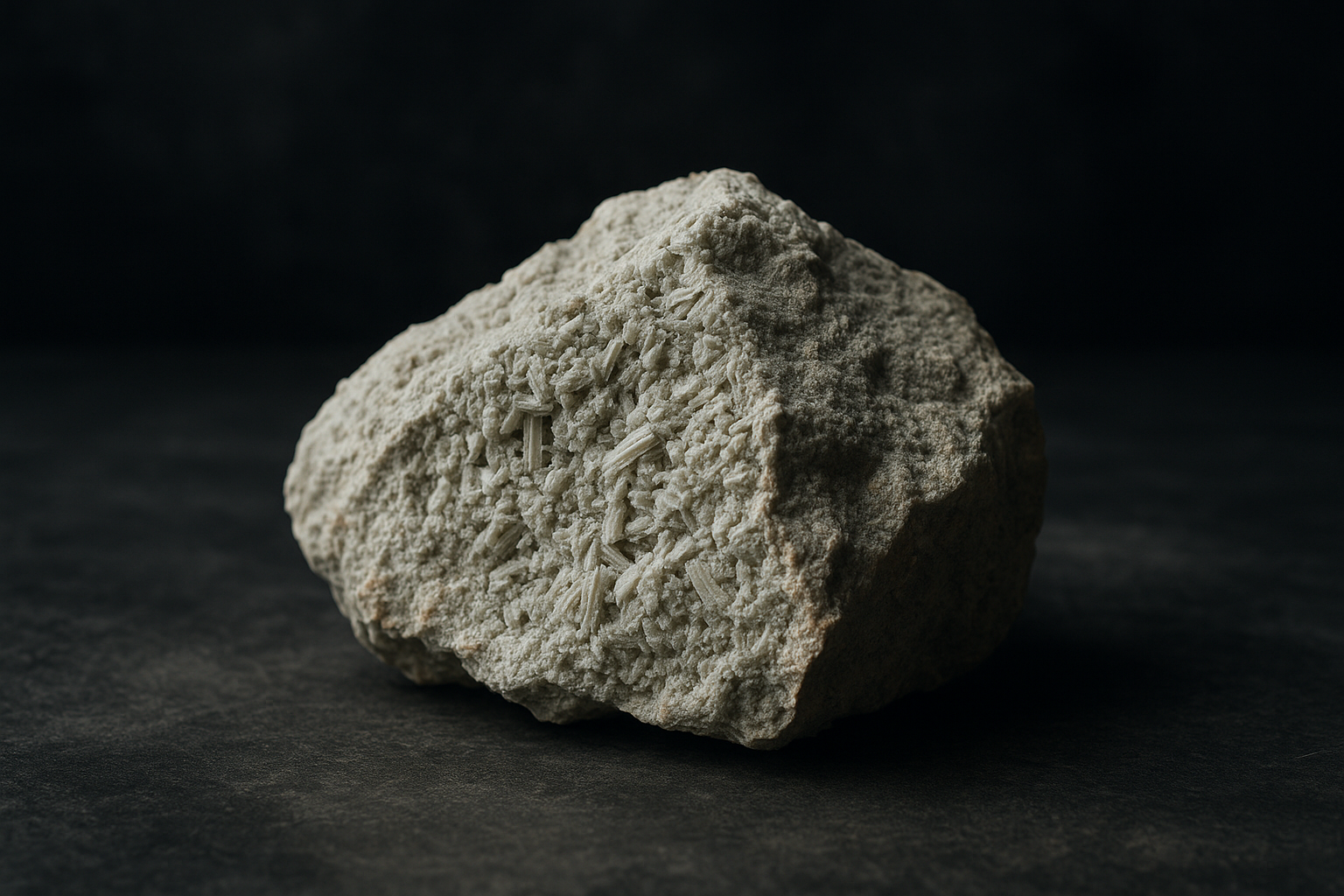
Geopolymer (Alkali-Activated) Precursor — Aluminosilicate Feedstock for Cement-Free, Low-Carbon Binders
A geopolymer is a cement-free, low-carbon binder that forms a binder network without Portland cement by activating an SiO₂- and Al₂O₃-rich aluminosilicate precursor with concentrated alkali hydroxide (NaOH/KOH) or silicate solution. The natural clinoptilolite supplied by KMIZEOLITE has an aluminosilicate composition of SiO₂ 66.7% and Al₂O₃ 11.48%, making it a candidate for laboratories and specialty-concrete companies seeking such alkali-activated binder feedstock.
This page treats clinoptilolite from the perspective of an alkali-activated binder precursor, whose chemistry and process differ from those of a natural pozzolan (SCM). That is, the focus is not the pozzolanic reaction with Ca(OH)₂ generated by cement hydration, but rather its role as feedstock for the N-A-S-H (sodium aluminosilicate hydrate) binder network formed directly by alkali activation.
Key Composition Data as a Precursor
The starting point of the geopolymer reaction is the supply and ratio of SiO₂ and Al₂O₃ in the aluminosilicate. KMIZEOLITE's chemical composition is as follows.
| Component | Formula | Content | Role from a geopolymer-precursor view |
|---|---|---|---|
| Silicon dioxide | SiO₂ | 66.7% | Source of silicate species — the Si backbone of the binder network |
| Aluminum oxide | Al₂O₃ | 11.48% | Source of aluminate species — framework negative charge and cross-linking |
| Potassium oxide | K₂O | 3.42% | Contains alkali cations (contributing to charge balance) |
| Sodium oxide | Na₂O | 1.8% | Alkali cation (Na₂O/Al₂O₃ balance factor) |
| Calcium oxide | CaO | 1.33% | Low-calcium system — favors an N-A-S-H-dominant binder network |
| Iron oxide | Fe₂O₃ | 0.9% | Trace |
| Magnesium oxide | MgO | 0.27% | Trace |
| Titanium dioxide | TiO₂ | 0.13% | Trace |
| Manganese oxide | MnO | 0.025% | Trace |
Converting SiO₂ 66.7% and Al₂O₃ 11.48% to a molar basis gives a SiO₂/Al₂O₃ molar ratio of about 9.9, a strongly silica-dominant composition. In the alkali-activated-binder literature, the SiO₂/Al₂O₃ range reported for adsorption and binding behavior is roughly 0.5–5, so when clinoptilolite is used as a precursor, the design must lower the ratio with supplementary alumina sources (metakaolin, fly ash, etc.) or adjust the silicate-solution composition (Luukkonen et al., 2019).
In addition, because CaO is low at 1.33% — a low-calcium system — it suits the aim of a binder network dominated by highly three-dimensionally connected N-A-S-H gel, unlike high-calcium slag-based systems (C-A-S-H).
Physical Properties and Precursor Applicability
| Property | Value | Meaning for precursor application |
|---|---|---|
| Cation exchange capacity (CEC) | 1.6–2.0 meq/g | Indicator of framework negative charge — alkali-cation acceptance |
| Pore diameter | 4.0–7.0 Å | Alkali dissolution and diffusion pathway (crystalline structure) |
| Specific gravity | 1.89 | Design factor for lightweight binders |
| Specific surface area | 40.0 m²/g | Secures reaction area for dissolution during alkali activation |
| Bulk density | 720–865 kg/m³ | Basis for weight-ratio calculation in mix design |
| pH stability range | 3.0–10.0 | Strongly alkaline activation environments require separate evaluation |
| Hardness | 4.0–5.0 Mohs | Easy to grind and micronize |
A point to note is that clinoptilolite is a crystalline zeolite. The most widely used precursors in alkali-activated binders are the amorphous (non-crystalline) aluminosilicates metakaolin and Class F fly ash, and crystalline minerals can dissolve in alkali relatively slowly. Accordingly, it is reasonable to position clinoptilolite as a reactive silica/alumina supplementary source or supplementary precursor rather than a stand-alone precursor, and micronization pretreatment to increase the dissolution area is recommended.
Alkali Activation Reaction Mechanism
The alkali-activation (geopolymerization) reaction is summarized in the literature in the following stages (Luukkonen et al., 2019): (1) dissolution of the aluminosilicate raw material, (2) speciation equilibrium of aluminate and silicate species, (3) gelation, (4) reorganization, and (5) polymerization & hardening.
In low-calcium systems, a highly three-dimensionally connected sodium aluminosilicate hydrate (N-A-S-H) gel forms, and this framework is intrinsically negatively charged. That negative charge is balanced by alkali cations such as Na⁺ and K⁺, and from a charge-balance standpoint an optimum is reported near a Na₂O/Al₂O₃ molar ratio of about 1. At the same time, the Na₂O/SiO₂ ratio governs the alkali-driven depolymerization of the framework, so too high a value can actually inhibit the reaction.
Forming a geopolymer binder network is not a matter of "more alkali" but of "the right SiO₂/Al₂O₃ and Na₂O/Al₂O₃ balance." The key is mix design that takes the precursor's composition as a starting point and tunes the activator ratios accordingly.
Why Cement-Free, Low-Carbon Binders Are Drawing Attention
Portland cement manufacturing is one of the largest carbon-emission sources in the construction industry. Alkali-activated materials (AAM) and their subcategory, geopolymers, are classified as low-carbon alternative binders, and their environmental and economic viability is emphasized by the fact that they can be produced through relatively simple, low-energy processes at or near ambient temperature (Luukkonen et al., 2019).
Industrial by-products such as metakaolin, fly ash, and blast-furnace slag are the main precursors, but natural aluminosilicate minerals are also considered as supplementary feedstock in terms of composition and supply stability. Natural zeolite, being mine-based, has a consistent composition and high SiO₂ content, giving it combined-use value as a reactive silica/alumina source.
Precursor and Binder-Network Characteristics from the Research
The review by Luukkonen et al. (Luukkonen et al., Reviews in Environmental Science and Bio/Technology, 2019) summarizes that alkali-activated materials are made by treating aluminosilicate precursors with concentrated alkali/silicate solutions, and that the SiO₂/Al₂O₃ ratios reported for adsorption and ion-exchange uses generally fall in the 0.5–5 range. It also reports that a lower ratio yields a more three-dimensional structure and a larger negative charge rather than two-dimensional chains, that the framework's zeta potential is negative (–), and that the principal adsorption mechanism is cation exchange, similar to zeolites.
Trends in geopolymer raw materials, mix design, and applications are covered broadly in review articles. The potential and limitations as an eco-friendly construction material are summarized — focusing on methodologies and evaluation criteria — in Recent Advances in Geopolymer Technology (Journal of Composites Science, 2021) and Geopolymer: A Systematic Review of Methodologies (Materials, 2022), while the circular-economy perspective of using industrial by-products as precursors is addressed in A Review of Industrial By-Product Utilization (Sustainability, 2025).
Geopolymer precursors and zeolites are also chemically on a continuum. It has been reported that the amorphous N-A-S-H gel formed by alkali activation can transform into a crystalline zeolite (e.g., the NaA type) under additional curing and hydrothermal conditions (NaA zeolite synthesis from geopolymer precursor, MRS Communications, 2011), suggesting that precursor composition and curing conditions govern the final microstructure.
In short, the value of a clinoptilolite precursor lies not in a single strength figure but in its stable aluminosilicate composition and the latitude to adjust ratios as a supplementary precursor; as these studies consistently emphasize, accurate mix and activator design must be confirmed through trial batches.
Recommended Product Specification
| Product | Mesh | Particle size | Suitability for precursor use |
|---|---|---|---|
| KMI 100- US MESH (Powder) | 100 mesh or finer | <150μm, median 50μm | Recommended for precursor use — fineness maximizes alkali dissolution area |
Because the alkali dissolution rate of crystalline minerals depends heavily on particle size, a fine powder of 100 mesh or finer is advantageous for precursor and supplementary-precursor applications. The activator concentration (NaOH / sodium-silicate modulus), liquid/solid ratio, and curing temperature and time must be determined by trial batches according to the target binder properties.
Application Points You Can Expect
- Evaluation as a supplementary aluminosilicate precursor for cement-free alkali-activated binders
- Combined use as a silica source to adjust the SiO₂/Al₂O₃ ratio with metakaolin/fly-ash precursors
- Support for designing a low-calcium, N-A-S-H-dominant binder network
- Raw material for low-carbon, eco-friendly specialty-binder R&D
- Research into possible zeolitization (secondary phase) depending on curing conditions
Distinguishing from Natural Pozzolan (SCM)
| Comparison item | Geopolymer precursor | Natural pozzolan (SCM) |
|---|---|---|
| Cement use | Cement-free (alkali activation only) | Partial cement replacement/supplement |
| Reaction mechanism | Alkali activation → N-A-S-H binder network | Pozzolanic reaction with Ca(OH)₂ → C-S-H |
| Key design variables | Activator (alkali/silicate) composition, Si/Al and Na/Al ratios | Replacement rate, fineness, curing |
| Binder classification | Low-carbon alternative binder | Supplementary cementitious material (SCM) |
Even for the same clinoptilolite, the pozzolan (SCM) use and the geopolymer-precursor use differ in chemistry and process. For the pozzolan application perspective, please also refer to the natural pozzolan page.
Application Examples
Combined use with a supplementary precursor
Fine clinoptilolite can be partially blended into a metakaolin/fly-ash main precursor and evaluated as a supplementary material to adjust the SiO₂/Al₂O₃ ratio and silica supply.
Low-carbon specialty-binder R&D
Laboratories and specialty-concrete companies developing cement-free binders can use it as a raw material to explore binder-network characteristics with activator composition and curing conditions as variables.
Zeolitization and porous-binder research
It can serve as a starting material for research that induces a transition from an amorphous gel to a crystalline zeolite phase depending on curing conditions, or for developing porous binders that combine adsorption and ion-exchange functions.
Evaluation Points
- Because clinoptilolite is crystalline, it may dissolve in alkali more slowly than amorphous precursors, so micronization and combined use with a supplementary precursor are prerequisites.
- The SiO₂/Al₂O₃ molar ratio (about 9.9) is high, so the ratio must be adjusted with a supplementary alumina source.
- Activator (alkali/silicate) composition, liquid/solid ratio, and curing temperature and time govern the binder properties.
- Safe handling of strong alkali (NaOH/KOH) and proper working-environment management are required.
- Final performance is determined by the combination of precursor composition, activator, and curing, so trial batches are essential.
Frequently Asked Questions (FAQ)
Is natural clinoptilolite suitable as a geopolymer (alkali-activated) precursor?
Geopolymers form an N-A-S-H binder network by activating SiO₂- and Al₂O₃-rich aluminosilicate precursors with concentrated alkali (NaOH/KOH) or silicate solutions. KMIZEOLITE clinoptilolite, at SiO₂ 66.7% and Al₂O₃ 11.48%, has an aluminosilicate composition and is therefore a precursor candidate. However, geopolymer reactivity depends on the proportion of amorphous (non-crystalline) silica and alumina and on particle size, and crystalline zeolites can dissolve in alkali more slowly than metakaolin or fly ash. As a result, clinoptilolite is generally evaluated as a supplementary precursor or a reactive silica/alumina source rather than as a stand-alone precursor.
By what mechanism does a geopolymer binder network harden?
Alkali activation proceeds through (1) dissolution of the aluminosilicate raw material, (2) speciation equilibrium of aluminate and silicate species, (3) gelation, (4) reorganization, and (5) polymerization and hardening. In low-calcium systems, a highly three-dimensionally connected sodium aluminosilicate hydrate gel (N-A-S-H) forms. The framework's negative charge is then balanced by alkali cations such as Na⁺, and from a charge-balance standpoint an optimum is reported near a Na₂O/Al₂O₃ molar ratio of about 1.
Why is the SiO₂/Al₂O₃ ratio important?
The SiO₂/Al₂O₃ ratio determines the dimensionality and charge density of the geopolymer framework. A lower ratio means a more three-dimensional structure and a larger negative charge rather than two-dimensional chains, while a higher ratio forms a network rich in silicate species. This product's clinoptilolite, at SiO₂ 66.7% and Al₂O₃ 11.48%, corresponds to a silica-dominant composition with a SiO₂/Al₂O₃ molar ratio of about 9.9, so mix design must adjust the ratio toward the target binder properties by tuning the alkali/silicate solution composition and adding supplementary alumina sources (metakaolin, fly ash, etc.).
Do geopolymer binders also adsorb anions (phosphate, arsenic, etc.)?
Both geopolymers and unmodified clinoptilolite have a negatively charged aluminosilicate framework, so they are inherently favorable to cation exchange and weak at anion adsorption. To target oxyanions such as arsenic and phosphate, metal (Ca/La/Fe·Al) or surfactant modification (SMZ) is effectively a prerequisite; in some cases, the formation of a secondary layered double hydroxide (LDH) phase such as hydrotalcite during alkali activation can impart anion-exchange capacity. Anion adsorption cannot be explained by cation-exchange logic.
As a cement-free binder, how does it differ from a natural pozzolan (SCM)?
A natural pozzolan (SCM) replaces part of the Portland cement and acts as a supplementary material that reacts with the Ca(OH)₂ generated by cement hydration to form additional C-S-H. A geopolymer precursor, by contrast, is a cement-free, low-carbon binder feedstock that forms an N-A-S-H binder network through alkali activation alone, without cement; its chemistry and process differ in that activator (alkali/silicate) design is central. The two uses must be evaluated separately, and even for the same mineral the application context differs.
Related Pages
- Natural Pozzolan Zeolite — cement-replacement SCM (C-S-H) perspective
- Construction & Industrial Materials Applications — category hub
- Products & Particle Size — powder specification for precursor use
- Technical Data & Certifications — detailed properties and TDS
Notice
Geopolymer-precursor application results can vary greatly depending on the raw-material composition and particle size, the activator (alkali/silicate) ratio, the liquid/solid ratio, the curing conditions, and whether a supplementary precursor is used. Before actual application, please verify suitability through trial batches and property testing. The chemical composition and property data on this page are based on KMI's published technical documentation; please confirm the latest TDS at the time of actual delivery.
[Inquire about zeolite particle size, powder specifications, and bulk supply for geopolymer precursor use →]
science Related Research Papers
Academic papers addressing alkali activation and geopolymer precursors in this field. Refer to them when evaluating adoption.
- Application of alkali-activated materials for water and wastewater treatment: a review
Luukkonen, T. et al. — Reviews in Environmental Science and Bio/Technology, 2019 - Recent Advances in Geopolymer Technology: A Potential Eco-Friendly Solution in the Construction Materials Industry — A Review
Journal of Composites Science, 2021 - Geopolymer: A Systematic Review of Methodologies
Materials, 2022 - A Review of Industrial By-Product Utilization and Future Pathways of Circular Economy: Geopolymers as Modern Materials for Sustainable Building
Sustainability, 2025 - NaA zeolite synthesis from geopolymer precursor
MRS Communications, 2011
The papers above are for reference only; actual application requires separate evaluation suited to on-site conditions.