Radiation Shielding & Nuclear Waste Solidification Concrete (Cs/Sr Immobilization)
An overview of the applicability of a zeolite admixture that binds cesium and strontium radionuclides into cement solidification matrices via ion exchange to reduce leaching.
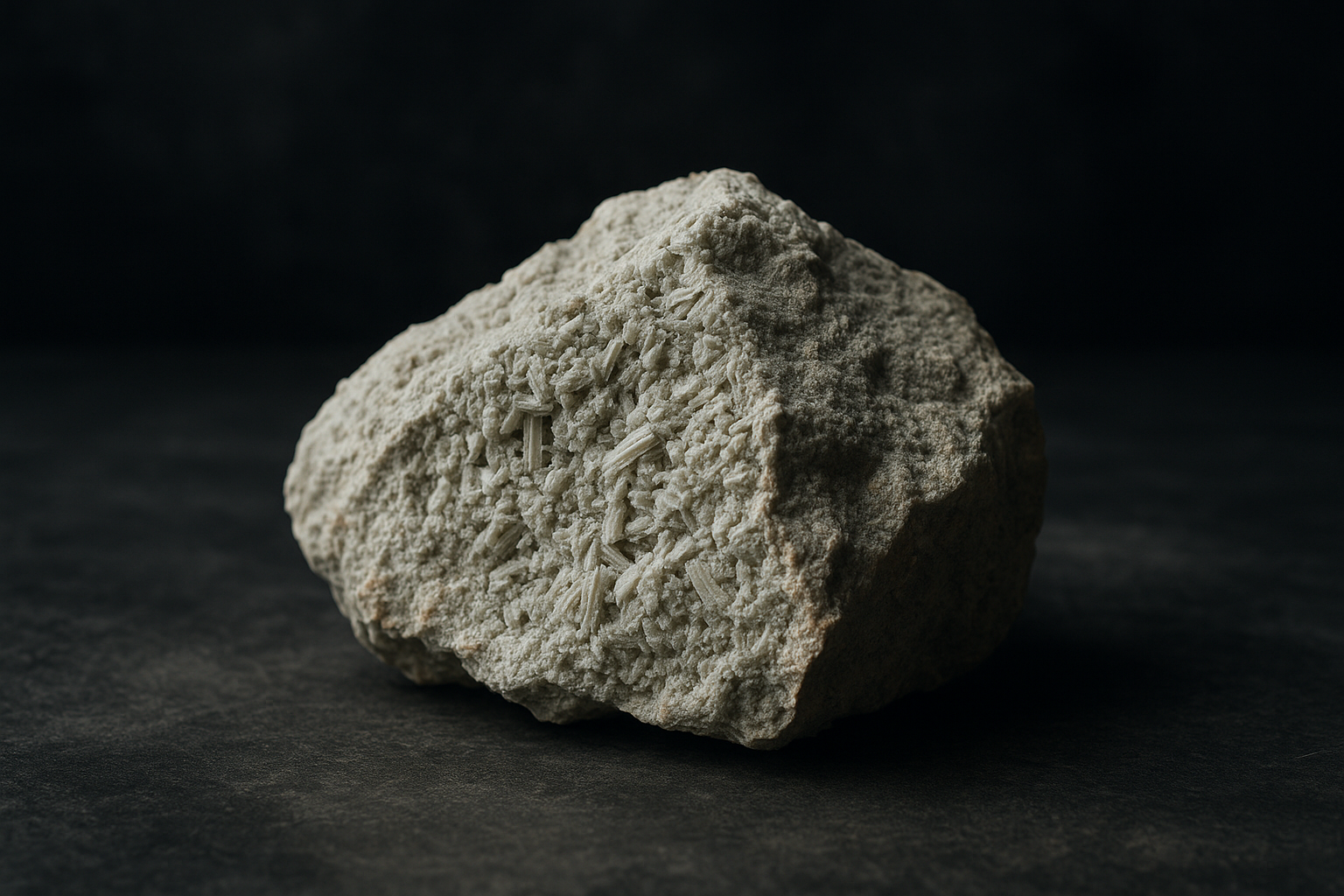
Radiation Shielding & Nuclear Waste Solidification Concrete — A Zeolite Admixture That Immobilizes Cs/Sr Radionuclides
In nuclear power plant operation, radioactive waste treatment facilities, and contaminated-water treatment processes, stably containing radionuclides such as cesium-137 (Cs⁺) and strontium-90 (Sr²⁺) is a key challenge. The natural clinoptilolite supplied by KMIZEOLITE is a high-purity mineral with a clinoptilolite content of 97.0%, mined in Amargosa Valley, Nevada, USA, and is reviewed as an admixture that immobilizes these radionuclides in the medium through ion exchange.
There are two concepts to distinguish first. One is shielding, which physically attenuates gamma rays and neutrons; the other is immobilization, which chemically binds radionuclides so they cannot escape again on contact with water. The area where zeolite contributes is the latter — reducing radionuclide leaching from cement solidification matrices.
Key Ion-Exchange Component Data
Radionuclide-immobilization performance arises from the amount of exchangeable cations that offset the framework's negative charge and from the aluminosilicate framework structure. The chemical composition of KMIZEOLITE shows a makeup favorable to this ion-exchange behavior.
| Component | Formula | Content | Role in Radionuclide Immobilization |
|---|---|---|---|
| Silicon dioxide | SiO₂ | 66.7% | Main framework of the aluminosilicate structure; forms the porous architecture |
| Aluminum oxide | Al₂O₃ | 11.48% | Source of framework negative charge — central to creating the exchangeable-cation sites that capture Cs⁺ and Sr²⁺ |
| Potassium oxide | K₂O | 3.42% | Exchangeable cation — an ion site that exchanges with Cs⁺ |
| Sodium oxide | Na₂O | 1.8% | Exchangeable cation — an ion-exchangeable site |
| Calcium oxide | CaO | 1.33% | Exchangeable cation — a site behaving similarly to Sr²⁺ |
| Iron oxide | Fe₂O₃ | 0.9% | Trace |
| Magnesium oxide | MgO | 0.27% | Trace |
| Titanium dioxide | TiO₂ | 0.13% | Trace |
| Manganese oxide | MnO | 0.025% | Trace |
The decisive item in radionuclide immobilization is Al₂O₃ at 11.48%. The negative charge created by Al in the framework forms sites that attract exchangeable cations (K⁺, Na⁺, Ca²⁺), and these sites exchange with Cs⁺ and Sr²⁺ in the liquid waste, capturing the radionuclides inside the framework. Clinoptilolite has particularly high selectivity for Cs⁺ and is reported to capture cesium preferentially over competing ions such as Pb²⁺ and Cu²⁺.
Physical Properties and Immobilization Applicability
| Property | Value | Meaning for Radionuclide Immobilization |
|---|---|---|
| Cation exchange capacity (CEC) | 1.6–2.0 meq/g | Direct measure of the capacity available to capture Cs⁺ and Sr²⁺ |
| Pore diameter | 4.0–7.0 Å | Determining factor for the accessibility of hydrated ions into the framework |
| Specific gravity | 1.89 | Basis for calculating weight ratios when proportioning the solidified mix |
| Specific surface area | 40.0 m²/g | Favorable for securing contact and exchange area with radionuclides |
| Bulk density | 720–865 kg/m³ | Basis for volume/weight conversion when designing the dosage |
| Stable pH range | 3.0–10.0 | Stability in alkaline cement and liquid-waste environments |
| Hardness | 4.0–5.0 Mohs | Eases grinding and classification processes |
CEC 1.6–2.0 meq/g is the cation equivalent that can be exchanged per unit mass and serves as a primary indicator of radionuclide-capture capacity. However, since the actual adsorbed amount varies with radionuclide concentration, competing ions, pH, temperature, particle size, and whether thermal treatment is applied, it should be interpreted as an upper-bound/trend indicator rather than an absolute value.
Why Zeolite Is Considered for Radionuclide Solidification
The goal of radioactive liquid-waste and waste management is to bind radionuclides into a stable solid isolated from the environment and prevent long-term leaching. Cement solidification is the most common stabilization method, but it has been noted that a cement-only matrix cannot capture soluble Cs⁺ sufficiently and can leak into leachate.
Natural zeolite has long been studied as an auxiliary adsorption/immobilization phase that fills this gap. Two routes are reviewed together: packing it into a column to first adsorb radionuclides from the liquid waste and then solidifying the spent zeolite into cement, or adding fine zeolite powder of 100 mesh or finer directly as an admixture to increase the radionuclide-retention capacity of the solidified body itself. Its mine-based stable supply and low cost are also important advantages in large-scale waste treatment.
Cs/Sr Adsorption and Immobilization Effects in Research
The treatment of radioactive nuclides by natural clinoptilolite has been addressed in several reviews and experimental studies. The review by de Gennaro et al. (including Borai-line research, Journal of Environmental Radioactivity, 2021) summarizes the overall radioactive-waste treatment flow in which zeolite captures Cs and Sr through ion exchange and, after adsorption, the medium is solidified into cement or ceramics. This product's CEC of 1.6–2.0 meq/g and 40 m²/g specific surface area are directly linked to this exchange/adsorption behavior.
An early study by Faghihian et al. (Faghihian et al., Applied Radiation and Isotopes, 1999) reported that clinoptilolite can remove not only radioactive cesium and strontium but also Pb²⁺, Ni²⁺, Cd²⁺, and Ba²⁺, and confirmed in particular a high selectivity for Cs. More recent ion-exchange studies (Ion exchange of Cs⁺ and Sr²⁺ by natural clinoptilolite, Journal of Radioanalytical and Nuclear Chemistry, 2020) and a study on thermal-treatment effects (Removal of Cesium and Strontium Ions by Thermally Treated Natural Zeolite, 2023) quantitatively summarize how Cs/Sr selectivity and adsorption capacity change with particle size, thermal treatment, and competing-ion conditions.
On the solidification-medium side, a review of alkali-activated materials (AAM) (Application of alkali-activated materials for water and wastewater treatment, Reviews in Environmental Science and Bio/Technology, 2019) cites values of about 24 mg/g Cs adsorption capacity for a single medium and 4.26–4.75 mg/g for AAM, summarizing how zeolite and geopolymer classes are used for cesium immobilization. In other words, the strength of zeolite lies not in simple shielding but in chemical immobilization that binds radionuclides to the framework and reduces leaching, and as all of the studies above commonly emphasize, the exact adsorption capacity and leaching behavior must be confirmed by batch, column, and leaching tests under actual liquid-waste conditions.
Recommended Product Specifications
| Product Name | Mesh | Particle Size | Suitability for Solidification Use |
|---|---|---|---|
| KMI 100- US MESH (Powder) | 100 mesh or finer | <150μm, median 50μm | Optimal for cement blending/solidification — maximizes dispersibility and reaction area |
| KMI 14×40 / 8×14 MESH (Granular) | 14×40, 8×14 mesh | Granular | For column packing for primary adsorption of liquid waste — linked to solidification after adsorption |
When blending directly into a cement solidification matrix, fine powder of 100 mesh or finer is most suitable in terms of dispersibility and exchange area. By contrast, for the route of first passing liquid waste through a column to capture radionuclides and then solidifying the spent medium, granular products are advantageous for managing pressure drop and channeling. In either route, the dosage and radionuclide loading must be determined by testing.
Expected Application Points
- Assisting in reducing Cs⁺/Sr²⁺ leaching within cement solidification matrices
- Linking primary column adsorption of radioactive liquid waste with cement solidification of the spent medium
- Supplementing the radionuclide-retention capacity of low-level radioactive waste (LLW) solidification mixes
- Reviewing combined use as an adsorption phase with alkali-activated materials (AAM) and geopolymer media
- Suitability for mass treatment thanks to mine-based stable supply and low cost
Distinguishing the Roles of Shielding and Immobilization
| Category | Radiation Shielding | Radionuclide Immobilization |
|---|---|---|
| Purpose | Physical attenuation of gamma rays and neutrons | Chemical capture of radionuclides and reduced leaching |
| Determining factor | Density and heavy-element content (barite, magnetite aggregates, etc.) | Cation exchange capacity and radionuclide selectivity |
| Role of zeolite | Not applicable (negligible density contribution) | Key adsorption/immobilization phase |
| Typical target | Structures around the radiation source | Cs⁺/Sr²⁺-bearing liquid-waste/waste solidified bodies |
This table is for general reference on distinguishing roles. Zeolite does not replace shielding itself; it is accurate to position it as an admixture responsible for radionuclide immobilization and leaching reduction.
Application Examples
Blending into Cement Solidification Matrices
For low-level radioactive waste solidification mixes, fine zeolite powder of 100 mesh or finer is reviewed for blending in to increase the matrix's Cs/Sr retention capacity.
Solidification After Column Adsorption of Liquid Waste
After primarily capturing radionuclides in liquid waste with a granular zeolite column, the spent medium is solidified into cement or geopolymer to stabilize it into a final disposal form.
Combined Use with AAM/Geopolymer
Zeolite can be reviewed for combined use as an adsorption phase in alkali-activated-material-based solidification media to supplement cesium-immobilization performance.
Review Points
- Radionuclide adsorption/immobilization performance is heavily influenced by radionuclide concentration, pH, competing ions, temperature, particle size, and thermal treatment.
- Literature values for CEC and adsorption capacity are upper-bound/trend indicators and must be re-verified under actual liquid-waste conditions.
- The leaching behavior of the final solidified body must be confirmed by prescribed leaching tests.
- Radiation-shielding performance is a separate density/aggregate design matter, and zeolite does not replace it.
- Radioactive-waste treatment and disposal presuppose compliance with relevant regulatory criteria, and actual application must follow licensing procedures.
Frequently Asked Questions (FAQ)
How does zeolite immobilize radioactive nuclides such as cesium and strontium?
Clinoptilolite is a porous aluminosilicate with exchangeable cations that offset the negative charge of its framework. Through ion exchange, it captures radionuclide cations such as Cs⁺ and Sr²⁺ at sites inside the framework. Clinoptilolite is reported to have especially high selectivity for Cs⁺ (preferentially adsorbing it over competing ions such as Pb²⁺ and Cu²⁺). When these exchanged cations are locked inside a cement solidification matrix, leaching back out on contact with water is reduced. This product's CEC of 1.6–2.0 meq/g is a measure of this exchange capacity.
How does the 'shielding' of shielding concrete differ from 'radionuclide immobilization'?
Gamma-ray and neutron shielding is physical attenuation determined mainly by the density and heavy-element content of the concrete (e.g., barite and magnetite aggregates), and this is not the role of zeolite. The part zeolite contributes is 'radionuclide immobilization' — chemical solidification (immobilization) that binds dissolved Cs⁺ and Sr²⁺ in radioactive liquid waste or contaminants into the matrix via ion exchange to reduce their release into the environment. Zeolite therefore does not replace shielding itself; it is reviewed as an admixture that supplements the radionuclide-retention performance of the solidified body.
What is the radionuclide adsorption capacity of a zeolite-blended cement solidification matrix?
In the literature, the cesium adsorption capacity of natural clinoptilolite and alkali-activated material (AAM) based media is reported in roughly the range of a few mg/g up to about 24 mg/g. For example, a review of alkali-activated materials cites a Cs adsorption capacity of about 24 mg/g for a single medium and around 4.26–4.75 mg/g for AAM. Because adsorption capacity varies greatly with radionuclide concentration, pH, competing ions, temperature, particle size, and whether thermal treatment is applied, it must be confirmed by batch and column tests under actual liquid-waste conditions.
Why is natural zeolite used for radioactive waste solidification?
Natural clinoptilolite has been studied for radioactive liquid-waste treatment and cement solidification for a long time because of its selective ion-exchange affinity for Cs⁺ and Sr²⁺, its stability in alkaline environments (pH 3–10), and its mine-based stable supply and low cost. Both approaches are reviewed: first capturing radionuclides from liquid waste by column adsorption and then solidifying the spent zeolite into a cement matrix, or adding fine zeolite powder directly as an admixture to increase the radionuclide-retention capacity of the solidified body. However, final application must be verified against regulatory criteria and long-term leaching tests.
Related Pages
- Natural Pozzolan Zeolite — from a supplementary cementitious material (SCM) perspective
- Zeolite for Concrete Blending/Admixture — application within concrete mixes
- Powder Zeolite Products — fine-powder specifications for solidification
- Granular Zeolite Products — specifications for liquid-waste column packing
- TDS / Technical Data — detailed CEC and property data
Notice
Radionuclide immobilization/solidification results may vary depending on radionuclide type and concentration, pH, competing ions, particle size, whether thermal treatment is applied, the solidification medium and mix conditions, the curing method, and the required leaching criteria. This page is technical reference material summarizing the ion-exchange behavior and research evidence of natural zeolite, and radioactive-waste treatment and disposal presuppose compliance with relevant regulations and licensing procedures. Before actual application, please confirm suitability through test adsorption and leaching verification. The chemical composition and property data on this page are based on KMI public technical data; please confirm the latest TDS at the time of actual delivery.
[Inquire about zeolite particle size, powder specifications, and bulk supply for radionuclide solidification/shielding concrete →]
science Related Papers
These are academic papers addressing zeolite application in this field. Please refer to them when reviewing adoption.
- Radioactive waste treatments by using zeolites. A short review
Journal of Environmental Radioactivity, 2021 - Use of clinoptilolite for removal of radioactive cesium, strontium and Pb2+, Ni2+, Cd2+, Ba2+
Faghihian, H. et al. — Applied Radiation and Isotopes, 1999 - Ion exchange of Cs+ and Sr2+ by natural clinoptilolite
Journal of Radioanalytical and Nuclear Chemistry, 2020 - Removal of Cesium and Strontium Ions by Thermally Treated Natural Zeolite
2023 - Application of alkali-activated materials for water and wastewater treatment: a review
Reviews in Environmental Science and Bio/Technology, 2019
The papers above are reference material; separate review tailored to actual on-site conditions is required for real application.