TDS / Technical Data Sheet
Product technical data sheet.
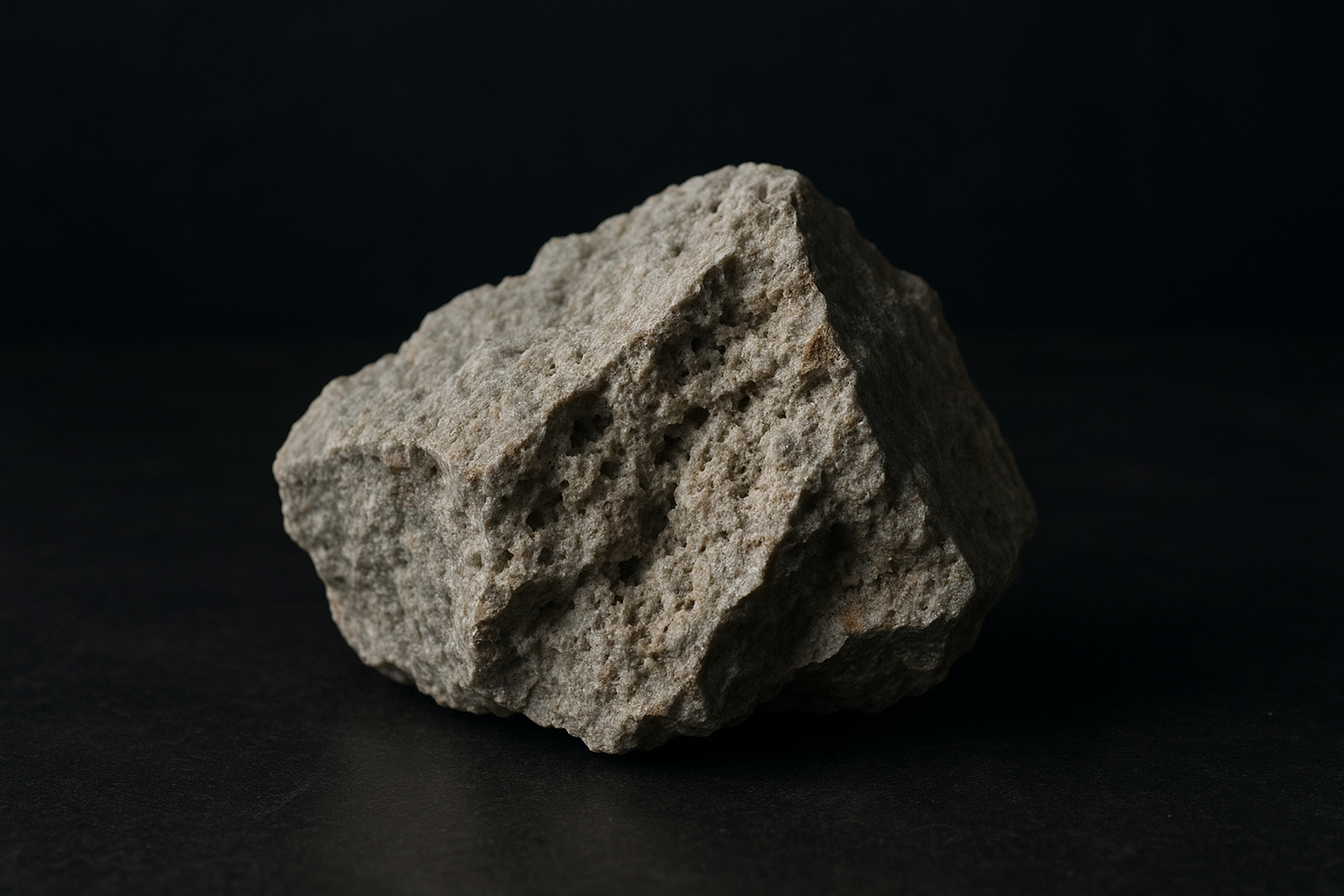
TDS / Technical Data — Complete Material Properties
When actually selecting a zeolite, the most important question is not simply "is it a zeolite or not" but rather what material properties does the zeolite have. A TDS (Technical Data Sheet) is the document that lets you verify the key properties needed for application decisions — purity, CEC, particle size, density, specific surface area, pore characteristics, and more.
KMIZEOLITE provides this page, based on KMIZEOLITE's publicly available technical data, so that customers can evaluate the product best suited to their application.
Basic Product Information
| Item | Details |
|---|---|
| Mineral type | Natural Clinoptilolite |
| Clinoptilolite content | 97.0% |
| Molecular formula | Na₆[Al₆Si₃₀O₇₂]·24H₂O |
| CAS No. | 1318-02-1 |
| EC No. | 215-283-8 |
| Manufacturer | KMIZEOLITE |
| Mine location | Amargosa Valley, Nevada, USA (Amargosa Valley, NV) |
| Appearance | Granules and Powders |
| Color | Beige/Gray |
Chemical Composition Analysis
| Component | Formula | Content | Remarks |
|---|---|---|---|
| Silicon dioxide | SiO₂ | 66.7% | Reactive silica — core of the pozzolanic reaction |
| Aluminum oxide | Al₂O₃ | 11.48% | Aluminosilicate framework |
| Potassium oxide | K₂O | 3.42% | Cation-exchange capacity |
| Sodium oxide | Na₂O | 1.8% | Cation-exchange capacity |
| Calcium oxide | CaO | 1.33% | Trace lime |
| Iron oxide | Fe₂O₃ | 0.9% | Trace |
| Magnesium oxide | MgO | 0.27% | Trace |
| Titanium dioxide | TiO₂ | 0.13% | Trace |
| Manganese oxide | MnO | 0.025% | Trace |
| SiO₂+Al₂O₃+Fe₂O₃ | — | ≈ 79.08% | Meets ASTM C618 Class N criterion (≥70%) |
Complete Physical Properties Data
| Item | Value | Application Significance |
|---|---|---|
| Cation Exchange Capacity (CEC) | 1.6–2.0 meq/g | Ammonium (NH₄⁺) ion exchange — water treatment, deodorization, soil nutrient retention |
| Pore diameter | 4.0–7.0 Å | Enables molecular-level selective adsorption |
| Specific gravity | 1.89 | Lightweight versus cement (3.15) — reference for mix design |
| Specific surface area | 40.0 m²/g | Provides surface area for adsorption, reaction, and contact |
| Bulk density | 45–54 lbs/ft³ (720–865 kg/m³) | For packaging, transport, and mix-weight calculations |
| pH stability range | 3.0–10.0 | Compatible with acidic to alkaline environments |
| Hardness | 4.0–5.0 Mohs | Easy to grind, with durable filter-media performance |
| Appearance | Granules and powders | Processed by application |
| Moisture content | Max. 10% | WMA foaming moisture source, with absorption capacity in reserve |
| Swelling index | Nil (none) | No expansion — stable during mixing and filling |
Particle Size Specifications by Product Line (TDS Reference)
| Product name | Mesh | Particle size | Category |
|---|---|---|---|
| KMI 100- US MESH | 100 mesh and finer | <150μm, median 50μm | Powder |
| KMI 30X50 US MESH | 30×50 mesh | 0.3–0.6mm | Fine Granule |
| KMI 14X40 US MESH | 14×40 mesh | 0.4–1.4mm | Medium Granule |
| KMI 8X14 US MESH | 8×14 mesh | 1.4–2.4mm | Coarse Granule |
| KMI 4X8 US MESH | 4×8 mesh | 2.4–4.8mm | Extra Coarse |
Points to Check First in the TDS
1. Purity
KMIZEOLITE has a clinoptilolite content of 97.0%, an exceptionally high purity among commercially available natural zeolites. High purity means low impurity content and high consistency of material properties.
2. CEC (Cation Exchange Capacity)
CEC 1.6–2.0 meq/g is a key indicator of the zeolite's ability to exchange cations. Clinoptilolite in particular has selective exchange characteristics for ammonium (NH₄⁺), making it an important benchmark in water treatment, deodorization, and soil nutrient management.
| CEC application area | Target exchange ion |
|---|---|
| Water treatment & wastewater | NH₄⁺ (ammonium) |
| Environmental remediation | Pb²⁺, Cu²⁺, Cd²⁺, Zn²⁺, Ni²⁺ |
| Soil amendment | K⁺ (potassium), NH₄⁺ |
| Deodorization | NH₄⁺ (manure & livestock-barn odor) |
3. Particle Size and Form
The powder form is better suited to blending, additives, and mixing applications, while the granular form is better suited to filter media, adsorbents, bedding, and soil amendments. Choosing the right particle size for the application has the greatest impact on performance.
4. Specific Surface Area & Pore Structure
A specific surface area of 40.0 m²/g and a pore diameter of 4.0–7.0 Å affect adsorption, filtration, moisture management, and nutrient retention. The pore-diameter range is well sized for the selective adsorption of small molecules such as ammonia (NH₃) and water (H₂O).
5. pH Stability & Hardness
Because it operates stably across the pH 3.0–10.0 range, it is broadly compatible from acidic wastewater to alkaline cement environments. A hardness of 4.0–5.0 Mohs is a level that maintains structural integrity without excessive wear, even during long-term use as filter media.
6. Swelling Index
A swelling index of Nil (none) means it does not expand upon contact with water — a key difference from swelling minerals such as bentonite. This ensures volumetric stability in concrete mixes, filter layers, and fillers.
Who Needs This
- Purchasing managers conducting quality reviews
- Engineers and practitioners who need to compare product specifications
- R&D and production staff preparing application testing
- Personnel evaluating import, distribution, or project delivery
Related Pages
- MSDS / SDS — safe handling information
- Mesh Size Chart — particle size selection guide
- Certifications, Registrations & Designations — OMRI, GRAS, EN-71-3 details
- Product Guide by Mesh Size — complete product specifications
Notice
This page is a reference guide intended to help you understand the technical data. For actual specification verification, pre-delivery review, and document submission prior to ordering, please rely on the latest original TDS. Supply specifications and particle sizes may vary by project, so before actual application you should request documentation matched to your specific use.