Mortar & Stucco Aid Zeolite
Replacing 5-15% of cement with natural clinoptilolite — reactive silica SiO₂ 66.7%, surface area 40 m²/g — converts calcium hydroxide into additional C-S-H gel through the pozzolanic reaction, reinforcing late-age strength and density, while its micropores (4.0-7.0 Å) hold mix water to mitigate bleeding, sag and drying-shrinkage cracking in plaster and stucco — but because absorbency is high, correcting the unit water content (w/b) makes or breaks the result.
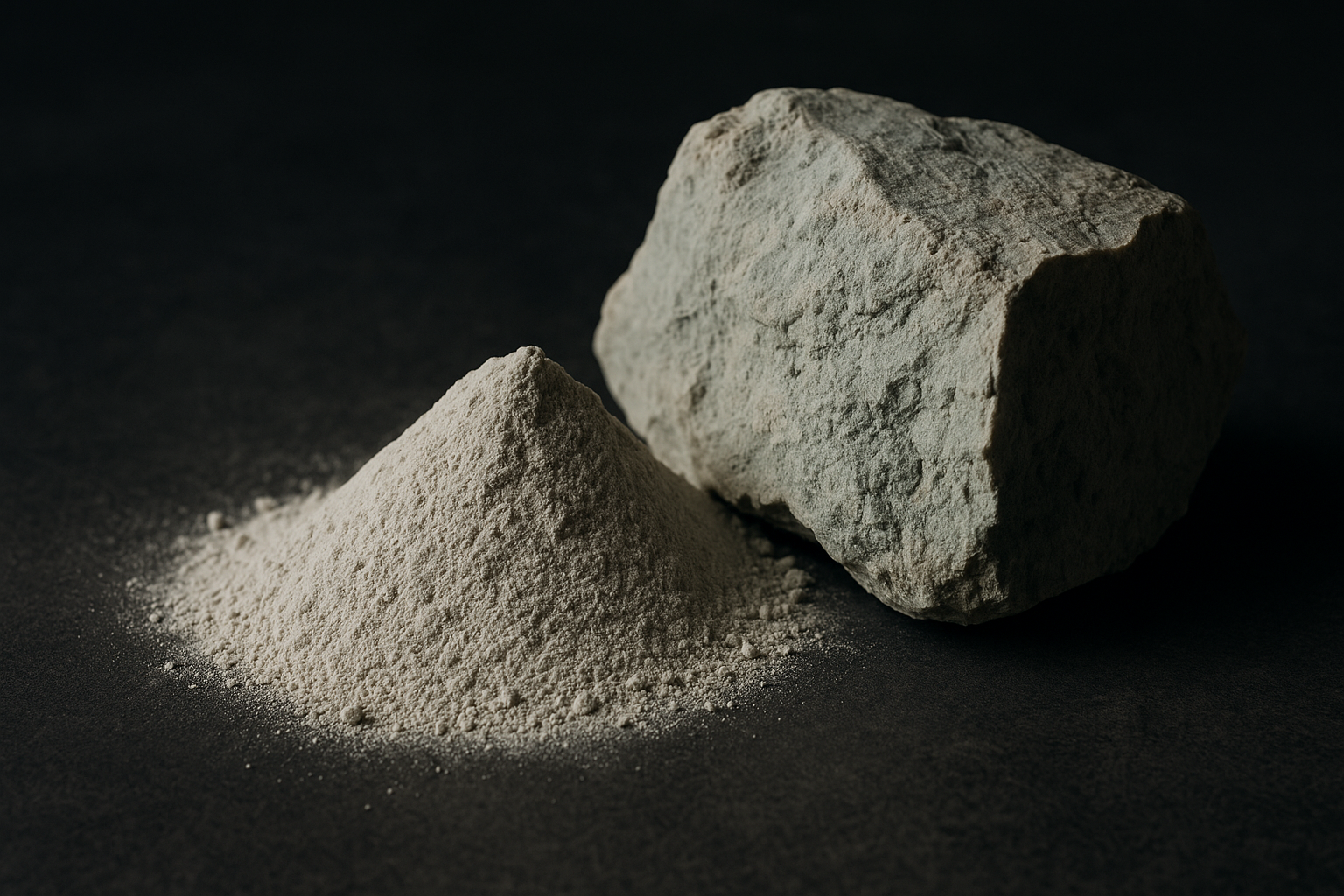
Recurring problems on mortar and stucco plastering sites
Masonry/plaster mortar and exterior stucco render carry chronic problems right after placement: bleeding, sag, insufficient water retention, and drying-shrinkage cracking. When mix water rises quickly to the surface, bond to the substrate weakens, adhesion between coats (scratch coat, brown coat, finish coat) becomes weak, and moisture evaporates all at once during curing, causing fine cracks (crazing). In cement-lime blended plaster, the balance between workability and water retention determines finish quality.
In addition, efflorescence, surface delamination from sulfate and freeze-thaw, and the CO₂ burden from heavy use of OPC (ordinary Portland cement) are major review items in the plaster and stucco field. For this reason, partial replacement using natural pozzolans has been steadily reviewed in the context of ASTM C618 and C926 (stucco application).
Why zeolite is considered as a mortar and stucco aid
Natural clinoptilolite is a natural pozzolan (ASTM C618 Class N) containing amorphous reactive silica (SiO₂ 66.7%) and alumina, and its operating mechanism falls into three broad strands.
- Pozzolanic reaction (secondary hydration): The calcium hydroxide Ca(OH)₂ produced by cement hydration reacts with the active SiO₂·Al₂O₃ of the zeolite framework to form additional C-S-H/C-A-S-H gel. This secondary product fills capillary pores to densify the surface, and by consuming soluble Ca(OH)₂ it raises resistance to efflorescence and sulfate attack. Because the pozzolanic reaction is a late-age reaction, its strength contribution comes into full effect after 28 days.
- Internal water retention / internal curing: Micropores with a pore diameter of 4.0-7.0 Å and a surface area of 40.0 m²/g act as an internal water reservoir that temporarily holds mix water and then slowly releases it in early curing. This reduces sag and bleeding in the stucco finish coat and mitigates early shrinkage cracking caused by self-desiccation.
- Alkali-ion behavior: The cation exchange capacity (CEC 1.6-2.0 meq/g) partially adsorbs and buffers alkali ions such as Na⁺ and K⁺ in the mix water, which can also be advantageous in terms of aggregate reactivity (ASR).
A point to note is the flip side of this water-retention effect. Because absorbency is high, keeping the same water-binder ratio (w/b) lowers the flow and stiffens the mix, so to maintain the same workability you must increase the mix water or correct it with a water-reducing agent (high-performance AE water reducer). In other words, zeolite is an aid for which "the replacement ratio and unit water content must be designed together," not a simple substitute.
KMIZEOLITE's natural clinoptilolite is 97% pure, mined and processed at the Amargosa Valley mine in Nevada, USA, with a stable pH range of 3.0-10.0, hardness of 4.0-5.0 Mohs, and thermal stability of 700°C, behaving stably in the alkaline environment of cementitious systems.
Research basis: pozzolanic behavior in plaster and concrete
Ahmadi and Shekarchi's (Cement and Concrete Composites, 2010) review of natural zeolite as a pozzolan concluded that clinoptilolite improves late-age strength and durability through the pozzolanic reaction in the 5-15% cement replacement range (Ahmadi & Shekarchi, 2010, doi:10.1016/j.cemconcomp.2009.10.006). Najimi et al. (Construction and Building Materials, 2012) reported improved chloride penetration resistance and water absorption in high-performance concrete incorporating natural zeolite (Najimi et al., 2012, doi:10.1016/j.conbuildmat.2011.12.034).
Feng et al. (Cement and Concrete Research, 2005) showed that natural zeolite improves the durability of cementitious materials in deicing-salt (freeze-thaw + chloride) environments (Feng et al., 2005, doi:10.1016/j.cemconres.2004.05.034), and Shekarchi et al.'s (Construction and Building Materials, 2023) review of supplementary cementitious materials (SCMs) synthesized zeolite's internal curing effect and self-desiccation mitigation mechanism (Shekarchi et al., 2023, doi:10.1016/j.conbuildmat.2023.133766). This is a direct reference for reviewing the water retention and crack reduction of exterior stucco and plaster mortar.
Meanwhile, for the high-replacement regime, the high-volume zeolite SCM eco-friendly concrete study in Scientific Reports (2023) is a useful reference. This study quantitatively addressed the trade-off in which higher zeolite replacement increases both the unit-water demand and the early-strength reduction, and reported that with appropriate replacement and curing management, benefits in durability and environmental load (CO₂) can be secured (Sci. Rep., 2023, doi:10.1038/s41598-023-50761-6). Since plaster and stucco require a balance between finishing workability and late-age strength, a conservative replacement range of 5-15% is recommended, consistent with the conclusions of these reviews and experiments.
KMIZEOLITE key properties
| Item | Value |
|---|---|
| Clinoptilolite purity | 97% |
| Cation exchange capacity (CEC) | 1.6-2.0 meq/g |
| Surface area | 40.0 m²/g |
| Pore diameter | 4.0-7.0 Å |
| Stable pH range | 3.0-10.0 |
| Hardness | 4.0-5.0 Mohs |
| Thermal stability | 700°C |
| Specific gravity | 1.89 |
| Bulk density | 45-54 lbs/ft³ |
| Certifications | OMRI KMI-10365, FDA GRAS, TSCA, EN-71-3 |
Comparison with other pozzolans and SCMs
When considering zeolite on plaster and stucco sites, understanding how it differs from other supplementary cementitious materials (SCMs) with the same purpose makes mix design easier.
| Material | Characteristics | Plaster & stucco perspective |
|---|---|---|
| Natural zeolite (clinoptilolite) | Natural pozzolan (Class N), micropore water retention, CEC 1.6-2.0 meq/g | Strong in water retention, bleeding reduction and internal curing / requires unit-water correction due to absorbency |
| Fly ash (Class F) | Spherical particles, improves early workability and flowability | Good flowability but weak contribution to water retention / supplements late-age strength |
| Silica fume | Ultra-fine, highly reactive silica | Strong densification but increases stickiness/tackiness and sharply raises unit water demand |
| Hydrated lime (lime plaster) | Traditional plaster binder, excellent plasticity and water retention | When used together with zeolite, aids hardening and supplements durability |
In summary, zeolite does not increase flowability as much as fly ash, but unlike silica fume it provides water retention and internal curing simultaneously without excessively raising tackiness — that is its differentiator in plaster and stucco. As long as the unit water content is well managed, it is advantageous for controlling sag, bleeding and surface cracking of the finished face.
Application examples of mortar and stucco aid zeolite
Below are representative scenarios for considering zeolite powder in plaster mortar and stucco mixes. The baseline is to incorporate powder 100 mesh or finer, not granular form, at the dry-mixing stage.
- Partial cement replacement type: Replacing 5-15% of the binder (cement) weight with zeolite powder to supplement late-age strength and density via the pozzolanic reaction
- Water-retention improver: Adding 3-8% to the stucco finish coat or plaster finishing layer to reduce bleeding and sag and extend the work time
- Lime-cement blended plaster: Incorporating it as a natural pozzolan to aid hardening and improve durability of traditional lime plaster
- Crack-reduction (internal curing) aid: Slowly releasing the absorbed mix water in early curing to mitigate self-desiccation shrinkage
- Test/pilot mix: Pre-verifying flow, water retention rate and 28-day strength with small samples
Recommended particle size and product specifications
For plaster mortar and stucco, Powder (100 mesh or finer, median about 50μm) is practically essential. To fill the voids between aggregate and binder, the powder must be similar to or finer than cement particles, and the reactive silica at SiO₂ 66.7% carries out the pozzolanic reaction. Granule products cause surface roughness and aggregate segregation, so they are unsuitable for finish plaster. Select the powder type in the table below.
| Product line | Mesh | Particle size | Typical use |
|---|---|---|---|
| Powder | 100 mesh or finer | <150μm | Pozzolan, feed, powder adsorption |
| Fine Granule | 30×50 mesh | 0.3-0.6mm | Water treatment, filtration, soil |
| Medium Granule | 14×40 mesh | 0.4-1.4mm | Filter layer, bedding, flooring |
| Coarse Granule | 8×14 mesh | 1.4-2.4mm | Swimming pools, de-icing, large filtration |
| Extra Coarse | 4×8 mesh | 2.4-4.8mm | Packed beds, air scrubbers |
→ View products by mesh size · Product selection guide by application
Pilot testing and field review points
When applying zeolite to plaster mortar and stucco, the following items must always be checked together.
- Standard conformity: Confirm conformity with ASTM C618 (natural pozzolan Class N) and the stucco application standard (ASTM C926)
- Replacement-ratio design: Design the mix within the range of 5-15% replacement of the binder for plaster mortar, and 3-8% addition for finish water-retention purposes (beware of reduced early strength and working time with excessive replacement)
- Flowability and water retention rate: Because zeolite has high absorbency, the mix water or a water-reducing agent must be adjusted to maintain the same slump — measure with a flow table test and check the water retention rate
- Strength development: Since the pozzolanic reaction appears late, test 7-day, 28-day and 90-day compressive strength together with bond strength
- Durability: For exterior stucco, evaluate freeze-thaw, sulfate attack, efflorescence and drying-shrinkage cracking
- Field-specific notes: Natural zeolite can replace up to 30% of cement, but for plaster and stucco a 5-15% range is generally recommended given the balance between workability and late-age strength. While the micropores hold mix water and reduce cracking through an internal curing effect, the high absorbency makes unit-water management the key.
→ View TDS (Technical Data Sheet) · View MSDS (Material Safety Data Sheet)
Mortar & Stucco FAQ
What effects does adding zeolite to mortar and stucco have?
Natural clinoptilolite is a natural pozzolan with reactive silica (SiO₂ 66.7%). It reacts with calcium hydroxide, a cement hydration product, to form additional C-S-H gel that supplements late-age strength and surface density. In addition, its micropores (4.0-7.0 Å) temporarily hold mix water, reducing bleeding and sag and mitigating early-age curing cracks. Ahmadi and Shekarchi (2010) reported durability improvements in the 5-15% replacement range. Actual effects vary with mix and substrate conditions, so a pilot test is recommended.
How much cement should be replaced?
For plaster mortar, replacing 5-15% of the binder weight is common, and for improving finish-coat water retention, an addition of 3-8% is considered. Some research indicates natural zeolite can replace up to 30%, but excessive replacement can lower early strength and working time, so a conservative range is recommended for plaster and stucco.
What particle size (mesh) is suitable?
For plaster mortar and stucco, Powder (100 mesh or finer, median about 50μm) is suitable. It should be similar to or finer than cement particles to fill voids and participate in the pozzolanic reaction, whereas granule products cause surface roughness and aggregate segregation, making them unsuitable for finish plaster. Refer to the product selection guide by application.
Does the mix water need to be adjusted?
Yes. Zeolite has high absorbency due to its micropores (pore diameter 4.0-7.0 Å, surface area 40 m²/g), so to maintain the same workability (slump/flow), the mix water or a water-reducing agent (high-performance AE water reducer) must be adjusted. If you keep the same water-binder ratio, the flow drops and the mix becomes stiff, so correct the unit water content with a flow table test. That said, the absorbed water is released slowly during early curing, providing internal curing that also reduces cracking.
Does it also help with durability issues like efflorescence and freeze-thaw?
The pozzolanic reaction consumes soluble calcium hydroxide Ca(OH)₂ and converts it into additional C-S-H, acting to reduce the substances that cause efflorescence and to densify the surface. Feng et al. (2005) reported durability improvements of natural zeolite in deicing-salt (freeze-thaw + chloride) environments, and Najimi et al. (2012) reported improvements in chloride penetration and water absorption. However, since effects depend on replacement ratio, curing and substrate conditions, it is safer to verify exterior stucco with freeze-thaw, sulfate and efflorescence tests as well.
Do you have test samples and certification documents?
Yes, KMIZEOLITE provides 100-mesh powder samples (1kg/22kg). Please leave your purpose and desired particle size on the sample request page. We also hold OMRI Listed (KMI-10365), FDA GRAS (21 CFR 182.2729), TSCA compliant and EN-71-3 PASS certifications, which can be verified on the certifications page.
Inquiries and sample requests
If you are considering applying zeolite in the mortar and stucco aid field, please contact us through the channels below.
Notice
Applicability may vary depending on site conditions, regulations and test results. Before actual application, test review suited to the site conditions must always be conducted first. Zeolite should be understood not as an all-purpose solution for this field, but as a material that supports existing processes.
Related pages
science Related Papers
Academic papers covering zeolite application in this field. Use them as references when reviewing adoption.
- Natural zeolite as pozzolanic material: A review
Ahmadi, B. & Shekarchi, M. — Cement and Concrete Composites, 2010 - Properties of high-performance concrete incorporating natural zeolite
Najimi, M. et al. — Construction and Building Materials, 2012 - Effect of natural zeolite on durability of concrete against deicing salt
Feng, N. et al. — Cement and Concrete Research, 2005 - Natural zeolite as supplementary cementitious material: A holistic review
Shekarchi, M. et al. — Construction and Building Materials, 2023 - Eco-friendly concrete with high-volume zeolitic supplementary cementitious material
Scientific Reports, 2023
The papers above are reference materials; actual application requires separate review suited to site conditions.