Zeolite for Walkway Traction
A chloride-free traction grit that physically restores ground friction on icy surfaces by spreading hard natural clinoptilolite granules of 4.0–5.0 Mohs (8×14 / 4×8 mesh, 1.4–4.8mm) at about 50–150 g/m². Unlike chloride-based deicers, it does not cause concrete spalling or rebar corrosion, and research on freeze–thaw and deicing-salt durability supports its pavement friendliness.
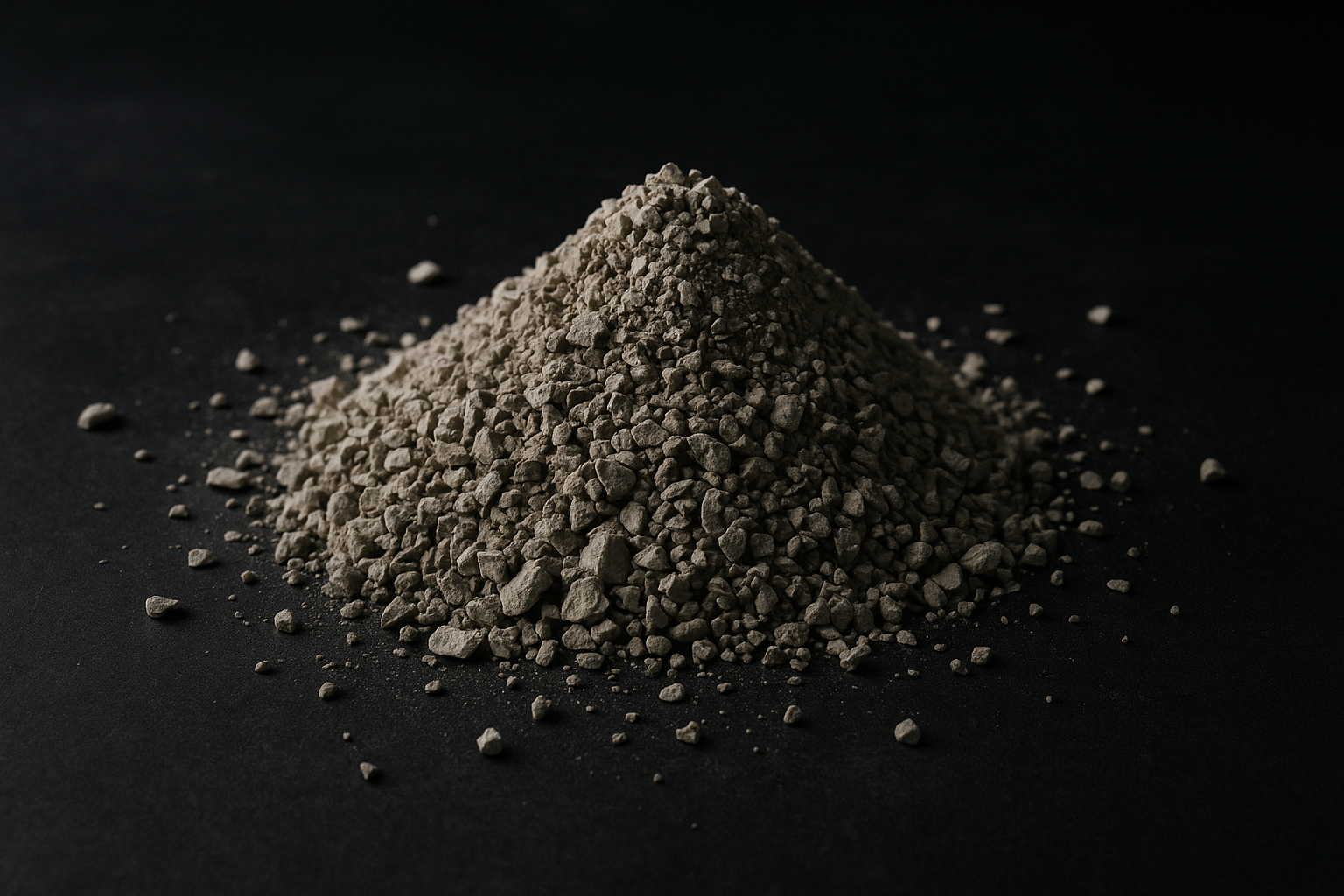
Why Do Winter Walkway Slip Accidents Keep Recurring?
Sidewalks, walkways within complexes, stairs, and sloped entrances are sections where pedestrian fall accidents concentrate once snowfall or black ice forms. From the perspective of facility managers, apartment management offices, and local governments, rapid friction (traction) recovery is the top priority, but the commonly used calcium chloride and industrial salt have side effects: they kill street trees and flower beds, spall the concrete surface, and corrode rebar.
That is why demand is growing not for "deicers that melt" but for "anti-slip material (traction grit) that creates a surface to step on." Traction grit does not chemically remove ice, but by laying a coarse granular layer on top of a smooth icy surface, it immediately raises the contact friction coefficient with shoe soles and wheels. The friction coefficient of an iced surface often drops to around 0.1, making walking dangerous; by scattering hard, angular granules, the particles microscopically bite into the ice surface (local indentation) and interlock with the shoe sole, restoring effective friction.
Three material properties govern this effect. First, hardness—the particles must not crumble into powder even when trodden on or pressed by vehicles, so the friction layer is maintained. Second, particle size and weight—if too fine, they blow away in the wind and cannot grip the ice surface; if too coarse, they catch underfoot. Third, chemical harmlessness—they must not harm vegetation, pavement, rebar, or waterways so they can be repeatedly spread throughout the season. Natural clinoptilolite is a rare mineral grit that satisfies all three conditions simultaneously.
Why Natural Zeolite Is Considered as Traction Grit
Natural clinoptilolite is a hard volcanic mineral with hardness of 4.0–5.0 Mohs and specific gravity of 1.89; its particle edges are sharper than sand or decomposed granite, giving superior friction grip even at the same particle size. It is softer than quartz sand (hardness 7 Mohs) but sufficiently hard compared to ordinary snow-removal sand or calcareous aggregate, so it does not easily crumble into powder even when trodden on or pressed by passing vehicles, and a once-spread traction layer lasts a long time. Thanks to its porous framework, its bulk density at the same particle size is also light at 45–54 lbs/ft³ (about 0.72–0.87 g/cm³), allowing the same weight to cover a wider area.
The biggest differentiator is that it is a chloride-free, neutral mineral. With a wide pH stability range of 3.0–10.0, it does not salt-damage soil or corrode concrete rebar the way deicers do. KMIZEOLITE's natural clinoptilolite has 97% purity, is mined and processed at the Amargosa Valley mine in Nevada, USA, and carries EN-71-3 (European toy safety), FDA GRAS (21 CFR 182.2729, general food processing aid), and OMRI-listed grades, securing safety for human and environmental contact. In addition, thanks to its micropores (pore diameter 4.0–7.0 Å) and cation exchange capacity CEC 1.6–2.0 meq/g, particles recovered after spring cleaning can be secondarily reused as a soil amendment or filtration medium.
Comparison with Deicers and General Grit
| Category | Calcium Chloride / Salt | Snow-Removal Sand / Decomposed Granite | Zeolite Grit |
|---|---|---|---|
| Mechanism | Chemical deicing | Physical friction | Physical friction |
| Hardness (Mohs) | Not applicable | 2–7 (mixed) | 4.0–5.0 (uniform) |
| Effect on Pavement / Rebar | Promotes spalling / corrosion | Neutral | Neutral (chloride-free) |
| Effect on Vegetation / Waterways | Salt-damage concern | Sediment deposition | Harmless, reusable after recovery |
| Low-Temperature Limit | Efficiency drops sharply below about -9°C | Temperature-independent | Temperature-independent |
Deicers see their melting efficiency drop sharply as the outside temperature falls, but physical traction works independently of temperature. However, since traction grit cannot remove the ice itself, in thick icing or black ice a design that divides roles and combines it with a deicer is realistic.
KMIZEOLITE Key Properties
| Item | Value |
|---|---|
| Clinoptilolite purity | 97% |
| Cation exchange capacity (CEC) | 1.6–2.0 meq/g |
| Specific surface area | 40.0 m²/g |
| Pore diameter | 4.0–7.0 Å |
| pH stability range | 3.0–10.0 |
| Hardness | 4.0–5.0 Mohs |
| Thermal stability | 700°C |
| Specific gravity | 1.89 |
| Bulk density | 45–54 lbs/ft³ |
| Certifications | OMRI KMI-10365, FDA GRAS, TSCA, EN-71-3 |
Walkway Traction Grit Application Examples
Below are representative spreading scenarios in which zeolite grit is considered for winter pedestrian safety management.
- Direct surface spreading: Scattering 8×14 to 4×8 mesh granules at about 50–150 g/m² over iced sidewalks, stairs, and ramps to immediately restore friction
- Combined with deicer: In deeply frozen sub-zero sections, melting the surface layer with a small amount of calcium chloride and covering it with zeolite grit to maintain grip even during re-icing
- Pre-stocked / simple spreading bins: Placing grit boxes at complex entrances, bus stops, and stair landings so residents or staff can spread immediately after snowfall
- Sand replacement: Replacing existing snow-removal sand or decomposed granite with zeolite, then reusing the recovered particles in spring as a flower-bed or soil amendment
- Trial / pilot application: Verifying site slope, ice thickness, and re-spreading cycle in advance with a small sample
Recommended Particle Size and Product Specifications
Since walkway traction aims for friction grip, coarse granules are key. Coarse Granule (8×14 mesh) and Extra Coarse (4×8 mesh) are suitable for slip prevention, while fine powder (100 mesh) blows away in the wind and provides poor friction, making it unsuitable for traction use. Select the product group that fits your purpose from the table below.
| Product Group | Mesh | Particle Size | Typical Use |
|---|---|---|---|
| Powder | 100 mesh or finer | <150μm | Pozzolan, feed, powder adsorption |
| Fine Granule | 30×50 mesh | 0.3–0.6mm | Water treatment, filtration, soil |
| Medium Granule | 14×40 mesh | 0.4–1.4mm | Filter layer, bedding, flooring |
| Coarse Granule | 8×14 mesh | 1.4–2.4mm | Swimming pools, snow removal, large filtration |
| Extra Coarse | 4×8 mesh | 2.4–4.8mm | Packed beds, air scrubbers |
→ View products by mesh size · Product selection guide by application
On-Site Review Points
When introducing zeolite as walkway traction grit, checking the following items together helps secure both effectiveness and safety.
- Particle size / weight selection: Choose 8×14 to 4×8 mesh (1.4–4.8mm) that does not blow away in the wind or catch underfoot. 100 mesh powder is unsuitable for traction use.
- Spreading rate estimation: Considering ice thickness, slope, and pedestrian frequency, start with a test spread of about 50–150 g/m² and adjust while observing the friction condition.
- Whether to combine a deicer: For deeply frozen sub-zero ice, melting it with a small amount of deicer and then covering with grit maintains grip even during re-icing.
- Review of pavement effect: Zeolite is a chloride-free neutral mineral (pH 3.0–10.0), so it does not cause concrete or asphalt spalling or rebar corrosion. In freeze–thaw and deicing-salt environments, many studies report that concrete and ground blended with natural zeolite actually have improved durability (see research evidence below).
- Drain and catch-basin management: Granular grit can be washed into rain gutters and catch basins in spring, so even though chloride-free grit has low aquatic toxicity, plan a recovery and cleaning route before snowmelt to prevent sediment buildup.
- Recovery / reuse plan: Recovering particles during spring cleaning and reusing them as a flower-bed or soil amendment can reduce disposal burden. Thanks to CEC 1.6–2.0 meq/g, recovered particles have room for secondary use as a soil fertility-improvement material.
→ Check TDS (Technical Data Sheet) · Check MSDS (Material Safety Data Sheet)
Research Evidence
Standardized tests addressing the friction performance of traction grit itself are difficult to generalize due to many site variables, but the core claim that "chloride-free zeolite is friendly to pavement" is supported by numerous concrete durability studies.
- Durability in deicing-salt environments — Feng et al. (2005) reported that concrete blended with natural zeolite showed improved freeze–thaw resistance and surface scaling resistance under deicing-salt exposure conditions (Feng, N. et al., Cement and Concrete Research, 2005).
- Chloride penetration resistance — Najimi et al. (2012) confirmed improved chloride penetration resistance and durability indicators in high-performance concrete where natural zeolite was substituted for part (about 15–30%) of the cement (Najimi, M. et al., Construction and Building Materials, 2012).
- Pozzolanic mechanism — The review by Ahmadi and Shekarchi (2010) summarized the mechanism by which the pozzolanic reaction of natural zeolite densifies the pore structure of concrete to improve permeability and durability (Ahmadi, B. & Shekarchi, M., Cement and Concrete Composites, 2010).
- Subgrade / roadbed freeze–thaw — Shirmohammadi et al. (2021) reported that ground stabilized with lime and partially substituted with clinoptilolite showed mitigated strength loss even after repeated freeze–thaw cycles, making it a useful reference from the perspective of freezing behavior of walkway subgrades and roadbeds (Shirmohammadi, S. et al., Coatings, 2021).
These studies consistently suggest that zeolite is not disadvantageous and is rather favorable in the freeze–thaw and chloride environments of concrete and ground. However, the above studies concern behavior as a "blending material" and do not directly guarantee the friction values of surface-spread grit, so for actual sites we recommend a procedure of verifying the degree of friction recovery through small-scale test spreading.
Traction FAQ
Is zeolite better than calcium chloride for walkway slip prevention?
They serve different purposes. Calcium chloride and salt are deicers that chemically melt ice, whereas zeolite grit is a physical anti-slip material that lays a coarse granular layer on top of ice to immediately restore friction (traction). Zeolite is a hard particle of 4.0–5.0 Mohs, so it does not crumble easily even when trodden on, and because it contains no salt there is little concern about corrosion of street trees, flower beds, or concrete rebar. However, since it does not melt the ice itself, in deeply frozen sub-zero sections combining a small amount of deicer is considered in practice.
What particle size (mesh) is suitable for walkway traction grit?
Since the goal is shoe and wheel contact friction rather than barefoot walking, coarse granules are advantageous. For sidewalks, stairs, and ramps, Coarse Granule (8×14 mesh, 1.4–2.4mm) or Extra Coarse (4×8 mesh, 2.4–4.8mm) is generally considered. Powder that is too fine (100 mesh) blows away in the wind and provides poor friction, making it unsuitable for traction use. Please refer to the product selection guide by application.
How much should be spread per square meter?
It varies with the degree of icing and pedestrian frequency, but for visible slip prevention it is typically spread at about 50–150 g/m² (enough to thinly cover the ice), then additional spreading is done while observing the friction condition. The exact spreading rate is best determined by small-scale testing that takes site slope, ice thickness, and re-spreading cycle into account.
Does zeolite grit damage paved concrete or asphalt?
Zeolite is a near-neutral, chloride-free mineral (pH stability range 3.0–10.0), so unlike chloride-based deicers it does not promote concrete surface spalling or rebar corrosion. On the contrary, concrete with natural zeolite partially blended into the cement has been reported in research to have improved freeze–thaw and chloride penetration resistance, so it is regarded as a material favorable to the pavement itself.
Can I get a sample for testing?
Yes, KMIZEOLITE supports providing samples for actual application review. On the sample request page, please leave your application purpose (walkway slip prevention) and desired particle size (8×14 or 4×8 mesh).
Inquiries and Sample Requests
If you are considering applying zeolite in the walkway traction field, please contact us through the channels below.
Notice
Applicability may vary depending on site conditions, regulations, and test results. Before actual application, testing and review suited to the site conditions must always be conducted first. Zeolite should be understood not as a cure-all for this field, but as a material that assists existing processes.
Related Pages
science Related Research Papers
Academic papers addressing zeolite application in this field. Please refer to them when reviewing adoption.
- Effect of natural zeolite on durability of concrete against deicing salt
Feng, N. et al. — Cement and Concrete Research, 2005 - Properties of high-performance concrete incorporating natural zeolite
Najimi, M. et al. — Construction and Building Materials, 2012 - Natural zeolite as pozzolanic material: A review
Ahmadi, B. and Shekarchi, M. — Cement and Concrete Composites, 2010 - Evaluation of natural zeolite as warm mix asphalt additive
Sengoz, B. et al. — Construction and Building Materials, 2013 - Effect of Lime Stabilization and Partial Clinoptilolite Zeolite Replacement on Freeze–Thaw Durability
Shirmohammadi, S. et al. — Coatings, 2021
The papers above are reference materials; actual application requires separate review suited to site conditions.