Landscape-Friendly Ice Melt Aid Zeolite
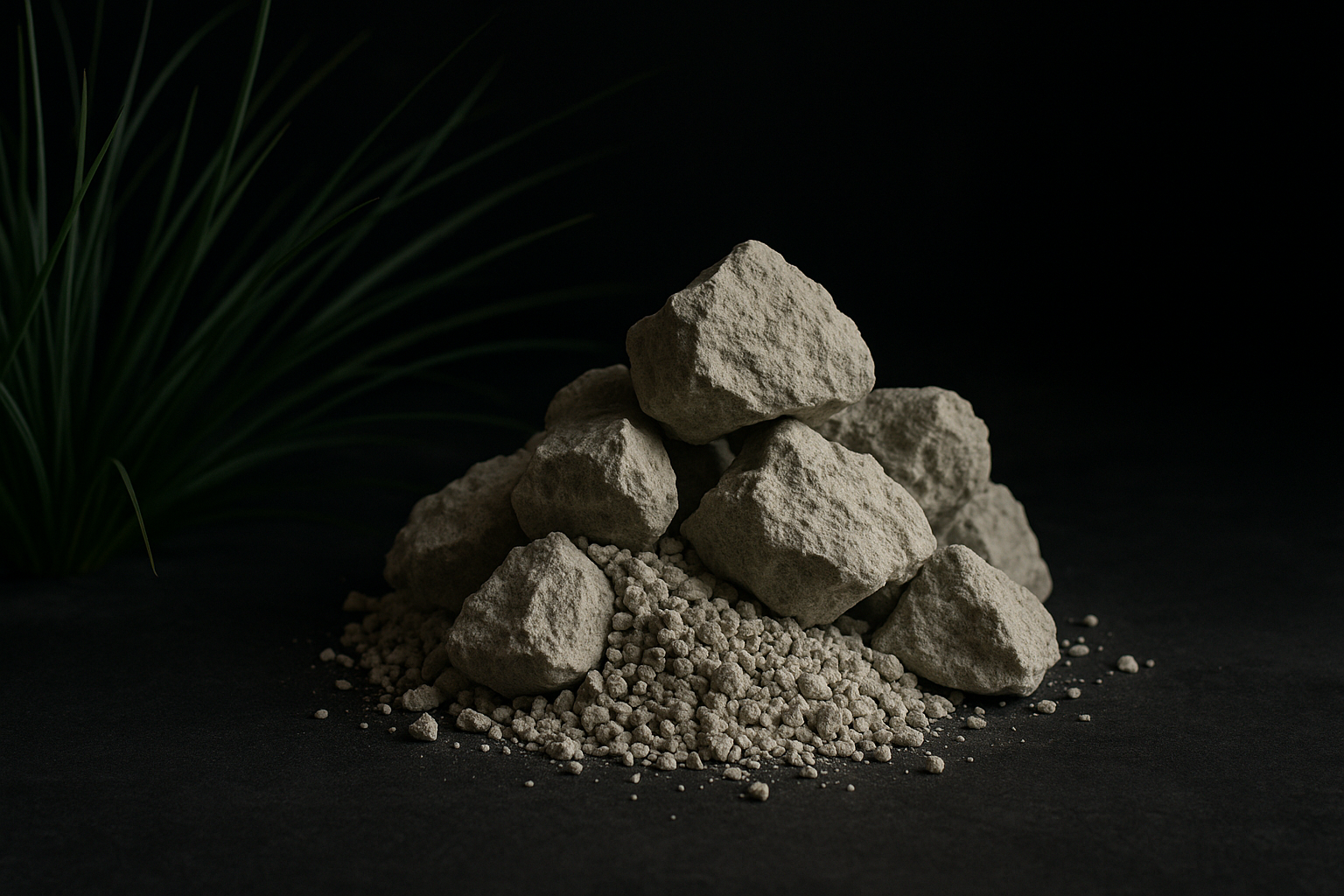
Natural clinoptilolite (97% purity, hardness 4.0-5.0 Mohs) is not a deicer that melts ice; with its 8x14 mesh angular particles, it is a non-chloride traction grit that creates instant friction on thin ice to reduce chloride application. In spring, when mixed into the topsoil, its CEC of 1.6-2.0 meq/g supports Ca2+/Na+ exchange to help mitigate the EC/SAR of accumulated salts.
The problems winter chloride deicers leave for landscaping and pets
Sodium chloride (NaCl) and calcium chloride (CaCl2) deicers spread on winter walkways, parking lots, and complex driveways melt ice quickly, but the salt that runs off with the meltwater scorches the edges of turf yellow and hinders root uptake by street trees and shrubs. As NaCl accumulates in soil, the electrical conductivity (EC) and sodium adsorption ratio (SAR) of the soil solution rise, so osmotic stress and Na+-driven soil structure dispersion (degraded dispersibility) progress at the same time. On walking paths used by pets, chloride crystals can irritate paw pads or become an irritant when licked. The core task in this field, searched under keywords such as "pet friendly ice melt," eco-friendly deicing, landscape protection, and traction (anti-slip), is to secure ice safety while simultaneously reducing planting damage and animal irritation.
Managers must balance melting (deicing) and traction (securing friction) by considering ice severity, slope, foot traffic, the types of adjacent plantings, and spring recovery conditions; for that reason, an approach using a non-chloride aid alongside chlorides rather than chlorides alone is frequently reviewed. Lowering the total chloride amount with a non-chloride grit can maintain surface safety while reducing the very starting point of the Na+ load entering soil and plantings in spring.
Why natural zeolite is reviewed as a landscape-friendly ice melt aid
The role zeolite plays in this field is most accurately understood as two mechanisms.
- (1) Physical traction (road surface, winter): Natural clinoptilolite is not a deicer that chemically melts ice, but a non-chloride traction grit in which angular, porous particles bite into thin ice and packed snow to create instant friction. At hardness 4.0-5.0 Mohs, it does not easily crumble to powder under foot or vehicle loads, so it provides better friction persistence than sand; as a granular material with a specific gravity of 1.89 and bulk density of 45-54 lbs/ft3, it does not scatter easily in wind. Because this mechanism is governed by particle size, shape, and hardness rather than a chemical reaction, the friction function is maintained even at low temperatures below -10C where deicers do not work well.
- (2) Cation exchange (soil, spring recovery): The negatively charged aluminosilicate framework of clinoptilolite has a cation exchange capacity (CEC 1.6-2.0 meq/g) that retains exchangeable cations. Mixed into the topsoil in spring, it supports Ca2+-for-Na+ exchange, holding Na+ from the soil solution in its framework and releasing Ca2+, which, combined with irrigation, can help mitigate the EC/SAR of accumulated salts. However, this is a separate spring soil amendment action unrelated to winter deicing, and it does not mean that grit spread on the road surface immediately purifies soil salt.
KMIZEOLITE's natural clinoptilolite is 97% pure, mined and processed at the Amargosa Valley mine in Nevada, USA. With properties including a specific surface area of 40.0 m2/g, pore diameter of 4.0-7.0 A, and a stable pH range of 3.0-10.0, it is stable even in environments with repeated freeze-thaw cycles. It holds EN-71-3 (European toy safety standard) PASS, FDA GRAS (animal feed intake use 21 CFR 582.2729, other general use 21 CFR 182.2729), and IARC non-toxic classification documentation, so it poses little review burden at landscape sites close to people and pet pathways.
Looking at the relevant academic evidence quantitatively: Feng et al. (2005, Cement and Concrete Research) reported that concrete incorporating natural zeolite showed improved durability in deicing-salt freeze-thaw environments, supporting the suitability of zeolite in deicing-salt-exposed infrastructure. On the turf rootzone (soil) side, Ferguson et al. (1986, Agronomy Journal) evaluated the growth and water retention of creeping bentgrass in a clinoptilolite-amended sand layer (USGA green rootzone), showing the potential for amending sandy planting layers such as golf course greens. The nutrient and water retention improvement effect is summarized in the comprehensive review on water and nutrient retention for sustainable agriculture by Ramesh and Reddy (2017, Water, Air, & Soil Pollution), and the cation exchange behavior of natural zeolite is organized in the review of natural zeolite cation exchange research trends (Sustainability, 2021), which aggregates numerous studies including the Cabrera-Lafaurie series.
Anions are different. Chlorine (Cl-), the anion in deicing salt, is not adsorbed by clinoptilolite because its framework is negatively charged. Therefore the landscape protection effect comes not from "Cl- removal" but from (1) reducing chloride application itself and (2) supporting EC/SAR mitigation of Na+ cations in spring soil. To capture anions such as Cl- as well, metal or surfactant modification (e.g., HDTMA surface modification) is a prerequisite, and the traction and soil amendment uses on this page assume unmodified natural zeolite.
KMIZEOLITE key properties
| Item | Value |
|---|---|
| Clinoptilolite purity | 97% |
| Cation exchange capacity (CEC) | 1.6-2.0 meq/g |
| Specific surface area | 40.0 m2/g |
| Pore diameter | 4.0-7.0 A |
| pH stability range | 3.0-10.0 |
| Hardness | 4.0-5.0 Mohs |
| Thermal stability | 700C |
| Specific gravity | 1.89 |
| Bulk density | 45-54 lbs/ft3 |
| Certifications | OMRI KMI-10365, FDA GRAS, TSCA, EN-71-3 |
Application examples of landscape-friendly ice melt aid zeolite
Below are representative application scenarios in which natural zeolite is reviewed at landscape and facility-management sites. Winter road surface uses ((1)-(3)) and spring soil use ((4)) work on different principles, so they are designed separately.
- (1) Standalone traction spreading (winter): Thinly spreading 8x14 mesh coarse granule on walkways and paths adjacent to turf and flower beds to provide anti-slip only, without chlorides. Suitable for pet walking paths and garden entrances where zero chloride is the goal
- (2) Partial chloride substitution (winter): Reducing the existing deicing-salt application and replacing part of it with zeolite grit to lower the total Na+ and Cl- flowing into plantings. The substitution ratio is determined by pilot based on the sensitivity of adjacent plantings
- (3) Mixed spreading with chloride (winter): Blending a small amount of melting CaCl2 with traction zeolite to secure both melting and friction. Prioritizes safety on thick ice and steep sections while suppressing total chloride
- (4) Spring soil recovery amendment: Mixing Fine to Medium Granule into the topsoil of turf and flower beds where Na+ has accumulated over winter, and irrigating thoroughly, to support nutrient and water retention along with Ca2+-for-Na+ exchange via CEC. For sandy greens, refer to the rootzone mixing ratio of Ferguson et al. (1986)
- (5) Field pilot: Spreading a small sample on some sections and then comparing friction feel, turf edge damage area, and spring recovery (leaf color recovery / EC measurement) against control sections
Recommended particle size and product specifications
For landscape-friendly ice melt aid, Coarse Granule (8x14 mesh, 1.4-2.4mm) is reviewed as the standard for road-surface traction. This is because the particles bite well into thin ice and packed snow to maintain friction and do not scatter easily under foot traffic or wind. The coarser 4x8 mesh (2.4-4.8mm) provides greater friction feel but can be rough for walkway foot traffic, so it is better limited to vehicle paths and parking lots. Conversely, for post-winter topsoil mixing for soil recovery of turf and flower beds, also consider Fine to Medium Granule (30x50 to 14x40 mesh), which mixes well with soil particles and has a large specific surface area. The key to particle-size selection is that, even for the same clinoptilolite, the required particle size runs in opposite directions for the road surface (coarse) and the soil (fine).
| Product group | Mesh | Particle size | Typical use |
|---|---|---|---|
| Powder | 100 mesh or finer | <150μm | Pozzolan, feed, powder adsorption |
| Fine Granule | 30x50 mesh | 0.3-0.6mm | Water treatment, filtration, soil |
| Medium Granule | 14x40 mesh | 0.4-1.4mm | Filter media, bedding, litter |
| Coarse Granule | 8x14 mesh | 1.4-2.4mm | Swimming pools, deicing, large filtration |
| Extra Coarse | 4x8 mesh | 2.4-4.8mm | Packed beds, air scrubbers |
→ View products by mesh size · Product selection guide by use
Field review points
When adopting zeolite as a landscape-friendly ice melt aid, please check the items below as well.
- Role distinction: Design on the premise that zeolite is not a deicer that melts ice but a traction and chloride-reduction aid that provides anti-slip. If actual deicing performance is required, chloride or acetate must be used together
- Awareness of the anion limit: Unmodified natural zeolite has a negatively charged framework, so it does not adsorb anions such as Cl-. Set expectations on the premise that the landscape protection effect comes from reduced application and EC/SAR mitigation on the Na+ (cation) side
- Icing conditions: Decide on standalone spreading or combined use with a small amount of chloride according to slope, ice thickness, and foot/vehicle traffic. At low temperatures (below -10C) where deicer efficiency drops, the relative advantage of traction grit grows
- Planting protection goal: Identify the types and salt sensitivity of adjacent turf, shrubs, and street trees to set the chloride substitution ratio
- Recovery and re-spreading: After the thin ice melts, particles remaining on the surface are a non-vegetative granular material, so they can be swept up and reused or moved into soil and flower beds. At hardness 4.0-5.0 Mohs, it generates relatively little fines even under repeated use
- Spring recovery: For salt accumulated over winter, combine ample spring irrigation with topsoil amendment (Fine to Medium Granule) to aid recovery. Adjusting irrigation while measuring EC/SAR allows the effect to be quantitatively confirmed
- Pilot comparison: Apply on a trial basis in some sections and compare friction feel, turf edge damage area, and suitability for pet pathways against control sections to confirm in advance
→ View TDS (Technical Data Sheet) · View MSDS (Safety Data Sheet)
Landscape-friendly ice melt aid FAQ
How does zeolite act as a landscape-friendly ice melt aid?
Natural clinoptilolite is not a chemical deicer that melts ice, but a non-chloride traction (grit) material spread over thin ice to reduce slipping, and an aid that helps cut chloride usage. Its angular, porous particles (hardness 4.0-5.0 Mohs) bite into the road surface to provide instant friction, so calcium chloride and sodium chloride application can be reduced, which in turn helps lower the salt load flowing into turf, shrubs, and street trees, as well as irritation to pet paws. Safety documentation includes EN-71-3 PASS, FDA GRAS (animal feed intake use 21 CFR 582.2729, other general use 21 CFR 182.2729), and IARC non-toxic classification.
Does zeolite adsorb the residual salt mixed into the meltwater?
This must be understood in two parts. Zeolite's cation exchange capacity (CEC 1.6-2.0 meq/g) can retain some cations such as Na+, but Cl-, the anion in deicing salt, is not adsorbed because unmodified clinoptilolite has a negatively charged framework. So the core of landscape protection is not anion adsorption but reducing chloride application itself and, in spring soil, mitigating EC/SAR via Ca2+-for-Na+ exchange. Feng et al. (2005, Cement and Concrete Research) reported that concrete incorporating natural zeolite showed improved durability in deicing-salt freeze-thaw environments. For mitigating salt that has entered the soil, combining ample spring irrigation with topsoil amendment is effective. Adsorbing Cl- as well requires metal or surfactant modification.
Which particle size (mesh) is suitable for landscape and walkway deicing aid?
For traction surface spreading, Coarse Granule (8x14 mesh, 1.4-2.4mm) is reviewed as the standard. The particles bite well into the surface to maintain friction and do not scatter easily under wind or foot traffic. For post-winter soil recovery of turf and flower beds via topsoil mixing, also consider Fine to Medium Granule (30x50 to 14x40 mesh).
How much should be applied?
Surface spreading for traction aid is typically a single thin application, adjusted according to slope, ice severity, and foot traffic. For turf rootzone (soil) amendment to protect grass, review mixing a set proportion into the sand layer as in the creeping bentgrass study by Ferguson et al. (1986, Agronomy Journal); the exact amount is best determined by small-scale trials based on site area and soil conditions.
Can I get a sample for testing?
Yes. KMIZEOLITE supports providing 1kg/22kg samples, such as 8x14 mesh coarse granule, for landscape and facility-management field review. On the sample request page, please note your application purpose (traction / soil recovery) and desired particle size.
Inquiries and sample requests
If you are reviewing the application of zeolite in the landscape-friendly ice melt aid field, please contact us through the channels below.
Notice
Whether the application is suitable may vary depending on site conditions, regulations, and test results. Before actual application, testing and review appropriate to the site conditions must always be carried out first. Zeolite is best understood not as an all-purpose solution in this field, but as a material that supports existing processes.
Related pages
science Related Papers
These are academic papers addressing zeolite application in this field. Please refer to them when reviewing adoption.
- Effect of natural zeolite on durability of concrete against deicing salt
Feng, N. et al. — Cement and Concrete Research, 2005 - Growth of Creeping Bentgrass on Clinoptilolite Zeolite-Amended Sand
Ferguson, G.A. et al. — Agronomy Journal, 1986 - Application of Zeolite for Sustainable Agriculture: Water and Nutrient Retention
Ramesh, K. and Reddy, D.D. — Water, Air, & Soil Pollution, 2017 - Cation Exchange of Natural Zeolites: Worldwide Research
Various — Sustainability, 2021
The papers above are reference material; actual application requires separate review appropriate to site conditions.