Radiocesium (137Cs) Reduction Feed Binder
Radiocesium (137Cs+) is a monovalent cation, so it is selectively captured at clinoptilolite's exchange sites. This page transfers the proven cation-exchange principle—by which approximately 95% pure clinoptilolite has removed 134/137Cs and 90Sr for decades at Sellafield SIXEP—to application as a dietary binder in the digestive tract of livestock in contaminated-feed situations.
The problem on contaminated-feed sites: transfer into milk and meat
When pastures and forage are contaminated with radiocesium (mainly 137Cs, 134Cs) due to a nuclear accident or fallout, livestock ingest it, absorb it into their bodies, and transfer it into muscle (meat) and milk. Because cesium is chemically similar to potassium (K), it distributes readily into muscle tissue, so meat and dairy products from ruminants that have eaten contaminated forage may exceed regulatory limits. This is not merely a feed-quality issue but is directly tied to food safety and shipment compliance.
This field differs in character from mycotoxin adsorption or anticaking. The key point is that the target is the monovalent cesium cation, and the central strategy is a dietary binder that grabs dietary cesium within the digestive tract to reduce absorption into the bloodstream itself.
Why clinoptilolite is evaluated for radiocesium
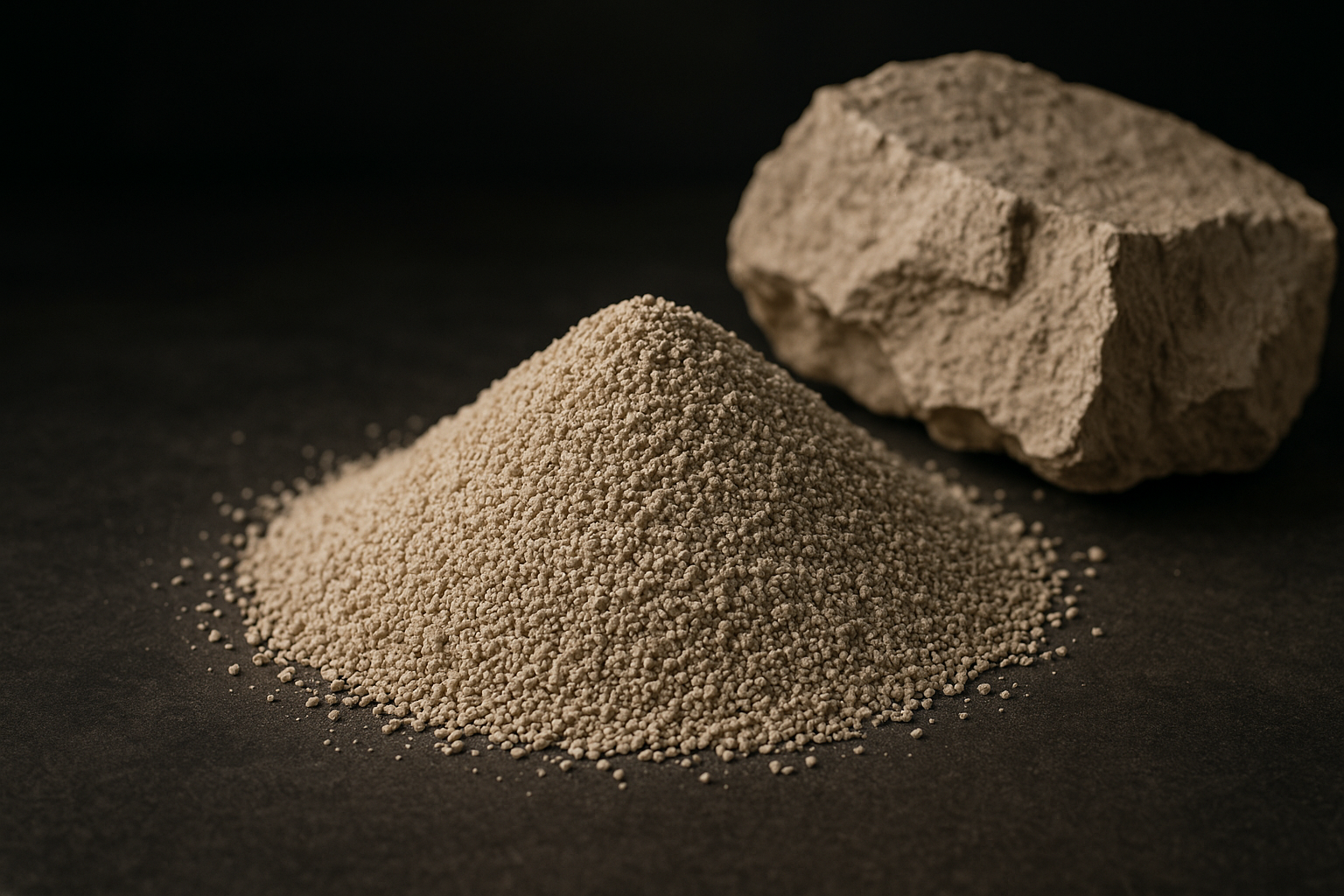
Natural clinoptilolite has a negatively charged aluminosilicate framework and a cation-exchange capacity (CEC) of 1.6–2.0 meq/g, holding exchangeable cations that offset the framework charge. Cesium behaves as a monovalent cation (Cs⁺) with a small hydration radius, so it enters specific exchange sites in clinoptilolite channels with higher selectivity than other monovalent ions. In other words, because cesium is a cation rather than an anion, meaningful binding is possible through the exchange selectivity of unmodified natural zeolite alone.
This principle has been validated for decades in nuclear waste treatment. Dyer et al. (2018) reported that in the SIXEP ion-exchange process at Sellafield in the UK, approximately 95% pure clinoptilolite has removed 134/137Cs and 90Sr for decades from alkaline liquid waste, and demonstrated in column experiments that clinoptilolite selectively extracts Cs⁺ and Sr²⁺ even in the presence of competing cations (Dyer et al., Journal of Radioanalytical and Nuclear Chemistry, 2018). Faghihian et al. (1999) quantified the removal of radioactive cesium, strontium, and heavy metals by natural clinoptilolite (Faghihian et al., Applied Radiation and Isotopes, 1999), and the review by Jimenez-Reyes et al. (2021) summarizes that zeolites have been widely used as cesium-fixing materials in radioactive waste and environmental remediation (Jimenez-Reyes et al., Journal of Environmental Radioactivity, 2021).
In the livestock application context, since the Chernobyl accident, Europe has accumulated cases where clinoptilolite and hexacyanoferrate (Prussian blue) class binders were applied as feed additives or slow-release boli to reduce cesium transfer in ruminants. Clinoptilolite mixed into feed exchanges and captures dietary cesium in the digestive tract, acting to reduce bloodstream absorption.
KMIZEOLITE's natural clinoptilolite has a purity of 97%, mined and processed at the Amargosa Valley mine in Nevada, USA, with a specific surface area of 40.0 m²/g, a pH stability range of 3.0–10.0 (covering rumen and digestive-tract pH variation), and thermal stability of 700°C (suitable for pellet processing temperatures), making it suitable for feed-blending processes. As an animal-feed intake use, the FDA recognizes it as GRAS as an anticaking agent per 21 CFR 582.2729, and the European Union has approved its use in the swine and poultry industries.
KMIZEOLITE key properties
| Item | Value |
|---|---|
| Clinoptilolite purity | 97% |
| Cation exchange capacity (CEC) | 1.6–2.0 meq/g |
| Specific surface area | 40.0 m²/g |
| Pore diameter | 4.0–7.0 Å |
| pH stability range | 3.0–10.0 |
| Hardness | 4.0–5.0 Mohs |
| Thermal stability | 700°C |
| Specific gravity | 1.89 |
| Bulk density | 45–54 lbs/ft³ |
| Certifications | OMRI KMI-10365, FDA GRAS, TSCA, EN-71-3 |
Radiocesium reduction application examples: review scenarios by contamination situation
Below are representative scenarios in which clinoptilolite is evaluated as a dietary binder under radiocesium load. All feed additions are reviewed for anticaking/binding support purposes at 2% or less of total formulation (21 CFR 582.2729) under FDA GRAS standards, and make no pharmacological claims.
- Ruminants fed contaminated forage: When forced to feed pasture or hay suspected of cesium contamination, mixing 100-mesh powder into compound feed at the 1–2% level to support binding of dietary cesium in the digestive tract
- Slow-release boli support: For grazing cattle, running in parallel with dedicated binder boli management such as Prussian blue to distribute the binding load on the feed side (not a replacement for dedicated binders)
- Milk transfer management in dairy cows: When cesium transfer into milk is a concern, evaluating a dietary binder together with the feeding design and tracking effectiveness via milk radioactivity testing
- Competing cation correction: When potassium (K⁺), ammonium (NH₄⁺), and calcium (Ca²⁺) are abundant in feed, Cs⁺ exchange efficiency drops, so checking the competing-cation load together during formulation design
- Pilot feeding trial: Applying a small amount to one cattle group, comparing meat and milk radioactivity concentrations against a control group, then deciding on full adoption
Recommended particle size and product specifications
For radiocesium dietary binding, Powder (100 mesh) is suitable for mixing into compound feed. Since smaller particles are advantageous for dietary cesium to contact surface exchange sites during digestive-tract residence time, the powder form is the first choice for feed mixing. For environmental-side applications such as bedding and floor material, Medium Granule (14×40 mesh) granular form is used. Refer to the table below to select the product group suited to your use.
| Product group | Mesh | Particle size | Typical use |
|---|---|---|---|
| Powder | 100 mesh or finer | <150μm | Pozzolan, feed, powder adsorption |
| Fine Granule | 30×50 mesh | 0.3–0.6mm | Water treatment, filtration, soil |
| Medium Granule | 14×40 mesh | 0.4–1.4mm | Filter beds, bedding, floor material |
| Coarse Granule | 8×14 mesh | 1.4–2.4mm | Swimming pools, de-icing, large filtration |
| Extra Coarse | 4×8 mesh | 2.4–4.8mm | Packed beds, air scrubbers |
→ View products by mesh size · Product selection guide by application
On-site review points and limitations
When applying clinoptilolite for radiocesium reduction, the following items must be checked together.
- Regulation first: For radioactively contaminated food and feed, the limits and inspection systems of the competent regulatory authorities (food and nuclear safety authorities) are absolute. The binder is a supplementary means and does not replace inspection or shipment determination
- Dosage limit: Under FDA GRAS (21 CFR 582.2729), anticaking feed addition is 2% or less of total formulation. Dietary binding is typically reviewed in the 1–2% range
- Competing cation load: When competing cations such as K⁺, NH₄⁺, and Ca²⁺ are abundant, Cs⁺ exchange selectivity drops. Check feed composition together
- Parallel use of dedicated binders: If clinically strong cesium binding is required, consider parallel use with dedicated hexacyanoferrate (Prussian blue) class binders; zeolite does not replace them
- Effect quantification: Measure meat and milk radioactivity concentrations together with a control group to quantitatively evaluate the transfer-reduction effect
- Certification check: To use it as an organic-livestock feed ingredient, verify OMRI Listed (KMI-10365) compliance
→ Check TDS (Technical Data Sheet) · Check MSDS (Material Safety Data Sheet)
Radiocesium reduction FAQ
How does clinoptilolite reduce radiocesium (137Cs) in livestock?
Radiocesium behaves as a monovalent cation (137Cs⁺), so it is selectively captured at the cation-exchange sites of clinoptilolite's negatively charged framework. Dyer et al. (2018) reported that approximately 95% pure clinoptilolite has removed 134/137Cs and 90Sr for decades in the UK Sellafield SIXEP process, and Faghihian et al. (1999) also quantified the removal of radioactive cesium and strontium by natural clinoptilolite. When mixed into feed, it binds dietary cesium in the digestive tract, acting to reduce bloodstream absorption and transfer into muscle and milk. However, this is not a treatment but a dietary binder for contaminated-feed situations, and its effect varies with contamination level, dosage, and competing cations.
Cesium is a cation, so does it capture anions like phosphate by the same principle?
No. 137Cs⁺ is a cation, so it is captured directly by clinoptilolite's cation exchange, but anions/oxyanions such as phosphate, fluoride, arsenic, boron, and nitrate-nitrogen work by a different mechanism. Unmodified clinoptilolite has a negatively charged framework, so anion adsorption is weak; capturing anions practically requires metal (Ca, La, Fe, Al) loading or surfactant modification (SMZ). The radiocesium covered on this page is a cation, so meaningful binding is possible through the exchange selectivity of unmodified natural zeolite alone.
Has it actually been used on livestock after Chernobyl or Fukushima?
Since the Chernobyl accident, Europe has accumulated research and management cases in which clinoptilolite and hexacyanoferrate (Prussian blue) class binders were applied as feed additives or slow-release boli to reduce radiocesium transfer in ruminants. The Jimenez-Reyes et al. (2021) review summarizes that zeolites have been widely used to fix cesium in radioactive waste liquids and environments. However, for domestic application, the competent regulatory authority's guidelines and inspection systems must be checked first.
How do you determine dosage and particle size?
Under FDA GRAS, anticaking feed addition is 2% or less of total formulation per 21 CFR 582.2729. Dietary application for radiocesium binding is also typically reviewed in the 1–2% range, and 100-mesh powder is preferred so it disperses uniformly in mash feed. When competing cations (K⁺, NH₄⁺, Ca²⁺) are abundant, exchange efficiency drops, so consider them together in the feeding design. Please refer to the product selection guide by application.
Do you have certification documentation?
KMIZEOLITE holds numerous certifications including OMRI Listed (KMI-10365), FDA GRAS (animal feed intake use, 21 CFR 582.2729), TSCA compliance, and EN-71-3 PASS, and has received approval for use in the EU swine and poultry industries. Please check the certifications page.
Inquiries and sample requests
If you are evaluating clinoptilolite application in the radiocesium reduction feed binder field, please contact us through the channels below.
Notice
For radioactively contaminated food and feed, the limits and inspection of the competent regulatory authority are absolute. Applicability may vary depending on site conditions, regulations, and test results, and before actual application, test review suited to site conditions and regulatory verification must always come first. Zeolite should be understood not as a cure-all for this field, but as a dietary binding material that supports inspection and management systems.
Related pages
science Related Papers
Academic papers covering zeolite application in this field. Refer to them when evaluating adoption.
- Use of columns of zeolite clinoptilolite in remediation of aqueous nuclear waste
Dyer, A. et al. — Journal of Radioanalytical and Nuclear Chemistry, 2018 - Use of clinoptilolite for removal of radioactive cesium, strontium and Pb2+, Ni2+, Cd2+, Ba2+
Faghihian, H. et al. — Applied Radiation and Isotopes, 1999 - Radioactive waste treatments by using zeolites. A short review
Jimenez-Reyes, M. et al. — Journal of Environmental Radioactivity, 2021 - Ion exchange of Cs+ and Sr2+ by natural clinoptilolite
Journal of Radioanalytical and Nuclear Chemistry, 2020
The papers above are reference materials, and separate review suited to site conditions is required for actual application.