Zeolite for Phosphorus (P) Recovery & Eutrophication Reduction
An information page for those who want to adsorb and recover phosphorus (P) from municipal and industrial wastewater effluent to prevent eutrophication and recycle it as a fertilizer source. It summarizes the principles of metal-modified phosphate adsorption, slow-release phosphorus fertilizer carrier applications, evaluation points, recommended particle sizes, and FAQs, and connects to technical data, samples, and bulk inquiries.
Why phosphorus (P) is a resource worth recovering
Phosphorus is a nutrient discharged in large quantities from domestic sewage, livestock wastewater, and food/fertilizer process wastewater, and at the same time an irreplaceable fertilizer raw material. Phosphorus is often the limiting nutrient that determines algal growth in lakes, reservoirs, and rivers, so once total phosphorus (T-P) exceeds a certain level, eutrophication such as green algae and red tides progresses rapidly. As a result, total phosphorus standards for sewage treatment plant effluent are tightening, while at the same time the limits of phosphate rock resources are driving growing demand for phosphorus recovery (P-recovery) to convert "discarded phosphorus" into "reusable phosphorus."
The most important technical constraint is the fact that phosphate is an anion (PO₄³⁻·HPO₄²⁻·H₂PO₄⁻). Natural clinoptilolite has a negatively charged framework, so while it is strong with cations (NH₄⁺, heavy metals), it electrostatically repels phosphate, which carries the same negative charge, meaning phosphorus adsorption efficiency is low in the raw, unprocessed ore state. Therefore, for phosphorus recovery applications, surface modification through loading/ion exchange of polyvalent metals (Ca, La, Fe, Mg, etc.) is effectively a prerequisite.
Why zeolite is considered in this field — metal modification is the key
Natural clinoptilolite is a cation exchanger with a cation exchange capacity (CEC) of 1.6–2.0 meq/g and 4.0–7.0 Å pores. To capture phosphate, you must introduce active sites with affinity for phosphorus onto this surface. The representative routes are (1) ion-exchanging/loading polyvalent metals such as calcium (Ca), lanthanum (La), iron (Fe), and magnesium (Mg) to form surface precipitation and complexation with phosphate (e.g., calcium phosphate, iron phosphate), and (2) modifying the external surface to be positively charged with a cationic surfactant (surfactant-modified zeolite, SMZ) such as HDTMA to impart anion exchange capacity. The key to a phosphorus adsorption medium is to capture phosphorus well enough to substitute for phosphate rock, while releasing it appropriately when used as fertilizer—a balance.
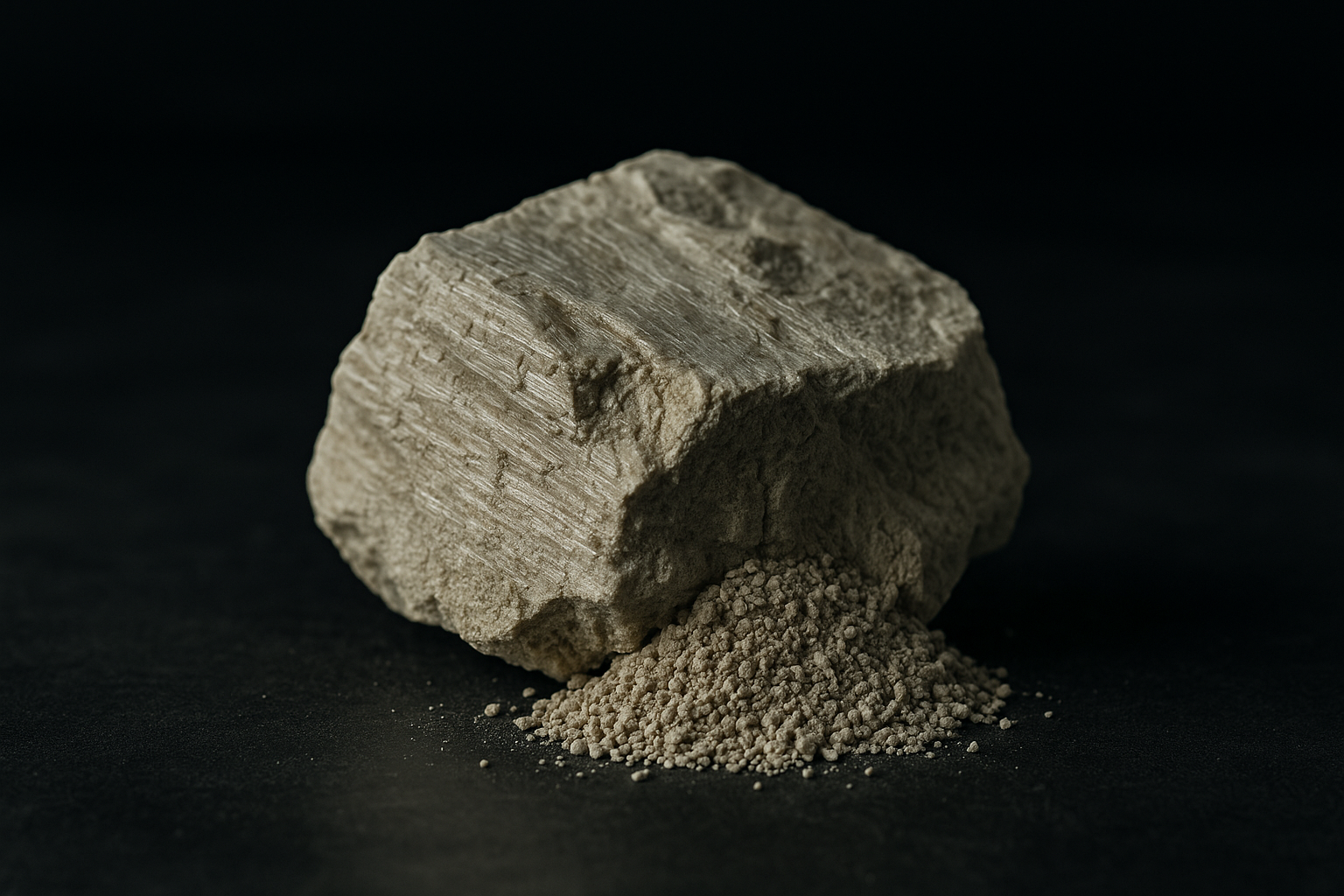
KMIZEOLITE's natural clinoptilolite is 97% pure and is mined and processed at the Amargosa Valley mine in Nevada, USA. With a specific surface area of 40.0 m²/g, pore diameter of 4.0–7.0 Å, a stable pH range of 3.0–10.0, and a hardness of 4.0–5.0 Mohs, it has the physical stability to withstand metal-modification processes and packed-bed operation, so it is considered as the base material for the phosphorus adsorption media above or as a slow-release phosphorus fertilizer carrier.
Looking at the research evidence, Bansiwal et al. (2006, Journal of Agricultural and Food Chemistry) reported that surfactant-modified zeolite (SMZ) functions as a slow-release phosphorus fertilizer that loads and slowly releases phosphate (Bansiwal, A.K. et al., 2006, doi:10.1021/jf060034b). Stepova et al. (2023, Water) measured the adsorption isotherms and breakthrough curves of ammonium and phosphate on natural and modified clinoptilolite, quantitatively presenting phosphate adsorption behavior (Stepova, K. et al., 2023, doi:10.3390/w15101933).
On the eutrophication and resource-recovery side, Ma et al. (2022, Journal of Soils and Sediments) reported results of removing pollutants from eutrophic river water using iron-modification carbon/zeolite (Ma, H. et al., 2022, doi:10.1007/s11368-022-03251-7), and the constructed wetland review by Wu et al. (2014, Bioresource Technology) summarized that the phosphorus adsorption capacity and Ca content of media such as zeolite are key factors in phosphorus removal, and that combining vegetation and substrate brings phosphorus removal rates to a wide range (about 24–80% P) (Wu, H. et al., 2014, doi:10.1016/j.biortech.2014.10.068).
KMIZEOLITE Key Properties
| Item | Value |
|---|---|
| Clinoptilolite purity | 97% |
| Cation exchange capacity (CEC) | 1.6–2.0 meq/g |
| Specific surface area | 40.0 m²/g |
| Pore diameter | 4.0–7.0 Å |
| pH stability range | 3.0–10.0 |
| Hardness | 4.0–5.0 Mohs |
| Thermal stability | 700°C |
| Specific gravity | 1.89 |
| Bulk density | 45–54 lbs/ft³ |
| Certifications | OMRI KMI-10365, FDA GRAS, TSCA, EN-71-3 |
Application examples of zeolite for phosphorus recovery & eutrophication reduction
In the phosphorus field, use as a metal-modified medium or phosphorus resource-recovery carrier is more realistic than "natural zeolite as-is." The representative scenarios are as follows.
- Ca/La/Fe metal-modified phosphorus adsorption column: A method that adsorbs phosphate from effluent and river water using a column packed with clinoptilolite that has been loaded/ion-exchanged with polyvalent metals (based on a CEC 1.6–2.0 meq/g base material)
- Surfactant-modified (SMZ) media: A phosphate filtration-layer method that imparts anion exchange capacity by modifying the external surface with cationic surfactants such as HDTMA
- Slow-release phosphorus fertilizer carrier: A resource-recovery (P-recovery) fertilizer carrier that applies a phosphorus-adsorbed, saturated medium to the crop root zone to release phosphorus slowly
- Constructed wetland/media mixing: A method that mixes zeolite into constructed wetland substrate to reduce the total phosphorus load
- Test/pilot application: A method that pre-verifies the modification approach, contact time, competing ions, and desorption reusability with a small sample
Recommended particle size and product specifications
For metal-modified phosphorus adsorption columns and filter beds, Fine Granule (30×50 mesh, 0.3–0.6mm) or Medium Granule (14×40 mesh), which is advantageous for securing specific surface area, is common, and when designing the packed bed, linear velocity and pressure loss should be reviewed together. For cases where drainage and handling must be maintained, such as constructed wetland/media mixing or fertilizer carriers, Medium to Coarse Granule is considered. If you intend to perform surface modification in your own process, the uniform particle size of the base material affects modification reproducibility, so selecting a single mesh grade is recommended.
| Product group | Mesh | Particle size | Typical use |
|---|---|---|---|
| Powder | 100 mesh or finer | <150μm | Pozzolan, feed, powder adsorption |
| Fine Granule | 30×50 mesh | 0.3–0.6mm | Water treatment, filtration, soil |
| Medium Granule | 14×40 mesh | 0.4–1.4mm | Filter beds, bedding, litter |
| Coarse Granule | 8×14 mesh | 1.4–2.4mm | Swimming pools, deicing, large-scale filtration |
| Extra Coarse | 4×8 mesh | 2.4–4.8mm | Packed beds, air scrubbers |
→ View products by mesh size · Application-based product selection guide
Pilot testing and on-site evaluation points
Phosphorus involves both anionic characteristics and a resource-recovery goal at the same time, so design differs from simple adsorption. Be sure to check the following items together.
- Determine the modification approach: Unmodified natural zeolite has low phosphorus removal capacity. The very first decision is whether to apply Ca/La/Fe metal modification or surfactant modification (SMZ).
- Initial concentration and target standards: Clarify the influent total phosphorus (T-P) and phosphate concentrations and the treatment target (effluent total phosphorus standard, etc.).
- Competing anions: Co-existing anions such as sulfate (SO₄²⁻), nitrate (NO₃⁻), and chloride (Cl⁻) compete for phosphate adsorption sites, so check their ratios.
- Contact time and linear velocity: In column operation, EBCT (empty bed contact time) and linear velocity govern the breakthrough point (pre-measurement of isotherms/breakthrough curves is recommended).
- Desorption and resource-recovery route: The medium choice and operation differ depending on whether phosphorus is returned as fertilizer (slow-release carrier) or desorbed/regenerated. Also design for the performance degradation of regenerated media and the disposal of spent media.
- Field-specific considerations: Phosphorus removal is often mainstreamed via chemical coagulation/precipitation (Ca/Fe/Al) and biological phosphorus removal (EBPR). Zeolite is generally considered not as a standalone solution but as an auxiliary medium for phosphorus recovery from effluent/river water or as an auxiliary medium for constructed wetlands.
→ Check TDS (Technical Data Sheet) · Check MSDS (Safety Data Sheet)
Phosphorus Recovery FAQ
Does natural zeolite adsorb phosphate directly?
In its unmodified state, efficiency is low. Phosphate is an anion (PO₄³⁻/HPO₄²⁻) and the natural clinoptilolite framework carries a negative charge, so the two repel each other. Clinoptilolite is inherently strong at cation (NH₄⁺, heavy metal) exchange. To recover phosphorus, you need a modified medium that loads/ion-exchanges polyvalent metals such as Ca, La, or Fe to introduce active sites that precipitate and complex with phosphate.
What is the principle behind recovering phosphorus and recycling it as fertilizer?
After phosphate is adsorbed onto metal-modified zeolite, the phosphorus-saturated medium can be applied to the crop root zone and used as a slow-release phosphorus fertilizer carrier that gradually releases phosphorus. Bansiwal et al. (2006, J. Agric. Food Chem.) reported that surfactant-modified zeolite functions as a slow-release phosphorus fertilizer that loads and slowly releases phosphate. It is an approach that links adsorption, desorption, and reuse into a single flow to return phosphorus from wastewater back into a resource.
How is it related to eutrophication reduction?
Phosphorus is often the limiting nutrient for eutrophication in lakes and rivers, so reducing total phosphorus (T-P) is key to suppressing algal blooms. Ma et al. (2022, J. Soils Sediments) reported that iron-modified carbon/zeolite was effective at removing pollutants from eutrophic river water. It is considered as an auxiliary medium that adsorbs phosphorus from effluent and river water to reduce the phosphorus load to water bodies.
Which particle size (mesh) is suitable?
For metal-modified adsorption columns and filter beds, Fine Granule (30×50 mesh, 0.3–0.6mm) to Medium Granule (14×40 mesh) is common, while for constructed wetland/media mixing or fertilizer carrier applications, Medium to Coarse Granule is considered for drainage and handling. Please refer to the application-based product selection guide.
Can I receive a test sample?
Yes, KMIZEOLITE supports sample provision for real-world application evaluation. On the sample request page, please leave your application purpose (metal-modified phosphorus adsorption, slow-release fertilizer carrier, etc.) and desired particle size.
Inquiries and sample requests
If you are considering applying zeolite in the phosphorus (P) recovery and eutrophication reduction field, please contact us through the channels below.
Notice
Whether the material can be applied may vary depending on field conditions, regulations, and test results. Before actual application, a test evaluation suited to the field conditions must be conducted first. Zeolite should be understood not as a cure-all for this field, but as a material that supports existing processes.
Related pages
science Related Research Papers
These are academic papers addressing zeolite application in this field. Please refer to them when evaluating adoption.
- Surfactant-Modified Zeolite as Slow Release Fertilizer for Phosphorus
Bansiwal, A.K. et al. — Journal of Agricultural and Food Chemistry, 2006 - Adsorption of Ammonium Ions and Phosphates on Natural and Modified Clinoptilolite: Isotherm and Breakthrough Curve Measurements
Stepova, K. et al. — Water, 2023 - Decontamination of pollutants from eutrophic river water using iron-modification carbon/zeolite
Ma, H. et al. — Journal of Soils and Sediments, 2022 - A review on the sustainability of constructed wetlands for wastewater treatment: Design and operation
Wu, H. et al. — Bioresource Technology, 2014
The papers above are reference material, and separate evaluation suited to field conditions is required for actual application.