Zeolite for Semiconductor Process Adsorption Aid
Not as a UHP material for chip contact, but as a supplementary adsorbent for low-concentration VOCs, moisture, and trace gases in semiconductor fab exhaust and abatement (facility/abatement) lines, we quantitatively review natural clinoptilolite from the perspective of a thermally regenerable packed-bed design that leverages its 4.0-7.0 A pores, CEC of 1.6-2.0 meq/g, and heat resistance of about 700 C (hydrophobic VOCs and high-humidity conditions presuppose an activated carbon hybrid or surface modification).
What problems arise in semiconductor process adsorption support
In the exhaust and abatement lines of a semiconductor fab, organic solvent vapors generated by etch, cleaning, photolithography, and CVD processes (IPA, acetone, PGMEA, thinner-class VOCs), trace acidic and basic gases (AMC, airborne molecular contamination), and moisture (humidity) in the process air are continuously subject to management. The process chemical and gas lines that directly contact the chip are managed separately in the UHP (ultra-high-purity) domain; what this page addresses is the exhaust and environmental management (facility/abatement) lines downstream of that. In this domain, activated carbon and synthetic molecular sieves (13X, 4A, etc.) are the primary adsorbents, but in supplementary adsorption stages such as the initial load distribution of low-concentration VOCs, moisture-uptake buffering, and pre-scrubber prefilters, inorganic adsorbents with good heat resistance and regenerability are reviewed separately.
The difficulty of this domain is that adsorption performance is determined not by a single property but by a combination of operating conditions. Specifically, it is governed by (1) the polarity and kinetic diameter of the target molecule (small polar molecules at the level of IPA approximately 4.7 A, acetone approximately 4.6 A vs. hydrophobic large molecules such as toluene and xylene), (2) the empty-bed velocity (EBV) and the resulting residence time (EBCT), (3) the competitive adsorption of moisture due to relative humidity (RH), and (4) the operating temperature. Hydrophilic adsorbents lose VOC capacity under high humidity because moisture occupies the active sites, and hydrophobic activated carbon poses ignition and degradation risks during thermal regeneration, so the adsorption aid material must be selected to match the process conditions in pore size, hydrophilic/hydrophobic character, and heat resistance. To emphasize again, zeolite is not a UHP material for chip contact; it is appropriately reviewed only as a supplementary adsorption and buffering material for the exhaust and environmental management lines.
Why natural clinoptilolite is reviewed as an adsorption aid
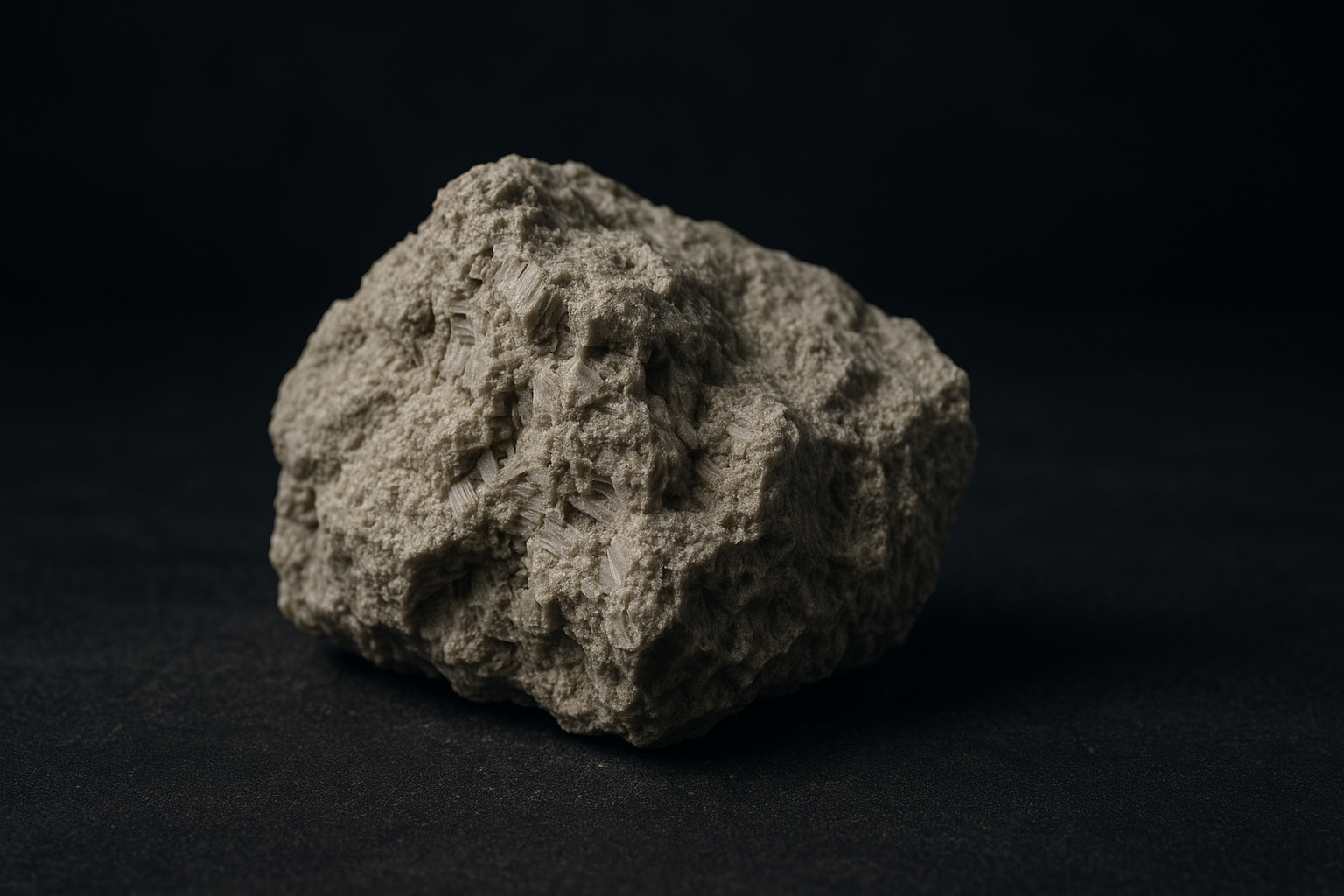
Natural clinoptilolite is a crystalline aluminosilicate (HEU-type framework) with uniform micropores of 4.0-7.0 A (a two-dimensional channel system) and cation-exchange characteristics (CEC 1.6-2.0 meq/g). Its pore diameter lies in the size range of small VOC molecules (IPA, acetone) and water molecules (~2.6 A), so the molecular sieving effect and physical adsorption (van der Waals condensation) within the channels work together. Al substitution in the framework creates a negative charge, and exchangeable cations (Ca2+, K+, Na+) that offset it are present, so the surface is hydrophilic; with high affinity for water molecules and polar VOCs, it is also reviewed as a moisture buffering (uptake) material for gas streams.
However, this hydrophilicity is a double-edged sword. Unmodified natural clinoptilolite (1) has a weaker capture capacity than activated carbon for hydrophobic large VOCs such as toluene and xylene, and (2) under high-humidity (RH) conditions, moisture competitively adsorbs with VOCs and lowers the effective capacity. Therefore, in exhaust with a large proportion of hydrophobic VOCs, hydrophobizing the surface with cationic surfactants and the like or configuring a hybrid with activated carbon is presupposed. In fact, Asgharzadeh et al. (MethodsX, 2025) reported that clinoptilolite surface-modified with a cationic surfactant can elevate organic VOC adsorption performance compared to the unmodified form.
KMIZEOLITE's natural clinoptilolite is 97% pure, mined and processed at the Amargosa Valley mine in Nevada, USA, and has a specific surface area of 40.0 m2/g, a specific gravity of 1.89, and a pH stability range of 3.0-10.0. In particular, the fact that its framework structure is stable up to about 700 C and withstands regeneration operation based on thermal desorption is an advantage as an industrial adsorption aid. De Gennaro et al. (Environmental Science and Pollution Research, 2024) also summarized that the specific surface area of natural clinoptilolite ranges from about 13-35 m2/g by mine and that its framework structure remains stable up to about 700 C, supporting its potential for thermally regenerable gas purification use.
On the adsorption mechanism side, "Zeolites in Adsorption Processes" (Chemical Reviews, 2022) comprehensively concluded that the pore geometry and framework Si/Al ratio of zeolites determine molecular selectivity and gas separation performance, and Cataldo et al. (Materials, 2024) experimentally compared the odor and VOC gas adsorption behavior of zeolites including natural clinoptilolite, confirming selective capture according to pore and surface characteristics. If moisture buffering is also required for the gas stream, the review by Sahin et al. (Building and Environment, 2020), which summarizes the simultaneous VOC and humidity management behavior of clinoptilolite, is a useful reference.
KMIZEOLITE key properties
| Item | Value |
|---|---|
| Clinoptilolite purity | 97% |
| Cation exchange capacity (CEC) | 1.6-2.0 meq/g |
| Specific surface area | 40.0 m2/g |
| Pore diameter | 4.0-7.0 A |
| pH stability range | 3.0-10.0 |
| Hardness | 4.0-5.0 Mohs |
| Thermal stability | 700 C |
| Specific gravity | 1.89 |
| Bulk density | 45-54 lbs/ft3 |
| Certifications | OMRI KMI-10365, FDA GRAS (21 CFR 182.2729), TSCA, EN-71-3 |
Semiconductor process adsorption support application examples
Below are representative scenarios in which natural clinoptilolite is reviewed as a supplementary adsorbent in semiconductor exhaust and environmental management (facility/abatement) lines. All are downstream environmental management areas, not chip-contact processes.
- Pre-scrubber prefilter: Placing a zeolite packed bed upstream of a wet/chemical scrubber for VOCs and acidic gases to distribute the initial load (especially hydrophilic polar VOCs and moisture) and reduce downstream absorbent/chemical consumption and mist load
- Low-concentration VOC adsorption packed bed (column): Physically adsorbing low-concentration polar organic solvent vapors such as IPA, acetone, and PGMEA in a fixed-bed column and regenerating by thermal desorption (temperature swing) leveraging the roughly 700 C heat resistance. When hydrophobic VOCs are abundant, a surface-modified type or an activated carbon hybrid is applied
- Moisture buffering (gas drying support): Buffering moisture peaks (RH fluctuations) in process gas streams and compressed air with hydrophilic pores to stabilize the load and regeneration frequency of downstream synthetic molecular sieves (13X/4A) and dryers
- Activated carbon hybrid bed: Arranging an activated carbon layer and a zeolite layer in series in a layered configuration so that activated carbon captures hydrophobic VOCs while zeolite shares the capture of hydrophilic VOCs and moisture, with thermal regeneration operated mainly on the zeolite layer
- Odor and trace gas buffering: Supplementarily buffering low-concentration odor components (ammoniacal, sulfur-based, etc.) in workplace and facility exhaust. Cataldo et al. (2024) reported the odor and VOC adsorption of natural clinoptilolite
- Pilot validation: Pre-confirming the breakthrough point, EBCT, and per-regeneration-cycle recovery rate with a small sample under actual exhaust gas composition, flow rate, and humidity conditions
Recommended particle size and product specifications
In gas-phase adsorption packed beds, the balance between pressure drop (differential pressure) and mass transfer is the key, so granular forms (8x14-30x50 mesh) are generally reviewed over powder (100 mesh). The smaller the particle, the larger the external mass transfer coefficient and the later the breakthrough, but the packed-bed differential pressure (sensitive to the inverse of particle diameter per the Ergun relation) increases sharply, so particle size is set together with the allowable differential pressure and blower power. Granular forms are a compromise point that secures packed-bed air permeability while maintaining external surface area and contact time (EBCT). For fine dust capture, blending, and coating, Powder (100 mesh) is used. Refer to the table below to select the product group suited to your operation mode.
| Product group | Mesh | Particle size | Representative uses |
|---|---|---|---|
| Powder | 100 mesh or finer | <150um | Pozzolan, feed, powder adsorption |
| Fine Granule | 30x50 mesh | 0.3-0.6mm | Water treatment, filtration, soil |
| Medium Granule | 14x40 mesh | 0.4-1.4mm | Filter media, bedding, flooring |
| Coarse Granule | 8x14 mesh | 1.4-2.4mm | Swimming pools, deicing, large-scale filtration |
| Extra Coarse | 4x8 mesh | 2.4-4.8mm | Packed beds, air scrubbers |
→ View products by mesh size · Product selection guide by application
Pilot testing and on-site review points
When applying this as an adsorption aid to a semiconductor exhaust and abatement line, the following items must always be confirmed together. The principle is to design based on breakthrough data measured under the on-site gas composition, not catalog capacity values.
- Identify gas composition: Analyze the target VOC type (polar/hydrophobic distinction) and concentration (ppmv), the coexistence of acidic/basic trace gases (AMC), and the relative humidity (RH). If the proportion of hydrophobic VOCs and high humidity is large, unmodified clinoptilolite alone is unsuitable, and a modified type or activated carbon hybrid is presupposed
- Design criteria: Set the empty-bed velocity (EBV) and contact time (EBCT) to calculate the packed-bed height and cross-sectional area. If the EBCT is short, the mass transfer zone (MTZ) lengthens and early breakthrough occurs, so confirm the breakthrough behavior in a pilot while varying the EBCT
- Operating conditions: Measure the operating temperature and differential pressure (delta P), and derive the adsorption capacity and the replacement/regeneration timing from the breakthrough curve
- Regenerability evaluation: After thermal desorption (temperature swing) leveraging the roughly 700 C heat resistance, test the cycle-by-cycle adsorption capacity recovery rate and cumulative capacity fade
- Competitive adsorption and humidity effects: Quantify, by RH range, the effect of moisture's competitive adsorption due to hydrophilicity on VOC capture capacity
- Field-specific notes: Zeolite is not a UHP material for chip contact but a supplementary adsorbent for exhaust and environmental management lines, and it is common to share roles through a hybrid configuration with activated carbon and synthetic molecular sieves
Multiple cases consistently show that the temperature variable is decisive in gas-phase adsorption operation. Davarpanah et al. (Journal of Environmental Management, 2020) reported that the physical adsorption amount of gas (CO2) on natural clinoptilolite decreases with rising temperature, suggesting that a low-temperature adsorption / high-temperature regeneration temperature swing design is the key. On the surface modification side, Asgharzadeh et al. (MethodsX, 2025) presented that clinoptilolite hydrophobized with a cationic surfactant can raise organic VOC adsorption performance, and Cataldo et al. (Materials, 2024) experimentally compared the odor and VOC gas adsorption selectivity of the zeolite group including natural clinoptilolite. When designing for simultaneous VOC and humidity management, the environmental application review by Sahin et al. (Building and Environment, 2020) is a useful reference for organizing operating variables.
→ Check the TDS (Technical Data Sheet) · Check the MSDS (Safety Data Sheet)
Semiconductor process adsorption support FAQ
Can zeolite be used as an ultra-high-purity material in direct contact with semiconductor chips?
No. Natural clinoptilolite is not a UHP (ultra-high-purity) material for chip contact; it is appropriately reviewed only as a supplementary adsorbent for VOCs, moisture, and trace gases in exhaust and abatement lines. Its main uses are in the facility/abatement domain, such as pre-scrubber prefilters, low-concentration VOC adsorption packed beds, and moisture buffering media. It is not a material that replaces chip-contact process chemical or gas lines.
Which VOCs is unmodified natural clinoptilolite effective against, and what are its limits?
Because of its hydrophilic framework, unmodified natural clinoptilolite is relatively affine toward water molecules and polar, small VOCs such as IPA and acetone, but its capture capacity for hydrophobic, large VOCs such as toluene and xylene is weaker than activated carbon. Its hydrophilicity also means that under high-humidity conditions moisture competitively adsorbs and lowers VOC capacity. When the proportion of hydrophobic VOCs is large, it is common to hydrophobize the surface with cationic surfactants and the like (Asgharzadeh et al., 2025) or to configure a layered hybrid bed with activated carbon.
What advantages does it offer compared to activated carbon?
Natural clinoptilolite has a framework structure stable up to about 700 C, so it withstands regeneration operation based on thermal desorption, and its hydrophilic pores are advantageous for moisture buffering and moisture uptake. On the other hand, activated carbon is often superior in capturing hydrophobic organics and in specific surface area per unit, so a hybrid bed layering the two materials, with each sharing the capture of hydrophilic and hydrophobic compounds, is frequently reviewed.
What particle size (mesh) is suitable for an adsorption packed bed?
For gas-phase packed beds, granular Fine to Coarse Granule (8x14-30x50 mesh) is generally reviewed for pressure drop and air permeability. The smaller the particle, the faster external mass transfer and the later breakthrough, but the higher the pressure drop, so particle size is set by considering EBCT and allowable differential pressure together. For fine dust capture and blending, Powder (100 mesh) is used. Please refer to the product selection guide by application.
How are the adsorbent replacement and regeneration cycles determined?
It varies with the target gas concentration, flow rate, and relative humidity. It is advisable to derive the replacement point by measuring the breakthrough curve and EBCT (residence time) in a pilot, then to determine the regeneration cycle by evaluating the cycle-by-cycle adsorption capacity recovery rate after thermal desorption at about 700 C. Since the physical adsorption equilibrium capacity decreases as operating temperature rises (Davarpanah et al., 2020), an adsorption-regeneration temperature swing design is the key.
Can I receive a sample for testing?
Yes, KMIZEOLITE supports sample provision for real-world application review. On the sample request page, please provide the target gas composition (VOC type and concentration), flow rate, relative humidity, and desired particle size.
Inquiries and sample requests
If you are reviewing the application of zeolite in the semiconductor process adsorption aid field, please contact us through the channels below.
Notice
Applicability may vary depending on on-site conditions, regulations, and test results. Before actual application, test review tailored to on-site conditions must always be carried out first. Zeolite should be understood not as a cure-all for this field, but as a material that supplements existing processes.
Related pages
science Related Papers
These are academic papers dealing with zeolite application in this field. Please refer to them when reviewing adoption.
- Adsorption of VOCs from kerosene using clinoptilolite modified by cationic surfactant
Asgharzadeh, F. et al. — MethodsX, 2025 - Odors Adsorption in Zeolites Including Natural Clinoptilolite
Cataldo, E. et al. — Materials, 2024 - CO2 capture on natural zeolite clinoptilolite: Effect of temperature
Davarpanah, E. et al. — Journal of Environmental Management, 2020 - Zeolite for indoor air quality: A review of environmental applications (VOC·humidity)
Sahin, O. et al. — Building and Environment, 2020 - Zeolites in Adsorption Processes: State of the Art and Future Prospects
Various — Chemical Reviews, 2022 - Fundamental properties and sustainable applications of natural zeolite clinoptilolite
De Gennaro, B. et al. — Environmental Science and Pollution Research, 2024
The papers above are reference materials, and actual application requires separate review tailored to on-site conditions.