Zeolite for DIY Deodorizer Ingredient
Natural clinoptilolite is a DIY deodorizing ingredient whose negatively charged framework (CEC 1.6–2.0 meq/g) preferentially captures the cationic ammonium ion (NH₄⁺), while its 4–7 Å micropores secondarily adsorb sulfur compounds and VOCs — giving it an edge over baking soda or activated carbon alone against the ammonia odor of pet urine. This page summarizes the mechanism, particle size, blending ratio, and regeneration cycle with academic references.
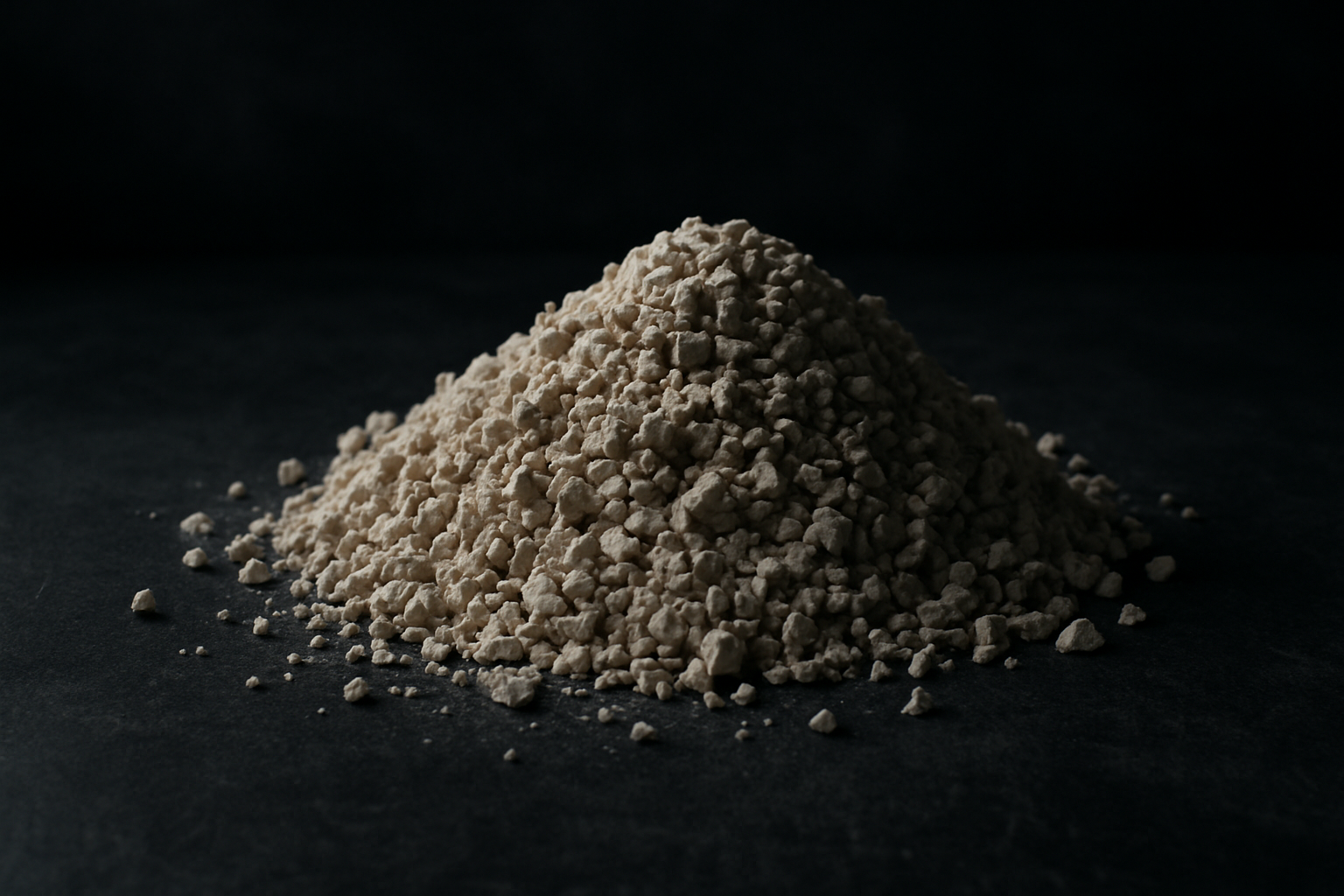
Making Your Own Deodorizer: What Makes It Difficult
A DIY deodorizer works by placing adsorbent powder or granules in a cotton pouch or breathable container — instead of a store-bought product — to capture odors in living spaces such as shoe cabinets, refrigerators, pet litter boxes, vehicles, and closets. The catch is that each raw material works on a different principle. Baking soda (NaHCO₃) neutralizes acidic odor molecules but is weak against alkaline ammonia, while ordinary activated carbon is strong against nonpolar VOCs but has limited capacity for polar, cationic molecules like ammonia. On top of that, both materials quickly harden or have their adsorption sites blocked once they take on moisture, causing performance to drop.
Household odors have widely varying source chemistries. From pet feces and urine, urea decomposes to produce ammonia (NH₃ ⇌ NH₄⁺); from food spoilage and drains come sulfur compounds (H₂S, methanethiol CH₃SH); and from shoes and sweat come mainly organic acids (such as isovaleric acid). When ammonia dissolves in water it becomes the positively charged ammonium ion, while sulfur compounds and VOCs are generally neutral small molecules. This is why a single raw material struggles to broadly capture all of them — and so the selection criterion for a DIY deodorizing material becomes whether it provides both ion exchange (cation capture) and physical adsorption (neutral-molecule capture) in one material.
Why Natural Zeolite Is Considered as a DIY Deodorizing Ingredient
Natural clinoptilolite has a crystalline framework in which Si–O–Al tetrahedra are connected in three dimensions. To the extent that Al³⁺ substitutes for Si⁴⁺ sites, the framework carries a permanent negative charge, and to offset this, exchangeable cations (Na⁺, K⁺, Ca²⁺, Mg²⁺) sit loosely within the pores. When ammonium (NH₄⁺) generated from urine and feces approaches, clinoptilolite — having high selectivity for NH₄⁺ — swaps places with these exchangeable cations and holds NH₄⁺ in its framework. KMIZEOLITE products' cation exchange capacity (CEC) of 1.6–2.0 meq/g is the key property that defines the total amount of ammonium this ion exchange can capture. In other words, it does not mask the odor with a chemical reaction; it isolates the odor-causing molecule itself within the lattice.
At the same time, clinoptilolite's uniform 4.0–7.0 Å micropores are sized so that neutral molecules such as H₂S (kinetic diameter ≈ 3.6 Å) or small VOCs can enter and reside, supplementing capture of sulfur and volatile odors not caught by ion exchange through physical adsorption. This dual mechanism — one material handling both cationic and neutral odors — is what distinguishes it from the single-action baking soda and activated carbon.
Cataldo et al. (Materials, 2024) experimentally reported that zeolites including natural clinoptilolite adsorb representative odorous gases such as ammonia and hydrogen sulfide to lower odor intensity (Cataldo et al., Materials, 2024). The same group's earlier work (Cataldo et al., Materials, 2021) assessed that natural zeolite treatment jointly reduces odors and harmful compounds. For cat litter applications, a report that clinoptilolite controls odor by adsorbing urine ammonia (Applied Clay Science, 2019), and for livestock environments a classic study showing clinoptilolite reduces ammonia release (Mumpton & Fishman, Clays and Clay Minerals, 1977), support the same mechanism. An indoor air quality review (Sahin et al., Building and Environment, 2020) also noted that zeolite combines VOC and odor adsorption with humidity regulation, making it advantageous for maintaining adsorption performance over time without hardening.
KMIZEOLITE's natural clinoptilolite is 97% pure and is mined and processed at a mine in Amargosa Valley, Nevada, USA. With a specific surface area of 40.0 m²/g, pore diameter of 4.0–7.0 Å, stable pH range of 3.0–10.0, and thermal stability of 700°C enabling thermal regeneration, plus EN-71-3 (Toy Safety) PASS and California Prop 65 compliance, it is also considered as a DIY ingredient for environments with children and pets.
KMIZEOLITE Key Properties
| Property | Value |
|---|---|
| Clinoptilolite purity | 97% |
| Cation exchange capacity (CEC) | 1.6–2.0 meq/g |
| Specific surface area | 40.0 m²/g |
| Pore diameter | 4.0–7.0 Å |
| Stable pH range | 3.0–10.0 |
| Hardness | 4.0–5.0 Mohs |
| Thermal stability | 700°C |
| Specific gravity | 1.89 |
| Bulk density | 45–54 lbs/ft³ |
| Certifications | OMRI KMI-10365, FDA GRAS, TSCA, EN-71-3 |
Application Examples of Zeolite for DIY Deodorizer Ingredient
Below are representative ways and specific conditions in which zeolite is used when blending a DIY deodorizer yourself. Particle size and dosage are premised on calibration through small-scale trials according to odor intensity and space volume.
- Deodorizer pouch type: Fill a breathable cotton pouch with 50–150 g of 30×50 mesh Fine Granule (0.3–0.6 mm) and place it in shoe cabinets, refrigerators, closets, or vehicles. The granular form produces little dust, and air flows through the voids between particles, maintaining contact area with NH₄⁺ and VOCs over time. It is especially advantageous in spaces with stagnant air such as tightly sealed refrigerators and vehicles.
- Cat litter blend type: Blend 100 mesh Powder (<150 μm) into existing litter or bentonite at 5–15 wt% to suppress the ammonia generated by the decomposition of urine urea. The powder disperses evenly over the litter surface, rapidly capturing NH₄⁺ with its 40 m²/g specific surface area and 1.6–2.0 meq/g CEC. The effect of clinoptilolite in cat litter applications was addressed in Applied Clay Science (2019) and Robins et al. (JFMS, 2022).
- Powder deodorizer blend type: Mix 100 mesh Powder with existing moisture-absorbing and deodorizing materials such as baking soda at 1:1 to 2:1, combining cation exchange (zeolite, ammonia) with acid neutralization (soda, organic acids) to broaden the odor spectrum. The two materials have different working pH and targets, making them mutually complementary.
- Combined moisture-absorption / mold-suppression type: Leverage the micropores' moisture-adsorption characteristics to pursue both deodorizing and dehumidifying in damp areas such as bathrooms and under sinks. However, in over-humid environments, moisture occupies some adsorption sites, so the replacement cycle should be brought forward.
- Small-scale trial: Use a 1 kg sample to verify in advance the appropriate particle size and dosage for each target space and odor type. We recommend varying particle size (powder vs. granule) and dosage in the same space and comparing the perceived odor reduction.
Recommended Particle Size and Product Specifications
For DIY deodorizers, Fine Granule (30×50 mesh) for deodorizer pouches and Powder (100 mesh) for cat litter and powder blends are suitable. Refer to the table below to select the product group that fits your application.
| Product group | Mesh | Particle size | Representative use |
|---|---|---|---|
| Powder | 100 mesh or finer | <150μm | Pozzolan, feed, powder adsorption |
| Fine Granule | 30×50 mesh | 0.3–0.6mm | Water treatment, filtration, soil |
| Medium Granule | 14×40 mesh | 0.4–1.4mm | Filter media, bedding, litter |
| Coarse Granule | 8×14 mesh | 1.4–2.4mm | Swimming pools, de-icing, large-scale filtration |
| Extra Coarse | 4×8 mesh | 2.4–4.8mm | Packed beds, air scrubbers |
→ View products by mesh size · Product selection guide by application
Review Points When Blending DIY
When making a deodorizer yourself, check the following items according to the type of odor and the usage environment.
- Identify the odor type: Design the particle size and blending ratio differently depending on whether it is ammonia (pet urine and feces), sulfur compounds (food and drains), or organic acids (shoes and sweat). Zeolite is particularly strong against cationic ammonia through ion exchange; combining baking soda for acidic organic acids and activated carbon for nonpolar large VOCs can broaden the odor spectrum.
- Particle size selection: Use low-dust 30×50 mesh granules for pouches and large-contact-area 100 mesh powder for litter and powder blends.
- Dosage setting: For pouches, start at 50–150 g depending on space volume and odor intensity; for litter blends, start at 5–15 wt% and adjust through small-scale trials.
- Humidity management: Because micropores also adsorb moisture, bring the replacement cycle forward in over-humid environments and arrange for good ventilation.
- Regeneration / replacement: Since it has thermal stability up to 700°C, at home some reactivation is possible via sun-drying or brief microwave heating when saturated, and the typical replacement cycle is 3–6 months.
- Safety: As a natural mineral with no chemical additives, with EN-71-3 (Toy Safety) PASS, California Prop 65 compliance, and FDA GRAS (general use 21 CFR 182.2729), it is considered as a DIY ingredient for environments accessible to children and pets.
→ View TDS (Technical Data Sheet) · View MSDS (Safety Data Sheet)
DIY Deodorizer FAQ
What kinds of odors is zeolite effective against?
It is strongest against ammonia-type odors (NH₄⁺) that dissolve in water and carry a positive charge. Because its negatively charged framework selectively captures NH₄⁺ by ion exchange within a CEC range of 1.6–2.0 meq/g, it is frequently considered for managing pet urine and feces, restroom, and food-spoilage odors. Its 4–7 Å micropores also secondarily adsorb neutral molecules such as small sulfur compounds like hydrogen sulfide (H₂S) and methanethiol, as well as some VOCs. Cataldo et al. (Materials, 2024) reported that natural clinoptilolite lowers odor intensity by adsorbing ammonia and hydrogen sulfide, and urine-odor control in cat litter was addressed in Applied Clay Science (2019) and Robins et al. (JFMS, 2022). Conversely, if the dominant odor is nonpolar, large VOCs, combining it with activated carbon may be more suitable.
Which particle size should I use for a pouch versus a litter blend?
For deodorizer pouches, we recommend Fine Granule (30×50 mesh) for low dust and good airflow; for cat litter or powder deodorizer blends, we recommend Powder (100 mesh) for its large contact area. Please refer to the product selection guide by application.
How much should I add?
For deodorizer pouches, use 50–150 g depending on the space volume and odor intensity; for cat litter blends, 5–15 wt%; and for powder deodorizer blends, start at a 1:1 to 2:1 ratio with baking soda or similar and adjust through small-scale trials.
Can it be reused once it loses effectiveness?
Partially. Because clinoptilolite has high thermal stability up to 700°C, at home you can desorb physically adsorbed moisture and some volatile molecules from the micropores by sun-drying or brief microwave heating, recovering its moisture-absorption and physical-adsorption performance to some degree. However, NH₄⁺ bound to the lattice by ion exchange is not fully released by household heating alone (industrially, brine regeneration is used), so recovery is limited. Because results vary with the degree of adsorption saturation, the typical replacement cycle is considered to be 3–6 months.
Is it safe even with children and pets around?
It is a natural mineral with no chemical additives and holds safety certifications including EN-71-3 (Toy Safety) PASS, California Prop 65 compliance, and FDA GRAS (21 CFR 182.2729). For details, please see the certifications page.
Inquiries and Sample Requests
If you are considering applying zeolite in the DIY deodorizer ingredient field, please reach out through the channels below.
Notice
Applicability may vary depending on site conditions, regulations, and test results. Before actual application, testing and review tailored to the specific site conditions must be carried out first. Zeolite should be understood not as an all-purpose solution for this field, but as a material that supports existing processes.
Related Pages
science Related Research Papers
Academic papers addressing zeolite application in this field. Refer to them when evaluating adoption.
- Use of zeolites for cat litter: Ammonia adsorption and odor control
Various — Applied Clay Science, 2019 - Control of felinine-derived malodor in cat litter
Robins L.I. et al. — Journal of Feline Medicine and Surgery, 2022 - Use of natural zeolite (clinoptilolite) in the reduction of ammonia from livestock environments
Mumpton, F.A. and Fishman, P.H. — Clays and Clay Minerals, 1977 - Odors Adsorption in Zeolites Including Natural Clinoptilolite
Cataldo, E. et al. — Materials, 2024 - Evaluation of Natural Zeolite Treatments for Eliminating Odors and Toxic Compounds
Cataldo, E. et al. — Materials, 2021 - Zeolite for indoor air quality: A review of environmental applications
Sahin, O. et al. — Building and Environment, 2020
The papers above are reference materials, and actual application requires separate review tailored to site conditions.