Zeolite for Shoe Deodorizers
Unlike deodorizers that mask odor with fragrance, natural clinoptilolite uses a single material—4–7 Å micropores, CEC 1.6–2.0 meq/g, surface area 40 m²/g—to simultaneously capture the sour-odor molecules (isovaleric acid), ammonium and foot-sweat moisture, lowering the very damp environment in which bacteria proliferate. This is a quantitative design guide anchored on a pouch particle size of 30×50 mesh and 30–80 g per shoe.
Why shoe odor is so hard to get rid of
The odor inside shoes does not disappear by masking it with fragrance. A single pair of feet has around 250,000 sweat glands and discharges a large amount of foot sweat each day; in the damp, poorly ventilated interior of a shoe, resident skin bacteria (Staphylococcus, Bacillus, etc.) break down leucine in the sweat and produce volatile organic acids such as isovaleric acid. This is the core compound behind the smell we perceive as "sour odor."
On top of this come ammonia and amines generated by protein breakdown, mildew-like odors, and—above all—residual moisture that never dries. In other words, shoe deodorizing is a problem that must solve "odor-molecule adsorption + moisture removal" at the same time, and approaches that only spray fragrance, or deodorizers that cannot capture moisture, tend to let the odor return the next day.
Why zeolite is considered for shoe deodorizing
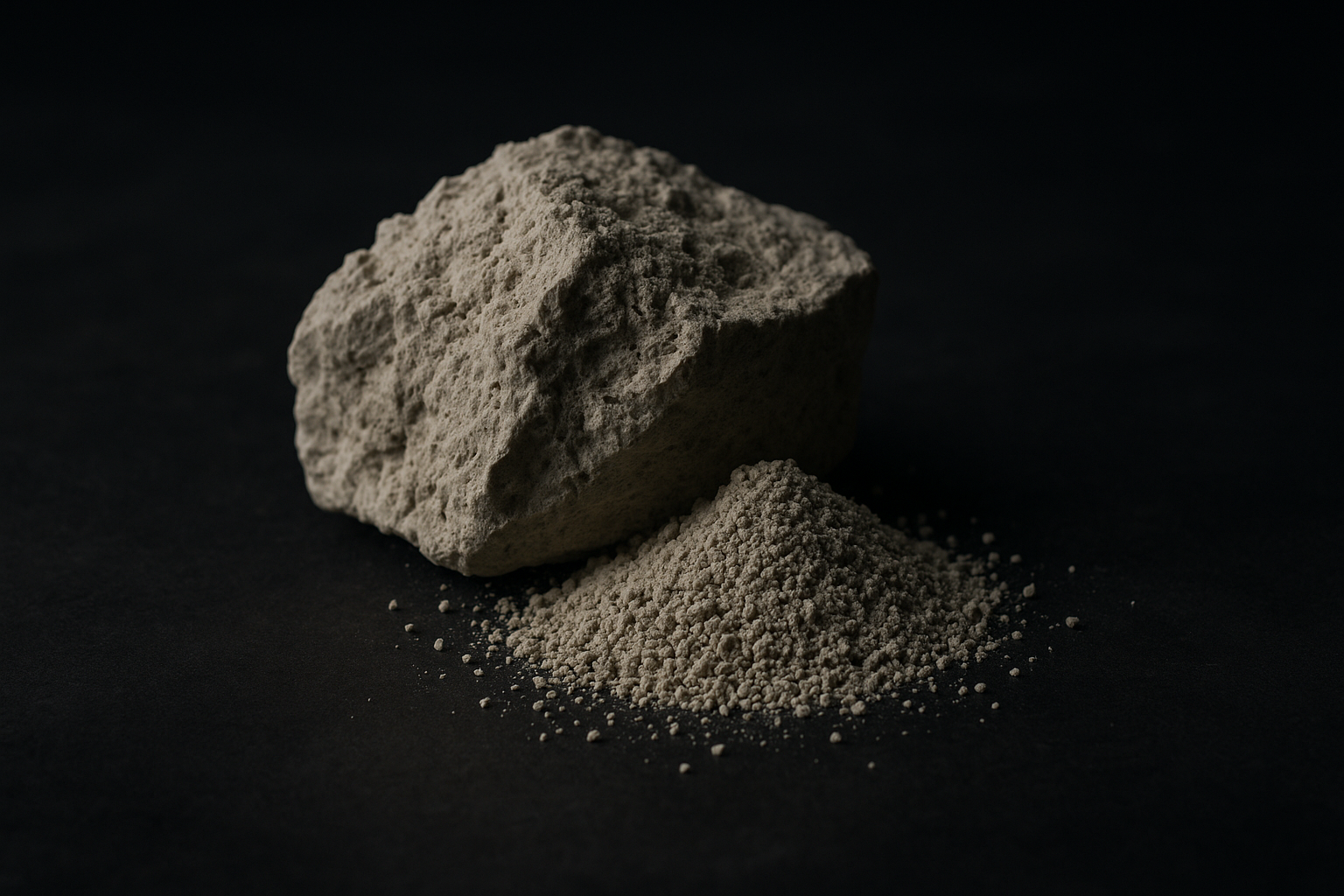
Natural clinoptilolite is a mineral that simultaneously possesses micropores of 4.0–7.0 Å and a negatively charged crystal framework (CEC 1.6–2.0 meq/g). The pore size matches small odor molecules such as isovaleric acid and ammonia (kinetic diameter roughly around 5 Å) well, trapping them by physical adsorption, while the framework's negative charge holds positively charged ammonium (NH₄⁺) and amines by ion exchange. At the same time, the hydrophilic pores with a surface area of 40.0 m²/g absorb moisture inside the shoe, lowering the very damp environment in which bacteria proliferate. The ability to handle both odor molecules and moisture with a single material is what sets it apart from an activated-carbon-only approach.
Three mechanisms operate simultaneously. (1) Physical adsorption — the 4.0–7.0 Å micropores trap volatile organic odor molecules such as isovaleric acid (kinetic diameter about 5–6 Å) and lower fatty acids inside the pores. (2) Ion exchange — the negatively charged framework swaps the cationic ammonium (NH₄⁺) and amines produced by protein breakdown of foot sweat with the framework's exchangeable cations (Na⁺·K⁺·Ca²⁺) and fixes them. (3) Moisture buffering (humidity control) — the hydrophilic pores draw in residual moisture, lowering the humidity that is the precondition for the microbial activity that creates odor precursors.
Quantitatively, the ammonium adsorption capacity of natural clinoptilolite is generally reported in the literature to be in the range of 10–20 mg NH₄⁺/g (varying with feed concentration and pretreatment), which is sufficient to meaningfully lower ammoniacal odor in enclosed odor environments such as shoes and cat litter. Indeed, a study addressing ammonia adsorption and odor control of clinoptilolite for cat litter (Applied Clay Science, 2019) and a comparative study of volatile-odor adsorption by zeolites including clinoptilolite (Cataldo et al., Materials, 2024) both reported that natural zeolite effectively captures ammonia and volatile odor components. Sahin et al. (Building and Environment, 2020) also summarized that zeolite is a multifunctional material performing both VOC adsorption and moisture control in indoor air quality applications (Sahin et al., Building and Environment, 2020), a mechanism that applies directly to the narrow, humid interior of a shoe.
KMIZEOLITE's natural clinoptilolite has a purity of 97% and is mined and processed at a mine in Amargosa Valley, Nevada, USA. With a pH stability range of 3.0–10.0 and thermal stability up to 700°C, it is stable even in the acidic environment of foot sweat and organic acids, and can be regenerated by heating.
KMIZEOLITE key properties
| Item | Value |
|---|---|
| Clinoptilolite purity | 97% |
| Cation exchange capacity (CEC) | 1.6–2.0 meq/g |
| Surface area | 40.0 m²/g |
| Pore diameter | 4.0–7.0 Å |
| pH stability range | 3.0–10.0 |
| Hardness | 4.0–5.0 Mohs |
| Thermal stability | 700°C |
| Specific gravity | 1.89 |
| Bulk density | 45–54 lbs/ft³ |
| Certifications | OMRI KMI-10365, FDA GRAS, TSCA, EN-71-3 |
Shoe-deodorizing application examples and dosage
In shoe deodorizing, the central approach is "passive adsorption," in which zeolite is placed inside the shoe. The representative application formats and field reference values are as follows.
- Shoe-deodorizing pouch: Fill a breathable cotton or non-woven pouch with granules and place 30–80 g per shoe (1–2 pouches), keeping it inside the shoe at all times when not worn. A low-dust granular form is advantageous for avoiding contamination of the shoe interior.
- Shoe cabinet / dressing-room moisture-buffering deodorizing: Place a 100–300 g pouch in each shoe-cabinet compartment to jointly manage the odor and moisture of the enclosed space shared by multiple pairs.
- Intensive care for sneakers / hiking boots: For high-sweat footwear, placing a pouch deep inside right after use while still damp captures odor precursors as the moisture dries.
- Powder-blend type: Mixing Powder (100 mesh) into ready-made shoe-deodorizing powders or deodorizer products at a fixed ratio as an adsorption-aid ingredient (for finished-product manufacturers).
- Trial / pilot application: Before adopting it into your own shoe-care products, pre-verifying particle size, fill amount and replacement cycle with a small sample.
Recommended particle size and product specifications
For shoe-deodorizing pouches, Fine Granule (30×50 mesh), which generates little dust and holds its shape inside a breathable pouch, is the most suitable. To increase the moisture-buffering area further, also consider Medium Granule (14×40 mesh), and for deodorizing-powder or finished-product blending use Powder (100 mesh). Refer to the table below to select the product group that fits your application.
| Product group | Mesh | Particle size | Typical use |
|---|---|---|---|
| Powder | 100 mesh or finer | <150μm | Pozzolan, feed, powder adsorption |
| Fine Granule | 30×50 mesh | 0.3–0.6mm | Water treatment, filtration, soil |
| Medium Granule | 14×40 mesh | 0.4–1.4mm | Filter media, bedding, floor material |
| Coarse Granule | 8×14 mesh | 1.4–2.4mm | Pools, de-icing, large-scale filtration |
| Extra Coarse | 4×8 mesh | 2.4–4.8mm | Packed beds, air scrubbers |
→ View products by mesh size · Product selection guide by application
Points to review when applying zeolite to shoe deodorizing
When designing or adopting a shoe-deodorizing pouch or product, check the following items together.
- Identify the odor source: The adsorption emphasis differs depending on whether the target is foot-sweat sour odor (organic acids such as isovaleric acid) or ammonia / mildew-like odor. A mixed organic-acid-and-ammonia type is common.
- Simultaneous moisture management: Shoe deodorizing is about not only odor adsorption but also moisture buffering. The hydrophilic pores with a surface area of 40.0 m²/g capture moisture and lower the bacteria-proliferating environment, so the effect is greater the wetter the shoe when the product is inserted.
- Particle size and fill amount: For the pouch type, the standard is filling 30–80 g per shoe with low-dust Fine Granule (30×50 mesh).
- Replacement / regeneration cycle: For home use, after typically 1–3 months, reactivate by drying in direct sunlight or heating in a microwave for 2 minutes to drive off the adsorbed moisture and odor, allowing repeated use.
- Safety and specification labeling: As a natural mineral with no chemical additives, it holds EN-71-3 (toy safety) PASS and California Prop 65 compliance documentation. Because FDA GRAS status is defined by application—21 CFR 182.2729 for general non-food use and 21 CFR 582.2729 for animal-feed ingestion use—cite the clause matching the relevant use when labeling finished products. Since a shoe-deodorizing pouch is not an ingestion use, it falls under the general clause (21 CFR 182.2729).
To elaborate on the regeneration mechanism, the main cause of adsorption reaching saturation in shoe deodorizing is not chemical bonding but the moisture filling the pores and the physically adsorbed volatile molecules. Therefore, drying in direct sunlight or heating in a microwave (about 2 minutes) desorbs the in-pore moisture and weakly held odor molecules, emptying the adsorption sites again and restoring performance. Clinoptilolite has a stable framework with thermal stability up to 700°C and a hardness of 4.0–5.0 Mohs, so the crystal structure does not collapse even when this heat-drying regeneration is repeated—a differentiator that lowers total cost of ownership compared with single-use fragrance deodorizers. However, some of the ammonium strongly fixed by ion exchange does not come out completely with heating alone, so for home use it is realistic to combine replacement and regeneration on a 1–3-month cycle.
→ View TDS (Technical Data Sheet) · View MSDS (Safety Data Sheet)
Shoe-deodorizing FAQ
Does zeolite also capture the compounds that cause shoe odor?
Yes. Volatile organic acids such as isovaleric acid, the main culprit behind shoe odor, and ammonia and amines are small molecules, so they are captured by the 4.0–7.0 Å micropores and the negatively charged framework (CEC 1.6–2.0 meq/g) of clinoptilolite through physical adsorption and ion exchange. Cataldo et al. (Materials, 2024) also reported the volatile-odor adsorption performance of natural clinoptilolite. Because it does not simply mask odor with fragrance, however, it is most effective when placed inside shoes while they are still damp.
What particle size is suitable for a deodorizing pouch?
Fine Granule (30×50 mesh), which generates little dust and holds its shape inside a cotton or non-woven pouch, is the most suitable. To increase the moisture-buffering area further, use Medium Granule (14×40 mesh); for deodorizing powders or finished-product blends, use Powder (100 mesh). Please refer to the product selection guide by application.
How much should I put in a pair of shoes?
A common starting point is 30–80 g of Fine Granule per shoe (1–2 pouches), with more for high-sweat footwear such as sneakers and hiking boots. For managing an entire shoe cabinet, place 100–300 g pouches per compartment. Adjust the exact fill amount to the shoe size and odor intensity.
Can a used pouch be reused?
Yes. After typically 1–3 months of home use, drying thoroughly in direct sunlight or heating in a microwave for about 2 minutes releases the adsorbed moisture and odor and restores the adsorption capacity. Because it is a mineral with thermal stability up to 700°C, the structure is maintained through repeated regeneration.
Can I receive a sample for testing?
Yes, KMIZEOLITE supports the provision of samples by particle size for evaluating shoe-deodorizing products. Please leave your application purpose and desired particle size on the sample request page.
Inquiries and sample requests
If you are considering applying zeolite in the shoe-deodorizer field, please get in touch through the channels below.
Notice
Whether the material is suitable may vary depending on field conditions, regulations and test results. Before actual application, testing and review appropriate to the field conditions must always be carried out first. Zeolite should be understood not as a cure-all for the field, but as a material that supports existing processes.
Related pages
science Related Papers
These are academic papers addressing zeolite application in this field. Please refer to them when reviewing adoption.
- Use of zeolites for cat litter: Ammonia adsorption and odor control
Various — Applied Clay Science, 2019 - Control of felinine-derived malodor in cat litter
Robins L.I. et al. — Journal of Feline Medicine and Surgery, 2022 - Odors Adsorption in Zeolites Including Natural Clinoptilolite
Cataldo, E. et al. — Materials, 2024 - Evaluation of Natural Zeolite Treatments for Eliminating Odors and Toxic Compounds
Cataldo, E. et al. — Materials, 2021 - Zeolite for indoor air quality: A review of environmental applications (VOC adsorption & moisture control)
Sahin, O. et al. — Building and Environment, 2020
The papers above are reference material; actual application requires separate review appropriate to the field conditions.