Camping Deodorizing & Moisture-Control Zeolite
Natural clinoptilolite performs ammonium ion exchange at CEC 1.6–2.0 meq/g and simultaneous adsorption of moisture (about 2.7 Å) and ammonia (about 2.6 Å) in its 4.0–7.0 Å micropores within a single mineral, making it a passive deodorizing and dehumidifying material that simultaneously buffers NH₃, foot odor, VOCs and overnight condensation in tents and car-camping spaces with no external power.
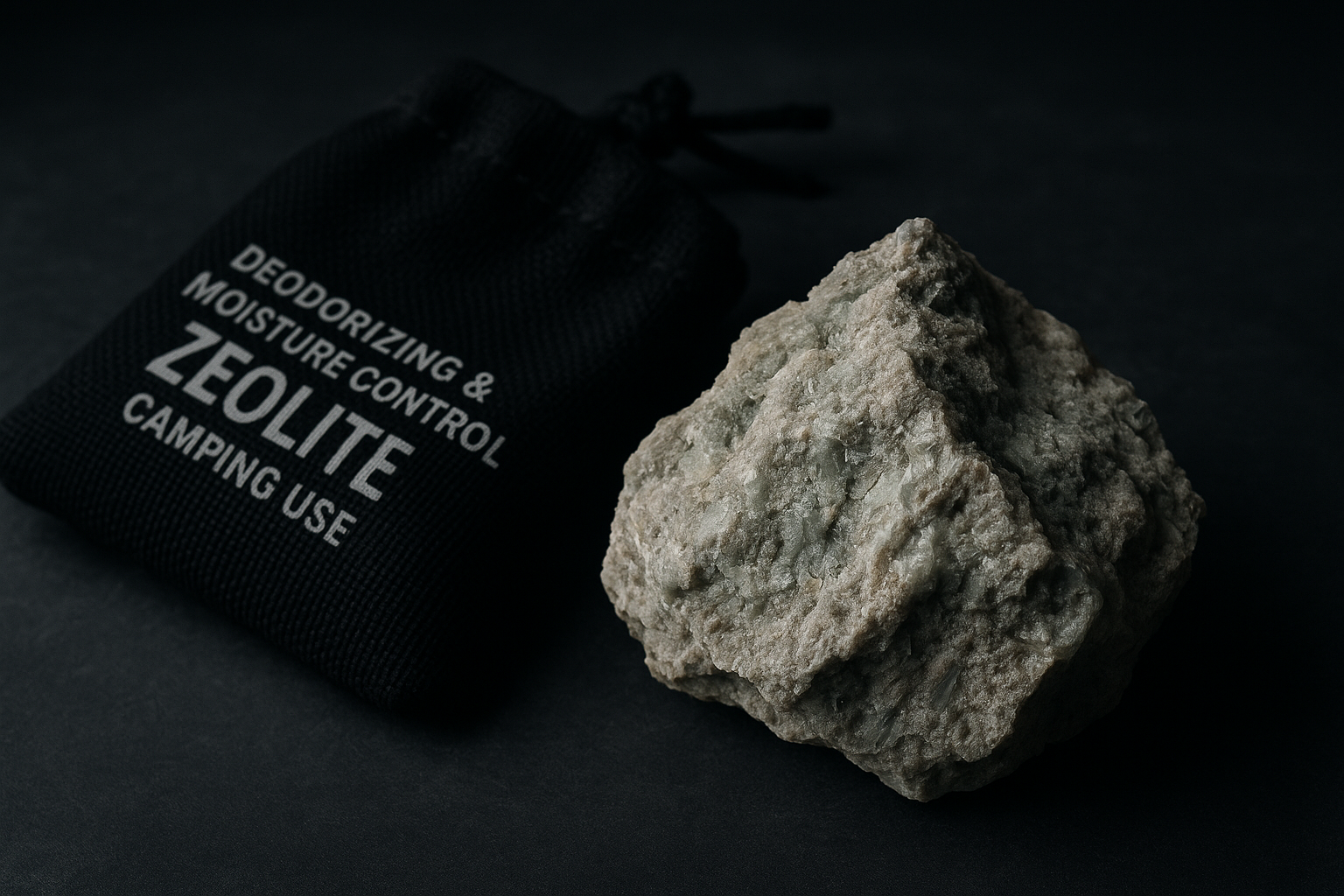
Why odor and moisture arise together in tent and car-camping spaces
The unpleasant odor and condensation moisture of a camping environment essentially originate from the same cause. A tent or car-camping vehicle is a confined space of only about 2–6 m³ with limited ventilation, so breathing and body heat alone during sleep can rapidly push the interior humidity to 80–90%, and condensation forms on the inside of the canopy by dawn. At the same time, the ammonia (NH₃), amines, sulfur compounds (mercaptans), and organic acids released from leftover food, wet hiking boots, pet waste, and protein decay inside coolers are trapped in the small air layer and accumulate as odor.
In particular, the higher the humidity, the more odor molecules dissolve into the moisture and the longer their residence time, becoming adsorbed onto the tent fabric and sleeping bag and leaving a lingering smell into the next day. Camping deodorizing therefore should not be approached by simply masking with an air freshener, but from the perspective of an adsorbent material that physically captures moisture and odor molecules together for a lasting effect.
Why zeolite is considered for camping deodorizing and dehumidifying
Natural clinoptilolite zeolite is a mineral with well-developed uniform micropores 4.0–7.0 Å in size inside its crystals. These pores are just the right size for water molecules (about 2.7 Å), ammonia (about 2.6 Å), and low-molecular VOCs to pass through, so a single material can capture moisture (dehumidifying) and odor molecules (deodorizing) at the same time. The mechanisms at work in camping deodorizing and dehumidifying fall broadly into three branches.
- Cation ion exchange (ammonium fixation): The negatively charged sites arising from Al³⁺ substitution in the framework attract positively charged ammonium (NH₄⁺) in the CEC 1.6–2.0 meq/g range. That is, a capacity to exchange about 27–34 mg of NH₄⁺-N per gram theoretically (= 1.6–2.0 meq × 17 g/mol), holding ammonia dissolved in moisture in ionic form to suppress re-volatilization.
- Physical adsorption (capturing odor molecules and VOCs): Neutral odor molecules and VOCs such as amines, sulfur compounds (mercaptans), and fatty acids (isovaleric acid, etc.) are adsorbed by van der Waals forces on the pore surfaces. Unlike ion exchange, this does not depend on charge, so it captures a wide range of odor components beyond cations.
- Moisture uptake and humidity buffering: Because zeolite has a hydrophilic framework, it absorbs moisture when relative humidity rises and releases some of it back when dry, acting as a passive humidity buffer that reduces the humidity swing in a confined space.
Actual research evidence aligns with these three mechanisms. Cataldo et al. (Materials, 2024) reported that zeolites including natural clinoptilolite effectively adsorb representative odor molecules such as ammonia, amines, and sulfur compounds within their pores (Cataldo et al., Materials, 2024), and the same group's earlier work summarized that natural zeolite treatment can substantially reduce odors and harmful compounds (Cataldo et al., Materials, 2021). For low-molecular VOCs, Kalantarifard et al. (TAO, 2016) addressed the formaldehyde adsorption behavior of clinoptilolite (Kalantarifard et al., TAO, 2016).
On the humidity and indoor-air side, Sahin et al. (Building and Environment, 2020) summarized that zeolite can perform VOC adsorption and humidity buffering simultaneously in indoor air-quality management (Sahin et al., Building and Environment, 2020), and Serhiienko et al. (Energy and Buildings, 2023) reported a case of applying natural zeolite to building finishes to actively buffer indoor humidity (Serhiienko et al., Energy and Buildings, 2023). Ammonia reduction in livestock housing was an early classical basis presented by Mumpton & Fishman (Clays and Clay Minerals, 1977), and in terms of managing NH₃ in a confined space the principle is identical to the tent and car-camping situation (Mumpton & Fishman, 1977).
KMIZEOLITE's natural clinoptilolite is 97% pure and is mined and processed at a mine in Amargosa Valley, Nevada, USA. With a specific surface area of 40.0 m²/g, a pH stability range of 3.0–10.0, and a hardness of 4.0–5.0 Mohs, it stays stable without crumbling even under outdoor temperature and humidity changes. Above all, as a natural mineral it has no chemical additives and holds EN-71-3 (toy safety) PASS and California Prop 65 compliance certifications, so it can be considered with confidence in camping environments shared with children and pets.
KMIZEOLITE key properties
| Item | Value |
|---|---|
| Clinoptilolite purity | 97% |
| Cation exchange capacity (CEC) | 1.6–2.0 meq/g |
| Specific surface area | 40.0 m²/g |
| Pore diameter | 4.0–7.0 Å |
| pH stability range | 3.0–10.0 |
| Hardness | 4.0–5.0 Mohs |
| Thermal stability | 700°C |
| Specific gravity | 1.89 |
| Bulk density | 45–54 lbs/ft³ |
| Certifications | OMRI KMI-10365, FDA GRAS, TSCA, EN-71-3 |
Camping field application examples
Below are representative ways zeolite is actually used in tent, car-camping, and auto-camping environments. Combining them to match the target space size and odor source gives the best results.
- Deodorizing and dehumidifying pouches: Place 200–500 g of granular zeolite in a breathable cotton or non-woven bag and hang it from a tent ceiling hook, in the car-camping trunk, or in the sleeping-bag storage box to adsorb odor and condensation moisture together
- Drying shoes and gear: Put a 100–200 g portioned pouch inside wet hiking boots, waders, or lantern cases to capture moisture and foot odor (isovaleric acid, etc.) at the same time
- Cooler and ice-box odor management: Place a small pouch on one side of a food-storage cooler to adsorb the amines and sulfur compounds from early-stage protein decay
- Camping with pets: Arrange a powder-to-granule mix under the floor mat of a pet tent or carrier to reduce the ammonia odor of waste
- Portable toilet assistance: Lay granular zeolite under a portable toilet for car-camping or backpacking to suppress ammonia volatilization
Recommended particle size and product specifications
For camping deodorizing and dehumidifying, Fine Granule (30×50 mesh) is the most versatile: it will not leak dust even in a breathable pouch and offers a large air-contact area. For applications needing faster moisture uptake such as shoes and carriers, mix in some Powder (100 mesh) in a cotton pouch, and for trunk and large-tent fill layers, low-dust Medium to Coarse Granule is suitable. Refer to the table below to select the product group that fits your use.
| Product group | Mesh | Particle size | Typical use |
|---|---|---|---|
| Powder | 100 mesh or finer | <150μm | Pozzolan, feed, powder adsorption |
| Fine Granule | 30×50 mesh | 0.3–0.6mm | Water treatment, filtration, soil |
| Medium Granule | 14×40 mesh | 0.4–1.4mm | Filter beds, bedding, flooring |
| Coarse Granule | 8×14 mesh | 1.4–2.4mm | Pools, de-icing, large filtration |
| Extra Coarse | 4×8 mesh | 2.4–4.8mm | Packed beds, air scrubbers |
→ View products by mesh size · Application-based product selection guide
Checkpoints for camping use
Checking the following items when using a zeolite deodorizing and dehumidifying pouch in a camping environment leads to higher satisfaction.
- Dosage by space volume: Start with 1–2 pouches (300–500 g total) for a 1–2 person tent or car-camping space and 2–3 pouches for a 4-person cabin-style tent, and increase the amount if the odor is strong
- Identifying the source component: Adjust the particle size and placement depending on whether the source is ammonia/amines (pets, food), foot-odor fatty acids, or mold-related moisture
- Managing moisture saturation (competitive adsorption): Owing to the hydrophilic framework, in highly humid environments water occupies the pores first and competitive adsorption reduces the room for odor molecules. Therefore, during the high-humidity rainy season or camping in the rain, drying the material more frequently helps maintain deodorizing performance
- Reactivation (regeneration) conditions: Clinoptilolite adsorption is reversible, so heating to desorb moisture and odor restores adsorption capacity. In the field, drying in direct sunlight or microwaving for 2 minutes is sufficient, and more thorough regeneration is achieved by heating at about 110–150°C (far below the 700°C framework-stability point, so it can be regenerated repeatedly without crystal-structure damage). Depending on usage intensity, it is typically replaced every 2–6 months
- Safety: As a natural mineral it has no chemical additives and holds EN-71-3 (toy safety) PASS and California Prop 65 compliance certifications, so it can be placed with confidence even on camping trips shared with children and pets (it is not for ingestion, so store it in pouch form)
→ View TDS (product data sheet) · View MSDS (safety data sheet)
Camping deodorizing and dehumidifying FAQ
Can a single zeolite material handle both odor and condensation moisture inside a tent?
Yes, that is the advantage of zeolite. The 4.0–7.0 Å micropores are sized to accept both water molecules (about 2.7 Å) and ammonia (about 2.6 Å), so a single material captures moisture (dehumidifying) and odor molecules (deodorizing) at the same time. Sahin et al. (Building and Environment, 2020) summarized that zeolite performs both VOC adsorption and humidity buffering indoors, and Serhiienko et al. (Energy and Buildings, 2023) reported the active humidity-buffering effect of natural zeolite. However, because the framework is hydrophilic, in highly humid environments water can fill the pores first and reduce the odor-adsorption capacity (competitive adsorption), so after camping in the rain it is best to dry the material before reuse.
Which particle size (mesh) is best for a camping deodorizing pouch?
Fine Granule (30×50 mesh) is the most versatile: it will not leak dust through a breathable pouch and offers a large air-contact area. For applications needing fast moisture uptake such as shoes or carriers, mix in some Powder (100 mesh), and for trunk and large-tent fill layers we recommend low-dust Medium to Coarse Granule. Please refer to the application-based product selection guide.
How much should I use for a 1–2 person tent or a car-camping vehicle?
Start with 1–2 pouches (300–500 g total) for a 1–2 person tent or car-camping space, and distribute 2–3 pouches in a 4-person cabin-style tent. Increase the amount if odor is strong or humidity is high. Because the exact amount depends on the space volume and odor source, it is best to adjust on site.
Can I reuse zeolite that has already been used once?
Yes. Clinoptilolite adsorption is reversible, so heating desorbs moisture and odor and restores adsorption capacity. In the field, drying in direct sunlight or microwaving for 2 minutes is sufficient; for more thorough regeneration, heat at about 110–150°C (far below the 700°C framework-stability temperature, so it can be regenerated repeatedly without structural damage). Depending on usage intensity it is typically replaced every 2–6 months, and as a natural mineral it places little environmental burden when disposed of.
Is it safe to use around children and pets?
Natural clinoptilolite has no chemical additives and holds certifications such as EN-71-3 (toy safety) PASS, California Prop 65 compliance, and FDA GRAS (21 CFR 182.2729), so it can be placed with confidence even on camping trips with children and pets. However, it is not for ingestion, so store it in a breathable pouch form. You can verify this on the certifications page.
Inquiries and sample requests
If you are considering applying zeolite in the camping deodorizing and moisture-control field, please reach out through the channels below.
Notice
Applicability may vary depending on field conditions, regulations, and test results. Before actual application, a test review suited to the field conditions must always come first. Zeolite should be understood not as a cure-all for the field, but as a material that supports existing processes.
Related pages
science Related Papers
Academic papers addressing zeolite application in this field. Please refer to them when reviewing adoption.
- Odors Adsorption in Zeolites Including Natural Clinoptilolite
Cataldo, E. et al. — Materials, 2024 - Zeolite for indoor air quality: A review of environmental applications
Sahin, O. et al. — Building and Environment, 2020 - Evaluation of Natural Zeolite Treatments for Eliminating Odors and Toxic Compounds
Cataldo, E. et al. — Materials, 2021 - Use of natural zeolite (clinoptilolite) in the reduction of ammonia from livestock environments
Mumpton, F.A. and Fishman, P.H. — Clays and Clay Minerals, 1977 - Formaldehyde Adsorption into Clinoptilolite Zeolite
Kalantarifard, A. et al. — Terrestrial, Atmospheric and Oceanic Sciences, 2016 - Natural zeolite for humidity control and energy saving in buildings
Serhiienko, A. et al. — Energy and Buildings, 2023
The papers above are reference material; actual application requires a separate review suited to the field conditions.