Vehicle Deodorizing Zeolite
A vehicle cabin is an enclosed space of 1–3 m³, so unlike air fresheners that mask with fragrance, natural clinoptilolite captures ammonium (NH₄⁺) through CEC 1.6–2.0 meq/g cation exchange and physically adsorbs VOCs in its 4.0–7.0 Å micropores, isolating the odor molecules themselves. We have summarized the recommended particle size of 30×50 mesh, 0.5–1 kg distributed per passenger car, and a 1–3 month replacement cycle, with quantitative evidence.
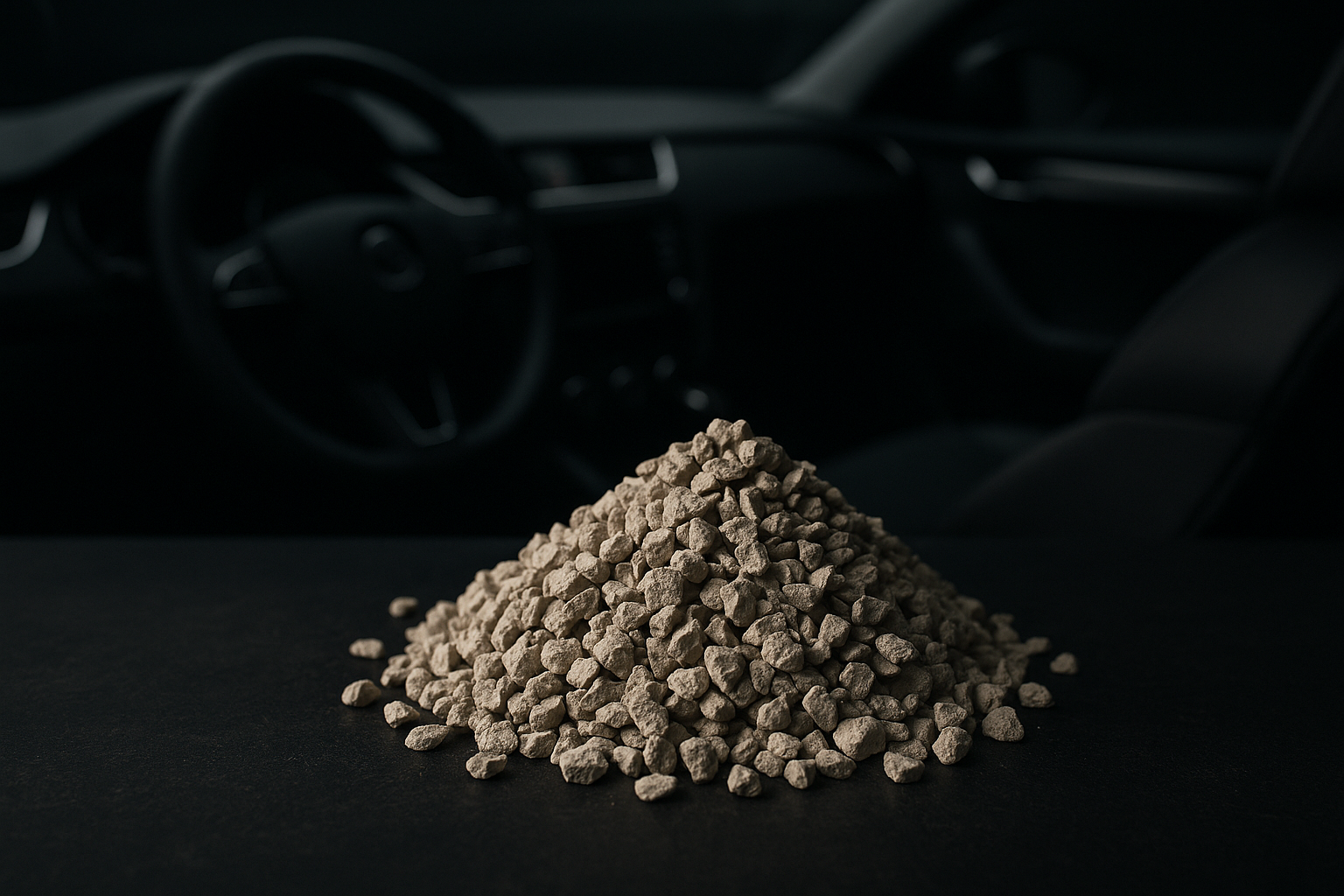
Why vehicle interior odors are so hard to clear
A passenger car cabin is an enclosed space of roughly 1–3 m³ packed with porous interior materials such as fabric seats, carpets, and the headliner. Odor molecules from food, pets, cigarettes, and sweat are repeatedly adsorbed and re-released by this fiber matrix and the surface of the air-conditioning evaporator, so ventilation alone does not easily remove the lingering smell. In particular, when the summer cabin temperature rises to 50–60°C, the volatile organic compounds (VOCs) that had been adsorbed re-vaporize and are perceived as a strong odor right when you board.
Vehicle odors come mainly from three sources: (1) ammonia (NH₃) and amines from pet urine, body odor, and food spoilage; (2) VOCs and formaldehyde from cigarettes, mold, and new interior materials; and (3) sulfur compounds and mold odor produced by microorganisms that breed in evaporator condensation. Air fresheners merely cover these molecules with a stronger fragrance rather than removing them, so once the scent fades the original odor returns unchanged. This is why a material approach that captures the causative molecules through adsorption and ion exchange is needed.
Why zeolite is considered for vehicle deodorizing
Natural clinoptilolite is a porous aluminosilicate that combines uniform micropores of 4.0–7.0 Å with cation exchange properties (CEC 1.6–2.0 meq/g). In vehicle deodorizing, two mechanisms work simultaneously.
- Ion exchange (chemical isolation): In cabin humidity (summer condensation and body-heat evaporation), ammonia dissolves in water and exists largely as ammonium (NH₄⁺). The clinoptilolite framework carries a negative charge and holds exchangeable cations such as Na⁺, K⁺, and Ca²⁺, so it attracts NH₄⁺ and binds it to the framework. The NH₄⁺ adsorption capacity of clinoptilolite is generally reported in the literature in the range of about 8–20 mg NH₄⁺/g, which is sufficient to buffer the localized ammonia load inside a vehicle.
- Physical adsorption (pore capture): The kinetic diameter of an ammonia molecule is about 2.6 Å and that of formaldehyde is about 4.3 Å, so they enter the 4.0–7.0 Å pores and are captured by van der Waals forces. Larger non-polar molecules such as VOCs are physically adsorbed onto the surface area (40.0 m²/g), and once saturated they can be desorbed by heating or ventilation for reactivation.
The key point is that both mechanisms target cationic and neutral molecules. Unlike fragrance masking, they isolate the odor molecules themselves, but their effect is limited against anionic gases or strongly acidic gases. They should be understood not as a cure-all that replaces ventilation, cleaning, and filter management, but as an adsorbent that supports them.
Actual research supports this. Cataldo et al. (2024, Materials) reported that zeolites including natural clinoptilolite effectively adsorb representative malodor molecules such as ammonia, amines, and sulfur compounds (DOI:10.3390/ma17133088), and related work (Cataldo et al., 2021, Materials, DOI:10.3390/ma14133724) confirmed that natural zeolite treatment can reduce odors and volatile toxic compounds at the same time. An indoor air quality review by Sahin et al. (2020, Building and Environment) summarized that zeolite can be used for VOC adsorption and humidity buffering in enclosed spaces (DOI:10.1016/j.buildenv.2020.106949), while an ammonia adsorption study for cat litter (Applied Clay Science, 2019, DOI:10.1016/j.clay.2019.03.002) and a study on controlling felinine-derived malodor (Robins et al., 2022, DOI:10.1177/1098612X211009136) provide evidence for application to the pet ammonia and body-odor family.
KMIZEOLITE's natural clinoptilolite is 97% pure, mined and processed at the Amargosa Valley mine in Nevada, USA, with a specific surface area of 40.0 m²/g, a pH stability range of 3.0–10.0, and thermal stability up to 700°C. Even when a summer vehicle interior rises to 50–60°C, the mineral itself does not degrade, and after adsorption saturation it can be reactivated by sunlight or heating for repeated use—an advantage as a vehicle deodorizing material. Because this is general adsorbent use rather than animal feed ingestion use, it falls under FDA GRAS (21 CFR 182.2729).
KMIZEOLITE Key Properties
| Item | Value |
|---|---|
| Clinoptilolite purity | 97% |
| Cation exchange capacity (CEC) | 1.6–2.0 meq/g |
| Specific surface area | 40.0 m²/g |
| Pore diameter | 4.0–7.0 Å |
| pH stability range | 3.0–10.0 |
| Hardness | 4.0–5.0 Mohs |
| Thermal stability | 700°C |
| Specific gravity | 1.89 |
| Bulk density | 45–54 lbs/ft³ |
| Certifications | OMRI KMI-10365, FDA GRAS, TSCA, EN-71-3 |
Application examples of vehicle deodorizing zeolite
Representative application methods tailored to the narrow, enclosed space of a vehicle interior are as follows. Because deodorizing depends on air-to-adsorbent contact, exposed surface area and distributed placement govern efficiency more than the amount piled in one spot.
- Deodorizing pouch (placement type): Place 200–500 g of granular zeolite in a breathable cotton bag and distribute it across 4–6 locations such as cup holders, door pockets, under the seats, and the trunk. For one passenger car (about 1–3 m³), a total of 0.5–1 kg secures an adsorbent density of roughly 0.2–0.5 kg/m³ relative to cabin volume. For vehicles with a heavy odor load, go closer to the upper limit (1 kg); to keep a new car odor-free, start at the lower limit (0.5 kg).
- Vehicles carrying pets: Place pouches around pet cages and rear-seat mats to capture the ammonia from urine and body odor. The NH₄⁺ adsorption of clinoptilolite (about 8–20 mg/g) and the evidence on controlling felinine-derived malodor (Robins et al., 2022) support this use. Being a natural, additive-free mineral, it is safe even if a pet licks it (EN-71-3 PASS, Prop 65 compliant).
- New or freshly painted vehicles: During the strong initial 1–2 months when formaldehyde (about 4.3 Å in diameter) and VOCs are released from new interior materials and adhesives, place a large amount (1 kg or more) and combine it with 5–10 minutes of ventilation after parking to repeat desorption and re-adsorption.
- HVAC (air-conditioning) support: Place small pouches near the cabin filter and around air vents to buffer the mold odor and sulfur compounds rising from evaporator condensation. However, if mold odor is the main cause, adsorption alone has limits, so cabin filter replacement and evaporator cleaning must come first.
- Trial / pilot application: Place small samples in several vehicles with different odor intensities and conduct sensory evaluation at 1-, 2-, and 4-week intervals to determine the appropriate dosing and replacement cycle in advance. Recommended before bulk adoption.
Target molecules and adsorption characteristics by odor type
Vehicle odor is not a single substance but a mixed gas of molecules differing in size, polarity, and ionization tendency. The mechanisms by which clinoptilolite responds, organized by type, are as follows.
| Odor type | Representative molecule | Molecular diameter (approx.) | Primary mechanism | Notes |
|---|---|---|---|---|
| Pet / urine / food | Ammonia (NH₃) / ammonium (NH₄⁺) | about 2.6 Å | Ion exchange + physical adsorption | Higher humidity raises the NH₄⁺ ratio, favoring adsorption |
| New car / adhesives | Formaldehyde (HCHO) | about 4.3 Å | Physical adsorption (pore capture) | Can enter 4.0–7.0 Å pores |
| Cigarette / combustion odor | VOCs / amines | Variable (medium–large) | Surface physical adsorption | Uses 40 m²/g surface area |
| Air-conditioner mold odor | Sulfur compounds | Variable | Physical adsorption (supplementary) | Filter replacement and cleaning required first |
As the table shows, the core targets of vehicle deodorizing—ammonia and formaldehyde—are both small neutral/cationic molecules that can be captured by 4.0–7.0 Å pores. Conversely, strongly acidic gases or anionic molecules are electrostatically repelled by the negatively charged framework and are weakly adsorbed, so in those cases ventilation and filter replacement take priority.
Recommended particle size and product specifications
Because vehicle deodorizing is generally done by placing the material in a breathable pouch to contact the air, Fine Granule (30×50 mesh)—low in dust and ample in surface area—is the most suitable. When you need to cover a wide area such as the trunk or underseat, consider Medium Granule (14×40 mesh); when laying it under mats for powder adsorption, consider Powder (100 mesh). Refer to the table below to choose the product group that fits your use.
| Product group | Mesh | Particle size | Typical use |
|---|---|---|---|
| Powder | 100 mesh or finer | <150μm | Pozzolan, feed, powder adsorption |
| Fine Granule | 30×50 mesh | 0.3–0.6mm | Water treatment, filtration, soil |
| Medium Granule | 14×40 mesh | 0.4–1.4mm | Filter media, bedding, flooring |
| Coarse Granule | 8×14 mesh | 1.4–2.4mm | Swimming pools, de-icing, large filtration |
| Extra Coarse | 4×8 mesh | 2.4–4.8mm | Packed beds, air scrubbers |
→ View products by mesh size · Product selection guide by application
Points to review when applying to vehicles
Unlike a typical indoor space, a vehicle is an environment where high heat, vibration, and enclosure act simultaneously. Check the items below before applying.
- Identify the odor source: Vary the placement depending on whether it is the pet/food family (ammonia, amines), the cigarette/new-car family (VOCs, formaldehyde), or air-conditioner mold odor (sulfur compounds). If mold odor is the main cause, combine zeolite with cabin filter replacement and evaporator cleaning.
- Dosing and placement: Distribute it across the cup holders, door pockets, under the seats, and the trunk rather than piling it in one spot to widen the air-contact area. A total of 0.5–1 kg is recommended for a passenger car.
- Heat and vibration response: The mineral is stable even in a 50–60°C summer interior (thermal stability 700°C), but to prevent dust scattering, place the granular form rather than powder into a breathable bag and secure it firmly.
- Reactivation and replacement cycle: Because effectiveness declines once adsorption is saturated, dry the pouch for several hours under direct sunlight or heat it to reactivate. Vehicles carry a high odor load, so they are generally inspected and replaced on a 1–3 month cycle (shorter than for indoor furniture use).
- Safety: Being a natural, additive-free mineral, it has none of the lingering scent or irritation of chemical air fresheners, and with EN-71-3 (toy safety) PASS and California Prop 65 compliance, it can be used even in vehicles carrying infants and pets.
→ View TDS (Technical Data Sheet) · View MSDS (Safety Data Sheet)
Vehicle Deodorizing FAQ
How is it different from an air freshener?
Air fresheners use a masking approach that covers odors with a stronger fragrance, so once the scent fades the original odor returns. Zeolite adsorbs and isolates the odor molecules themselves—such as ammonia (NH₄⁺ adsorption of about 8–20 mg/g) and VOCs—through its 4.0–7.0 Å micropores and cation exchange (CEC 1.6–2.0 meq/g). Studies including Cataldo et al. (2024) report that natural clinoptilolite effectively adsorbs representative malodor molecules. It is not a cure-all, however; its effect is limited against anionic and acidic gases, and it is best understood as a supplementary material used alongside ventilation, cleaning, and filter management.
How much should I put in one car?
For a passenger car (about 1–3 m³), we recommend a total of 0.5–1 kg distributed across the cup holders, door pockets, under the seats, and the trunk. Spreading it across several locations rather than piling it in one spot widens the air-contact area and is more effective. For pet or smoking vehicles with a heavy odor load, increase the amount and shorten the replacement cycle.
Which particle size (mesh) is best?
For vehicle deodorizing, where the material is placed in a breathable pouch to contact the air, low-dust Fine Granule (30×50 mesh) is the most suitable. For wide areas such as the trunk, consider Medium Granule (14×40 mesh); for powder adsorption under floor mats, consider Powder (100 mesh). Refer to the product selection guide by application.
Can I keep using it once I buy it? What is the replacement cycle?
Because effectiveness declines once adsorption is saturated, you can reuse the pouch repeatedly by drying it for several hours under direct sunlight or heating it to reactivate (thermal stability 700°C). Vehicles carry a high odor load, so we recommend inspecting and replacing on a shorter 1–3 month cycle than for indoor furniture use.
Is it safe with pets and children on board?
Yes. KMIZEOLITE is a natural, additive-free clinoptilolite mineral with none of the lingering scent or irritation of chemical air fresheners. It holds evidence such as EN-71-3 (toy safety) PASS, California Prop 65 compliance, and FDA GRAS (general adsorbent use 21 CFR 182.2729; animal feed ingestion use 21 CFR 582.2729), so it can be used even in vehicles carrying infants and pets. Check the certifications page.
Inquiries and Sample Requests
If you are considering applying zeolite in the vehicle deodorizing field, please reach out through the channels below.
Disclaimer
Applicability may vary depending on site conditions, regulations, and test results. Before actual application, testing and review suited to the specific site conditions must always come first. Zeolite is not a cure-all solution for this field; it is best understood as a material that supports existing processes.
Related Pages
science Related Papers
These are academic papers addressing zeolite application in this field. Please refer to them when reviewing adoption.
- Use of zeolites for cat litter: Ammonia adsorption and odor control
Various — Applied Clay Science, 2019 - Control of felinine-derived malodor in cat litter
Robins L.I. et al. — Journal of Feline Medicine and Surgery, 2022 - Zeolite for indoor air quality: A review of environmental applications
Sahin, O. et al. — Building and Environment, 2020 - Odors Adsorption in Zeolites Including Natural Clinoptilolite
Cataldo, E. et al. — Materials, 2024 - Evaluation of Natural Zeolite Treatments for Eliminating Odors and Toxic Compounds
Cataldo, E. et al. — Materials, 2021
The papers above are reference materials, and actual application requires separate review suited to site conditions.