Zeolite for Sludge Odor Reduction
A pre-treatment-type supplementary material that uses the cation exchange (CEC 1.6-2.0 meq/g) of natural clinoptilolite to curb ammonia (NH3/NH4+) volatilization from sludge - this page organizes dosing of 3-8% for dewatered cake and 5-10% for composting, along with deodorization-tower packed-bed design criteria, by sludge processing stage. For H2S-dominated loads, combination with iron salts and biofilters is a prerequisite.
Where Do Municipal and Industrial Sludge Odors Come From?
Sludge odors at sewage treatment plants and at night-soil, livestock and animal-waste treatment facilities arise mostly from ammonia (NH3) generated under anaerobic conditions and hydrogen sulfide (H2S), together with volatile odorants such as methyl mercaptan and amines. When sludge sits in thickening or storage tanks, or is stockpiled as dewatered cake, the breakdown of organic nitrogen and the reduction of sulfate proceed, and odor intensity rises sharply.
Odor loading varies greatly with the moisture content of the dewatered cake, the storage time, pH and temperature (high heat in summer), so the sludge line is a demanding site that must simultaneously manage both composite-odor (dilution-ratio) and designated odorant (ammonia and hydrogen sulfide) emission limits. Because downstream equipment such as blower deodorization towers and chemical scrubbing alone struggles to cope with load fluctuations, a pre-treatment-type supplementary material that suppresses odor generation in the sludge itself is also considered.
Why Zeolite Is Considered for Sludge Odor Reduction
Natural clinoptilolite has a cation exchange (CEC 1.6-2.0 meq/g) property in which the negatively charged microporous framework within the crystal selectively captures cationic ammonium (NH4+). Ammonia, the core of sludge-derived odor, exists in water largely in NH4+ equilibrium, so when zeolite fixes this within its lattice, the amount of NH3 escaping into the gas phase decreases. The 4.0-7.0 Å pore diameter is a suitable range for ammonium (ionic radius about 1.4 Å in hydrated state) and small polar molecules to enter, and unlike activated carbon, the structure does not collapse even in high-moisture, high-ionic-strength environments.
Research targeting actual sludge water has also demonstrated ammonium removal by natural clinoptilolite. Cyrus et al. (2021, Molecules) reported that clinoptilolite effectively adsorbs ammonium from sludge dewatering return liquor, and that the smaller the particle size, the faster the ion-exchange rate (Cyrus et al., Molecules, 2021). In drinking-water experiments as well, results were reported showing that the ammonium removal efficiency of a natural-zeolite packed bed reaches around 84% with coarse particle sizes, and that the finer the particle size, the higher the exchange rate and efficiency, which supports the particle-size selection logic for the sludge line (Mažeikienė et al., JEELM, 2010). On the odor side, Cataldo et al. (2021, Materials) evaluated that natural zeolite is effective in adsorbing and reducing odorous and toxic compounds such as ammonia and amines (Cataldo et al., Materials, 2021), and a follow-up study (2024, Materials) quantitatively compared the odor-adsorption behavior of zeolites including clinoptilolite (Cataldo et al., Materials, 2024).
The same cation-exchange principle operates in the composting and livestock-manure stabilization stages, which are an extension of sludge resource recovery. Blending natural zeolite into compost and manure has been reported to capture NH4+ in its lattice, simultaneously reducing nitrogen loss (ammonia volatilization) and odor, which justifies the use of supplementary dosing for composting and solidification of sludge cake (Subova et al., Agriculture, 2021).
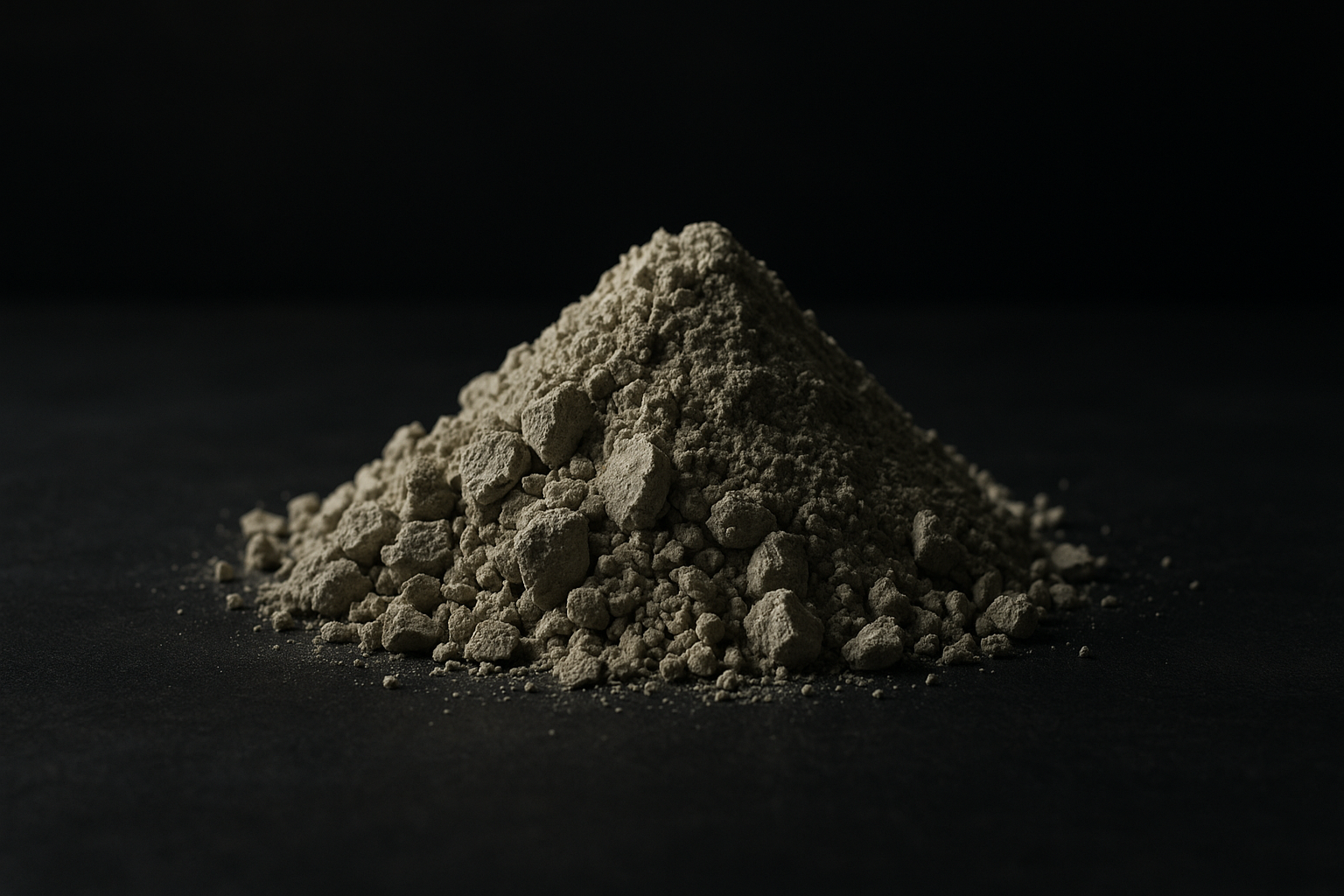
KMIZEOLITE's natural clinoptilolite has a purity of 97% and is mined and processed at a mine in the Amargosa Valley, Nevada, USA. With a specific surface area of 40.0 m²/g, a pore diameter of 4.0-7.0 Å, and a stable pH range of 3.0-10.0, it can be considered for stable application even in the alkaline environment of the sludge line (where NH3 volatilization intensifies at high pH). Natural clinoptilolite is listed under US FDA GRAS (Generally Recognized As Safe; general use 21 CFR 182.2729; for animal-feed ingestion use 21 CFR 582.2729), so even in sludge lines that are recycled as composting and soil-amendment resources, the review burden regarding material safety is low.
KMIZEOLITE Key Properties
| Item | Value |
|---|---|
| Clinoptilolite Purity | 97% |
| Cation Exchange Capacity (CEC) | 1.6-2.0 meq/g |
| Specific Surface Area | 40.0 m²/g |
| Pore Diameter | 4.0-7.0 Å |
| Stable pH Range | 3.0-10.0 |
| Hardness | 4.0-5.0 Mohs |
| Thermal Stability | 700°C |
| Specific Gravity | 1.89 |
| Bulk Density | 45-54 lbs/ft³ |
| Certifications | OMRI KMI-10365, FDA GRAS, TSCA, EN-71-3 |
Application Examples by Sludge Treatment Stage
Because sludge odor differs in character by where it occurs (storage, dewatering, stockpiling, composting), the dosing method is varied stage by stage. Below are representative scenarios in which clinoptilolite is considered, along with field-standard dosing amounts.
- Dewatered-cake powder spreading and blending: 100 mesh powder is blended at a level of 3-8% (with cases of high dosing up to 38%) of the dewatered cake's dry weight to suppress ammonia volatilization. Used for immediate odor mitigation in cake stockpiling yards and transfer-conveyor sections.
- Direct dosing into thickening and storage tanks: 30x50 mesh Fine Granule is dispersed into storage-tank sludge to fix NH4+ in the lattice, lowering the ammonia load that escapes into the supernatant (return liquor).
- Deodorization-tower packed bed (dry scrubber): 8x14 to 4x8 mesh Coarse/Extra Coarse is used as packing media upstream of blower deodorization towers and biofilters to flatten H2S and NH3 peaks. An empty-bed residence time (EBRT) of 2 seconds or more is recommended as a starting value in the design.
- Composting and solidification support: In sludge composting and biogas digesters, 14x40 mesh is blended at 5-10% on a dry basis to fix NH4+ in the lattice, simultaneously reducing volatile nitrogen loss from ammonia and odor. Livestock-manure and compost-stabilization studies have also reported that clinoptilolite blending contributes to nitrogen retention.
- Pilot pre-verification: First confirm the dosing rate matched to the target sludge's moisture content, pH and odor intensity using a small 1-22 kg sample.
Recommended Particle Size and Product Specifications
For applications that blend or spread directly into sludge to curb ammonia volatilization, Powder (100 mesh) with a large contact area is advantageous, while Fine Granule (30x50 mesh) is favorable for dispersed dosing into storage tanks. By contrast, for dry-scrubber packed beds upstream of deodorization towers and biofilters, Coarse to Extra Coarse (8x14 to 4x8 mesh) is appropriate in order to reduce pressure drop and channeling. Refer to the table below to select the product group suited to the use at each stage.
| Product Group | Mesh | Particle Size | Typical Use |
|---|---|---|---|
| Powder | 100 mesh or finer | <150μm | Pozzolan, feed, powder adsorption |
| Fine Granule | 30x50 mesh | 0.3-0.6mm | Water treatment, filtration, soil |
| Medium Granule | 14x40 mesh | 0.4-1.4mm | Filter beds, bedding, litter |
| Coarse Granule | 8x14 mesh | 1.4-2.4mm | Swimming pools, de-icing, large filtration |
| Extra Coarse | 4x8 mesh | 2.4-4.8mm | Packed beds, air scrubbers |
→ View products by mesh size · Product selection guide by application
Pilot Testing and On-Site Review Points
When applying clinoptilolite to a sludge odor line, sludge-specific items that differ from general water treatment must also be checked.
- Odor component analysis: Measure the concentrations of designated odorants such as ammonia, hydrogen sulfide and methyl mercaptan, together with composite odor (dilution ratio), to identify the main causative substance. Clinoptilolite is strong at controlling cationic NH3/NH4+, and when the H2S-alone load is large, consider combination with iron salts, biofilters and the like.
- Moisture content and pH check: Check the dewatered-cake moisture content and the sludge pH. The higher the pH, the stronger the NH3 volatilization, so adjust the dosing rate upward.
- Competing-ion evaluation: Clinoptilolite's cation selectivity is generally in the order K+ ≈ NH4+ > Na+ > Ca²+ > Mg²+, so the K+ and polyvalent cations common in sludge return liquor compete for the NH4+ exchange sites. Particularly in digested sludge and livestock return liquor with high K+ concentrations, design the dosing rate upward to account for the decline in effective exchange capacity (the available fraction of CEC 1.6-2.0 meq/g).
- Saturation and replacement cycle: For packed beds, base the replacement and replenishment plan on the breakthrough point; for blended types, base it on the stockpiling and removal cycle.
- Post-use handling: Because ammonium-saturated zeolite contains nitrogen, also consider a route for reusing it as a resource for sludge composting and soil amendment.
- Position as a supplementary material: In the sludge field, zeolite is generally considered as a load-buffering, pre-treatment stage for existing deodorization processes such as blower deodorization, chemical scrubbing and biofilters. A recent review comprehensively examining sludge and sewage treatment plants and zeolite application (Water, 2026) also emphasizes the strengths and opportunities in integrated operation rather than as a standalone solution.
→ Check the TDS (product data sheet) · Check the MSDS (safety data sheet)
Sludge Odor Reduction FAQ
Which sludge odor components is zeolite effective against?
By virtue of its cation exchange capacity (CEC 1.6-2.0 meq/g), clinoptilolite is particularly strong at controlling cationic and polar odorants such as ammonia (NH3/NH4+) and amines. Ammonium adsorption from sludge dewatering return liquor has also been confirmed in research (Cyrus et al., 2021). However, when hydrogen sulfide (H2S) is the dominant odor source, it is common practice to use it in combination with iron salts, biofilters and similar measures.
How much should be dosed into the sludge?
For dewatered-cake blending, a starting dose of 3-8% on a dry-weight basis is considered, and 5-10% for composting and solidification support. Because the effective dose depends on moisture content, pH and odor intensity, it is advisable to confirm the dosing rate through a small-scale pilot.
Which particle size should I use for a deodorization-tower packed bed versus direct sludge dosing?
For direct blending or spreading into sludge, Powder (100 mesh) or Fine Granule (30x50 mesh) with a large contact area is suitable, while for blower deodorization towers and dry-scrubber packed beds, Coarse to Extra Coarse (8x14 to 4x8 mesh) is appropriate to reduce pressure drop.
How is zeolite that has adsorbed ammonium handled?
Because saturated zeolite contains nitrogen, rather than disposing of it, a route for reusing it as a resource for sludge composting and soil amendment should be considered in parallel. The post-use handling method must be decided in accordance with on-site regulations.
Can I receive a sample for testing?
Yes. KMIZEOLITE supports the provision of samples in 1-22 kg units for real-world application review. Please leave the target sludge type and desired particle size on the sample request page.
Inquiries and Sample Requests
If you are considering zeolite application in the field of sludge odor reduction, please get in touch through the channels below.
Notice
Applicability may vary depending on site conditions, regulations and test results. Before actual application, testing and review tailored to the site conditions must always be carried out first. Zeolite should be understood not as a cure-all for this field, but as a material that supplements existing processes.
Related Pages
science Related Research Papers
Academic papers addressing zeolite application in this field. Please refer to them when reviewing adoption.
- Application of Natural Clinoptilolite for Ammonium Removal from Sludge Water
Cyrus et al. — Molecules, 2021 - Odors Adsorption in Zeolites Including Natural Clinoptilolite
Cataldo, E. et al. — Materials, 2024 - Evaluation of Natural Zeolite Treatments for Eliminating Odors and Toxic Compounds
Cataldo, E. et al. — Materials, 2021 - Sludge from Sewage Treatment Plants and Zeolite: A Bibliometric and SWOT-Based Review
Various — Water, 2026 - Laboratory Study of Ammonium Ion Removal by Using Zeolite (Clinoptilolite)
Mažeikienė, A. et al. — J. Environ. Eng. Landsc. Manag., 2010 - Amendment of Livestock Manure with Zeolite-Clinoptilolite and Effect on Nitrogen
Subova, E. et al. — Agriculture, 2021
The papers above are reference materials, and a separate review tailored to site conditions is required for actual application.