Zeolite for Deodorizing Building Materials
When 100-mesh powder of natural clinoptilolite is blended into gypsum board, mortar or coatings at 5–15 wt%, it works through a dual mechanism: ion exchange of about 21 mg/g NH₄⁺ (CEC 1.6–2.0 meq/g) and formaldehyde physisorption in its 4.0–7.0 Å pores. Thanks to a framework that is thermally stable to 700°C, it is a deodorizing adsorbent that does not collapse even within alkaline inorganic-binder mixes.
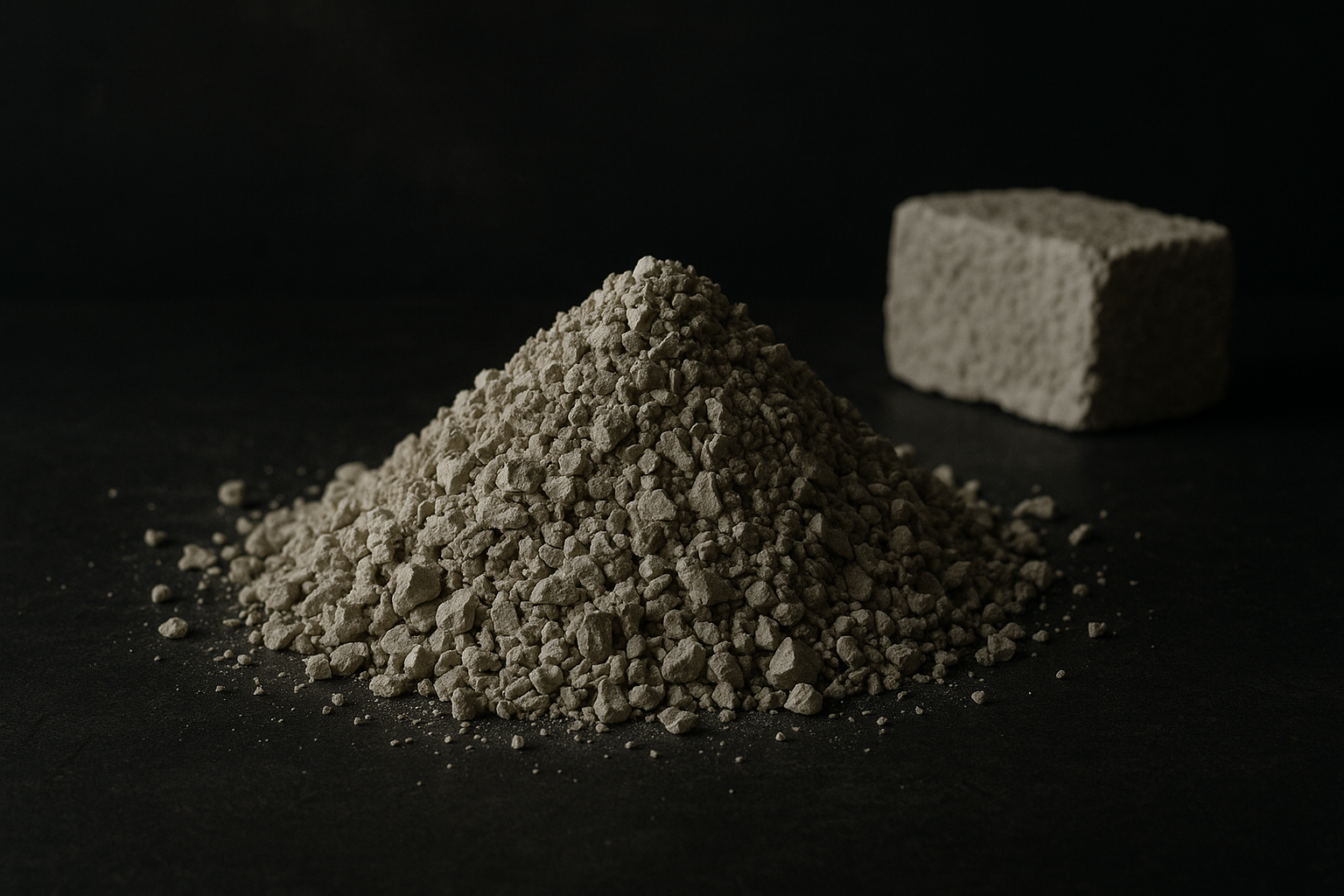
Why odors linger on deodorizing-building-material sites
In new and remodeled spaces, ammonia-like odors, mold smells, and residual volatile organic compound (VOC) odors from paint and adhesives often linger even after finishing work is done. When building finishes such as boards, mortar and coatings cannot actively capture these odors, ventilation alone after move-in fails to solve the problem and leads to sick-house syndrome complaints. Under indoor air-quality management standards, formaldehyde and total volatile organic compounds (TVOC) reach their highest concentrations at move-in and are then released slowly over several months, so the adsorption function of the finish itself acts as a buffer that shaves off the initial peak concentration.
In particular, low-molecular-weight VOCs such as formaldehyde (molecular size about 0.45 nm) and toluene differ from ammonia (NH₃) and hydrogen sulfide (H₂S) from sewage and waste systems in molecular size and polarity, so a single adsorbent cannot capture them all. This is why an approach that builds the adsorption function into the building material itself—gypsum board, diatomite board, functional mortar, interior coatings—is considered. Because workability, dust, pH compatibility and long-term release behavior of the material must all be assessed, review at the material-selection stage is important. Zeolite is best understood not as a standalone purification device but as a distributed supplementary adsorbent that is dispersed in the finish matrix and captures contaminants near the surface.
Why zeolite is considered for deodorizing building materials
Natural clinoptilolite zeolite simultaneously possesses uniform micropores of 4.0–7.0 Å and cation-exchange properties (CEC 1.6–2.0 meq/g). The two adsorption routes handle different contaminants.
- Ion-exchange route (ammonia/amines): In the presence of moisture, NH₃ dissociates into NH₄⁺ and exchanges with the framework's exchangeable cations (mainly K⁺, Na⁺, Ca²⁺). The NH₄⁺ adsorption capacity of clinoptilolite is reported in the literature at roughly 21 mg/g, with cases reaching 31.7 mg/g after surface modification. This is directly linked to its high potassium-dominant exchange capacity (K about 1.9 meq/g).
- Physisorption route (formaldehyde/low-molecular-weight VOCs): Polar low-molecular-weight VOCs are weakly adsorbed by the electrostatic field within the pores and by surface silanol groups. Unlike ion exchange, this route is reversible and therefore sensitive to temperature and humidity, requiring parallel ventilation and replacement to be sustained.
Because the two routes coexist, the expected performance and durability differ depending on whether the target odor is cationic (ammonia-type) or a neutral low-molecular-weight compound (formaldehyde/toluene-type). Distinguishing the on-site odor before mix design is the first step.
KMIZEOLITE's natural clinoptilolite has 97% purity and is mined and processed at the Amargosa Valley mine in Nevada, USA. With a specific surface area of 40.0 m²/g, a pH stability range of 3.0–10.0 and thermal stability to 700°C, its framework structure does not collapse even when mixed with alkaline inorganic binders such as cement and gypsum, making it suitable for board and mortar mixes. The pH of cement hydrates is high, above 12, so ordinary organic adsorbents decompose easily, but the aluminosilicate framework maintains structural stability in this environment. It also holds safety certifications such as OMRI, FDA GRAS and EN-71-3, making it easy to use as an interior finishing material in residential spaces.
Research basis
The deodorizing-building-material application is supported by the following academic literature on indoor air quality, odor and VOC adsorption.
- Formaldehyde adsorption — Kalantarifard et al. (2016, TAO) experimentally confirmed that clinoptilolite adsorbs formaldehyde, a major cause of sick-house syndrome, at room temperature (Kalantarifard et al., 2016).
- Odor-molecule capture — Cataldo et al. (2024, Materials) evaluated how zeolites including natural clinoptilolite effectively capture odor molecules such as ammonia and amines in their pore structure and ion-exchange sites (Cataldo et al., 2024), and their earlier work (2021, Materials) summarized the removal of odors and toxic compounds through natural-zeolite treatment (Cataldo et al., 2021).
- Indoor VOC purification comparison — Mobasser et al. (2022, Ind. Eng. Chem. Res.) compared the indoor VOC purification performance of activated carbon, zeolite and organosilica, presenting the strengths and weaknesses of each adsorbent (Mobasser et al., 2022).
- Comprehensive indoor air-quality review — Sahin et al. (2020, Building and Environment) comprehensively reviewed the use of zeolite for building applications in indoor air quality, VOC and humidity control (Sahin et al., 2020).
To reduce condensation and mold alongside deodorizing, humidity-control behavior also matters. Serhiienko et al. (2023, Energy and Buildings) reported that natural zeolite contributes to building humidity control and energy savings (Serhiienko et al., 2023). Note, however, that most of the above figures are laboratory and powder-condition results; in actual finish mixes, some adsorption sites are embedded in the binder, which can lower performance per unit mass, so this must be separately validated through mix-design testing.
KMIZEOLITE key properties
| Item | Value |
|---|---|
| Clinoptilolite purity | 97% |
| Cation Exchange Capacity (CEC) | 1.6–2.0 meq/g |
| Specific surface area | 40.0 m²/g |
| Pore diameter | 4.0–7.0 Å |
| pH stability range | 3.0–10.0 |
| Hardness | 4.0–5.0 Mohs |
| Thermal stability | 700°C |
| Specific gravity | 1.89 |
| Bulk density | 45–54 lbs/ft³ |
| Certifications | OMRI KMI-10365, FDA GRAS, TSCA, EN-71-3 |
Application examples of zeolite for deodorizing building materials
Below are representative application scenarios in which zeolite is considered for deodorizing functional building finishes. All blend ratios are starting review ranges; the balance point of strength, workability and deodorizing performance is finalized through mix-design testing.
- Functional board admixture: Blend 100-mesh powder at 5–15 wt% into the raw material of gypsum and diatomite boards. Diatomite board is porous in itself, so its adsorption sites are complemented when used together with zeolite. The board surface is designed to continuously adsorb indoor ammonia and low-molecular-weight VOCs.
- Deodorizing mortar/plaster: Add powdered zeolite at 5–10 wt% relative to the binder (cement/gypsum) to plastering and finishing mortar to give the wall itself an adsorption function. Zeolite has some pozzolanic activity, so as long as overdosing is avoided it integrates relatively well into the hardened body (maintaining its 700°C thermally stable framework in alkaline environments).
- Coating/putty addition: Disperse fine powder (<150 μm) in water-based paints and putty to assist formaldehyde adsorption by the film. Because the film is thin and its absolute loading is small, this is seen as a supplement to board and mortar adsorption.
- Ceiling plenum/ventilation-duct fill layer: Configure 4×8–8×14 mesh granules as a cassette-type fill layer to capture odors from circulating indoor air. Granules have low pressure drop and the module is easy to replace when saturated, making them suitable for maintenance-oriented designs.
- Pilot application: Use a small 1 kg sample to verify in advance the target material's mix ratio, the degree of odor reduction, and changes in strength and workability.
Recommended particle size and product specifications
For deodorizing building materials, Powder (100 mesh or finer, <150 μm), which maximizes adsorption area, is the baseline for blending into board, mortar and coatings. For structures through which air passes, such as ceiling plenums and ventilation-duct fill layers, granular grades (8×14–4×8 mesh) with low pressure drop are suitable. Refer to the table below to select the product group that matches your application.
| Product group | Mesh | Particle size | Typical use |
|---|---|---|---|
| Powder | 100 mesh or finer | <150μm | Pozzolan, feed, powder adsorption |
| Fine Granule | 30×50 mesh | 0.3–0.6mm | Water treatment, filtration, soil |
| Medium Granule | 14×40 mesh | 0.4–1.4mm | Filter media, bedding, flooring |
| Coarse Granule | 8×14 mesh | 1.4–2.4mm | Swimming pools, de-icing, large-scale filtration |
| Extra Coarse | 4×8 mesh | 2.4–4.8mm | Packed beds, air scrubbers |
→ View products by mesh size · Product selection guide by application
Pilot testing and on-site review points
When applying zeolite to deodorizing functional building materials, check the following items together.
- Identify the target odor: Distinguish whether it is ammonia/amines (ion-exchange dominant) or low-molecular-weight VOCs such as formaldehyde/toluene (pore physisorption dominant), and design the adsorption mechanism accordingly
- Set the blend ratio: 5–15 wt% for board and mortar; for coatings, increase the dosage stepwise while watching viscosity and workability (overdosing can reduce strength and adhesion)
- Manage particle size and dust: 100-mesh powder has a large adsorption area but a risk of scattering, so confirm dust countermeasures for the construction environment
- Indoor emission testing: Evaluate TVOC and formaldehyde emission and adsorption durability using KS M 1998 / the chamber method, etc.
- Adsorption saturation and regeneration: Adsorbents saturate over time, so decide maintenance methods in advance, such as parallel ventilation and replaceable fill modules
- Field-specific notes: The adsorption capacity of zeolite is sensitive to temperature and relative humidity. When humidity is high, moisture can occupy the pores and lower VOC adsorption efficiency, so it is effective to design it together with dehumidification and humidity control.
→ View TDS (Technical Data Sheet) · View MSDS (Safety Data Sheet)
Deodorizing-building-material FAQ
Does building material containing zeolite control sick-house syndrome odors?
Natural clinoptilolite is a supplementary adsorbent that captures ammonia and amine odors by ion exchange (CEC 1.6–2.0 meq/g, NH₄⁺ ~21 mg/g) through its 4.0–7.0 Å pores, and low-molecular-weight VOCs such as formaldehyde by pore physisorption. Kalantarifard et al. (2016) confirmed room-temperature formaldehyde adsorption on clinoptilolite, Mobasser et al. (2022) positioned zeolite for indoor VOC purification, and Sahin et al. (2020) comprehensively reviewed its potential for indoor air-quality building applications. However, adsorbents are not a cure-all and lose performance once saturated, so they must be combined with ventilation and humidity control to maintain their effect.
What ratio should be blended into board or mortar?
Generally, 100-mesh powder is considered at 5–15 wt% relative to the binder for gypsum and diatomite boards and plastering mortar, while it is added stepwise to coatings and putty while watching viscosity and workability. More admixture means more adsorption sites, but excessive dosing can reduce strength and adhesion, so the balance point between strength and deodorizing performance is set through mix-design testing.
Which particle size (mesh) is suitable?
For blending into board, mortar and coatings, Powder (100 mesh or finer, <150 μm) with its large adsorption area is suitable; for structures through which air passes, such as ceiling plenums and ventilation-duct fill layers, granular grades (8×14–4×8 mesh) with low pressure drop are suitable. Please refer to the product selection guide by application.
Does high humidity reduce deodorizing performance?
Yes. The adsorption capacity of zeolite is sensitive to temperature and relative humidity. When humidity is high, moisture can occupy the pores and lower VOC adsorption efficiency, so it is effective to design it together with dehumidification and ventilation. Confirm exact performance through indoor emission tests such as the chamber method.
Is it safe to use in indoor living spaces?
KMIZEOLITE holds safety certifications including OMRI Listed (KMI-10365), FDA GRAS (21 CFR 182.2729), TSCA compliance and EN-71-3 PASS, making it easy to use in interior finishing materials. Check the certifications page.
Inquiries and sample requests
If you are considering applying zeolite in the deodorizing-building-material field, please contact us through the channels below.
Notice
Applicability may vary depending on site conditions, regulations and test results. Before actual application, test review suited to the site conditions must always be carried out first. Zeolite is best understood not as a cure-all for this field but as a material that supplements existing processes.
Related pages
science Related Papers
Academic papers covering zeolite applications in this field. Refer to them when reviewing adoption.
- Zeolite for indoor air quality: A review of environmental applications
Sahin, O. et al. — Building and Environment, 2020 - Indoor Air Purification of VOCs Using Activated Carbon, Zeolite, and Organosilica
Mobasser S. et al. — Industrial & Engineering Chemistry Research, 2022 - Odors Adsorption in Zeolites Including Natural Clinoptilolite
Cataldo, E. et al. — Materials, 2024 - Evaluation of Natural Zeolite Treatments for Eliminating Odors and Toxic Compounds
Cataldo, E. et al. — Materials, 2021 - Zeolites in Adsorption Processes: State of the Art and Future Prospects
Various — Chemical Reviews, 2022
The papers above are reference material; actual application requires separate review suited to the site conditions.