Zeolite for Building Moisture-Proof Materials
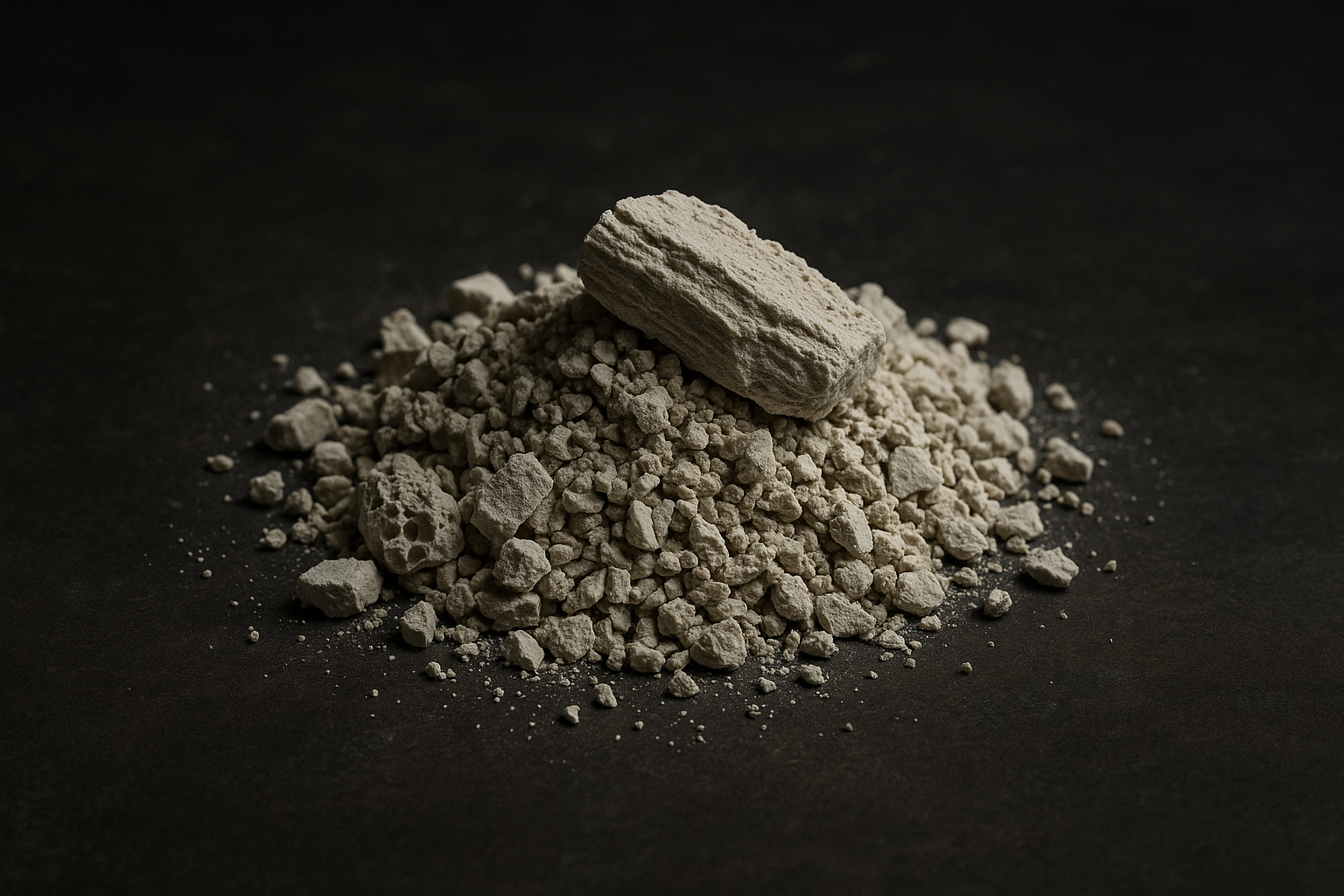
An inorganic humidity-control auxiliary material made from natural clinoptilolite, which has a hydrophilic aluminosilicate framework (4.0–7.0 Å micropores, CEC 1.6–2.0 meq/g). Substituted into plasters and putties at 10–20 wt% of the dry binder, it buffers indoor RH within roughly the 40–60% band through reversible moisture sorption that barrier-type waterproofing cannot provide.
Why do condensation, mold, and humidity fluctuation recur on building moisture-proof material sites?
In basements, semi-basements, walls adjacent to bathrooms, the inner side of exterior insulation, warehouse-type buildings, and similar spaces, the indoor–outdoor temperature difference can drop the wall surface temperature below the dew point, producing surface condensation, while interior condensation proceeds behind the finishing material. For example, under conditions of 25°C indoors and 60% RH (dew point about 16.7°C), if the wall surface temperature falls to 16°C or below, condensation water forms on that surface. When relative humidity (RH) exceeds 80% and is maintained for a long period, the germination and proliferation of Aspergillus/Cladosporium-family molds accelerate in earnest, and gypsum board, laminated paper, and wood-based finishes lift or efflorescence appears. Simple painting or waterproofing alone has no buffering function to absorb and release water vapor itself, so the surface RH repeatedly crosses the critical point and the problem recurs.
What is essential in the moisture-proofing materials field is not simple blocking but humidity buffering: a property that adsorbs water vapor when humid and releases it again when dry, autonomously buffering indoor RH within a fixed band (roughly 40–60%). In Japanese and domestic tests, this is quantified by moisture sorption/desorption amount (g/m²) and response speed. The narrower the range maintained between the mold critical RH (about 80%) and the dry critical RH (about 30–40%, where static electricity and mucous-membrane irritation increase), the more condensation, hygiene, and comfort all improve. For this reason, the choice of inorganic moisture-sorbing material added to plaster mortar, humidity-control boards, finishing putties, and the backing layer behind wallpaper becomes important at the design stage.
Why is natural zeolite considered as a humidity-control/moisture-proof auxiliary material — the moisture-sorption mechanism
Natural clinoptilolite has well-developed uniform two-dimensional channel-type micropores of 4.0–7.0 Å inside its crystal, so it readily takes in water molecules (kinetic diameter about 2.6 Å). Moisture sorption proceeds in two stages: (1) the ion–dipole interaction in which water molecules form hydration bonds around the exchangeable cations (Na⁺, K⁺, Ca²⁺) within the framework, and (2) capillary condensation and physical adsorption proceeding on the channel inner walls. Because this primary adsorption occurs at hydrophilic sites, the key differentiator for moisture-proof material use is that it effectively captures and releases moisture even in the low-to-medium relative humidity (RH 30–70%) range, where activated carbon with its hydrophobic surface barely works. Since the adsorption is physical and electrostatic rather than chemical bonding, the binding energy is low, so when RH drops, desorption (moisture release) occurs autonomously without additional energy input, and the cycle repeats.
Added to this, a cation exchange capacity (CEC) of 1.6–2.0 meq/g and a specific surface area of 40.0 m²/g provide a side effect of also capturing some polar gases such as indoor ammonia and formaldehyde, not just moisture (see research evidence below). With a stable pH range of 3.0–10.0 and thermal stability of 700°C, the crystal framework does not collapse in a short time even in the alkaline environment of cementitious systems (the early pore-water pH of plaster/mortar can exceed 12), and with a hardness of 4.0–5.0 Mohs, equipment wear during powder processing and mixing is low. As a lightweight inorganic material with a specific gravity of 1.89 and a bulk density of 45–54 lbs/ft³, the increase in finishing-layer self-weight per unit volume when added is also limited. KMIZEOLITE natural clinoptilolite, at 97% purity, is mined and processed at the Amargosa Valley mine in Nevada, USA; as it is for general building-material use rather than animal-feed ingestion use, the FDA GRAS classification of 21 CFR 182.2729 (general food-grade designation) applies.
Limitations designers should know
Zeolite's moisture sorption has a finite capacity. The sorption amount per unit area is determined by the addition rate, powder particle size, and finishing thickness; once the sorption sites are saturated, the additional buffering reserve decreases until desorption (the dry phase) occurs. Therefore, applying a humidity-control material alone to leakage or groundwater-intrusion zones where large amounts of moisture continuously enter is inappropriate; the correct process position is to first lower the water-vapor load by combining barrier-type waterproofing and insulation (dew-point location control), and then buffer the minor fluctuations of RH with the humidity-control material.
KMIZEOLITE Key Properties
| Item | Value |
|---|---|
| Clinoptilolite purity | 97% |
| Cation exchange capacity (CEC) | 1.6–2.0 meq/g |
| Specific surface area | 40.0 m²/g |
| Pore diameter | 4.0–7.0 Å |
| Stable pH range | 3.0–10.0 |
| Hardness | 4.0–5.0 Mohs |
| Thermal stability | 700°C |
| Specific gravity | 1.89 |
| Bulk density | 45–54 lbs/ft³ |
| Certifications | OMRI KMI-10365, FDA GRAS, TSCA, EN-71-3 |
Application examples of zeolite for building moisture-proof materials
Below are the representative application methods and field deployment criteria in which natural zeolite is considered in the moisture-proof/humidity-control materials field. All addition rates are substitution rates based on dry binder mass, and the actual values are finalized through the KS F 2611 moisture sorption/desorption test and a bond-strength test.
- Humidity-control plaster/mortar blending: Substitute 100 mesh powder (<150 μm) into cement/gypsum plaster mixes at 10–20 wt% of the dry binder. As the addition rate increases, the moisture sorption/desorption amount rises, but zeolite's high absorptivity increases the mixing-water demand and reduces workability (flow), so a water reducer or a 5–10% mixing-water correction is usually considered as well.
- Humidity-control board/putty filler: Added as an inorganic moisture-sorbing filler to gypsum and calcium-silicate boards and finishing putties to give the finishing surface itself a humidity-control function. For board-type composites, moisture sorption/desorption tests reported that reversible moisture adsorption/desorption behavior is maintained even over repeated cycles (see research evidence below).
- Backing layer behind wallpaper/laminated paper: Disperse the powder in the paste layer or backing sheet to buffer the surface RH of condensation-prone areas (north-facing walls, corners, thermal-bridge zones). Because the layer is thin, fine powders with fast response speed are advantageous.
- Basement/warehouse floor and sub-base filling: Spread Fine–Medium Granule (30×50–14×40 mesh, 0.3–1.4 mm) under a floor slab or in an inspection-hatch sorption layer to buffer rising moisture. Granular forms have good air permeability and re-spreadability.
- Localized moisture-sorption pouch type: Fill granular zeolite into a breathable pouch and place it in built-in closets or wall inspection spaces. When saturated, heat-drying at about 200°C desorbs the adsorbed water and regenerates the moisture-sorption capacity; since the crystal framework is stable up to 700°C, repeated regeneration is possible.
Example of approximate moisture-sorption capacity estimation
For reference, an approximate estimate: when 15 wt% zeolite relative to the binder is incorporated into a 10 mm-thick plaster layer over a 1 m² unit area, the zeolite mass per area is on the order of about 1.5–2.0 kg/m². Because zeolite's equilibrium moisture sorption depends strongly on RH and temperature (from a few % to the low-10% range of its own weight at low-to-medium RH), the exact moisture sorption/desorption amount and buffering duration must be confirmed by a specimen-level KS F 2611 test. The figures above are examples for grasping the scale of the mix and are not performance guarantee values.
Recommended particle size and product specifications
In the moisture-proof/humidity-control materials field, Powder (100 mesh, <150 μm) is standard for blending into plaster, board, and putty; the finer the powder particle size, the faster the moisture-sorbing surface area is exposed, improving RH-buffering response. For spreading under floors or in inspection spaces, the granular form (Granule) is used. Refer to the table below to select the product group suited to your application.
| Product group | Mesh | Particle size | Typical use |
|---|---|---|---|
| Powder | 100 mesh or finer | <150μm | Pozzolan, feed, powder adsorption |
| Fine Granule | 30×50 mesh | 0.3–0.6mm | Water treatment, filtration, soil |
| Medium Granule | 14×40 mesh | 0.4–1.4mm | Filter media, bedding, flooring |
| Coarse Granule | 8×14 mesh | 1.4–2.4mm | Swimming pools, de-icing, large-scale filtration |
| Extra Coarse | 4×8 mesh | 2.4–4.8mm | Packed beds, air scrubbers |
→ View products by mesh size · Product selection guide by application
Humidity-control performance confirmed by research
The building humidity-control effect of zeolite has been examined in numerous academic studies. Serhiienko et al. (Energy and Buildings, 2023) evaluated natural zeolite from the perspective of indoor humidity control and energy savings, reporting that zeolite-containing finishing materials can buffer indoor relative humidity fluctuations to lower condensation risk and HVAC load (DOI: 10.1016/j.enbuild.2023.113245).
The moisture sorption/desorption behavior of zeolite-based composite humidity-control materials was addressed quantitatively in the hygrothermal performance study in the International Journal of Heat and Technology (2016) (DOI: 10.18280/ijht.340309) and the moisture-migration experiment in Applied Thermal Engineering (2017) (ScienceDirect S1359431117336268), which showed that the zeolite composite reversibly adsorbs and desorbs moisture in response to RH changes and keeps indoor humidity within a stable band. The temperature-humidity control performance study in the Alexandria Engineering Journal (2023) (ScienceDirect S1110016823000479) addresses the simultaneous temperature-and-humidity control behavior of zeolite composite boards.
In addition, Sahin et al. (Building and Environment, 2020) summarized the multifunctionality of zeolite in adsorbing, along with moisture, some polar pollutants such as VOCs and ammonia from an indoor-air-quality perspective (DOI: 10.1016/j.buildenv.2020.106949). This provides a basis for expecting reduction of gases related to sick-building syndrome simultaneously with humidity control. Because the experimental conditions and specimen compositions all differ from study to study, the cited figures should be referenced as qualitative trends, and the quantitative performance must be finalized by a KS F 2611 test on your own mix.
Pilot test and on-site review points
When applying zeolite in the moisture-proof/humidity-control materials field, be sure to check the following items together.
- Understand site conditions: Measure the indoor–outdoor temperature difference, relative humidity (RH) distribution, dew-point temperature, and condensation-prone areas in advance
- Mix design: When blending into plaster/putty, set the powder addition rate within the 10–20 wt% range relative to the binder and verify changes in workability and bond strength
- Humidity-control performance test: Evaluate moisture sorption/desorption amount and response speed with the KS F 2611 (or JIS A 1470) moisture sorption/desorption test
- Durability/hygiene: Verify strength retention after repeated adsorption/desorption, mold resistance (mold test), and the presence of efflorescence
- Regeneration/maintenance: For pouch types, set the saturation point and the heat-regeneration (about 200°C) cycle as operating criteria
- Field-specific notes: Unlike a simple waterproofing membrane, zeolite is a humidity-control auxiliary material that buffers RH through reversible moisture adsorption/desorption, and is most effective when used together with a barrier-type waterproofing method.
→ Check the TDS (Technical Data Sheet) · Check the MSDS (Safety Data Sheet)
Moisture-Proof Material FAQ
How does a zeolite humidity-control material differ from an ordinary waterproofing material?
A waterproofing material physically blocks liquid water but cannot reduce the indoor water vapor itself. Natural zeolite, with its 4.0–7.0 Å micropores, adsorbs moisture when the air is humid and releases it again when the air is dry, performing reversible humidity buffering that keeps indoor relative humidity within roughly the 40–60% band. Serhiienko et al. (Energy and Buildings, 2023) reported that this behavior can lower condensation risk and HVAC load. Used together with a barrier-type waterproofing system, it is effective at suppressing the recurrence of condensation and mold.
How much should be added to plaster or putty?
Typically, 100 mesh powder is blended at 10–20 wt% of the dry binder in cement/gypsum plasters or finishing putties for evaluation. A higher addition rate increases the moisture sorption capacity, but because of zeolite's high absorptivity the mixing-water demand rises, which can change workability (flow) and bond strength. Therefore, the use of a water reducer or mixing-water correction should be considered together, and the actual mix proportion is best determined under site conditions together with the KS F 2611 moisture sorption/desorption test and a bond-strength test.
Which particle size (mesh) is suitable?
For blending into plaster, board, and putty, Powder (100 mesh, <150 μm) is standard. For under-floor slabs, inspection spaces, or pouch filling, Fine–Medium Granule (30×50–14×40 mesh) is used. Please refer to the product selection guide by application.
Does performance disappear once moisture sorption is saturated? Is it reusable?
Zeolite's moisture adsorption is reversible, so when the surroundings become dry it releases the moisture again and the humidity-control cycle repeats. Separable products such as pouch types can be regenerated by heat-drying at about 200°C when saturated, restoring the moisture-sorption capacity for reuse. Blended-in plaster/board types autonomously adsorb and release moisture in response to indoor wet/dry changes.
Is a humidity-control material alone sufficient even for a basement with water leakage?
No. The moisture-sorption capacity of a zeolite humidity-control material is finite, so in environments where water continuously enters in large quantities, such as leakage or groundwater intrusion, the sorption sites quickly saturate and the buffering reserve disappears. In this case, the correct process sequence is to first lower the water-vapor load itself with barrier-type waterproofing and insulation (dew-point location control), and then use the humidity-control material as an auxiliary layer that buffers the routine, minor fluctuations of RH.
Do you have certification documents?
KMIZEOLITE holds numerous certifications, including OMRI Listed (KMI-10365), FDA GRAS (general use, 21 CFR 182.2729), TSCA compliance, and EN-71-3 PASS. Please check the certifications page.
Inquiries and sample requests
If you are considering applying zeolite in the building moisture-proof materials field, please contact us through the channels below.
Notice
Applicability may vary depending on site conditions, regulations, and test results. Before actual application, test review suited to the site conditions must always come first. Zeolite should be understood not as an all-purpose solution for this field but as a material that supports existing processes.
Related pages
science Related Papers
These are academic papers addressing zeolite applications in this field. Please refer to them when reviewing adoption.
- Natural zeolite for humidity control and energy saving in buildings
Serhiienko, A. et al. — Energy and Buildings, 2023 - Experimental Study on Moisture Migration of Zeolite-based Composite Humidity Control Material
Various — Applied Thermal Engineering, 2017 - Hygrothermal Performance of Zeolite-Based Humidity Control Building Materials
Various — International Journal of Heat and Technology, 2016 - Zeolite for indoor air quality: A review of environmental applications
Sahin, O. et al. — Building and Environment, 2020 - Temperature-humidity controlling performance of zeolite-based composite for building
Various — Alexandria Engineering Journal, 2023
The papers above are reference materials; actual application requires separate review suited to the site conditions.