Endothermic Insulating Inorganic Filler for Fireproof Boards & Fire-Stop Putty
A material evaluated as an endothermic insulating inorganic filler for delaying temperature rise in fireproof boards, fire-stop putty, and intumescent coatings, using the reversible framework (structural) water dehydration endotherm of clinoptilolite together with its 4.0-7.0 Angstrom microporous, 40 m2/g surface-area insulating structure.
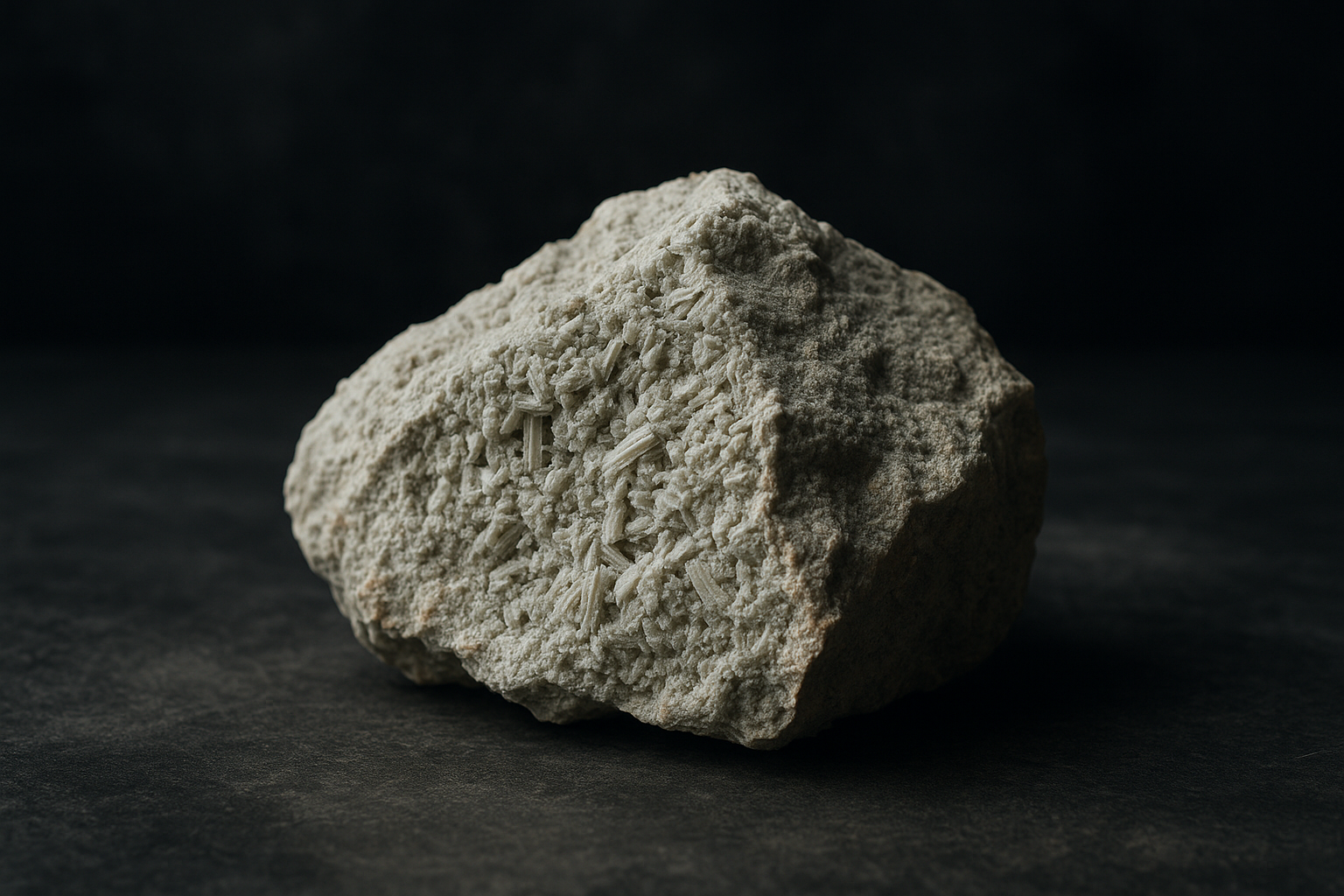
Endothermic Insulating Inorganic Filler for Fireproof Boards & Fire-Stop Putty - Using Clinoptilolite Framework-Water Dehydration Endotherm
In the manufacture of fireproof boards, fire-stop putty (sealing/joint fillers), and fire-resistant/flame-retardant coatings, the inorganic filler is designed not as a mere extender but as a functional filler that delays temperature rise in a fire. The natural clinoptilolite supplied by KMIZEOLITE is a high-purity aluminosilicate with a clinoptilolite content of 97.0%, mined at the Amargosa Valley deposit in Nevada, USA. It is an endothermic insulating inorganic filler candidate that simultaneously offers two physical mechanisms: reversible framework (structural) water dehydration endotherm and a porous insulating structure.
Unlike the natural pozzolan application, which deals with cement reactivity, this page covers the intended use as an inorganic filler that absorbs and shields heat within the binder matrix. We first make clear that zeolite is not an active species that chemically foams char like a phosphate-based intumescent flame retardant, but rather an inorganic phase that assists through endothermic dehydration and low-thermal-conductivity porosity.
Two Heat-Shielding Mechanisms: Dehydration Endotherm and Porous Insulation
The clinoptilolite framework is a porous aluminosilicate of linked [SiO4] and [AlO4] tetrahedra, and its channels contain reversibly adsorbed/desorbed framework water (zeolitic/structural water) and exchangeable cations. The review by De Gennaro et al. notes that water molecules within zeolite cavities move easily, allowing reversible dehydration to occur (De Gennaro et al., Environmental Science and Pollution Research, 2024). Viewed from a fireproof-filler perspective, this behavior can be organized into the following two mechanisms.
- Dehydration endotherm (heat sink) - during heating, the framework water leaves in stages, absorbing the latent heat of vaporization/desorption and acting to slow the rate of temperature rise behind the fire-exposed surface
- Porous insulation (low-k barrier) - the porous structure with 4.0-7.0 Angstrom micropores and a 40 m2/g surface area forms a low-thermal-conductivity inorganic insulating layer
However, because the water content that contributes to the endotherm varies with the sample's moisture state (relative-humidity history), the endothermic contribution per unit mass must be quantified by differential thermal/thermogravimetric analysis (DTA/TGA). This page does not assert a specific endothermic value (J/g).
Key Physical Property Data
The properties most directly relevant to endothermic insulating filler design are porosity, surface area, thermal stability, and hardness (grindability).
| Property | Value | Significance for Fireproof/Insulating Use |
|---|---|---|
| Pore diameter | 4.0-7.0 Angstrom | Pathway for retaining/dehydrating framework water; basis of the porous insulating structure |
| Surface area | 40.0 m2/g | Favorable for forming a porosity-based low-thermal-conductivity shielding layer |
| Cation exchange capacity (CEC) | 1.6-2.0 meq/g | Secures cation sites for metal (Ca/La/Fe/Al) modification |
| Specific gravity | 1.89 | Lightweight inorganic filler - eases the weight burden on boards and coatings |
| Bulk density | 720-865 kg/m3 | Basis for calculating filler loading and weight ratio |
| Hardness | 4.0-5.0 Mohs | Easy grinding/classification; good fine-milling processability |
| pH stability range | 3.0-10.0 | Broadly compatible with inorganic and water-based binders |
The main constituents of the inorganic filler are an aluminosilicate of 66.7% SiO2 and 11.48% Al2O3, which is itself a non-combustible inorganic phase. However, the quantitative heat-shielding performance the filler contributes in a fire (temperature-rise delay time, back-face temperature) depends on board thickness, binder, and the combination with other flame-retardant fillers, so it should as a rule be finally verified by cone calorimeter and fire-resistance certification tests (e.g., for insulation and integrity).
Thermal Stability and Collapse Limit - The Core Design Variable
The endothermic and insulating functions work only while the framework remains intact. The classic study by Smyth and Caporuscio (Smyth & Caporuscio, 1981) summarizes the thermal stability and cation-exchange properties of clinoptilolite, mordenite, and analcime, reporting that clinoptilolite's dehydration behavior and framework collapse limit temperature vary with the mineral's deposit origin and exchangeable-cation composition. In other words, even for the same clinoptilolite, the high-temperature structural retention limit changes depending on which cation occupies the sites.
Structural changes due to heat treatment are also addressed in relatively recent research. Khajeh Aminian et al. analyzed the structural, optical, and color changes when natural clinoptilolite is heat-treated, showing that dehydration and structural deformation proceed in stages with heating temperature (Khajeh Aminian et al., 2023), and Abdel-Galil et al. reported that thermally treated natural zeolite exhibits ion behavior that changes with the treatment conditions (Abdel-Galil et al., Materials, 2023). As these studies commonly imply, fireproof-filler design must confirm, sample by sample via TGA/XRD, the region where reversible dehydration occurs and the irreversible collapse limit temperature in order to set the service temperature range.
Heat/Moisture-Buffering Behavior in Building Materials
The reversible moisture behavior of zeolite has already been studied as a heat/moisture-buffering material in building finishing materials. Research on the hygrothermal (heat/moisture) performance of zeolite-based humidity-control building materials quantitatively examined how zeolite buffers the indoor environment through moisture adsorption/desorption (International Journal of Heat and Technology, 2016). In addition, research that measured changes in thermo-mechanical properties when zeolite is incorporated into concrete reports that zeolite, as a lightweight porous aggregate, affects the thermal behavior of construction materials (Bayiit, International Journal of the Physical Sciences, 2010). This adsorption/desorption/porous behavior starts from the same physical-property basis as the dehydration-endotherm/insulation logic of fireproof fillers.
Modification Is a Prerequisite for Loading Flame-Retardant Active Species
Many of the active flame-retardant ingredients frequently used in fire-protection products are anionic/oxyanionic species such as phosphates, ammonium polyphosphate (APP), and borates. Here a caution is needed. Unmodified clinoptilolite has a negatively charged aluminosilicate framework, so the framework itself cannot electrostatically attract and retain anions such as phosphates and borates. Therefore, to load and fix such anionic flame-retardant active species onto zeolite, changing the surface charge through metal (Ca/La/Fe/Al) cation modification or surfactant modification (SMZ, surfactant-modified zeolite) is effectively a prerequisite.
In other words, cation-exchange (CEC) logic alone cannot explain the loading of anionic flame retardants. The role of unmodified zeolite is strictly (1) framework-water dehydration endotherm, (2) porous insulation, and (3) a non-combustible inorganic aggregate/char-reinforcing phase; the active flame-retardant chemistry (intumescent foaming, etc.) must be handled by a separate flame retardant or imparted through modification. Blurring this distinction misaligns the application design.
Recommended Product Specification
| Product | Mesh | Particle Size | Suitability as Fireproof Filler |
|---|---|---|---|
| KMI 100- US MESH (Powder) | 100 mesh or finer | <150um, median 50um | Optimal for filler use - secures dispersibility, packing density, and insulating-layer homogeneity |
In board, putty, and coating matrices, fine-powder dispersibility governs insulating-layer homogeneity and heat-shielding consistency. A powder of 100 mesh or finer is most suitable in terms of packing density and dispersibility, and because viscosity, curing, and mechanical properties change as filler loading increases, trial formulation is essential.
Evaluation by Application Form
Fireproof Boards & Fire-Protection Panels
The approach is to evaluate replacing part of the inorganic filler in gypsum-, cement-, and calcium-silicate-based boards with fine zeolite powder, so that the dehydration endotherm and porous insulation contribute supplementarily to delaying back-face temperature rise. The balance with board density and strength is the key variable.
Fire-Stop Putty & Sealants (Joint Fillers)
In penetration-seal and joint fire-stop fillers, it is evaluated as a non-combustible lightweight inorganic phase. Because the reversible moisture behavior is affected by the post-installation moisture state, the endothermic contribution must be evaluated reflecting the moisture state of the actual service environment.
Fire-Resistant/Flame-Retardant Coatings (Including Intumescent)
In intumescent coatings, it is evaluated as a char-reinforcing inorganic phase, extender, or carrier. If loading of phosphate-based active flame-retardant ingredients is required, metal/surfactant modification is a prerequisite as explained above, and the unmodified powder should be designed with a role limited to non-combustible filling and insulation support.
Role Comparison with Conventional Flame-Retardant Fillers
| Filler | Primary Action | Relationship with Zeolite |
|---|---|---|
| Aluminum hydroxide (ATH) | Dehydration endotherm / water-vapor dilution | Similar endothermic mechanism - combined use can distribute the endothermic temperature ranges |
| Calcium carbonate | Extender / inorganic aggregate | Zeolite differentiates through porous insulation and light weight |
| Vermiculite / perlite | Porous insulation / lightweight | Similar insulating function; zeolite adds dehydration endotherm and ion-exchange capability |
| Ammonium polyphosphate (APP) | Intumescent acid catalysis / foaming | Anionic active species - cannot be loaded onto unmodified zeolite; modification is a prerequisite |
This comparison is a reference summarizing general roles; in actual formulations, fillers are combined so that the endothermic temperature ranges either overlap or spread out, designing the heat-shielding curve.
Evaluation Points
- Because the endothermic contribution varies with the sample's moisture state, the unit endothermic value must be quantified by TGA/DTA.
- Confirm the reversible-dehydration region and the irreversible framework-collapse limit temperature per sample, and set the service temperature range.
- Loading anionic (phosphate/borate) active flame retardants requires metal/surfactant modification as a prerequisite.
- Final insulation/integrity performance must be verified by fire-resistance certification testing at the board/coating system level.
- Design zeolite not as a standalone flame retardant but as a supplementary filler that complements the endothermic, insulating, and non-combustible inorganic phase.
Frequently Asked Questions (FAQ)
How does zeolite delay temperature rise in a fire?
The cavities of the clinoptilolite framework hold framework (structural) water that is adsorbed and desorbed reversibly. As a fire raises the temperature, this framework water dehydrates in stages and absorbs heat (endotherm), while at the same time the porous structure - with 4.0-7.0 Angstrom micropores and a 40 m2/g surface area - acts as a low-thermal-conductivity insulating layer, helping slow the temperature rise on the back face of the board or coating. However, because the water content that contributes to the endotherm varies with the sample's moisture state, the quantitative contribution must be confirmed by tests such as TGA.
Can dehydrated zeolite reabsorb moisture and be reused?
The framework water of clinoptilolite is reported to desorb and re-adsorb reversibly at relatively low temperatures. However, once it is heated to the temperature at which the framework collapses irreversibly, the endothermic and insulating functions are permanently lost. Smyth & Caporuscio (1981) summarize the thermal stability and dehydration behavior of clinoptilolite and report that the structural collapse limit at high temperature varies with the mineral's deposit origin and cation composition. In fireproof filler design, the key is to confirm, sample by sample, the reversible range and the collapse limit temperature.
How do you evaluate particle size and loading as a fireproof filler?
For dispersibility and packing density within board, putty, and coating matrices, a powder of 100 mesh or finer (median 50 um) is suitable. As the inorganic filler loading increases, the endothermic and insulating contribution grows, but viscosity, curing, and mechanical strength change relative to the binder, so the blend and substitution ratio with conventional flame-retardant fillers such as calcium carbonate, aluminum hydroxide (ATH), and vermiculite should be determined through trial formulations. Zeolite is applied not as a standalone flame retardant but as a supplementary inorganic filler that complements endothermic, insulating, and porous functions.
Does zeolite act directly like a phosphate-based intumescent flame retardant?
No. Unmodified clinoptilolite has a negatively charged aluminosilicate framework, so the framework itself cannot attract and retain anionic flame-retardant active species such as phosphates and borates. To load anionic active species, modification with metals (Ca/La/Fe/Al) or surfactants (SMZ) is effectively a prerequisite. Therefore, zeolite's role is not the intumescent chemistry itself but physical shielding as an endothermic-dehydration, porous-insulation, inorganic aggregate; in intumescent coatings, it is accurately evaluated as a carrier, extender, or char-reinforcing inorganic phase.
Related Pages
- Construction & Industrial Materials Applications - category hub
- Natural Pozzolan - cement-reactive SCM application (distinct from endothermic filler)
- Powder-Type Zeolite Products - 100 mesh specification for filler use
- TDS / Technical Data - check detailed properties
Notice
The results of fireproof/fire-protection filler applications vary with raw-material purity, moisture state, fineness, filler loading, the combination of binder and co-used flame retardants, the board/coating system configuration, and the required fire-resistance rating. Before actual application, please verify insulation/integrity performance through thermal analysis such as TGA/DTA and fire-resistance certification testing at the board/coating level. The property data on this page is based on KMI public technical literature; please confirm the latest TDS at the time of actual delivery.
[Inquire about particle size, powder specifications, and bulk supply of endothermic insulating filler for fireproof boards & fire-stop putty →]
science Related Research Papers
Academic papers addressing the thermal behavior and porous insulation of zeolite in this field. Refer to them when evaluating adoption.
- Review of the thermal stability and cation exchange properties of the zeolite minerals clinoptilolite, mordenite, and analcime
Smyth, J.R. and Caporuscio, F.A. — 1981 - Enhancing Colorant Pigment Properties of Natural Clinoptilolite Zeolite Through Thermal Treatment: Structural, Optical, and Colorimetric Analysis
Khajeh Aminian, M., Fatah, S. and Bahamirian, M. — 2023 - Removal of Cesium and Strontium Ions by Thermally Treated Natural Zeolite
Abdel-Galil, E.A. et al. — Materials, 2023 - Hygrothermal Performance of Zeolite-Based Humidity Control Building Materials
International Journal of Heat and Technology, 2016 - The effect of zeolite rate on the thermo-mechanical properties of concrete
Bayiit, C. — International Journal of the Physical Sciences, 2010
The papers above are reference material; actual application requires separate evaluation suited to on-site conditions.