Zeolite for Paint & Coating Additives
When 100-mesh powder (<150 μm) loaded with Ce³⁺·Zn²⁺ anti-corrosion cations by ion exchange onto a CEC 1.6–2.0 meq/g framework partially replaces the primer pigment fraction, it acts as a non-toxic "smart anti-corrosion pigment" that releases inhibitor on demand when the film is damaged, replacing chromate systems — while simultaneously serving as a single material for matte matting, extender and low-VOC adsorption.
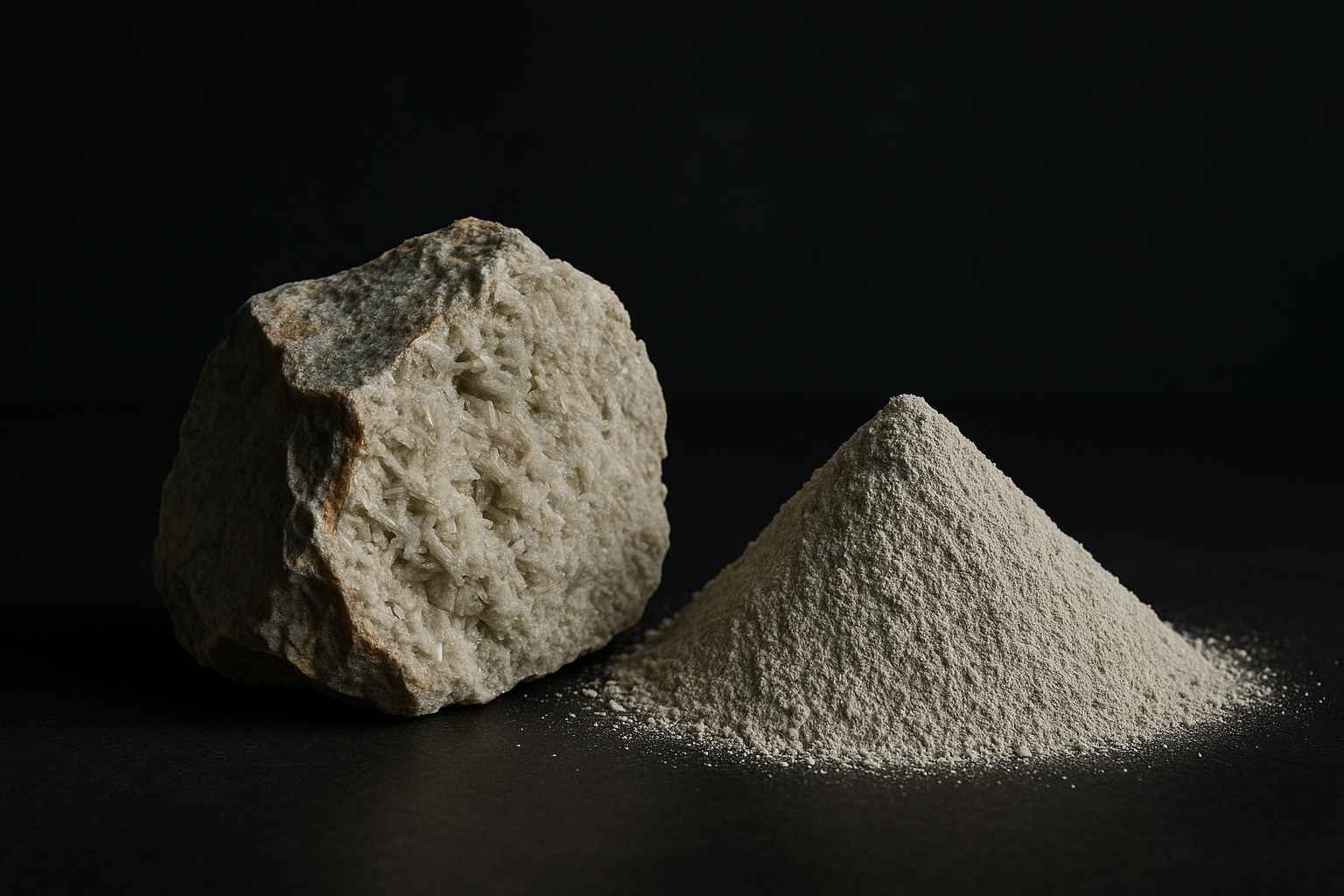
Why Zeolite Is Considered in Paint & Coating Formulations
In paint and coating formulation practice, the three most demanding challenges converge as follows. First is anti-corrosion (rust prevention) of metal substrates: as traditional anti-corrosion pigments such as zinc chromate and strontium chromate are phased out under environmental regulations (RoHS, REACH), non-toxic alternative pigments have become necessary. Second is gloss control and extending (extender): matting and pigment volume concentration (PVC) adjustment are required for matte and semi-matte finishes. Third is the management of residual solvent, odor and moisture associated with the shift to low-VOC and waterborne systems.
Natural clinoptilolite is considered as a supplementary material across all three of these axes. Its three-dimensional microporous framework (pore diameter 4.0–7.0 Å) provides adsorption and ion-storage sites, while its cation exchange capacity (CEC 1.6–2.0 meq/g) enables "smart pigment" behavior in which anti-corrosion active cations (e.g., Ce³⁺, Zn²⁺, Ca²⁺) are pre-loaded by ion exchange and then released slowly when the coating is damaged. The fact that a single inorganic powder combines the multiple functions of anti-corrosion carrier, matting, extending and adsorption is what differentiates it from single-function fillers (talc, silica, barium sulfate).
Review Points vs. Chromate-Based Anti-Corrosion Pigments
| Item | Zinc chromate · SrCrO₄ | Zeolite loaded-type pigment |
|---|---|---|
| Anti-corrosion principle | Chromate leaching · passivation | Sustained ion-exchange release of inhibitor cations (Ce³⁺·Zn²⁺) |
| Toxicity · regulation | Carcinogenic Cr(VI), RoHS/REACH restricted | Non-toxic, FDA GRAS · EN-71-3 PASS |
| Release behavior | Initial over-release · depletion | Controlled release triggered by Cl⁻ ingress at damage sites |
| Additional functions | Single (anti-corrosion) | Anti-corrosion + Cl⁻ trapping + moisture/VOC adsorption |
How It Works — Ion-Exchange Loaded Anti-Corrosion Pigment + Inorganic Extender Pigment
In anti-corrosion coatings, the core mechanism of zeolite is inhibitor loading and release. When the exchangeable Na⁺·K⁺·Ca²⁺ sites within the clinoptilolite framework (CEC 1.6–2.0 meq/g) are filled with anti-corrosion cations by ion exchange, then when microcracks form in the film or corrosive ions (Cl⁻) penetrate, the cations are exchanged out and form a protective film on the metal surface (Ce oxide/hydroxide, Zn phosphate-like layer). At the same time, the pores (4.0–7.0 Å) capture the penetrating chloride ions and moisture inside the framework, acting as dual protection that traps corrosion factors.
This behavior can be summarized quantitatively as follows.
- Loading: When the powder is immersed and stirred for a set time in a 0.05–0.5 M salt solution such as Ce(NO₃)₃·ZnSO₄, the framework cations are substituted with inhibitor cations. The upper limit of loading is defined by the CEC (1.6–2.0 meq/g).
- Release: When Cl⁻·H⁺ penetrating at the film damage site re-exchanges with the framework cations, the loaded inhibitor is released locally — unlike chromate, which depletes after an initial over-release, this is an "on-demand" release proportional to corrosion activity.
- Barrier: Dispersed platy/columnar particles lengthen the diffusion path within the film (increasing tortuosity), physically delaying the permeation of moisture, oxygen and ions.
The improvement in corrosion resistance of such modified zeolite pigments has been reported through electrochemical impedance (EIS) and salt-spray testing (D'Alessandro et al., 2021; Korniy et al., 2024), and the key point is that it is "not the unmodified powder, but a modified grade loaded with inhibitor cations".
On the extender/matting side, the relatively soft particle characteristics of a specific surface area of 40.0 m²/g and a Mohs hardness of 4.0–5.0 are utilized. When added in powder form (100 mesh, <150 μm, median about 50 μm), it creates fine surface texture on the film that scatters incident light to lower the 60° gloss, supplements film solids and applied thickness as an inorganic filler, and raises the pigment volume concentration (PVC) toward the critical pigment volume concentration (CPVC) to strengthen the matte effect. Research has also reported that heat-treating natural clinoptilolite improves its whiteness and optical properties, increasing its suitability as an inorganic extender/coloring pigment (Aminian et al., 2023). With a pH stability range of 3.0–10.0, application can be considered broadly from alkaline waterborne latex to mildly acidic formulations, and with a thermal stability of 700°C it does not decompose under baking/stoving coating conditions.
On the low-VOC and waterborne side, the porous framework acts as a supplementary adsorbent. There are numerous reports that natural and modified clinoptilolite adsorbs volatile organic compounds and odor components in indoor-air and odor environments (Cataldo et al., 2024; Sahin et al., 2020), so a supplementary function of partially capturing residual solvent, amine-hardener odor and moisture during film curing can be expected. However, since the adsorption capacity is lower than activated carbon, it is appropriate to achieve primary VOC reduction through formulation design (low-VOC resins, reactive diluents) and to position zeolite as a complementary material.
KMIZEOLITE's natural clinoptilolite has a purity of 97% (SiO₂ 66.7%, Al₂O₃ 11.48%), mined and processed at the Amargosa Valley mine in Nevada, USA, with a specific gravity of 1.89 and OMRI·FDA GRAS·EN-71-3 certifications, making it consistent with formulations aiming for eco-friendly, low-toxicity pigments.
KMIZEOLITE Key Properties
| Item | Value |
|---|---|
| Clinoptilolite purity | 97% |
| Cation exchange capacity (CEC) | 1.6–2.0 meq/g |
| Specific surface area | 40.0 m²/g |
| Pore diameter | 4.0–7.0 Å |
| pH stability range | 3.0–10.0 |
| Hardness | 4.0–5.0 Mohs |
| Thermal stability | 700°C |
| Specific gravity | 1.89 |
| Bulk density | 45–54 lbs/ft³ |
| Certifications | OMRI KMI-10365, FDA GRAS, TSCA, EN-71-3 |
Application Examples of Zeolite for Paint & Coating Additives
Below are representative application scenarios in which zeolite is considered in paint and coating formulations.
- Anti-corrosion functional pigment: Formulating zeolite loaded with anti-corrosion cations such as Ce³⁺·Zn²⁺ by ion exchange into primers and anti-corrosion paints as a non-toxic pigment
- Matte/semi-matte matting agent: Adding 100-mesh powder to lower the film surface gloss and achieve a matte finish
- Inorganic extender pigment: Supplementing solids and hiding power and adjusting PVC in waterborne latex/emulsion paints
- Low-VOC and moisture-management aid: Supplementary adsorption of residual solvent, moisture and odor during film curing via porous adsorption
- Test/pilot formulation: Pre-evaluating dispersibility, settling and viscosity changes with a small powder sample
The effectiveness as an anti-corrosion pigment has also been reported academically. D'Alessandro et al. (2021, Pigment & Resin Technology) confirmed by electrochemical impedance analysis (EIS) that an anti-corrosion paint using a cation-exchange-modified natural zeolite as a functional pigment improved the corrosion resistance of steel substrates compared with the unmodified case (DOI: 10.1108/PRT-05-2020-0052), and Korniy et al. (2024, Advances in Polymer Technology) reported that zeolite-based anti-corrosion pigments provide protection by sustained-release of corrosion-inhibiting cations in polymer coatings (DOI: 10.1155/2024/6533170). On the matting/extender side, Aminian et al. (2023) analyzed the chromaticity and optical properties of heat-treated clinoptilolite and reported its potential as an inorganic pigment (DOI: 10.2139/ssrn.4542438), and on the low-VOC supplementary adsorption side, Cataldo et al. (2024) and Sahin et al. (2020) summarized the VOC, odor and moisture adsorption behavior of natural zeolite. However, since these quantitative values were measured in model systems rather than a paint matrix, actual performance in real films varies depending on the formulation, substrate and exposure conditions.
Recommended Particle Size and Product Specifications
In paint and coating formulations, particle size determines the film appearance, so Powder (100 mesh or finer, <150 μm, median about 50 μm) is effectively essential. Matting, extender and anti-corrosion pigments all require a fine powder to secure dispersibility and film smoothness. Granule product grades are too coarse for paint use and unsuitable; in the table below, specifications other than powder are for reference for other uses of the same mineral.
| Product grade | Mesh | Particle size | Typical use |
|---|---|---|---|
| Powder | 100 mesh or finer | <150μm | Pozzolan, feed, powder adsorption |
| Fine Granule | 30×50 mesh | 0.3–0.6mm | Water treatment, filtration, soil |
| Medium Granule | 14×40 mesh | 0.4–1.4mm | Filter bed, litter, flooring |
| Coarse Granule | 8×14 mesh | 1.4–2.4mm | Pools, de-icing, large-scale filtration |
| Extra Coarse | 4×8 mesh | 2.4–4.8mm | Packed beds, air scrubbers |
Recommended for this field: Single specification of 100-mesh powder (<150 μm) / for anti-corrosion use, cation-exchange-loaded grade to be discussed separately
→ View products by mesh size · Product selection guide by application
Pilot Formulation and Review Points
When adding zeolite to paints and coatings, the following items should be checked together.
- Dosage design: For matting/extender use, start at 2–8% of the total formulation; for anti-corrosion pigment use, start at a level that replaces a portion of the pigment fraction, and adjust while observing film properties
- Dispersion conditions: Because the porous particles have high oil absorption, add dispersant/wetting agents and use high-shear dispersion to prevent agglomeration and clumping
- Viscosity and settling: As a specific-gravity 1.89 inorganic powder, evaluate storage stability (settling, hard caking) and viscosity increase in advance
- Film properties: Test gloss (60° gloss), hiding power, adhesion and water resistance; for anti-corrosion paints, test salt-spray (ASTM B117) and EIS corrosion resistance
- VOC and waterborne compatibility: Verify waterborne latex/emulsion stability within the pH stability range of 3.0–10.0
- Field-specific notes: Pre-loading anti-corrosion cations by ion exchange enables "smart anti-corrosion pigment" behavior that releases on demand when the film is damaged, and is considered as a non-toxic alternative to chromate-based anti-corrosion pigments.
Anti-Corrosion Pigment Loading & Evaluation Procedure (Example)
- Loading: Immerse and stir 100-mesh powder in a 0.05–0.5 M Ce(NO₃)₃ or ZnSO₄ solution (room temperature, several hours) to substitute the framework cations with the inhibitor. The loading limit is the CEC 1.6–2.0 meq/g.
- Washing and drying: Remove residual salts by washing and dry at 100–110°C to reduce the risk of blooming and blistering in the film.
- Formulation: Partially substitute the loaded powder into the primer pigment fraction and disperse at high shear. Because oil absorption is high, correct the dispersant/wetting agents.
- Accelerated corrosion evaluation: Observe scribe corrosion and blistering by salt-spray (ASTM B117), and compare the low-frequency impedance (|Z|0.01Hz) retention by EIS against an unmodified control.
- Matting/extender evaluation: Evaluate 60° gloss, hiding power (contrast ratio), oil absorption, and settling/viscosity under the same PVC conditions.
→ View TDS (Technical Data Sheet) · View MSDS (Safety Data Sheet)
Zeolite for Paint & Coating Additives FAQ
Does zeolite really work in anti-corrosion (rust-inhibiting) paints?
It has been reported in academic research. The key point, however, is that it is not the unmodified powder but a modified grade loaded with inhibitor cations. Zeolite loaded with anti-corrosion cations such as Ce³⁺·Zn²⁺ via cation exchange (CEC 1.6–2.0 meq/g) slowly releases these cations when Cl⁻ penetrates a damaged area of the film, protecting the metal substrate, while the pores (4.0–7.0 Å) simultaneously trap Cl⁻ and moisture. D'Alessandro et al. (2021, Pigment & Resin Technology) confirmed via EIS that modified zeolite pigment improved the corrosion resistance of steel substrates, and Korniy et al. (2024, Advances in Polymer Technology) also reported the sustained-release protective effect of zeolite-based anti-corrosion pigments. Since actual performance depends on the formulation, substrate and environment, salt-spray and EIS pilot testing is recommended.
Which particle size (mesh) should I use?
For paint use, powder of 100 mesh or finer (<150 μm, median about 50 μm) is effectively the standard. Matting, extender and anti-corrosion pigments all need a fine powder to secure dispersibility and film smoothness. Granule product grades are too coarse and unsuitable for paints.
How much should I dose?
For matting/extender use, start in the 2–8% range of the total formulation and adjust while observing gloss and hiding power; for anti-corrosion pigment use, consider replacing a portion of the existing pigment fraction. Because the porous powder has high oil absorption, dispersant/wetting-agent correction and viscosity/settling evaluation are required. The exact ratio is best determined through formulation testing.
Can it also be used in low-VOC waterborne paints?
Yes. With a pH stability range of 3.0–10.0, application can be considered from alkaline waterborne latex/emulsion to mildly acidic formulations, and the porous framework provides supplementary adsorption of residual solvent, amine-hardener odor and moisture during curing (VOC/odor adsorption reported by Cataldo et al. 2024, Sahin et al. 2020, etc.). However, since the adsorption capacity is lower than activated carbon, primary VOC reduction should be achieved through low-VOC resin design, with zeolite positioned as a complementary material. As an inorganic powder, also evaluate waterborne storage stability (settling/viscosity) in advance.
Do you have eco-friendly, non-toxic certification documents?
KMIZEOLITE holds OMRI Listed (KMI-10365), FDA GRAS (21 CFR 182.2729), TSCA compliance, EN-71-3 PASS and more, making it suitable for evaluation as a non-toxic alternative to chromate-based anti-corrosion pigments. Please check the certifications page.
Inquiries and Sample Requests
If you are considering applying zeolite in the field of paint and coating additives, please contact us through the channels below.
Notice
Applicability may vary depending on site conditions, regulations and test results. Before actual application, test review suited to the specific site conditions must always be conducted first. Zeolite should be understood not as a universal solution for this field, but as a material that supports existing processes.
Related Pages
science Related Papers
These are academic papers covering zeolite application in this field. Please refer to them when evaluating adoption.
- Zeolites in Adsorption Processes: State of the Art and Future Prospects
Various — Chemical Reviews, 2022 - Zeolite-Based Anti-corrosion Pigments for Polymer Coatings
Korniy, S.A. et al. — Advances in Polymer Technology, 2024 - Anticorrosive paint with modified zeolite as functional pigment
D'Alessandro, O. et al. — Pigment & Resin Technology, 2021 - Enhancing Colorant Pigment Properties of Natural Clinoptilolite Zeolite Through Thermal Treatment
Aminian, M.K. et al. — SSRN Preprint, 2023 - Odors Adsorption in Zeolites Including Natural Clinoptilolite
Cataldo, E. et al. — Materials, 2024 - Zeolite for indoor air quality: A review of environmental applications
Sahin, O. et al. — Building and Environment, 2020
The papers above are reference materials; actual application requires separate review suited to the specific site conditions.