Photocatalytic Facade Coating Carrier (TiO₂ Carrier)
Not a photocatalyst itself but a porous carrier that fixes TiO₂: a 40 m²/g surface area and 4.0–7.0 Å pores adsorb and concentrate VOCs and organic pollutants near the photocatalytic active sites, supporting self-cleaning and air-purification efficiency.
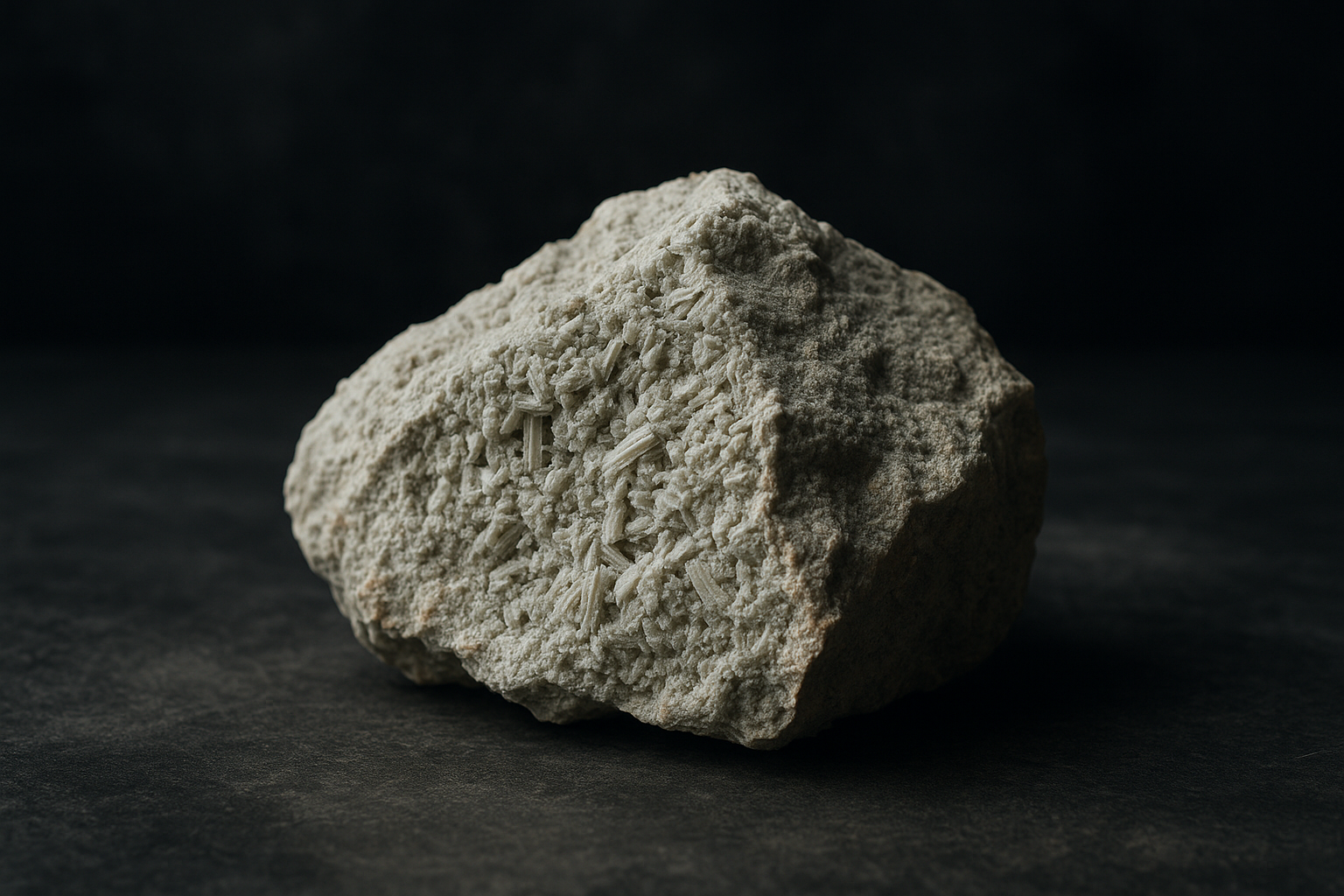
Photocatalytic Facade Coating Carrier — Zeolite Carrier for TiO₂ Self-Cleaning Coatings
Self-cleaning photocatalytic coatings applied to building facade tiles, panels and glass surfaces are a technology in which TiO₂ (titanium dioxide, anatase form) absorbs ultraviolet light, generates strongly oxidizing radicals, and degrades surface-bound pollutants and VOCs so they wash away in the rain. In this system, natural clinoptilolite is evaluated not as a photocatalyst itself but as a porous carrier/support that disperses and fixes TiO₂ and as an auxiliary material that adsorbs and concentrates organic pollutants.
The natural clinoptilolite supplied by KMIZEOLITE is mined at the Amargosa Valley deposit in Nevada, USA, and is a porous mineral with high purity of 97.0% clinoptilolite content, a 40.0 m²/g surface area and 4.0–7.0 Å pores. This porous structure forms the basis of the adsorb-and-degrade mechanism that first captures dilute VOCs and supplies them to the TiO₂ active sites.
Key Property Data as a Carrier
For photocatalytic carrier applications, the meaningful properties are surface area, pores and surface porosity rather than chemical composition. These govern the TiO₂ loading area and the VOC adsorption capacity.
| Property | Value | Significance for Carrier Use |
|---|---|---|
| Surface area | 40.0 m²/g | Core of securing TiO₂ dispersion area + VOC adsorption area |
| Pore diameter | 4.0–7.0 Å | Physisorption channel for formaldehyde and small-molecule VOCs |
| Cation exchange capacity (CEC) | 1.6–2.0 meq/g | Surface ionic activity (supports TiO₂ anchoring during loading) |
| Specific gravity | 1.89 | Low film burden as a lightweight filler |
| pH stability range | 3.0–10.0 | Compatible with inorganic/silicate-based coating environments |
| Hardness | 4.0–5.0 Mohs | Easy fine classification, stable within the film |
| Bulk density | 720–865 kg/m³ | Reference for calculating weight ratios in coating formulation |
Because TiO₂ can only degrade molecules that reach its surface, dilute airborne VOCs have a low probability of contacting the photocatalyst surface, lowering the degradation rate. When clinoptilolite with a 40 m²/g surface area first adsorbs and concentrates pollutants and supplies them near the TiO₂ active sites, it works in a direction that supplements degradation efficiency and durability compared with the photocatalyst alone.
Photocatalytic Carrier Mechanism — Division of Labor Between Adsorption and Photodegradation
The operation of a zeolite-TiO₂ self-cleaning coating is divided into two stages. It is important not to confuse the two functions.
- Adsorption (handled by zeolite) — The porous surface of clinoptilolite physically adsorbs VOCs, organic pollutants and the organic components of dust, concentrating them on the film surface.
- Photodegradation (handled by TiO₂) — TiO₂ that absorbs ultraviolet light generates reactive species such as ·OH radicals, oxidatively degrading the concentrated pollutants into CO₂ and H₂O.
- Hydrophilization and washing — The photo-induced hydrophilicity of TiO₂ forms a water film on the coating surface, so degradation residues are washed away by rainwater (self-cleaning).
In other words, the photoactivity of self-cleaning is entirely created by TiO₂, while zeolite is the carrier and adsorption-concentration matrix that raises its efficiency. Because zeolite does not generate radicals from light, it cannot replace the photocatalyst and must always be used in combination with TiO₂.
VOC and Organic Pollutant Adsorption — What It Captures and What It Cannot
The main targets that self-cleaning facade materials deal with are VOCs (volatile organic compounds) and organic pollutants in urban air. Formaldehyde, toluene and the like are neutral organic molecules and are therefore physically adsorbed onto the pores and surface of clinoptilolite. The formaldehyde adsorption behavior of clinoptilolite has been reported in a separate study, and the use of zeolite for VOC adsorption has been examined in the context of improving indoor and outdoor air quality.
An important limitation — anions/oxyanions are different. Anions/oxyanions such as phosphate, fluoride, arsenic, boron and nitrate nitrogen are electrostatically repelled by the negatively charged aluminosilicate framework of unmodified clinoptilolite, so their adsorption is weak. To handle such targets, metal (Ca·La·Fe·Al) or surfactant modification (SMZ, Surfactant-Modified Zeolite) is effectively a prerequisite. However, the main target for self-cleaning carrier use, VOCs, are neutral molecules handled by physisorption, and the mechanism on this page centers on physical adsorption on the porous surface plus TiO₂ loading rather than cation exchange.
TiO₂/Zeolite Composite Performance in Research
The adsorb-and-degrade synergy of using zeolite as a TiO₂ carrier is supported by several studies. Liao et al. prepared a zeolite/TiO₂ cement-based composite and reported excellent photocatalytic performance, showing that zeolite functions as a carrier that disperses and fixes TiO₂ and adsorbs pollutants to promote photodegradation (Liao, Yao & Zuo, Materials, 2018).
Ebrahimi et al. photodegraded an organic pollutant (Microcystin-LR) under ultraviolet light with a TiO₂/NaY-zeolite nanocomposite and reported achieving up to 97.63% removal efficiency under optimal conditions (pH 5, contact time 120 min, catalyst 1.2 g/L) (Ebrahimi et al., Environmental Health Engineering and Management Journal, 2020). This shows a structure in which zeolite does not directly create photocatalytic activity but, as a loading matrix, raises the degradation efficiency of TiO₂.
The behavior of facade self-cleaning coatings themselves has also been studied. Malek & Sudol evaluated the influence of paint type on the self-cleaning process of facade coatings (Malek & Sudol, IOP Conf. Series: Materials Science and Engineering, 2019), and Hua et al. presented a wipe-on, durable self-cleaning coating for glass facades (Hua et al., Thin Solid Films, 2020). Taken together, the strength of a zeolite carrier lies in supplementing the photodegradation efficiency and durability of TiO₂ through VOC adsorption and concentration, and actual performance must be confirmed through testing according to loading, film and exposure conditions.
Recommended Product Specifications
| Product Name | Mesh | Particle Size | Suitability as a Carrier |
|---|---|---|---|
| KMI 100- US MESH (Powder) | 100 mesh or finer | <150μm, median 50μm | Suitable as a carrier — secures coating dispersibility and surface adsorption area |
| Finely classified powder (custom specification) | 100 mesh or finer fine powder | Median of a few to tens of μm | Consider when thin films and smooth surfaces are required |
For carrier applications, fineness matters, considering coating dispersibility and film surface roughness. Self-cleaning and VOC-degradation performance vary with TiO₂ loading, the zeolite-to-photocatalyst mixing ratio, binder type (inorganic/silicate-based recommended), film thickness and UV exposure environment, so trial coating is essential.
Application Points You Can Expect
- TiO₂ carrier (dispersion and fixation matrix) for self-cleaning coatings on building facade tiles, panels and glass
- Supports photodegradation efficiency by adsorbing and concentrating urban-air VOCs and organic pollutants
- Adsorb-and-degrade synergy for dilute-concentration pollutants
- Lightweight porous filler for inorganic/silicate-based facade coatings
- Supplements photocatalytic activity durability (increases surface contact frequency through pollutant concentration)
Application Examples
Self-cleaning facade coating formulation
TiO₂ photocatalyst and fine clinoptilolite can be dispersed in an inorganic binder and evaluated as the carrier and adsorption component of a self-cleaning coating applied to facade panel and tile surfaces.
Photocatalyst-adsorption composite paint
In environments where dilute-concentration VOCs are a problem, the application potential as an adsorption matrix can be evaluated for a composite-paint design in which a zeolite adsorption layer concentrates pollutants and TiO₂ degrades them.
Glass and facade hydrophilic coating
In facade coatings that combine photo-induced hydrophilicity with adsorption concentration, it can be evaluated as an auxiliary material that supplements dispersibility within the film and surface porosity.
Review Points
- Zeolite is not a photocatalyst but a TiO₂ carrier and adsorbent. The photoactivity is handled by TiO₂.
- Neutral organic molecules such as VOCs are physisorbed, but anions/oxyanions are weakly adsorbed without modification (metal·SMZ).
- Performance varies greatly with TiO₂ loading, mixing ratio, film thickness and UV exposure.
- Inorganic/silicate-based binders that withstand photocatalytic oxidation are generally advantageous.
- Self-cleaning and VOC-degradation performance must be finally confirmed through trial coating and exposure evaluation.
Frequently Asked Questions (FAQ)
Does zeolite replace the photocatalyst in self-cleaning facade coatings, or does it act as a carrier?
Zeolite (clinoptilolite) itself is not a photocatalyst that generates radicals under light. The photoactivity that creates the self-cleaning function is provided by TiO₂ (anatase), while zeolite is applied as a porous carrier/support that disperses and fixes that TiO₂, and as an auxiliary material that adsorbs VOCs and organic pollutants to concentrate them near the photocatalytic active sites. In other words, zeolite does not replace TiO₂ but is a carrier that combines with TiO₂ to support photodegradation efficiency.
Why is a zeolite carrier more advantageous than a TiO₂-only coating?
TiO₂ can only degrade pollutants that reach its surface, so the degradation rate drops for dilute concentrations of VOCs. With its 40 m²/g surface area and 4.0–7.0 Å pores, clinoptilolite first adsorbs and concentrates organics such as formaldehyde and toluene, then supplies them to the TiO₂ active sites, creating an adsorb-and-degrade synergy. The literature reports cases where TiO₂/zeolite composites achieved up to 97.63% removal efficiency in the photodegradation of organic pollutants.
Can zeolite directly adsorb organic anions and neutral molecules such as VOCs?
VOCs (formaldehyde, toluene, etc.) are neutral organic molecules and are physically adsorbed onto the pores and surface of clinoptilolite. However, anions/oxyanions such as phosphate, fluoride, arsenic and boron are repelled by the negatively charged framework of unmodified clinoptilolite, so their adsorption is weak; in these cases, metal (Ca·La·Fe·Al) or surfactant modification (SMZ) is effectively a prerequisite. For self-cleaning carrier use, the key mechanism is not cation exchange but physical adsorption on the porous surface combined with TiO₂ loading.
What particle size and review items are recommended when used as a facade coating carrier?
Considering coating dispersibility and film surface roughness, a fine powder of 100 mesh or finer (median 50 μm) or a finer classified grade is suitable as a carrier. Self-cleaning and VOC-degradation performance vary with TiO₂ loading, film thickness, binder type (inorganic/silicate-based recommended), UV exposure environment and the photocatalyst-to-carrier mixing ratio, so the specification should be finalized through trial coating against the target performance.
Related Pages
- Zeolite for Paint & Coating Additives — applied as functional filler and coating material
- Zeolite for Deodorizing Building Materials — VOC and odor adsorption building materials
- Zeolite for Cleanroom Air Purification — adsorption of airborne organics
- Natural Pozzolan Zeolite — applied as a cementitious SCM
- All Construction & Industrial Materials Applications — category hub
Notice
Photocatalytic carrier application results may vary depending on TiO₂ loading, zeolite fineness, mixing ratio, binder, film thickness, UV exposure conditions and the required performance criteria. Before actual application, please confirm suitability through trial coating and self-cleaning/VOC-degradation performance evaluation. The property data on this page is based on KMI public technical documentation; please check the latest TDS at the time of actual supply.
[Inquire about zeolite particle size, powder specifications and bulk supply for photocatalytic carriers →]
science Related Papers
Academic papers covering zeolite applications in this field. Use them as a reference when reviewing adoption.
- Preparation and Characterization of Zeolite/TiO₂ Cement-Based Composites with Excellent Photocatalytic Performance
Liao, G., Yao, W. and Zuo, J. — Materials, 2018 - The performance of TiO₂/NaY-zeolite nanocomposite in photocatalytic degradation of Microcystin-LR (max. 97.63% removal)
Ebrahimi, A. et al. — Environmental Health Engineering and Management Journal, 2020 - Influence of Different Kinds of Paints on Self-Cleaning Process of the Facade Coating
Malek, M. and Sudol, E. — IOP Conf. Series: Materials Science and Engineering, 2019 - Wipe-on and durable self-cleaning coating for glass facade
Hua, L. et al. — Thin Solid Films, 2020 - Formaldehyde Adsorption into Clinoptilolite Zeolite
Kalantarifard, A. et al. — Terrestrial, Atmospheric and Oceanic Sciences, 2016
The papers above are for reference only; separate review suited to on-site conditions is required for actual application.