Anti-Condensation Insulation Coating Additive
An inorganic filler that disperses porous clinoptilolite with 4.0-7.0Å pores and 40 m²/g surface area into a coating film, reversibly buffering surface water vapor (condensation mitigation) and supporting insulation through the air layer inside the particles. It is designed not as a waterproofing membrane, but as a functional filler that delays the surface reaching the dew point.
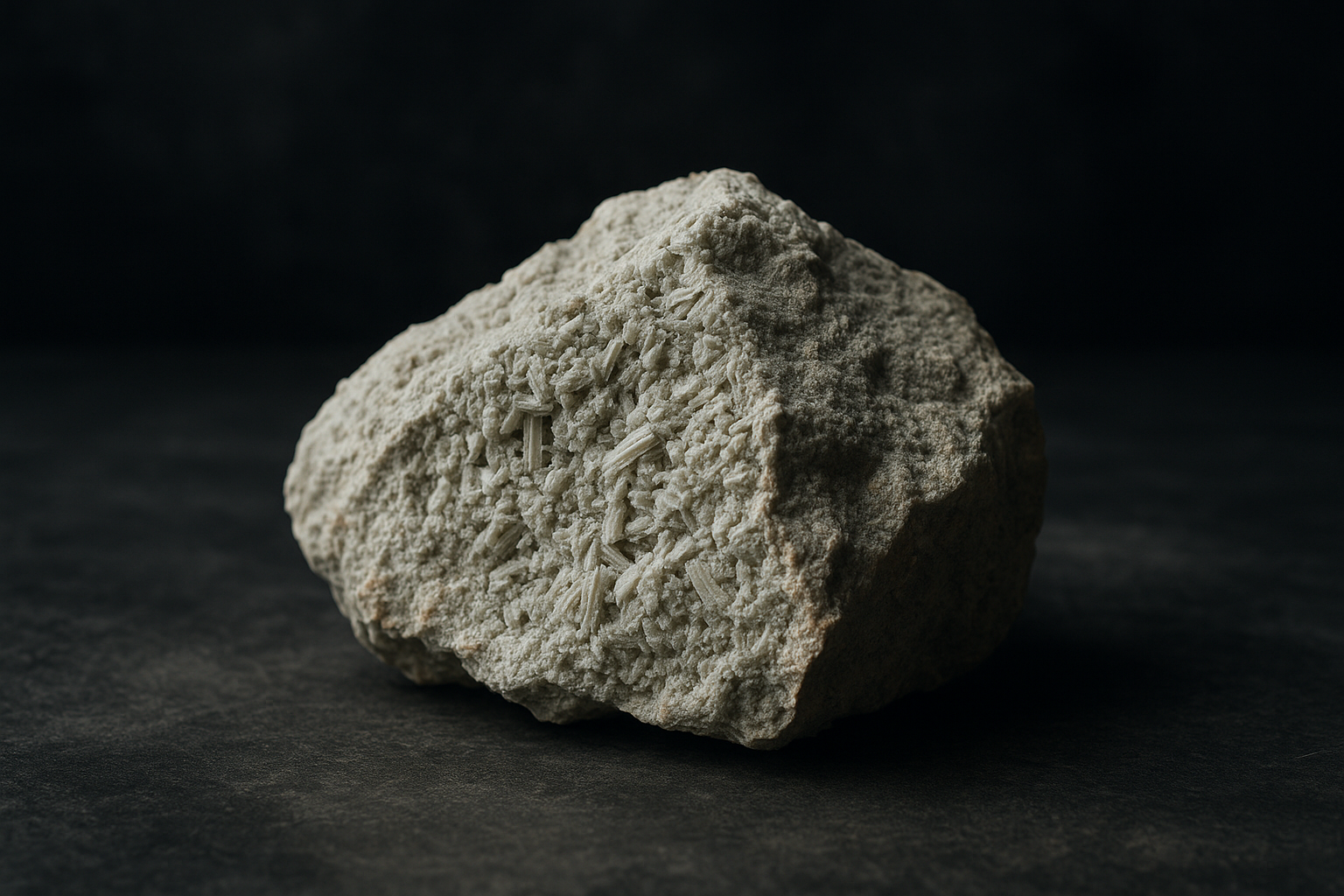
Anti-Condensation Insulation Coating Additive — Porous Clinoptilolite Moisture-Buffering and Insulating Inorganic Filler
Condensation occurs when the air near a cold wall or ceiling surface cools below the dew point and water vapor condenses. Anti-condensation insulation paints and ceramic coatings are finishing materials that raise surface temperature and ease the humidity near the surface to delay reaching the dew point; adding a porous inorganic filler here can provide both moisture-buffering and insulation functions at once. The natural clinoptilolite supplied by KMIZEOLITE is mined at the Amargosa Valley deposit in Nevada, USA, and is a high-purity porous mineral with a clinoptilolite content of about 97.0%.
Zeolite is not a waterproofing membrane that physically blocks condensation. It is more accurate to view it as a functional filler that buffers local humidity fluctuations near the surface through a reversible moisture sorption (humidity buffering) behavior — taking in water vapor into its micropores by physical adsorption when relative humidity is high, then releasing it again when humidity falls. This moisture buffering is physical adsorption of water vapor molecules, and its mechanism differs from cation exchange or ion adsorption.
Key Properties Governing Moisture Buffering and Insulation
What matters as an anti-condensation film filler is the pore structure, surface area, and porosity rather than the chemical composition. The representative properties of KMIZEOLITE clinoptilolite are as follows.
| Property | Value | Meaning in Anti-Condensation/Insulation Films |
|---|---|---|
| Pore diameter | 4.0–7.0 Å | Micropores in the water-vapor molecular size range — key to moisture-buffering reversibility |
| Surface area | 40.0 m²/g | Secures effective surface where water-vapor adsorption occurs |
| Specific gravity | 1.89 | Lightweight porous filler — minimizes increase in film density |
| Bulk density | 720–865 kg/m³ | Porous structure secures an air layer within particles — supports insulation |
| Cation exchange capacity (CEC) | 1.6–2.0 meq/g | Indicator of hydrophilicity and surface activity (moisture-buffering function is a physical-adsorption contribution) |
| pH stability range | 3.0–10.0 | Compatible with a wide range of paint matrices such as waterborne and inorganic binders |
| Hardness | 4.0–5.0 Mohs | Eases grinding and ultra-fine classification processes |
The table values are based on KMI published technical data, and actual film performance is determined by the combination of binder type, dosage, film thickness, and ventilation conditions, so it must be confirmed by formulation-level testing.
Condensation Mitigation Mechanism — Moisture-Sorption Buffering
Condensation mitigation in a zeolite-filled film is explained through two pathways. First, the porous structure shows lower thermal conduction than a solid filler, helping keep the film surface temperature close to the indoor air temperature, which lengthens the time the surface stays above the dew point. Second, when humidity near the surface temporarily rises, the micropores adsorb water vapor and work to shave off the peak of local relative humidity (buffering).
Studies that treat zeolite as the active component of moisture-buffering, humidity-control building materials report that porous aluminosilicate can, through reversible behavior that repeats adsorption and desorption, buffer indoor humidity fluctuations and consequently help reduce heating and cooling loads (Serhiienko et al., Energy and Buildings, 2023; International Journal of Heat and Technology, 2016). However, most of these studies deal with board, plaster, or composite-panel forms, and one must assume that the moisture-buffering capacity in a thin film of a few mm or less is limited compared with board types, given the small volume.
Why Porous Zeolite for Anti-Condensation and Insulation Films
Condensation is the starting point of mold, lifting, film delamination, and degraded insulation performance. A simple waterproofing film blocks moisture but does not itself mitigate surface condensation, while a moisture-absorbing finish must re-release moisture well so as not to foster mold. Zeolite's strength is that its adsorption and desorption repeat reversibly, enabling a self-regenerating behavior that gives moisture back when humidity falls at night or during ventilation.
Also, being an inorganic mineral, it has non-combustible and heat-resistant characteristics, making it more favorable than organic fillers in terms of fire safety; porous fillers of the same family are also considered as fillers for insulating and fireproof boards (see our internal Fireproof Board & Thermal Insulation Filler). As a natural mineral filler, in general construction uses without animal or food contact, the GRAS classification (21 CFR 182.2729) is generally referenced; note that this is a general classification of the raw mineral, not a guarantee of regulatory compliance of the paint filler itself.
Moisture-Sorption and Insulation Behavior in Research
Experimental studies on the moisture-transport and moisture-sorption dynamics of zeolite-based humidity-control composites quantitatively tracked the behavior in which moisture diffusion into the porous structure and surface adsorption/desorption repeat, and the material buffers the surrounding humidity as it follows it (Applied Thermal Engineering, 2017; Alexandria Engineering Journal, 2023). These studies commonly point out that moisture-buffering performance depends greatly on the material's pore structure and surface area and on the outdoor humidity cycle.
Reviews organizing the building application of zeolite from the perspective of indoor air quality and humidity report that zeolite can incidentally provide volatile organic compound (VOC) and odor adsorption functions along with humidity buffering (Sahin et al., Building and Environment, 2020; Cataldo et al., Materials, 2024). From the general perspective of adsorption, it is broadly established that the porous structure of clinoptilolite provides an effective surface for molecular adsorption including water vapor (Chemical Reviews, 2022).
In summary, the strength of a zeolite-filled anti-condensation film is not a single insulation figure but the combined functions of moisture-sorption buffering + supplementary insulation + inorganic non-combustibility + incidental deodorization. As the studies above emphasize, quantitative values such as absolute moisture uptake and thermal conductivity depend greatly on material shape and formulation, so a paint manufacturer should measure and finalize them directly within its own binder matrix.
Recommended Product Specifications
| Product Name | Mesh | Particle Size | Suitability for Film Application |
|---|---|---|---|
| KMI 100- US MESH (Powder) | 100 mesh or finer | <150μm, median 50μm | Standard fine powder for thicker insulation films and spray formulations |
| KMI ultra-fine (200–325 mesh grade) | 200–325 mesh grade | Ultra-fine powder | For thin-film finishes — prioritizes surface smoothness and dispersibility |
The thinner the film, the more directly the filler particle size affects surface roughness and film defects, so it is reasonable to use the ultra-fine grade for finish coats and to baseline trial coating with the 100 mesh grade for thick spray and ceramic insulation films. The exact grade requires consultation to match the required film thickness and binder.
Application Points You Can Expect
- Review of delaying and reducing condensation through moisture buffering near the surface
- Supplementary film insulation through the porous air layer within particles
- Securing fire safety as an inorganic non-combustible filler
- Mitigating a mold-favorable environment through reversible desorption after adsorption
- Review of the possibility of an incidental VOC and odor adsorption function in parallel
Formulation and Process Considerations
- Porous powders with large surface area can increase binder and water demand, so dispersant and thickener design is needed.
- Raising the dosage increases moisture uptake but changes adhesion, crack resistance, and film viscosity, so the balance point must be set through trial formulations.
- Because films are thin, their absolute moisture-uptake capacity is limited compared with board types, and this must be reflected in performance expectations.
- To ensure smooth desorption after adsorption, it must be reviewed together with ventilation and air-flow design to lower mold risk.
- The root causes of condensation (insulation deficiencies, lack of ventilation) cannot be solved by the film alone, so it must be carried out in parallel with insulation and ventilation design.
A Correct Understanding of Anion Adsorption
The moisture-buffering function of this film is physical adsorption of water vapor molecules, not ion adsorption. Meanwhile, some users also expect the film to adsorb anionic contaminants (fluoride, phosphate, boron, nitrate, etc.), but unmodified clinoptilolite has a framework that carries a negative charge, so its anion adsorption is inherently weak. It has high exchange capacity for cations (ammonium, heavy metals), but to capture anions/oxyanions, metal (Ca, La, Fe, Al) loading or surfactant modification (SMZ) is effectively a prerequisite. An anti-condensation moisture-buffering film is a use separate from such anion adsorption, so the two functions must not be confused, nor should anion adsorption be explained by cation-exchange logic.
Application Examples
Anti-Condensation Functional Paints
Mixed in as a moisture-buffering filler in finishing paints for condensation-prone areas such as bathrooms, basements, and around windows to review delaying surface condensation.
Ceramic and Thin-Film Insulation Coatings
Added as a porous inorganic filler to insulation films combined with hollow fillers (glass bubbles, etc.) to provide both a moisture-buffering function and supplementary insulation.
Spray-Type Moisture-Buffering Finishes
In spray formulations that secure thickness, the 100 mesh grade fine powder is used to increase moisture-uptake capacity while also leveraging inorganic non-combustibility.
Frequently Asked Questions (FAQ)
When zeolite is added to an anti-condensation insulation film, by what mechanism does it reduce condensation?
Clinoptilolite is a porous aluminosilicate with micropores of 4.0-7.0Å and a surface area of about 40 m²/g. When relative humidity is high, it takes in water vapor around the film surface by physical adsorption, then releases it again when humidity falls — a reversible moisture sorption (buffering) behavior. Because it works to ease local humidity near the surface and delay reaching the dew point, it should be understood not as a waterproofing membrane that fundamentally blocks condensation, but as a functional filler that delays and reduces surface condensation. Since the magnitude of the effect varies with film thickness, dosage, and ventilation conditions, it must be confirmed with trial coating.
How is the insulation effect provided, and can it replace ordinary insulation?
The porous air layer formed inside and between zeolite particles works to lower thermal conduction compared with solid fillers, so it is considered as a supplementary insulating filler in thin-film and ceramic insulation coatings. However, since films are generally a few mm thick or less, rather than replacing insulation (EPS, mineral wool, etc.), a realistic use is as a finishing or supplementary insulation that also provides surface temperature homogenization and a moisture-buffering function. Because quantitative thermal conductivity depends on the combination with the binder and hollow fillers (glass bubbles, etc.), it must be measured at the formulation level.
As an anti-condensation film filler, how do you set the particle size and dosage?
For thin-film coating, considering film thickness and surface smoothness, use fine powder of 100 mesh or finer (<150μm, median about 50μm); for thinner finishes, considering 200-325 mesh ultra-fine powder is advantageous. Dosage is a matter of balance between moisture-buffering performance and film properties (adhesion, crack resistance, viscosity), and is generally determined by stepping it up gradually in trial formulations. Since high powder surface area can increase binder and water demand, it must be reviewed together with dispersant and thickener design.
Can adsorption of anionic contaminants (fluoride, phosphate, etc.) also be expected?
It is difficult to expect. Because the framework of unmodified clinoptilolite carries a negative charge, it is strong at exchanging cations (ammonium, heavy metals, etc.) but its affinity for anions/oxyanions such as fluoride, phosphate, and boron is inherently weak. If anion adsorption function is needed, metal (Ca, La, Fe, Al) loading or surfactant modification (SMZ) is effectively a prerequisite, and this is a modification process separate from the basic function of an anti-condensation moisture-buffering film (moisture sorption). The moisture-buffering function on this page is physical adsorption of water vapor, not ion adsorption.
Related Pages
- Zeolite for Humidity-Control Gypsum Board — board-type moisture-buffering material
- Zeolite for Construction Moisture-Proof Materials — comparison of moisture-proof and moisture-buffering materials
- Paint & Coating Additive — functional fillers for paints in general
- Fireproof Board & Thermal Insulation Filler — inorganic porous insulation filler
- Construction & Industrial Materials Applications — view the entire category
Notice
The results of applying an anti-condensation insulation film may vary depending on the raw material's porosity and particle size, dosage, binder matrix, film thickness, surface conditions, ventilation and insulation design, and required performance standards. Before actual application, please confirm suitability through trial coating in your own formulation and verification of moisture-sorption, adhesion, and insulation properties. The property data on this page is based on KMI published technical data; please check the latest TDS at the time of actual delivery.
[Inquire about zeolite particle size, ultra-fine specifications, and bulk supply for anti-condensation insulation films →]
science Related Papers
Academic papers covering zeolite's moisture-sorption, humidity-control, and insulation applications in this field. Refer to them when reviewing adoption.
- Natural zeolite for humidity control and energy saving in buildings
Serhiienko, A. et al. — Energy and Buildings, 2023 - Hygrothermal Performance of Zeolite-Based Humidity Control Building Materials
International Journal of Heat and Technology, 2016 - Experimental Study on Moisture Migration of Zeolite-based Composite Humidity Control Material
Applied Thermal Engineering, 2017 - Temperature-humidity controlling performance of zeolite-based composite for building
Alexandria Engineering Journal, 2023 - Zeolite for indoor air quality: A review of environmental applications
Sahin, O. et al. — Building and Environment, 2020
The papers above are reference material, and actual application requires separate review suited to site conditions.