Zeolite for New-House Odor Control
Natural clinoptilolite physically adsorbs formaldehyde (molecular diameter ~4.5 Å) and small VOCs through its 4.0–7.0 Å micropores, while its negatively charged framework with CEC 1.6–2.0 meq/g captures ammonium (NH₄⁺) by ion exchange — making it a natural mineral studied as a supplementary deodorizing layer for ventilation blind spots that does not replace ventilation or bake-out. We have organized particle-size selection, dosage, and regeneration cycles with quantitative criteria and 6 academic references.
Why new-house odor concentrates in the early move-in period
The distinctive "new-house smell" of new apartments and newly built houses is not a single substance but a complex gas mixture of volatile organic compounds (VOCs) and formaldehyde (HCHO) released from finishing materials, adhesives, and paints. Urea-formaldehyde (UF) resins used in plywood, MDF, particleboard, and wallpaper adhesives emit formaldehyde, while paints, varnishes, sealants, and floor adhesives slowly off-gas VOCs such as toluene, xylene, and acetaldehyde over months to as long as several years. When the smell of ammonia (NH₃) and sulfur compounds from pet waste and feed is added, the perceived odor rises sharply in a sealed interior.
Emission accelerates as temperature and humidity rise and as ventilation falls short. Formaldehyde emission from UF resins shows a strong temperature dependence, empirically roughly doubling for every 7–8°C rise, and higher relative humidity increases emission further through hydrolysis. That is why new-house odor concentrates right after move-in, in summer and during the heating season. For the same reason, airtight homes with low ventilation rates (an air change rate, ACH, of 0.5 or below) develop higher indoor steady-state concentrations.
The first priority in response is always dilution (ventilation) and exhaust after promoting emission (bake-out). However, ventilation barely reaches blind spots with almost no air exchange, such as the inside of built-in closets, shoe cabinets, drawers, and new furniture. Natural zeolite is studied as a supplementary fixed adsorption layer that traps residual gases at the surface in such stagnant zones. In other words, zeolite is not a substitute for ventilation but a complement that fills the time and space where ventilation is lacking.
Why zeolite is studied for new-house odor control
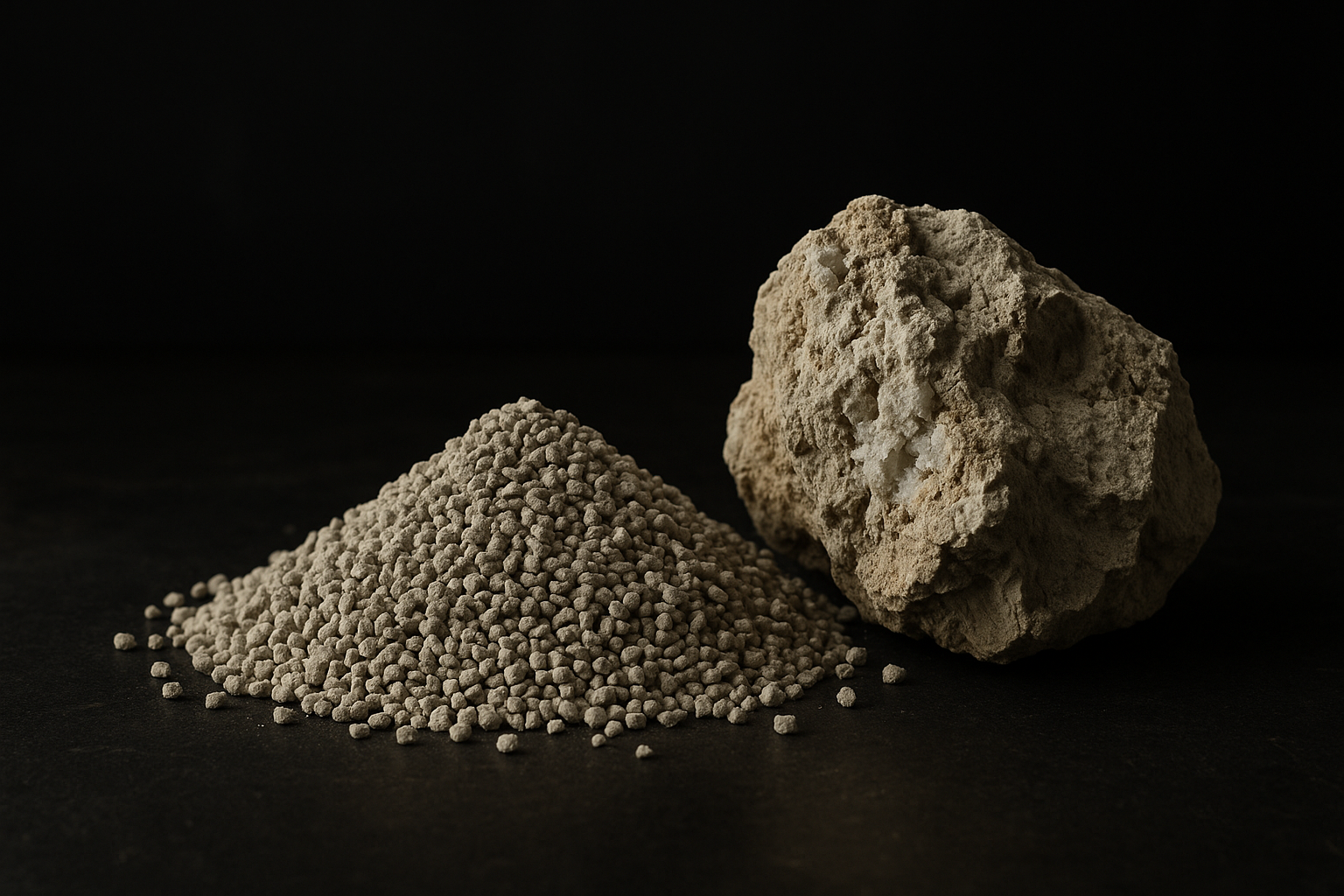
Natural clinoptilolite (HEU-type framework) develops intersecting channels inside the crystal, forming uniform micropores with an effective pore diameter of 4.0–7.0 Å. In new-house odor control, the mechanism at work is not one but three operating in parallel.
- ① Molecular sieving / physical adsorption (VOCs and formaldehyde): With a molecular diameter of about 4.5 Å, formaldehyde lies in the range overlapping the pore mouth, so it enters the channels and is captured by weak van der Waals forces. Larger VOCs such as toluene (~6.8 Å) and xylene are adsorbed mainly on the external surface and mesopores — which is why a particle's external surface area and shape govern actual throughput.
- ② Ion exchange (ammonium): The negatively charged framework arising from Al substituting for Si holds exchangeable cations (Na⁺, K⁺, Ca²⁺), and at these sites it selectively attracts cationic ammonium (NH₄⁺) in the range of CEC 1.6–2.0 meq/g. Clinoptilolite has high selectivity for NH₄⁺, making it especially effective at controlling ammonia odor in pet-waste areas.
- ③ Moisture buffering (indirect effect): The hydrophilic framework adsorbs and desorbs moisture, buffering local humidity. As humidity drops, there is an indirect effect of reducing both hydrolysis-driven formaldehyde emission from UF resins and the development of moldy odors.
Unlike activated carbon, which adsorbs mainly hydrophobic organics, zeolite can handle polar gases and ammoniacal cations at the same time — and that is the core reason it is studied in environments where formaldehyde, VOCs, and ammonia are mixed together, as in new-house odor. That said, its total adsorption capacity per unit mass is smaller than that of high-surface-area activated carbon, so it is more accurate to position zeolite not as a "high-capacity standalone purifier" but as a "supplementary layer that broadly buffers complex gases."
A review by Sahin et al. (Building and Environment, 2020) examining indoor air applications concluded that natural zeolite is promising for indoor air quality management as a low-energy, regenerable material that simultaneously controls VOCs and moisture (Sahin et al., 2020, Building and Environment). In an adsorption experiment specialized for formaldehyde, Kalantarifard et al. (2016) reported that clinoptilolite significantly lowered formaldehyde concentration in a closed environment and is applicable as an adsorbent (Kalantarifard et al., 2016, TAO). Mobasser et al. (IECR, 2022), which directly compared activated carbon, zeolite, and organosilica, showed that the zeolite family is a competitive option for removing certain VOCs while also demonstrating that performance superiority varies by target substance across adsorbents (Mobasser et al., 2022, IECR). In the odor field, Cataldo et al. (Materials, 2024) organized the odor-molecule adsorption behavior of zeolites including natural clinoptilolite, and Cataldo et al. (Materials, 2021) summarized applications that reduce odorous and toxic compounds through natural zeolite treatment (Cataldo et al., 2024; Cataldo et al., 2021).
KMIZEOLITE's natural clinoptilolite is 97% pure, mined and processed at the Amargosa Valley mine in Nevada, USA, with a surface area of 40.0 m²/g, a pH stability range of 3.0–10.0, and thermal stability of 700°C. Being a natural mineral with no chemical additives, it is suitable for placement in interiors where pets and infants live. For animal feed intake, FDA GRAS (21 CFR 582.2729) applies, and for other general uses 21 CFR 182.2729 applies; thanks to thermal stability up to 700°C, it can be considered for repeated use by regenerating it through sun-drying or heating after adsorption saturation.
KMIZEOLITE key properties
| Item | Value |
|---|---|
| Clinoptilolite purity | 97% |
| Cation exchange capacity (CEC) | 1.6–2.0 meq/g |
| Surface area | 40.0 m²/g |
| Pore diameter | 4.0–7.0 Å |
| pH stability range | 3.0–10.0 |
| Hardness | 4.0–5.0 Mohs |
| Thermal stability | 700°C |
| Specific gravity | 1.89 |
| Bulk density | 45–54 lbs/ft³ |
| Certifications | OMRI KMI-10365, FDA GRAS, TSCA, EN-71-3 |
Application examples of zeolite for new-house odor control
Below are the representative ways zeolite is used to manage new-house odor in new and remodeled residential spaces. Adjust the dosage to space volume, ventilation conditions, and odor intensity, but consider the reference values below as a starting point.
- Distributed deodorizing pouches: Place granular zeolite in breathable cotton pouches in ventilation blind spots such as built-in closets, shoe cabinets, and drawers. The starting reference is to distribute 5–10 kg per 10 pyeong (about 33㎡) split across several pouches. Rather than concentrating it in one place, splitting it into 0.3–1 kg portions at each point where gas stagnates gives greater contact area and perceptible effect.
- Localized placement inside furniture: In sealed interiors with high formaldehyde emission — new furniture, plywood cabinets, the underside of mattresses, and so on — place small pouches (0.5–1 kg) in each compartment to lower the local concentration. The closer to the emission source, the more each unit of adsorbent captures.
- Parallel management of pet areas: Place separate pouches around litter pads and toilets to also adsorb ammonia (NH₄⁺) odor by ion exchange. Cat-litter and ammonia deodorizing applications share the same mechanism as those covered in Applied Clay Science (2019) and Cataldo et al. (2021).
- Supplementary layer for air purifiers and filters: Pack granular zeolite into a ventilated cartridge to use it as a supplementary adsorption layer before or after the activated-carbon filter. Placing activated carbon (hydrophobic VOCs) and zeolite (polar gases, ammonia, moisture) in series broadens the target range.
- Parallel bake-out cycles: Raise the indoor temperature with heating to promote emission (bake-out), then ventilate sufficiently, and place zeolite in the stagnant intervals between ventilations to trap the residual gases that are re-emitted. Adsorbent alone should not be relied on to replace bake-out.
Recommended particle size and product specifications
For new-house odor control, granules with little dust and good airflow — such as Coarse Granule (8×14 mesh) or Medium Granule (14×40 mesh) — are suitable for deodorizing pouches. Powder (100 mesh) has a large surface area but tends to scatter, so consider it only for sealed cartridge and filter packing. Refer to the table below to choose the product group that fits your use.
| Product group | Mesh | Particle size | Typical use |
|---|---|---|---|
| Powder | 100 mesh or finer | <150μm | Pozzolan, feed, powder adsorption |
| Fine Granule | 30×50 mesh | 0.3–0.6mm | Water treatment, filtration, soil |
| Medium Granule | 14×40 mesh | 0.4–1.4mm | Filter beds, bedding, flooring |
| Coarse Granule | 8×14 mesh | 1.4–2.4mm | Pools, de-icing, large-scale filtration |
| Extra Coarse | 4×8 mesh | 2.4–4.8mm | Packed beds, air scrubbers |
→ View products by mesh size · Application-based product selection guide
On-site review points (specific to new-house odor)
When applying zeolite for new-house odor control in residential spaces, check the following items as well.
- Space volume and ventilation priority: First grasp the floor area (volume) and the air change rate (ACH). Since zeolite is only an adsorption aid and does not replace ventilation, make clear that bake-out, natural ventilation, and mechanical ventilation are the first priority, and the adsorption layer is the second priority that fills their blind spots.
- Identify the main causative components: Where new furniture and plywood dominate, formaldehyde and VOCs prevail; where pets cohabit, the share of ammonia (NH₄⁺) is large. Because formaldehyde is captured by physical adsorption and ammonia by ion exchange — different mechanisms — adjust placement location (inside furniture vs. waste areas) and particle size to the cause.
- Placement location (stagnant zones first): Prioritize blind spots where gas stagnates and ventilation does not reach, such as built-in closets, shoe cabinets, drawers, and the underside of furniture. The shorter the distance to the emission source, the higher the efficiency per unit of adsorbent.
- Replacement and regeneration cycle: During the early move-in emission peak, inspect and replace pouches every 1–2 months, and in the stable phase as emission subsides, replace or regenerate every 3–6 months. As moisture uptake progresses, gas-adsorption sites decline, so a damp pouch is a sign to replace.
- Reactivation (regeneration): At adsorption saturation, you can consider reuse by driving off adsorbed moisture and some volatile gases through direct-sunlight drying or low-temperature heating (thermal stability 700°C). However, effective capacity gradually decreases as the number of regeneration cycles grows, so treat it as a supplementary means rather than infinitely repeatable.
- Safety and certifications: A natural mineral with no chemical additives, it holds EN-71-3 (toy safety) PASS and California Prop 65 compliance certifications. Animal feed intake is covered by FDA GRAS (21 CFR 582.2729) and other general uses by 21 CFR 182.2729, making it suitable for placement in interiors with infants and pets.
→ View TDS (Technical Data Sheet) · View MSDS (Material Safety Data Sheet)
New-house odor control FAQ
Does zeolite also capture formaldehyde from new-house syndrome?
Zeolite physically adsorbs formaldehyde (molecular diameter about 4.5 Å) and small VOCs through its 4.0–7.0 Å micropores. Kalantarifard et al. (2016) reported that clinoptilolite significantly lowered formaldehyde concentration in a closed environment. That said, its adsorption capacity per unit mass is limited, so it is appropriate to consider it not as a replacement for ventilation and bake-out but as a supplementary means of managing residual gases in ventilation blind spots.
Which is better, activated carbon or zeolite?
The two target different substances. Activated carbon has a large surface area and excels at adsorbing large amounts of hydrophobic VOCs such as toluene and xylene, but it is weak against ammonia and moisture. Zeolite has a smaller total adsorption capacity but handles polar gases, cationic ammonia (NH₄⁺, CEC 1.6–2.0 meq/g), and moisture together, and can be regenerated up to 700°C. Mobasser et al. (2022), which compared activated carbon, zeolite, and organosilica, also reported that superiority varies by target substance. Therefore a design that runs the two in series to broaden the target range is realistic.
What particle size is best for new-house odor control?
For deodorizing pouches we recommend Coarse Granule (8×14 mesh) or Medium Granule (14×40 mesh), which generate little dust and offer good airflow. Powder (100 mesh) has a large surface area but tends to scatter, so it is limited to sealed cartridge and filter packing. Please refer to the application-based product selection guide.
How much should I place per unit of floor area?
As a starting point, consider distributing 5–10 kg per 10 pyeong (about 33㎡) across built-in closets, shoe cabinets, the inside of new furniture, and similar spots. Rather than concentrating it in one place, splitting it into 0.3–1 kg portions at each point where gas stagnates is more effective. When emission is high in the early move-in period, increase the amount or check it every 1–2 months, and it is advisable to adjust the exact usage to the space volume and odor intensity.
Can saturated zeolite be reused?
Natural clinoptilolite has thermal stability up to 700°C, so after adsorption saturation you can consider regenerating it by direct-sunlight drying or low-temperature heating to drive off moisture and some adsorbed gases. However, adsorption performance gradually declines as the number of regeneration cycles increases, so in the stable phase also consider replacement every 3–6 months.
Inquiries and sample requests
If you are considering applying zeolite in the field of new-house odor control, please reach out through the channels below.
Notice
Applicability may vary depending on site conditions, regulations, and test results. Before actual application, a test review tailored to the site conditions must always be carried out first. Zeolite should be understood not as a cure-all for the field but as a material that supplements existing processes.
Related pages
science Related Papers
Academic papers covering zeolite applications in this field. Please refer to them when reviewing adoption.
- Formaldehyde Adsorption into Clinoptilolite Zeolite
Kalantarifard, A. et al. — Terrestrial, Atmospheric and Oceanic Sciences, 2016 - Zeolite for indoor air quality: A review of environmental applications
Sahin, O. et al. — Building and Environment, 2020 - Indoor Air Purification of VOCs Using Activated Carbon, Zeolite, and Organosilica
Mobasser S. et al. — Industrial & Engineering Chemistry Research, 2022 - Odors Adsorption in Zeolites Including Natural Clinoptilolite
Cataldo, E. et al. — Materials, 2024 - Evaluation of Natural Zeolite Treatments for Eliminating Odors and Toxic Compounds
Cataldo, E. et al. — Materials, 2021 - Use of zeolites for cat litter: Ammonia adsorption and odor control
Various — Applied Clay Science, 2019
The papers above are reference materials; actual application requires a separate review tailored to site conditions.