Zeolite for Houseplant Soil Aid
Mixing just 10–15% by volume of natural clinoptilolite with CEC 1.6–2.0 meq/g and 97% purity into potting soil captures ammonium (NH₄⁺) and potassium (K⁺) (nitrate leaching reduced by up to 70% in research cases) while maintaining aeration pores from particles that do not collapse — this is the key differentiator of the mineral. As a "reinforcing material" that does not replace the soil, we have organized, with quantitative evidence, how to set particle size and blend ratio to reduce overwatering, root suffocation and nutrient loss.
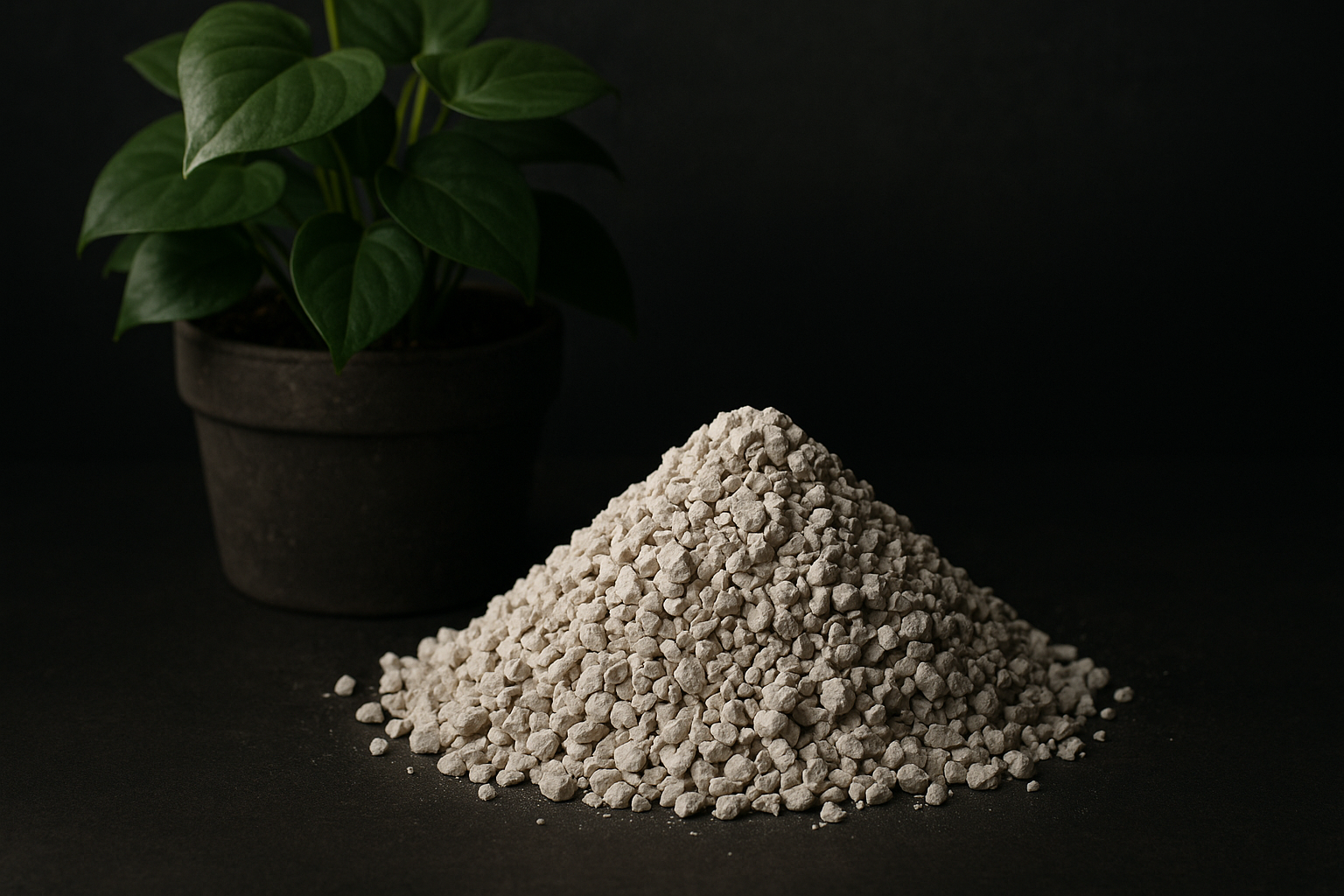
Why indoor pot soil keeps degrading
When growing foliage plants, succulents and herbs indoors, the most common cause of failure is root suffocation (root rot) from overwatering and nutrient loss in which nutrients are washed out together every time you water. Commercial potting soils have a high proportion of peat moss and coco peat, so over time the organic particles break down into fine pieces (decomposition and compaction), the pores become blocked and water pools, or conversely, once dry the soil repels water (water-repellency / hydrophobicity). Unlike natural soil, a pot is a closed container with no bottom through which water can drain by capillary rise, so a perched water table always forms above the drainage hole. In environments where evaporation is slow, such as balconies and indoors, this perched water table persists longer, oxygen becomes scarce, and under anaerobic conditions the root hairs are the first to be damaged.
On the fertilizer side, too, a pot has a structure in which water is given frequently to a limited amount of soil, so nitrogen given as liquid fertilizer (nitrate-N NO₃⁻ and ammonium-N NH₄⁺) and potassium (K⁺) tend to drain out through the drainage hole before being absorbed by the roots. In particular, nitrate (NO₃⁻) is an anion and is barely held by the negative charges on organic matter surfaces, so a significant amount leaches out with a single watering. In the end, leaves turn yellow (chlorophyll deficiency), white salts accumulate on the soil surface, and the user repeatedly faces the situation of "I gave both water and fertilizer, so why isn't it growing?" In other words, the two enemies of pot soil are physical aeration (porosity) and chemical nutrient retention (nutrient-holding capacity), and commercial potting soil loses both as time goes on.
Why zeolite is considered as a potting soil aid
The reason natural clinoptilolite addresses both of the above problems at once is that its working mechanism spans both physical and chemical aspects.
- Cation exchange (ion exchange): The framework carries a negative charge from aluminum substitution, and the exchangeable cations (Ca²⁺·K⁺·Na⁺) that offset that negative charge are loosely held within the pores. When NH₄⁺ and K⁺ from the soil solution enter, they swap places (exchange) with these and are captured, then released again when the roots absorb nutrients and the concentration drops. This "capture-and-release" buffering occurs within the exchange capacity of CEC 1.6–2.0 meq/g (= on the order of 160–200 cmol/kg), raising the nutrient-holding capacity above that of plain peat-moss soil alone. However, anions such as NO₃⁻ are repelled by the negatively charged framework and cannot be directly captured. The reason nitrate leaching is reduced in pots is that NH₄⁺ is captured and buffered before it proceeds to nitrification and leaching, not because the nitrate ion itself is adsorbed.
- Porous water retention and aeration: Crystal channels with a pore diameter of 4.0–7.0 Å combine with the pores between particles to form a specific surface area of 40.0 m²/g and a pore volume of about 50%. The water held inside and outside the particles is released slowly as the soil dries, extending the watering interval, while the granules do not collapse and thus preserve the macropores (aeration pores), reducing the perched water table.
- Structural stability: As a hard mineral with a hardness of 4.0–5.0 Mohs and specific gravity of 1.89, it does not decompose or compact like organic matter. Once mixed in, the pore structure is largely maintained throughout the repotting cycle (2–3 years).
KMIZEOLITE's natural clinoptilolite has 97% purity and is mined and processed at the Amargosa Valley mine in Nevada, USA. With a pH stability range of 3.0–10.0, it does not abruptly shift the soil pH wherever it is mixed, from acidic to neutral potting soils. It is a natural mineral free of chemical additives, and holds OMRI Listed (KMI-10365), FDA GRAS (general use 21 CFR 182.2729) and EN-71-3 PASS, so it can be considered without concern for pots in indoor spaces and spaces with pets or children.
Research evidence has also accumulated. McConnell et al. reported that mixing zeolite into the substrate of container (pot) grown plants improved nutrient (especially K and NH₄-N) retention and growth (McConnell D.B. et al., HortTechnology, 2001, full text), and it has also been confirmed that adding clinoptilolite to the substrate reduces nitrate leaching and improves plant growth, with nitrogen runoff reduced to the level of tens of percent in some cases (Journal of Hazardous Materials, 2011, full text). He et al. showed that in calcareous sandy soil, clinoptilolite suppresses ammonia volatilization (NH₃ volatilization), reducing the loss of nitrogen in NH₄⁺ form into the air (He, Z.L. et al., Plant and Soil, 2002, DOI). A review synthesizing the soil-level water and nutrient retention effects also positions zeolite as a soil amendment that improves water retention and nutrient use efficiency (NUE) (Ramesh, K. & Reddy, D.D., Water, Air, & Soil Pollution, 2017, DOI).
KMIZEOLITE Key Properties
| Item | Value |
|---|---|
| Clinoptilolite purity | 97% |
| Cation Exchange Capacity (CEC) | 1.6–2.0 meq/g |
| Specific surface area | 40.0 m²/g |
| Pore diameter | 4.0–7.0 Å |
| pH stability range | 3.0–10.0 |
| Hardness | 4.0–5.0 Mohs |
| Thermal stability | 700°C |
| Specific gravity | 1.89 |
| Bulk density | 45–54 lbs/ft³ |
| Certifications | OMRI KMI-10365, FDA GRAS, TSCA, EN-71-3 |
Pot & potting soil blending application examples
Below are representative blending scenarios in which zeolite is considered for indoor pot soil. All are methods of "partially replacing or reinforcing the soil" and do not replace the soil on their own. Note that the volume ratio and particle size differ.
- Direct potting soil mixing: The most basic method, evenly mixing in 10–15% by volume into general repotting or potting soil to reinforce water retention and nutrient-holding capacity. Using 30×50 mesh granules as the main component with a small amount of 100 mesh powder captures both aeration and nutrient retention.
- Partial perlite replacement: A method of replacing 1/3–1/2 of the perlite used as an aeration material with 30×50 mesh granules, compensating for the drawbacks of perlite, which is light and floats up and crumbles (suitable for succulents and foliage plants). With a specific gravity of 1.89, zeolite does not float up even when watered.
- Pot bottom drainage layer: A method of laying 1–2cm of coarse 8×14 mesh (1.4–2.4mm) granules at the bottom of the pot to prevent drainage-hole clogging and lower the perched water table. Considered as a substitute for decomposed granite (masato) or hydroballs.
- Powder addition (enhanced nutrient retention): A method of adding 5–10% of 100 mesh (<150μm) powder to leafy vegetable and herb pots to reduce short-term loss of liquid-fertilizer nutrients. Powder has a large specific surface area so NH₄⁺·K⁺ exchange is fast, but since aeration drops when over-added, 10% is regarded as the upper limit.
- Topsoil mulching: A supplementary method of covering the soil surface with a 5–10mm layer of granules to reduce surface drying, mold and the egg-laying environment for small flying insects (fungus gnats). The soil surface stays dry, making it harder for larvae to survive.
As a rule of thumb, in the above scenarios if the volume occupied by zeolite exceeds 20% the soil becomes too heavy and dries too fast, so for general indoor pots it is safest not to deviate from the 10–15% range.
Recommended particle size and product specifications
For indoor pots, Fine Granule (30×50 mesh) is suitable as the aeration and drainage structural material, and Powder (100 mesh) is suitable as a fine-powder additive to increase nutrient and moisture retention. For a coarse drainage layer, use Coarse Granule (8×14 mesh). Refer to the table below to select the product group that matches your purpose.
| Product group | Mesh | Particle size | Typical use |
|---|---|---|---|
| Powder | 100 mesh or finer | <150μm | Pozzolan, feed, powder adsorption |
| Fine Granule | 30×50 mesh | 0.3–0.6mm | Water treatment, filtration, soil |
| Medium Granule | 14×40 mesh | 0.4–1.4mm | Filter media, bedding, litter |
| Coarse Granule | 8×14 mesh | 1.4–2.4mm | Swimming pools, de-icing, large-scale filtration |
| Extra Coarse | 4×8 mesh | 2.4–4.8mm | Packed beds, air scrubbers |
→ View products by mesh size · Product selection guide by application
Review points before repotting
Checking the following items when mixing zeolite into indoor pot soil can reduce failure.
- Identify the plant type: Set the particle size and ratio differently depending on whether drainage is the priority (succulents, cacti, foliage plants) or water and nutrient retention is the priority (leafy vegetables, herbs)
- Set the blend ratio: Use 10–15% of the total potting soil volume as the baseline, but if the soil dries too easily, increase the proportion of 100 mesh powder, and if overwatering is frequent, increase the proportion of 30×50 mesh granules
- Re-adjust watering: After mixing, the soil dries slowly, so do not simply apply the previous watering cycle; extend the interval while observing the dryness of the soil surface
- Fertilizer coordination: Since the CEC holds nutrients, applying liquid fertilizer diluted and frequently rather than concentrated all at once fits well with the nutrient-buffering effect
- Dust and rinsing: When using powder, fine dust can float up onto the soil surface, so rinsing lightly before mixing is recommended
- Safety: As a natural mineral free of chemical additives, with EN-71-3 PASS, California Prop 65 compliance and OMRI Listed status, it can be used even in pots that pets and children touch
→ Check the TDS (Technical Data Sheet) · Check the MSDS (Safety Data Sheet)
Indoor Pot Soil FAQ
How much zeolite should I mix into pot potting soil?
Typically 10–15% of the total potting soil volume is recommended. For plants where drainage matters, such as succulents and foliage plants, replacing part of the perlite with 30×50 mesh (0.3–0.6mm) zeolite is commonly considered, while for leafy vegetable and herb pots where nutrient retention matters, adding 5–10% of 100 mesh powder is common. The exact ratio is best adjusted after a small trial, depending on the plant type and the drainage of the existing soil.
Which particle size (mesh) is suitable for indoor pots?
For physical porosity and aeration as a structural material, Fine Granule (30×50 mesh, 0.3–0.6mm) is suitable, and to increase nutrient and moisture retention capacity, mix in a small amount of Powder (100 mesh, <150μm) as well. Granules do not break down in the soil, which is advantageous for reducing overwatering and root suffocation. Please refer to the product selection guide by application.
How does mixing in zeolite change the watering cycle?
With its pores (4.0–7.0 Å) and specific surface area (40.0 m²/g), zeolite holds moisture and releases it slowly, so the soil dries more slowly and you can extend the watering interval. However, since it is an inorganic mineral its own water-holding capacity is limited, so it is safest to check the dryness of the soil surface before watering, taking into account pot size, indoor humidity and season.
Does it help reduce fertilizer loss when repotting?
Thanks to its cation exchange capacity (CEC 1.6–2.0 meq/g), it is considered a buffering material that captures nutrient cations such as ammonium (NH₄⁺) and potassium (K⁺) by exchange and adsorption, holding them and supplying them slowly to the roots, thereby reducing the loss that washes out together when watering. Research cases have reported nitrogen leaching reduced by up to 70% in potted plants (Journal of Hazardous Materials, 2011), and an ammonia volatilization suppression effect has also been confirmed (He et al., Plant and Soil, 2002). However, nitrate (NO₃⁻) is an anion and does not directly bind to the negatively charged framework, so the effect comes from capturing NH₄⁺ and buffering it before the nitrification and leaching stage. It is a natural mineral and is OMRI Listed (KMI-10365), so it can also be used in organically grown pots.
Can I get a sample for testing?
Yes, KMIZEOLITE supports providing samples for actual blend evaluation. On the sample request page, please leave your application purpose (e.g., mixing into foliage plant potting soil) and desired particle size (30×50 mesh / 100 mesh).
Inquiries and sample requests
If you are considering mixing zeolite into indoor pot or foliage plant potting soil, please contact us through the channels below.
Notice
Whether the application is suitable may vary depending on site conditions, regulations and test results. Before actual application, a test review tailored to the site conditions must always be conducted first. Zeolite should be understood not as a cure-all for the field, but as a material that supports existing processes.
Related pages
science Related Papers
These are academic papers covering zeolite applications in this field. Please refer to them when evaluating adoption.
- Substrate Nutrient Retention and Growth of Container-grown Plants in Zeolite-amended Substrates
McConnell D.B. et al. — HortTechnology, 2001 - Influences of clinoptilolite on nitrate leaching and plant growth
Various — Journal of Hazardous Materials, 2011 - Application of Zeolite for Sustainable Agriculture: Water and Nutrient Retention
Ramesh, K. and Reddy, D.D. — Water, Air, & Soil Pollution, 2017 - Clinoptilolite zeolite reduces ammonia volatilization in calcareous sandy soil
He, Z.L. et al. — Plant and Soil, 2002
The papers above are reference material, and actual application requires a separate review tailored to site conditions.