Zeolite for Potting Mix
Blending CEC 1.6-2.0 meq/g natural clinoptilolite into potting mix at 5-15% by volume forms a nutrient-buffering layer that electrostatically captures NH₄⁺ and K⁺ and returns them to the roots, simultaneously reducing nitrogen leaching and the burden of frequent watering in container plants. Applying Fine Granule (30x50 mesh) as a perlite replacement or companion is the standard position in pot environments.
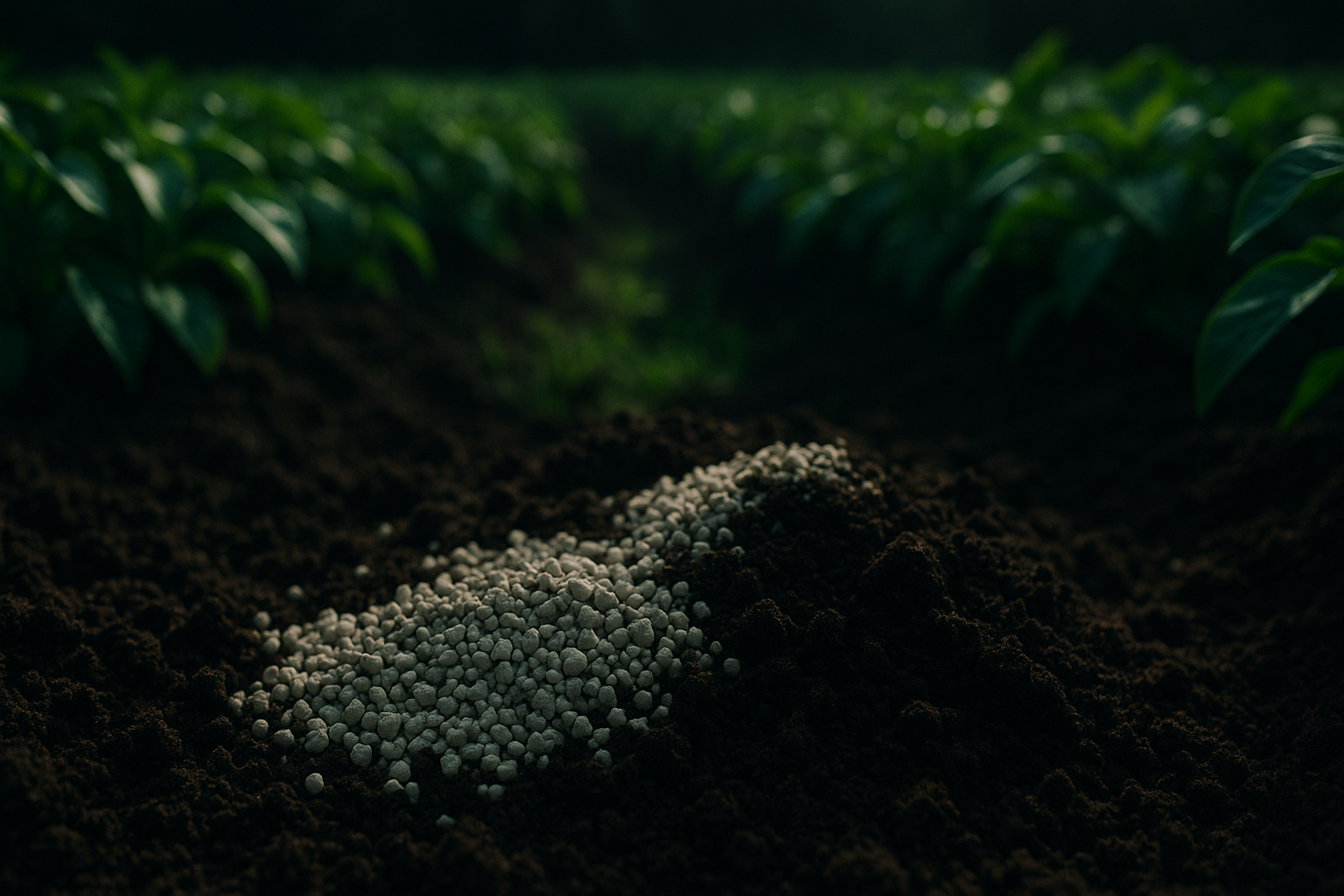
The recurring problem in potting mix: water and fertilizer don't stay in the soil
Unlike open-field growing, container cultivation must resolve roots, moisture, and nutrients all within a limited volume of potting mix. The main components of commercial media—peat moss, coco coir, and perlite—are favorable for aeration and light weight, but their low ability to hold nutrients (cation-exchange capacity) means that nutrients such as nitrogen and potassium drain quickly through the drainage hole every time you water. A plant that grows well right after repotting but then shows leaf-tip dieback or stalled growth within a few weeks, the burden of frequent watering, and fertilizer stains left in the saucer are all connected to this "lack of nutrient and moisture holding capacity."
The smaller the volume of potting mix—as with indoor foliage plants, succulents, potted flowering plants, and seedling raising—the more pronounced this problem becomes. For potting mix, therefore, what is needed is not simply a lightweight aggregate but a buffer material that briefly holds nutrients and moisture and returns them to the roots.
Why clinoptilolite is considered for potting mix
Natural clinoptilolite zeolite is a mineral that combines a regular microporous framework of 4.0-7.0 Å pore size with cation-exchange characteristics (CEC 1.6-2.0 meq/g). In a potting-mix environment, these two properties work as follows. Negatively charged sites within and on the surface of the framework electrostatically hold nutrient cations such as NH₄⁺ (ammonium) and K⁺, then release them again when the roots absorb nutrients and the soil-solution concentration drops—acting as a "store-and-release" buffer. At the same time, the micropores hold capillary water and slow rapid drying after watering. In other words, a single material supplements both nutrient holding (fertility) and water holding.
This buffering is ion exchange occurring at the negatively charged sites determined by the Si/Al ratio (about 4-5) of the clinoptilolite framework. The theoretical cation-exchange capacity of clinoptilolite reaches about 2.2 meq/g per framework, while the effective CEC actually utilized in soil environments appears in the range of 1.6-2.0 meq/g depending on coexisting cations and particle size. What matters is not simple capacity but exchange selectivity. Clinoptilolite has a higher affinity for NH₄⁺ and K⁺ than for Ca²⁺ and Mg²⁺ (typical selectivity Cs⁺ > Rb⁺ > K⁺ > NH₄⁺ > Ba²⁺ > ... > Ca²⁺ > Mg²⁺), so it preferentially captures the ammonium form of nitrogen fertilizer and potassium supplied to the potting mix. As actual measurements have reported K⁺ exchange on the order of 1.9 meq/g, the decisive difference from non-exchanging aggregates such as perlite and sand is that it targets and retains the NH₄⁺ and K⁺ that leach most easily from pots.
The operating principle is equally clear on the water-retention side. Clinoptilolite holds water close to its own weight through its micropores and inter-particle voids and releases it slowly as the soil dries, widening the available-water range of the potting mix and delaying the rapid arrival of the wilting point after watering. As a result, in potting mix, zeolite delivers three effects with one material: (1) reduced leaching loss of nitrogen and potassium, (2) extended watering intervals due to expanded available water, and (3) mitigation of sudden swings in nutrient concentration.
KMIZEOLITE's natural clinoptilolite is 97% pure and is mined and processed at the Amargosa Valley mine in Nevada, USA. With a specific surface area of 40.0 m²/g, pore diameter of 4.0-7.0 Å, pH stability range of 3.0-10.0, and hardness of 4.0-5.0 Mohs, it maintains its shape without crumbling or dissolving even under the frequent watering of pots and weakly acidic to neutral medium conditions. If perlite is an aggregate focused on physical aeration and drainage, the difference is that zeolite adds a chemical nutrient-buffering function on top of that.
Studies blending zeolite into container-cultivation media have consistently reported improved nutrient retention and plant growth. McConnell et al. (HortTechnology, 2001) reported that zeolite-amended container media increased nutrient (especially nitrogen and potassium) retention and improved potted-plant growth. The study showing that clinoptilolite in pot soil reduced nitrate leaching and aided growth (Journal of Hazardous Materials, 2011) is evidence directly targeting the nitrogen loss draining through the bottom hole of the pot, and the Ramesh & Reddy (Water, Air, & Soil Pollution, 2017) review, synthesizing improvements in soil moisture and nutrient retention, organizes how zeolite application raises both water-holding capacity and nutrient-use efficiency.
There is also evidence specific to horticultural application. Polat et al. (Journal of Food, Agriculture & Environment, 2004) presented a horticultural application pathway in which blending natural clinoptilolite into media and soil aids crop growth through slow-release nutrients and water retention, and Jarosz et al. (Applied Sciences, 2022) provides a meta-level organization of the mechanisms by which natural-zeolite soil amendment raises yield and nutrient-use efficiency. However, the magnitude of the effect varies with potting-mix composition, watering and fertilizing habits, and plant type, so it is advisable to confirm with a small trial comparing untreated and treated using two pots of the same plant.
KMIZEOLITE Key Properties
| Item | Value |
|---|---|
| Clinoptilolite purity | 97% |
| Cation-exchange capacity (CEC) | 1.6-2.0 meq/g |
| Specific surface area | 40.0 m²/g |
| Pore diameter | 4.0-7.0 Å |
| pH stability range | 3.0-10.0 |
| Hardness | 4.0-5.0 Mohs |
| Thermal stability | 700°C |
| Specific gravity | 1.89 |
| Bulk density | 45-54 lbs/ft³ |
| Certifications | OMRI KMI-10365, FDA GRAS, TSCA, EN-71-3 |
Potting-mix application examples: how to blend it
Below are representative ways to apply zeolite (Fine Granule 30x50 mesh) to potting mix in pot and repotting situations, along with recommended volume ratios. The volume ratio is decided based on the plant's drainage needs and fertility goals: generally, the stronger the water and nutrient holding you want, the higher the ratio, and the more sensitive the plant is to overwatering, the lower it should be.
| Target | Recommended volume ratio | Per 1 L of potting mix | Goal effect |
|---|---|---|---|
| Foliage / general pots | 10-15% | approx. 100-150 mL | Supplements fertility and water retention together |
| Succulents / cacti / orchids | around 5% | approx. 50 mL | Trace-nutrient buffering, avoiding overwatering |
| Seedlings / plug raising | 5-10% | approx. 50-100 mL | Reduced nitrogen loss, seedling uniformity |
- Foliage / general potting mix: Blend zeolite into the existing medium (peat moss/coco coir) at 10-15% by volume. Replace part of the perlite or use it together to supplement fertility and water retention simultaneously
- Succulents / cacti / orchids: Since drainage takes priority, add only a small amount at around 5% by volume to buffer trace nutrients while avoiding overwatering
- Seedling / nursery media: Blend 5-10% into cell-tray and plug media to reduce nitrogen loss before transplanting and secure seedling uniformity
- Bottom layer when repotting: Lay a thin layer above the drainage layer at the bottom of the pot as a supplementary use that recaptures some of the nutrients draining out
- Small pilot: Compare untreated and treated using two pots of the same plant, observe the difference in watering interval and leaf condition over 1-2 months, then decide the ratio
How it differs from perlite and vermiculite
Perlite, vermiculite, and zeolite—commonly used as pot aggregates—seem to have overlapping roles but work on different principles. Perlite is a porous aggregate with virtually no cation-exchange capacity, specialized for aeration and drainage; vermiculite has some CEC but swells in a layered structure when it absorbs water and tends to break down with repeated use, reducing aeration. Because clinoptilolite provides nutrient buffering of CEC 1.6-2.0 meq/g without crumbling thanks to its rigid crystalline framework (4.0-5.0 Mohs), a combination of "perlite for aeration + zeolite for nutrient and water buffering," or partial replacement of perlite, is reasonable.
| Material | Cation exchange (CEC) | Main function | Durability |
|---|---|---|---|
| Clinoptilolite | 1.6-2.0 meq/g | Nutrient and water buffering + aeration | High (no decomposition or collapse) |
| Perlite | Almost none | Aeration and drainage | Medium (can turn to dust) |
| Vermiculite | Medium | Water retention, some fertility | Low (collapses with repeated use) |
Recommended particle size and product specifications
Fine Granule (30x50 mesh, 0.3-0.6mm) is the most suitable for potting mix, because the particles settle stably between the medium particles and provide both capillary water retention and aeration. Powder grade (100 mesh) can float to the surface or clump during watering, so it is recommended for fertilizer coating and soil amendment rather than pot blending. Select the product group that matches your use from the table below.
| Product group | Mesh | Particle size | Typical uses |
|---|---|---|---|
| Powder | 100 mesh and below | <150μm | Pozzolan, feed, powder adsorption |
| Fine Granule | 30x50 mesh | 0.3-0.6mm | Water treatment, filtration, soil |
| Medium Granule | 14x40 mesh | 0.4-1.4mm | Filter layer, bedding, litter |
| Coarse Granule | 8x14 mesh | 1.4-2.4mm | Swimming pools, de-icing, large filtration |
| Extra Coarse | 4x8 mesh | 2.4-4.8mm | Packed beds, air scrubbers |
→ View products by mesh size · Product selection guide by application
Review points when applying to potting mix
Checking the following items together when applying zeolite to potting mix can reduce failures.
- Plant type and drainage needs: Apply differentiated ratios—water-retention focused (10-15%) for foliage and flowering plants, drainage focused (around 5%) for succulents and orchids
- Particle-size selection: Use Fine Granule (30x50 mesh) for pot blending and avoid powder grade because of floating and clumping
- Watering and fertilizing habits: The nutrient-buffering effect lets you lengthen watering and fertilizing intervals somewhat, but adjust gradually while monitoring the plant's condition
- Salt management: Because it holds cations, over-applying liquid fertilizer can accumulate salts, so flush thoroughly with water periodically
- Organic and indoor safety: For organic cultivation or companion-plant environments, check for OMRI Listed (KMI-10365) and EN-71-3 PASS status
- Longevity: At 4.0-5.0 Mohs, zeolite does not break down in soil, so its function is maintained throughout the repotting cycle and it can be reused or topped up when repotting
→ View TDS (Technical Data Sheet) · View MSDS (Material Safety Data Sheet)
Potting Mix FAQ
How much zeolite should I mix into potting soil?
For general foliage and potted-plant mixes, 5-15% of the total volume is recommended. Use 10-15% when you want strong water retention and nutrient holding, and around 5% for drainage-focused plants such as succulents and orchids. When repotting, mix it into your existing medium (peat moss/coco coir) in place of, or together with, perlite. The exact ratio is best determined after a small trial based on plant type and watering habits.
What particle size (mesh) should I use for potting soil?
Fine Granule (30x50 mesh, 0.3-0.6mm) is the most suitable for potting-mix blending, because the particles settle between the medium particles and provide both capillary water retention and aeration at once. Powder grade (100 mesh) can float to the surface or clump during watering, so it is not recommended for pots and is mainly used for fertilizer coating and soil amendment.
Does adding zeolite to a pot let me water and fertilize less?
With its cation-exchange capacity of 1.6-2.0 meq/g, zeolite holds onto nutrients such as NH₄⁺ and K⁺ and releases them gradually as the roots demand, acting as a buffer. Container-plant research (McConnell et al., 2001) reported that zeolite-amended media improved nutrient retention and growth. You may be able to lengthen watering and fertilizing intervals somewhat, but it is safest to adjust while monitoring the plant's condition.
Does the zeolite in potting soil need to be replaced over time?
Zeolite is a hard mineral (4.0-5.0 Mohs) that does not break down in soil, so its shape and function are maintained throughout the repotting cycle. It needs no separate replacement; simply mix it into the fresh medium when repotting to reuse or top it up. That said, aged medium with accumulated salts is best replaced entirely.
Can I use zeolite instead of perlite?
Perlite is an aggregate specialized for aeration and drainage with almost no cation-exchange capacity, so it cannot hold nutrients. Clinoptilolite, by contrast, buffers NH₄⁺ and K⁺ with a CEC of 1.6-2.0 meq/g while also contributing aeration and water retention. For plants where aeration is critical, keep some perlite and blend in zeolite together; for plants that need more nutrient and water holding, replace part of the perlite with zeolite.
If I add too much zeolite, will salts build up?
Because zeolite holds cations, over-applying liquid fertilizer can cause held salts to accumulate. Keep to the recommended volume ratio (5-15%) and periodically flush with water equal to 2-3 times the pot volume (leaching) to wash out accumulated salts. It does not lock nutrients away permanently but holds them electrostatically and releases them in a reversible buffer, so salt problems rarely occur under normal watering habits.
Can it be used in organic cultivation?
Yes. KMIZEOLITE natural clinoptilolite is OMRI Listed (KMI-10365) and permitted as an organic soil amendment, and it holds FDA GRAS (21 CFR 182.2729) and EN-71-3 PASS certifications, so it can be used with confidence even in indoor pot and companion-plant environments. Check on the certifications page.
Inquiries and Sample Requests
If you are considering zeolite application in the potting-mix field, please reach out through the channels below.
Notice
Applicability may vary depending on site conditions, regulations, and test results. Before actual application, a test review suited to your site conditions must always come first. Zeolite should be understood not as a cure-all for this field but as a material that supports existing processes.
Related Pages
science Related Papers
Academic papers addressing zeolite application in this field. Refer to them when evaluating adoption.
- Substrate Nutrient Retention and Growth of Container-grown Plants in Zeolite-amended Substrates
McConnell D.B. et al. — HortTechnology, 2001 - Application of Zeolite for Sustainable Agriculture: Water and Nutrient Retention
Ramesh, K. and Reddy, D.D. — Water, Air, & Soil Pollution, 2017 - Natural zeolite clinoptilolite: new way of its application in agriculture
Polat, E. et al. — Journal of Food, Agriculture & Environment, 2004 - The role of natural zeolites as soil amendments to increase crop yield and nutrient efficiency
Jarosz, R. et al. — Applied Sciences, 2022 - Influences of clinoptilolite on nitrate leaching and plant growth
Journal of Hazardous Materials, 2011
The papers above are reference material; actual application requires a separate review suited to your site conditions.