Repotting Zeolite
As a repotting additive, natural clinoptilolite uses CEC 1.6–2.0 meq/g cation exchange to temporarily hold applied NH₄⁺·K⁺ and release them gradually, while its non-degrading, robust particles (4.0–5.0 Mohs) create stable porosity within the media to capture aeration and water retention at the same time—the key differentiators from peat and perlite.
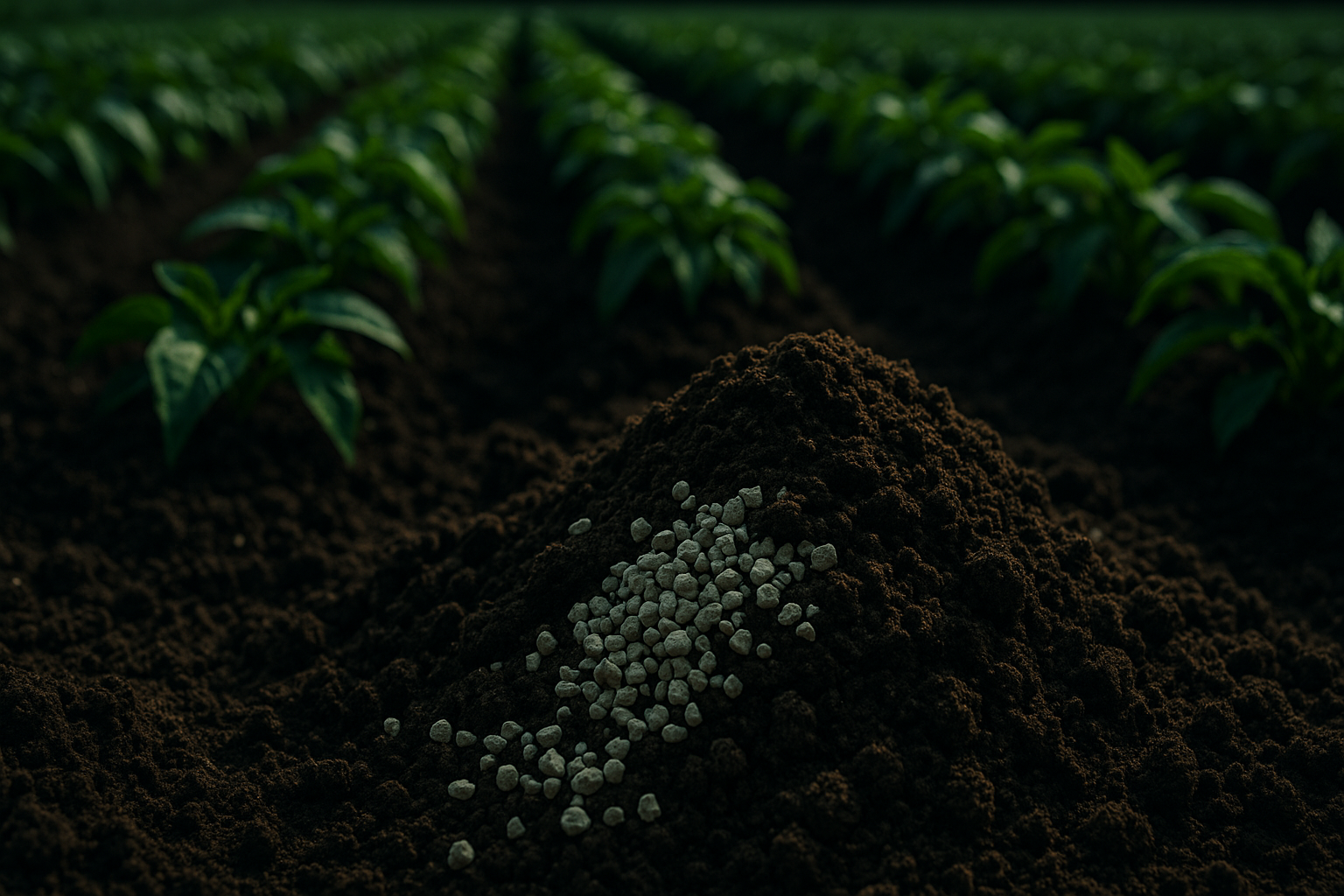
What goes wrong in the media when repotting
Repotting is the task of moving a plant into fresh media when its roots have grown to fill the pot volume, or when the media has compacted and lost aeration and drainage. The two most common problems at this point are as follows. First, peat moss / coco peat–based media collapses in structure within 1–2 years due to microbial decomposition and repeated irrigation, so aeration pores become blocked and overwatering reduces root respiration. Second, unlike open ground, a single irrigation in a pot easily exceeds the water-holding capacity of the media, so the NH₄⁺·NO₃⁻·K⁺ from liquid and solid fertilizers leaches straight out the drainage hole, lowering nutrient efficiency and requiring frequent top-dressing.
These two problems involve conflicting physical properties. Adding fine particles (peat / clay) to raise water retention blocks the pores and worsens aeration, while adding coarse perlite to restore aeration lowers water retention and nutrient retention together. The essential challenge for a repotting additive is to simultaneously raise the "aeration ↔ water retention ↔ nutrient retention" triangular balance with a single material, and simple bulking agents (sand / decomposed granite) solve only one of these (aeration). In particular, indoor foliage plants, succulents, and flowering pot plants are vulnerable to overwatering until roots establish right after repotting, and sharp swings in media pH and EC increase root stress, so a material with buffering capacity is advantageous.
Why zeolite is considered as a repotting additive
The primary basis for natural clinoptilolite being suited to the triangular balance above is the cation exchange (CEC 1.6–2.0 meq/g) arising from its negatively charged aluminosilicate framework. The permanent negative charge created when Al³⁺ substitutes for Si⁴⁺ sites within the framework electrostatically holds nutrient cations such as NH₄⁺·K⁺·Ca²⁺·Mg²⁺, and according to the H⁺ and organic acids secreted by roots and the concentration gradient of the soil solution, it releases them gradually—an exchange and buffering behavior. In other words, it acts as a nutrient reservoir that "deposits" nutrients that would otherwise wash out at once into the framework and "withdraws" them as the plant requires. McConnell et al. (2001) reported that in zeolite-amended container media, nutrient retention of ammonium, potassium, and the like was improved and plant growth was maintained (McConnell et al., HortTechnology, 2001). The CEC of agricultural clinoptilolite is reported, depending on refining and source, in cmol(p⁺)/kg units far exceeding 100 (e.g., about 133.92 cmol(p⁺)/kg), suggesting nutrient-retention potential tens of times higher than sandy soils or artificial media (Ramesh & Reddy, Water, Air, & Soil Pollution, 2017).
The second basis is physical structure. The 4.0–7.0 Å micropores and 40.0 m²/g specific surface area retain water by capillary force within the internal channels, raising water retention, while the robustness of the particles themselves (hardness 4.0–5.0 Mohs) and their non-degradability mean that, unlike peat, they do not collapse over time, maintaining "stable porosity". Unlike sand or clay additions, which raise water retention and CEC but lower aeration, granular zeolite handles aeration and drainage through the macropores between particles and water retention and nutrient buffering through the micropores inside the particles, raising the triangular balance with a single material. When mineral amendments were added to sandy media, a tendency for water retention (a reported base-material moisture content of about 57.6%) and CEC and nutrient retention to improve together was reported (Ramesh & Reddy, 2017). On the nitrate-leaching front as well, there is research that clinoptilolite suppressed nitrate leaching in pot soil and had a positive effect on plant growth (Influences of clinoptilolite on nitrate leaching and plant growth, Journal of Hazardous Materials, 2011). KMIZEOLITE's clinoptilolite is 97% pure, with a stable pH range of 3.0–10.0, making it stable in any acidic to mildly alkaline media, and being OMRI Listed (KMI-10365), it can also be considered for organic-cultivation media.
NO₃⁻ (nitrate) is not captured by cation exchange
A point to note is that the nutrient buffering above is limited to cations (NH₄⁺·K⁺). Because the clinoptilolite framework is negatively charged, it cannot directly adsorb anions such as nitrate (NO₃⁻) and phosphate. The reduction in nitrate leaching observed in pots is not because the framework captures NO₃⁻, but stems from indirect effects: ① by exchanging and holding NH₄⁺, it slows the very rate at which NO₃⁻ is generated through nitrification, and ② by improving water retention, it reduces excessive drainage itself. Therefore, if the goal is to directly adsorb and remove nitrate and phosphate, the prerequisite is a product whose surface has been modified with metals (e.g., Fe/Al) or surfactants rather than unmodified natural zeolite, and this must be considered separately from general repotting-additive use.
KMIZEOLITE key properties
| Item | Value |
|---|---|
| Clinoptilolite purity | 97% |
| Cation exchange capacity (CEC) | 1.6–2.0 meq/g |
| Specific surface area | 40.0 m²/g |
| Pore diameter | 4.0–7.0 Å |
| pH stability range | 3.0–10.0 |
| Hardness | 4.0–5.0 Mohs |
| Thermal stability | 700°C |
| Specific gravity | 1.89 |
| Bulk density | 45–54 lbs/ft³ |
| Certifications | OMRI KMI-10365, FDA GRAS, TSCA, EN-71-3 |
Repotting zeolite application examples
Below are representative ways zeolite is considered as a media additive in pot and planter repotting practice. The granular form is suited to uses aiming simultaneously at improved aeration and drainage and at nutrient retention.
- Media-blend type: blending zeolite at roughly 10–20% by volume into peat moss / coco peat / perlite–based media to reinforce water retention and nutrient retention (the most common approach)
- Pot-bottom drainage layer: laying coarse particle sizes (8×14 mesh) at the pot bottom to reduce drainage-hole clogging and ease overwatering
- Direct blending around roots: concentrating Fine Granule in the root-establishment zone during repotting to aid early nutrient and water buffering
- Liquid-feed buffer: blending in foliage and succulent pots with high nutrient leaching from frequent liquid feeding, for NH₄⁺·K⁺ buffering
- Trial / pilot application: first verifying the blend ratio with small samples per flowering-pot crop and media recipe
Blend ratio and process parameters
Repotting is a simple process of blending → filling → irrigation, but the resulting properties depend on blend ratio, particle size, and blending uniformity. The values below are a starting point for general foliage, and the premise is that the actual ratio be finalized through small-scale trials with the media recipe you are using.
| Parameter | Recommended starting value | Notes |
|---|---|---|
| Blend ratio (volume) | 10–20% | Lower to 5–10% for succulents/flowering pots, or focus on drainage layer |
| Blending particle size | 30×50 mesh (0.3–0.6mm) | Exclude powder (100 mesh) due to pore-clogging risk |
| Drainage-layer particle size | 8×14 mesh (1.4–2.4mm) | Lay 1–2cm at pot bottom |
| Blending method | Dry uniform blending | Local clumping causes uneven aeration/nutrient distribution |
| Application durability | Until next repotting (1–2 years+) | Non-degrading → no additional replenishment needed |
Because zeolite releases the NH₄⁺·K⁺ "deposited" in its framework according to the concentration gradient, the higher the dependence on liquid feed, the more tangible the buffering effect. However, it does not replace high-concentration fertilization that supplies a large amount at once; it is more accurately understood as a "nutrient-efficiency aid" that recovers and re-supplies some of the nutrients that would otherwise be wasted to leaching (Ramesh & Reddy, 2017).
Recommended particle size and product specifications
For repotting media, Fine Granule (30×50 mesh), which does not break down and maintains porosity, is the standard, while a coarser Medium to Coarse Granule is used for the pot-bottom drainage layer. The powder form (100 mesh), when mixed into media, can fill the pore space and cause overwatering, so it is not recommended for repotting use. Select the product group that fits your application from the table below.
| Product group | Mesh | Particle size | Typical uses |
|---|---|---|---|
| Powder | 100 mesh or finer | <150μm | Pozzolan, feed, powder adsorption |
| Fine Granule | 30×50 mesh | 0.3–0.6mm | Water treatment, filtration, soil |
| Medium Granule | 14×40 mesh | 0.4–1.4mm | Filter beds, bedding, floor material |
| Coarse Granule | 8×14 mesh | 1.4–2.4mm | Swimming pools, de-icing, large filtration |
| Extra Coarse | 4×8 mesh | 2.4–4.8mm | Packed beds, air scrubbers |
→ View products by mesh size · Product selection guide by application
Review points when applying to repotting
Checking the following items together when adding zeolite to pot repotting can reduce trial and error.
- Understand the media base: check the peat / coco peat / perlite ratio and the current water retention and drainage to adjust the blending amount
- Blend ratio: apply 10–20% by volume for general foliage, and conservatively—mainly via the drainage layer—for overwatering-sensitive succulents and flowering pots
- Particle-size selection: use 30×50 mesh for media blending and 8×14 mesh for the bottom drainage layer, kept separate
- Irrigation and fertilization conditions: since the higher the dependence on liquid feed the greater the nutrient-buffering effect, check fertilization frequency and EC together
- Regulatory check: for organic-cultivation media, confirm OMRI Listed (KMI-10365) status
- Field-specific notes: zeolite does not break down in media, so once blended, the porosity and nutrient-buffering effect are maintained until the next repotting. A high proportion of powder can instead cause overwatering, so it is safer to use mainly the granular form.
→ View TDS (Technical Data Sheet) · View MSDS (Material Safety Data Sheet)
Repotting Zeolite FAQ
What improves when zeolite is mixed into repotting media?
Zeolite plays two roles in potting media. The stable porosity created by its particles improves aeration and drainage, while cation exchange (CEC 1.6–2.0 meq/g) temporarily holds the applied ammonium and potassium and releases them gradually, reducing nutrient leaching. Studies on container-grown plants report improved nutrient retention in zeolite-amended media (McConnell et al., HortTechnology, 2001), and a tendency for water retention and CEC to improve together in sandy media has also been reported (Ramesh & Reddy, 2017). However, since actual effects vary with media composition and irrigation conditions, small-scale trials per crop are recommended.
How much (at what ratio) should it be blended into the media?
For general foliage plants, blending roughly 10–20% by volume into the existing media is commonly considered. For succulents and flowering pot plants sensitive to overwatering, it is safer to lower the ratio or apply it mainly in the pot-bottom drainage layer. The precise ratio is best determined through small-scale trials with the media recipe you are using.
What particle size (mesh) should be used?
For media blending, Fine Granule (30×50 mesh), whose particles do not break down, is the standard, while Medium to Coarse Granule (8×14 to 14×40 mesh) is suitable for the pot-bottom drainage layer. The powder form (100 mesh) can fill the pore space and cause overwatering, so it is not recommended for repotting use.
Does zeolite also directly capture nitrate (NO₃⁻)?
No. Unmodified natural clinoptilolite has a negatively charged framework, so it cannot directly adsorb anions such as nitrate and phosphate. The reduction in nitrate leaching observed in pots is not because the framework captures NO₃⁻, but an indirect effect: by exchanging and holding the cation NH₄⁺ it slows the rate of nitrification, and by improving water retention it reduces excessive drainage itself (Journal of Hazardous Materials, 2011). To directly remove nitrate and phosphate, a product whose surface has been modified with metals or surfactants is a prerequisite, and this is distinct from general repotting-additive use.
Is it safe for indoor pots and companion plants? Is certification documentation available?
Natural clinoptilolite is a non-toxic mineral holding OMRI Listed (KMI-10365), FDA GRAS (21 CFR 182.2729), EN-71-3 PASS, TSCA compliance, and more, so it can be considered for indoor potting media as well. For detailed documentation, see the certifications page.
Inquiries and sample requests
If you are considering applying zeolite in the repotting field, please reach out through the channels below.
Notice
Whether zeolite is applicable may vary with field conditions, regulations, and test results. Before actual application, a test review suited to the field conditions must always be conducted first. Zeolite should be understood not as an all-purpose solution for the field, but as a material that supports existing processes.
Related pages
science Related Papers
Academic papers addressing zeolite application in this field. Refer to them when reviewing adoption.
- Substrate Nutrient Retention and Growth of Container-grown Plants in Zeolite-amended Substrates
McConnell, D.B. et al. — HortTechnology, 2001 - Influences of clinoptilolite on nitrate leaching and plant growth
Journal of Hazardous Materials, 2011 - Comparison of zeolite and perlite as substrate for crisp-head lettuce
Gul, A. et al. — Scientia Horticulturae, 2005 - Application of Zeolite for Sustainable Agriculture: Water and Nutrient Retention
Ramesh, K. and Reddy, D.D. — Water, Air, & Soil Pollution, 2017
The papers above are reference material; actual application requires a separate review suited to field conditions.