Warm Mix Asphalt
An additive in which the crystal water (up to 10%) of non-calcined natural clinoptilolite is released and foams in stages over roughly the 100–140°C range, temporarily lowering binder viscosity. Dosed at just around 0.3% of combined aggregate and binder weight, it lowers mixing and paving temperatures by 20–30°C versus HMA and provides a path toward cutting burner fuel by more than 35%.
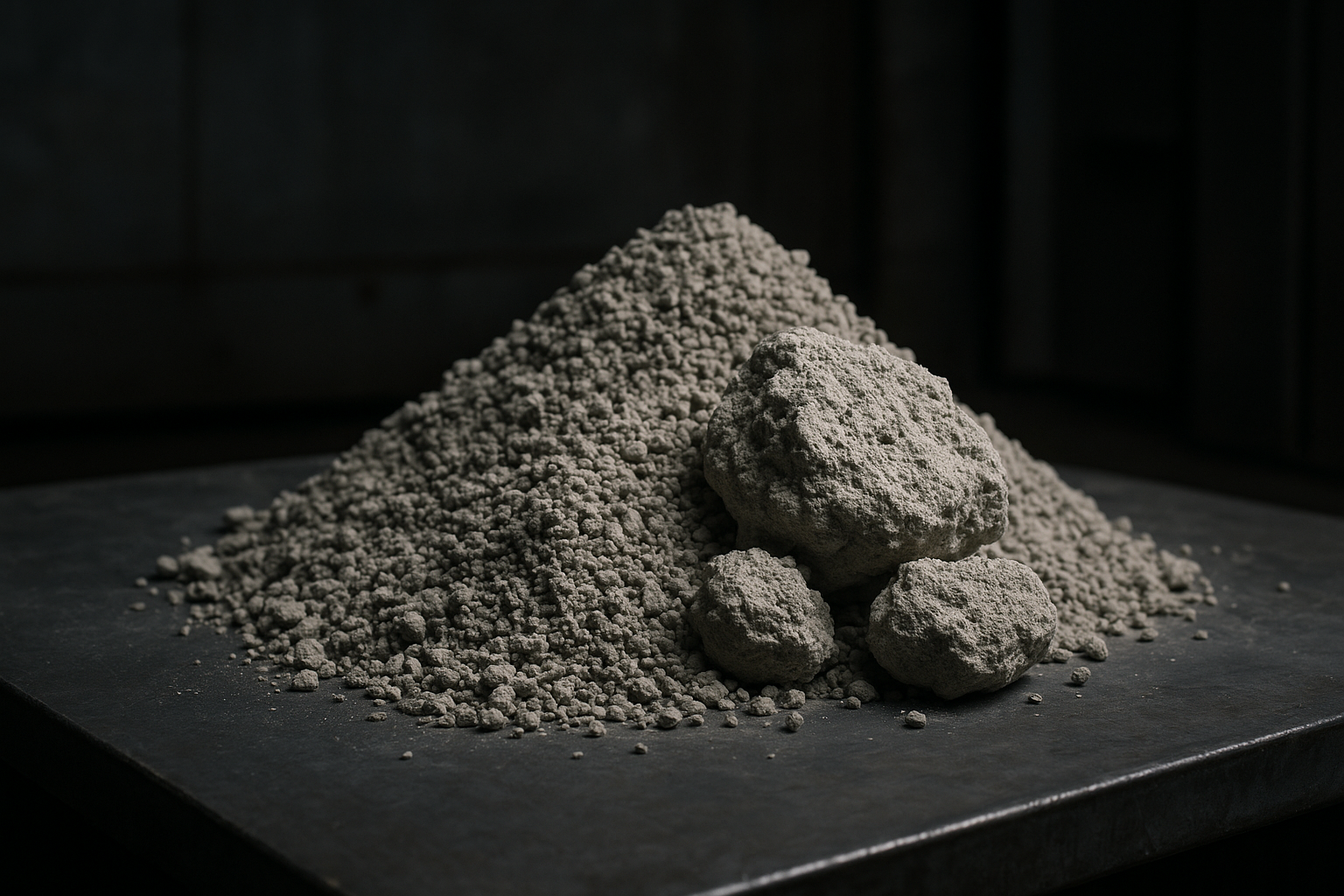
Zeolite for Warm Mix Asphalt — A Crystal-Water Foaming Temperature-Reduction Additive
Warm mix asphalt (WMA) is a family of technologies that produces and lays conventional hot mix asphalt (HMA, typically 150–180°C) at around the 120–140°C range, divided into three categories: foaming, organic additives, and chemical surfactants. Natural zeolite belongs to the powder-type additive within the foaming category, and KMI natural clinoptilolite works by releasing, in stages at mixing temperature, the crystal water (moisture content up to 10%) physically bound within its crystal framework to create fine bubbles inside the binder. Unlike the chemical-surfactant approach, the powder can be dosed directly onto the aggregate without separate chemical metering or injection equipment, so the burden of retrofitting an existing batch plant is small.
The important point is that this effect stems from crystal-water foaming, not from the cation exchange (CEC 1.6–2.0 meq/g) of clinoptilolite. Therefore the key variables governing foaming behavior are the crystal-water content and its release temperature profile, and a calcined zeolite from which the crystal water has been driven off in advance loses its foaming power as a WMA additive. For this reason, non-calcined (non-activated) natural zeolite must always be used for WMA. Sengoz et al. (2013) experimentally confirmed that natural zeolite can lower the mixing temperature while providing workability and foaming behavior equivalent to synthetic foaming zeolite (Sengoz et al., Construction and Building Materials, 2013).
According to KMI public materials, applying natural zeolite to WMA presents a path toward reducing burner-fuel use by more than 35%, which goes beyond simple fuel-cost savings to lower on-site emissions such as CO₂, asphalt fumes and VOCs, extend the paving season into off-peak and cold periods, and secure a temperature-loss margin for long-distance hauling.
Properties Relevant to Warm Mix Asphalt Applications
| Property | Value | WMA Relevance |
|---|---|---|
| Moisture content | Up to 10% | Foaming moisture source — crystal-water release |
| Specific gravity | 1.89 | Dispersion within the asphalt mixture |
| Bulk density | 720–865 kg/m³ | Basis for dosage calculation |
| Hardness | 4.0–5.0 Mohs | Physical compatibility with aggregate |
| pH stable range | 3.0–10.0 | Compatibility with the binder environment |
Foaming Mechanism — The Stepwise Behavior of Crystal-Water Release
Zeolite foaming is not a single boiling event but a stepwise dehydration process. The crystal water of clinoptilolite is split between water coordinated to cations inside the pores and water filling the channels, and as the temperature rises it is released in order from the most weakly bound. Thus it does not boil away all at once but slowly gives off water vapor over a wide range from about 100°C up past 200°C; this very "slow release" is the key to sustaining the foaming effect throughout WMA mixing, hauling and paving (about 30–60 minutes).
- ① Absorption (dosing) — The powder zeolite is added immediately after the aggregate drying and heating stage, or just before binder injection, to disperse it throughout the mixture.
- ② Release (foaming) — At mixing temperature (about 120–140°C), the crystal water escapes as fine water vapor, forming countless fine bubbles in the binder.
- ③ Viscosity reduction (workability) — The bubbles temporarily lower the apparent viscosity of the binder, securing a working window in which aggregate coating and compaction are possible even at a lower temperature than HMA.
- ④ Dissipation (compaction complete) — As paving and compaction finish and the temperature drops, the bubbles disappear and the binder returns to its normal viscosity, minimizing any residual impact on service performance.
In this mechanism the zeolite acts only as a foaming medium, and its cation exchange capacity (CEC 1.6–2.0 meq/g) is not directly involved in foaming. What actually governs foaming behavior is the crystal-water content (up to 10%), the temperature distribution of crystal-water release, and the pore stability that keeps the framework from collapsing under heating. As a result the mixing and paving temperature can be lowered by 20–30°C, and Sengoz et al. (2013) reported that natural zeolite lowers the temperature while providing workability and foaming similar to synthetic foaming zeolite (Sengoz et al., Construction and Building Materials, 2013).
Recommended Product Specification
| Product | Mesh | Particle Size | WMA Application |
|---|---|---|---|
| KMI 100- US MESH (Powder) | 100 mesh or finer | <150μm, median 50μm | Suited to fine dispersion in asphalt mixing |
The dosage is generally around 0.3% (0.3–0.5% depending on the study) of the combined aggregate and binder weight, applied as a powder-type zeolite. A particle size of 100 mesh or finer (<150μm, median about 50μm) is the standard, because the finer the particles, the larger the specific surface area, so the crystal water is released quickly and evenly and the foaming throughout the mixture becomes uniform. To preserve the crystal water needed for foaming, a non-calcined (non-activated) zeolite must always be used.
Plant Application Parameters (Reference for Trial Design)
| Parameter | Recommended Range | Notes |
|---|---|---|
| Dosage (of combined weight) | Around 0.3% (0.3–0.5%) | Watch for over-foaming and residual moisture if over-dosed |
| Particle size | 100 mesh or finer (<150μm) | The finer, the more uniform and rapid the foaming |
| Target mixing temperature | About 120–140°C | 20–30°C↓ versus HMA (150–180°C) |
| Dosing point | Dispersed onto aggregate just before binder injection | Dry powder, no separate chemical equipment needed |
| Condition | Non-calcined (non-activated) | Preserved crystal water is the prerequisite for foaming |
The ranges above are a starting point for trial design; the optimum values must be confirmed through plant trials according to binder grade, aggregate absorption and hauling time.
Academic Basis for Compaction and Stiffness
Woszuk et al. (2016) compared natural clinoptilolite and synthetic Na-P1 zeolite under identical conditions and showed that both additives can secure the compactability (air-void management) and stiffness modulus of the mixture even at lowered production temperatures, analyzing that natural clinoptilolite holds a practical advantage in supply and cost (Woszuk et al., Construction and Building Materials, 2016). Akisetty et al. (2009) showed at an early stage that applying natural zeolite to crumb-rubber-modified (CRM) binder WMA can secure compaction quality even at a production temperature about 30°C lower (Akisetty et al., Journal of Materials in Civil Engineering, 2009). The overall mechanism, performance and limitations of zeolite-based WMA technology are organized in a comprehensive review (Review of Application of Zeolite Materials in WMA, Applied Sciences, 2017).
Expected Application Points
- Reduced mixing and paving temperature (direction of 20–30°C reduction)
- Potential for 35%+ reduction in burner-fuel use (based on KMI public materials)
- Review of the direction for reducing plant and on-site emissions
- Review of the potential to reduce worker hazardous exposure (fumes, VOCs)
- Potential to improve operability for long-distance hauling and off-peak paving
Application Examples
Asphalt Plant Process Improvement
Unlike the chemical-surfactant approach, this is a dry powder dosing, so it can be introduced using an existing batch plant's filler/additive feed path without installing a new chemical metering or injection line. The aggregate heating load is reduced, so burner fuel (a path toward 35%+ savings based on KMI public materials) and exhaust gas decrease together.
Road Paving Work · Off-Peak / Cold-Period Paving
Because the crystal water maintains the foaming effect even during hauling and waiting, it is advantageous for securing paveability at sites with low ambient temperatures or long hauling distances. The dosage and target mixing temperature are applied on a trial basis to match the combination of construction temperature, season, hauling distance and compaction equipment.
Eco-Friendly · Low-Carbon Procurement Projects
In procurement where reducing CO₂, asphalt fumes and VOCs and saving energy are evaluation criteria, it can be comparatively reviewed on the basis of being a natural, chemical-free material versus organic-wax and chemical-surfactant approaches.
Review Points
- Moisture sensitivity — Because WMA's lower production temperature may leave residual moisture on the aggregate surface, verify moisture-damage and stripping resistance with compaction tests (TSR, etc.) and use an anti-stripping agent together if needed.
- Calcination status — Calcined zeolite with the crystal water driven off has no foaming power, so a non-calcined (non-activated) grade must always be used.
- The asphalt binder grade and the mixing facility (batch/continuous) conditions must be considered together, and beware of residual moisture and over-foaming when the dosage is excessive.
- Because foaming and compaction results vary widely with zeolite type, particle size and dosing point, verify them through plant trials.
- A suitability review against design criteria, specifications and procurement conditions (low-carbon credits, etc.) must precede application.
Related Pages
- Powder-type zeolite products — WMA product specifications
- Natural pozzolan zeolite — The full pozzolan application
Frequently Asked Questions (FAQ)
By what principle does zeolite lower the temperature in warm mix asphalt?
Natural clinoptilolite holds crystal water (moisture content up to 10%) inside its 4.0–7.0Å pore structure. At mixing temperature this crystal water is released in stages, creating fine bubbles (foaming) in the binder, and these bubbles temporarily lower the viscosity to secure workability. Because the crystal water does not boil off all at once but slowly escapes over a wide range starting from about 100°C, the foaming persists throughout the hauling and paving time. As a result, the mixing and paving temperature can be lowered by about 20–30°C versus HMA. This effect comes from crystal-water foaming, not from cation exchange (CEC).
What particle size and dosage are used for WMA?
For uniform dispersion within the mixture, KMI 100 mesh or finer powder (under 150μm, median about 50μm) is used. The finer the particles, the larger the specific surface area, so the crystal water is released quickly and evenly. The dosage is about 0.3% (0.3–0.5% depending on the study) of the combined aggregate and binder weight, and non-calcined (non-activated) natural zeolite with preserved crystal water is used for the foaming effect. Sengoz et al. (2013) reported that natural zeolite provides workability and foaming comparable to synthetic foaming zeolite.
Can calcined zeolite be used?
No. WMA foaming depends entirely on crystal-water release, so a zeolite whose crystal water has already been driven off by high-temperature calcination loses its foaming power. A non-calcined (non-activated) grade must be used to preserve the crystal water (up to 10%). For the same reason, foaming is unrelated to adsorption performance (CEC); the crystal-water content and its release temperature profile are the key variables.
How much do fuel and emissions actually decrease?
Based on KMI public materials, a path toward reducing burner-fuel use by more than 35% is presented. Temperature reduction is also linked to lower on-site emissions such as CO₂, fumes and VOCs, an extended paving season, and improved operability for long-distance hauling. However, the actual savings vary with dosage, binder type, plant equipment and hauling time, so they must be verified through plant trials.
Which is more advantageous, clinoptilolite or synthetic zeolite?
Woszuk et al. (2016) compared natural clinoptilolite and synthetic Na-P1 zeolite and reported that both additives are effective for the compactability and stiffness of the mixture, with natural clinoptilolite holding a practical advantage in cost and supply. Natural clinoptilolite has a high crystal-water content and is compatible with the aggregate and binder environment thanks to its wide stable range of pH 3.0–10.0 and its 4.0–5.0 Mohs hardness.
Notice
Warm mix asphalt performance can vary with dosage, binder characteristics, mixing temperature, hauling time, paving equipment, compaction conditions and more. Plant trials and field construction verification are recommended before actual application.
[Inquire about the application feasibility and supply specifications of zeolite for warm mix asphalt →]
science Related Research Papers
Academic papers covering zeolite application in this field. Please refer to them when reviewing adoption.
- Use of natural zeolite as warm mix asphalt additive
Akisetty, C.K. et al. — Journal of Materials in Civil Engineering, 2009 - Properties of Warm Mix Asphalt with clinoptilolite and Na-P1 zeolite additives
Woszuk, A. et al. — Construction and Building Materials, 2016 - Evaluation of natural zeolite as warm mix asphalt additive
Sengoz, B. et al. — Construction and Building Materials, 2013 - Review of Application of Zeolite Materials in Warm Mix Asphalt Technologies
Various — Applied Sciences, 2017 - Natural zeolite as pozzolanic material: A review
Ahmadi, B. and Shekarchi, M. — Cement and Concrete Composites, 2010
The papers above are reference materials, and a separate review tailored to site conditions is needed for actual application.