Zeolite for Asphalt Additive
A wax-free warm mix (WMA) additive that uses the crystal water (up to about 10 wt%) of natural clinoptilolite as a foaming source: dosing 100-mesh-and-finer powder at about 0.3% of the total mix weight lowers production and compaction temperatures by roughly 20–30°C versus HMA, through physical dehydration and foaming alone with no chemical reaction. As a dry-added material whose core mechanism is crystal-water foaming rather than ion exchange, this page summarizes the academic basis along with particle size, dosage criteria, and field review points.
The Temperature Burden of Hot Mix Asphalt (HMA) Production
Conventional hot mix asphalt (HMA) heats aggregate and binder to about 150–180°C for mixing and paving. This high-temperature heating is the source of recurring burdens at road-paving sites: burner fuel consumption, CO₂ and smoke emissions, fume exposure on the work site, and poor compaction due to heat loss during short-haul transport. Particularly during cold-weather night paving or on long-haul routes, the mix temperature drops quickly, making compaction and air-void control difficult.
Warm mix asphalt (WMA) is a technology that reduces this burden by lowering production and paving temperatures by 20–30°C. Lowering the temperature requires an additive that temporarily improves binder workability; alongside organic waxes and chemical surfactants, the foaming method using natural zeolite is a representative wax-free approach under consideration.
Why Natural Zeolite Is Used as a WMA Additive
Within the crystal framework of natural clinoptilolite, crystal water (up to about 10 wt%) is bound in its 4.0–7.0 Å micropores. This bound water is released in stages in the roughly 85–180°C range; when powdered zeolite is added to the hot binder, the released steam forms fine bubbles (micro-foam) that temporarily expand the binder volume and lower its viscosity. As a result, aggregate coating and compaction become possible even at lower temperatures. Unlike environmental-remediation applications driven by ion exchange (CEC 1.6–2.0 meq/g), this is a mechanism in which the zeolite's dehydration/rehydration behavior and thermal stability up to 700°C are the key drivers.
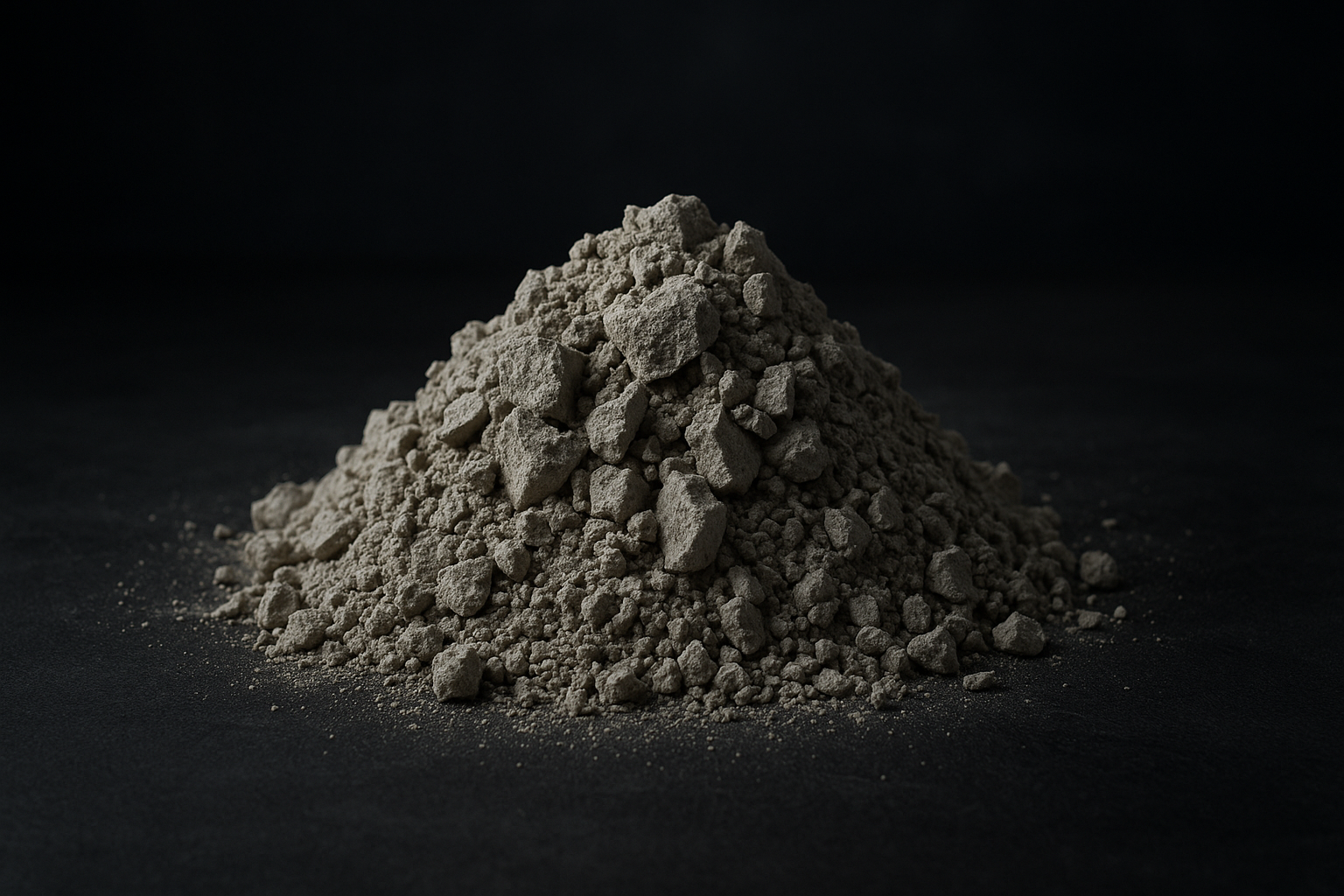
KMIZEOLITE's natural clinoptilolite is 97% pure, mined and processed at the Amargosa Valley mine in Nevada, USA. For WMA additive use, 100-mesh-and-finer Powder is used, and this stable mineral powder with a specific surface area of 40.0 m²/g and a specific gravity of 1.89 disperses evenly throughout the binder to induce foaming.
An important point is that this addition is not a chemical action such as ion exchange or a pozzolanic reaction. Unlike the cation exchange (CEC 1.6–2.0 meq/g) used in environmental-remediation applications or the pozzolanic activity used for cement replacement, in WMA application only the staged dehydration of crystal water and the resulting micro-foam are at work. Therefore the zeolite's crystal structure and framework Si/Al ratio remain almost unchanged, and once foaming ends the mineral powder remains in the matrix as a fine filler, contributing to stiffness. The effective foaming temperature range is roughly 130–150°C, and outside this range the workability-improvement effect drops sharply.
Academic research also supports this effect. Sengoz et al. (2013, Construction and Building Materials) evaluated natural zeolite as a WMA additive and reported that a dosage of about 0.3% could meaningfully lower mixing and compaction temperatures (DOI: 10.1016/j.conbuildmat.2013.02.026). Woszuk et al. (2016, Construction and Building Materials) compared natural clinoptilolite with synthetic Na-P1 zeolite and showed that zeolites with higher bound-water content provide longer foaming duration and greater workability improvement (DOI: 10.1016/j.conbuildmat.2016.03.188). Akisetty et al. (2009, Journal of Materials in Civil Engineering), who first formally evaluated natural zeolite as a WMA additive, reported that adequate compaction could be achieved even at reduced heating temperatures (DOI: 10.1061/(ASCE)0899-1561(2009)21:3(79)), and a later comprehensive review (2017, Applied Sciences) summarized the advantages of zeolite-based WMA for fuel and emissions reduction and high-RAP-content mixes, together with the importance of moisture-damage management (DOI: 10.3390/app7030293).
KMIZEOLITE Key Properties
| Property | Value |
|---|---|
| Clinoptilolite Purity | 97% |
| Cation Exchange Capacity (CEC) | 1.6–2.0 meq/g |
| Specific Surface Area | 40.0 m²/g |
| Pore Diameter | 4.0–7.0 Å |
| pH Stability Range | 3.0–10.0 |
| Hardness | 4.0–5.0 Mohs |
| Thermal Stability | 700°C |
| Specific Gravity | 1.89 |
| Bulk Density | 45–54 lbs/ft³ |
| Certifications | OMRI KMI-10365, FDA GRAS, TSCA, EN-71-3 |
Warm Mix Asphalt Application Examples
Below are representative ways in which a zeolite WMA additive is considered at road-paving and asphalt-plant sites.
- Dry Addition: The most common method, in which powdered zeolite is added directly to the mixer together with aggregate or RAP (reclaimed asphalt pavement) and mixed simultaneously with the binder
- Binder Pre-Foaming: A method in which zeolite is dispersed into the binder in a pump line or a separate foaming device to create foam in advance before coating the aggregate
- High-RAP-Content Mix Aid: Supplementary addition to secure compaction temperature in mixes with a high reclaimed-aggregate ratio that have reduced workability
- Cold-Weather / Night Paving: Application to extend the workability window at long-haul, low-temperature sites where heat loss during transport is significant
- Pilot Paving Trials: A method of creating a trial paving section with a small sample to verify compaction, air voids, and temperature-reduction effects in advance
Recommended Particle Size and Dosage Criteria
Warm mix asphalt addition uses Powder (100 mesh and finer, median about 50μm). The powder disperses quickly throughout the binder to produce uniform foaming, whereas granular products are unsuitable because foaming occurs locally. The typical dosage is reported as about 0.3% of the total mix weight, and the exact ratio must be determined by trial mixes depending on binder type, target temperature reduction, and RAP content.
| Product Line | Mesh | Particle Size | Typical Uses |
|---|---|---|---|
| Powder | 100 mesh and finer | <150μm | Pozzolan, feed, powder adsorption |
| Fine Granule | 30×50 mesh | 0.3–0.6mm | Water treatment, filtration, soil |
| Medium Granule | 14×40 mesh | 0.4–1.4mm | Filter media, bedding, flooring |
| Coarse Granule | 8×14 mesh | 1.4–2.4mm | Swimming pools, deicing, large-scale filtration |
| Extra Coarse | 4×8 mesh | 2.4–4.8mm | Packed beds, air scrubbers |
→ View products by mesh size · Product selection guide by application
Pilot Paving and Field Review Points
When applying a zeolite WMA additive, the following items should be checked together at the road-paving site.
- Setting the Temperature Reduction: Set target production and compaction temperatures at 20–30°C below HMA, and confirm the temperature range (about 130–150°C) where the foaming effect is valid
- Dosage Testing: Adjust up or down around a baseline of about 0.3%, and check the possibility of stripping due to residual moisture in case of overdosing
- Compaction and Air Voids: Verify via core sampling whether the target compaction and design air voids (usually around 4%) are achieved at the reduced temperature
- Moisture Sensitivity: Plan moisture-damage testing (e.g., TSR, tensile strength ratio) given the crystal-water foaming characteristic
- RAP Compatibility: Measure changes in workability and compaction time when the reclaimed asphalt content is high
- Sector-Specific Note: Lowering the production temperature via the crystal-water foaming of natural zeolite is reported to reduce burner fuel consumption by about 35% or more, which in turn reduces CO₂ emissions and on-site fume exposure.
→ View TDS (Technical Data Sheet) · View MSDS (Safety Data Sheet)
Warm Mix Asphalt FAQ
How does zeolite lower temperature in warm mix asphalt?
Crystal water (up to about 10 wt%) bound in the micropores (4.0–7.0 Å) of natural clinoptilolite is released as steam inside the hot binder, creating fine bubbles. This foaming temporarily lowers the binder viscosity, making aggregate coating and compaction possible at roughly 20–30°C below HMA. Unlike pozzolanic action (cement replacement), this is a physical dehydration and foaming mechanism rather than a chemical reaction.
How are dosage and particle size determined?
WMA addition uses Powder (100 mesh and finer); granular products are unsuitable because foaming is localized. A dosage of about 0.3% of the total mix weight is commonly reported, but the exact ratio should be confirmed by trial mixes depending on binder type, target temperature reduction, and RAP content.
Does lowering the temperature cause problems with compaction or durability?
At appropriate dosages, the target compaction and design air voids (about 4%) can reportedly be achieved. However, because of the crystal-water foaming characteristic, the mix can be sensitive to moisture damage (stripping), so moisture-sensitivity testing such as tensile strength ratio (TSR) and verification on a trial paving section are recommended.
How does the zeolite foaming method differ from other WMA additives (organic waxes and chemical surfactants)?
Organic waxes lower binder viscosity to improve workability, and chemical surfactants modify the binder-aggregate interface. Unlike both, natural zeolite is a physical foaming method in which steam from crystal-water dehydration creates micro-foam inside the binder; because no wax is used, concerns about low-temperature cracking and viscosity change are relatively low. Since the foaming source is water, however, moisture-damage management is key, and the effect diminishes outside the roughly 130–150°C range where foaming is effective. Chemical actions such as cation exchange (CEC) or pozzolanic reaction are irrelevant to this application.
How significant are the fuel and emissions savings?
Lowering the production temperature is reported to reduce burner fuel consumption by about 35% or more, and accordingly CO₂ emissions and on-site asphalt fume exposure are reduced as well. Actual savings vary with plant efficiency and operating conditions.
Can I receive a sample for testing?
Yes. KMIZEOLITE supports the provision of powder samples for trial paving and mix-design review. On the sample request page, please indicate your target temperature reduction and binder type.
Inquiries and Sample Requests
If you are considering applying zeolite in the asphalt additive field, please contact us through the channels below.
Notice
Applicability may vary depending on site conditions, regulations, and test results. Before actual application, a test review suited to the site conditions must always be carried out first. Zeolite should be understood not as a cure-all for the field but as a material that supports existing processes.
Related Pages
science Related Research Papers
These are academic papers addressing zeolite application in this field. Please refer to them when evaluating adoption.
- Use of natural zeolite as warm mix asphalt additive
Akisetty, C.K. et al. — Journal of Materials in Civil Engineering, 2009 - Properties of Warm Mix Asphalt with clinoptilolite and Na-P1 zeolite additives
Woszuk, A. et al. — Construction and Building Materials, 2016 - Evaluation of natural zeolite as warm mix asphalt additive
Sengoz, B. et al. — Construction and Building Materials, 2013 - Review of Application of Zeolite Materials in Warm Mix Asphalt Technologies
Various — Applied Sciences, 2017
The papers above are reference material; actual application requires a separate review suited to site conditions.