Composting Aid Zeolite
An application guide for an inorganic composting additive: natural clinoptilolite at a level of CEC 1.6-2.0 meq/g and NH4+ adsorption of about 21 mg/g is mixed into manure by dry weight during early fermentation to hold ammonium in the fermentation layer just before it volatilizes, reducing ammonia volatilization and nitrogen loss.
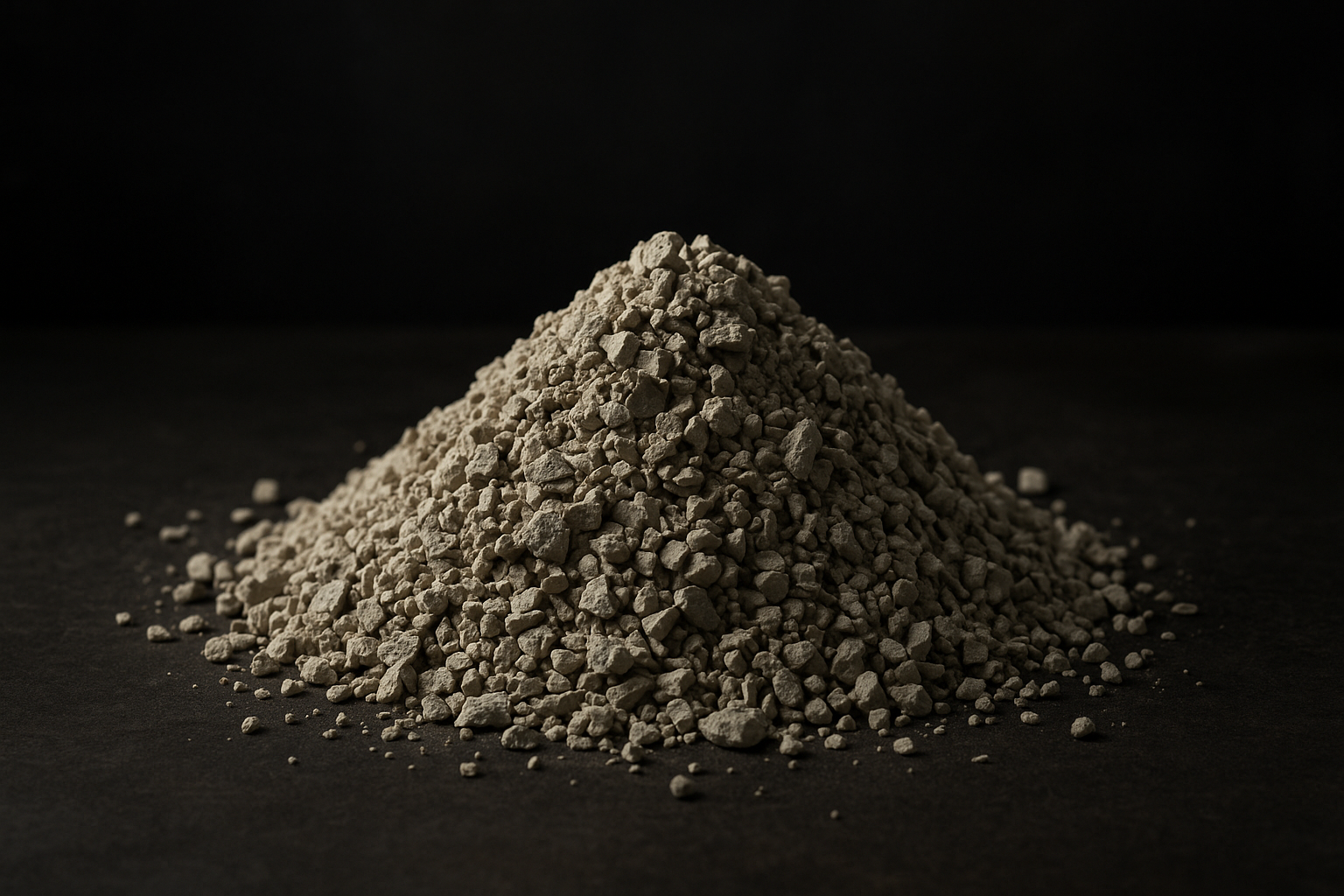
Where Does Nitrogen Disappear To During Livestock Manure Composting?
When composting livestock manure, the greatest loss occurs as ammonia (NH3) volatilization. During the early, high-temperature (thermophilic, 50-65 degrees C) stage of aerobic fermentation, microbes break down proteins and urea and generate large amounts of ammonium (NH4+). When the pH of the compost pile rises above 8, NH4+ converts to volatile NH3 and escapes into the air. In this process, a significant portion of the initial total nitrogen (TN) is lost, lowering the fertilizer value of the compost and leading to odor complaints around the barn and an environmental nitrogen burden.
The key to selecting a composting additive is to hold this NH4+, just before volatilization, within the fermentation layer. Along with operating conditions such as the C/N ratio, moisture content (typically 50-65%), aeration, and pile temperature, an inorganic material is required that fixes nitrogen without interfering with fermentation itself.
Why Is Clinoptilolite Considered as a Composting Additive?
Natural clinoptilolite has a microporous structure with negative charge on its framework (pore diameter 4.0-7.0 angstroms) and a high cation exchange capacity (CEC 1.6-2.0 meq/g), allowing it to selectively capture the NH4+ ions generated during compost fermentation at exchange sites within the framework. In clinoptilolite's ion selectivity series, NH4+ has a higher priority than Ca2+, Mg2+, and Na+, so it competitively captures ammonium even in the multi-ion environment of manure. The NH4+ adsorption capacity of unmodified natural clinoptilolite is typically around 21 mg/g (~1.5 meq/g) for model solutions, and up to about 31.7 mg/g has been reported with surface modification (because the ion exchange mechanism itself acts directly on the cation NH4+, unmodified raw material is sufficient for composting use).
The 4.0-7.0 angstrom pores are an appropriate size for hydrated ammonium ions to move in and out, serving a buffering role: temporarily fixing nitrogen before volatilization loss and then releasing it slowly into a plant-available form after soil application. Organized into steps, the working principle is: (1) in early fermentation, microbes break down proteins and urea to generate NH4+; (2) just before the rising pH (above 8) shifts the NH4+/NH3 equilibrium toward the gas phase, clinoptilolite captures NH4+ by ion exchange; (3) by blocking the volatilization pathway, nitrogen is retained within the fermentation layer; (4) after mature compost is applied, it is released slowly in the soil. In short, the distinguishing feature of this application is that it acts not as a simple adsorbent but as a nitrogen reservoir within the compost.
KMIZEOLITE's natural clinoptilolite has a purity of 97% and is mined and processed at the Amargosa Valley mine in Nevada, USA. With a pH stability range of 3.0-10.0, its structure remains stable even in the alkaline rise zone of a compost pile (pH 8-9), and because it is an OMRI Listed (KMI-10365) organic-allowed input, it can also be used in organic livestock compost. With a specific surface area of 40.0 m2/g and a specific gravity of 1.89, it mixes uniformly into manure.
KMIZEOLITE Key Properties
| Item | Value |
|---|---|
| Clinoptilolite purity | 97% |
| Cation exchange capacity (CEC) | 1.6-2.0 meq/g |
| Specific surface area | 40.0 m²/g |
| Pore diameter | 4.0-7.0 Å |
| pH stability range | 3.0-10.0 |
| Hardness | 4.0-5.0 Mohs |
| Thermal stability | 700°C |
| Specific gravity | 1.89 |
| Bulk density | 45-54 lbs/ft³ |
| Certifications | OMRI KMI-10365, FDA GRAS, TSCA, EN-71-3 |
Application Examples in the Composting Process
Below are representative scenarios in which clinoptilolite is dosed in the composting of livestock manure and agricultural byproducts. The central approach is direct mixing into the compost feedstock, and the dosing point and weight ratio govern the nitrogen-conservation effect.
- Feedstock blending (most common): A method of stacking manure, sawdust, and other bulking agents after mixing in powdered/fine-grain zeolite at a fixed ratio on a dry-weight basis. This is the form addressed by manure-amendment studies such as Subova (2021), and it is the most direct route to fixing NH4+ in early fermentation.
- Additional dosing during the fermentation stage: A method of applying more at the point of entering the high-temperature phase (the zone where pH and ammonia concentration spike) to suppress the volatilization peak.
- Pile surface capping: A method of covering the surface of the pile with granular zeolite to curb surface volatilization and odor dispersion.
- Dual use as composting-shed flooring/bedding: A method of laying it down in advance as bedding so that the absorbed manure and ammonia carry directly into the compost feedstock.
- Pilot application: A method of using a small sample to confirm in advance the optimal dosage suited to the on-site manure type and moisture content.
Recommended Particle Size and Product Specifications
For composting, Powder (100 mesh or finer), which mixes uniformly into manure and broadens the NH4+ contact area, is suitable for feedstock blending, while Medium Granule (14x40 mesh), which produces little dust, works well for surface capping and composting-shed flooring. Refer to the table below to select the product family that fits your application.
| Product family | Mesh | Particle size | Typical use |
|---|---|---|---|
| Powder | 100 mesh or finer | <150μm | Pozzolan, feed, powder adsorption |
| Fine Granule | 30×50 mesh | 0.3-0.6mm | Water treatment, filtration, soil |
| Medium Granule | 14×40 mesh | 0.4-1.4mm | Filter media, bedding, flooring |
| Coarse Granule | 8×14 mesh | 1.4-2.4mm | Swimming pools, de-icing, large filtration |
| Extra Coarse | 4×8 mesh | 2.4-4.8mm | Packed beds, air scrubbers |
→ View products by mesh size · Product selection guide by application
Nitrogen-Conservation Effects Confirmed by Research
Studies that mixed clinoptilolite into compost feedstock consistently report reductions in ammonia volatilization and nitrogen loss. Bernal et al. (Bioresource Technology, 1993) showed that adding natural zeolite to the composting process reduces ammonia volatilization and improves the nitrogen retention of the final compost (Bernal et al., 1993), and Subova et al. (Agriculture, 2021) confirmed that amending livestock manure with clinoptilolite improved composting behavior and nutrient conservation (Subova et al., 2021). The use of clinoptilolite for reducing ammonia in livestock environments was reviewed early on by Mumpton & Fishman (Clays and Clay Minerals, 1977) (Mumpton & Fishman, 1977), and a review covering zeolite applications across agriculture (Agronomy, 2021) also presents nitrogen conservation via NH4+ adsorption as a key benefit (Cataldo et al., 2021). A review comparing zeolite and biochar (Journal of Cleaner Production, 2021) likewise identifies zeolite's NH4+ ion exchange as the key mechanism for reducing compost nitrogen loss (Cleaner Production review, 2021). Because the exact degree of reduction varies greatly with manure type, dosage (typically tested in the range of a few to a dozen-odd percent of manure dry weight), and fermentation conditions, on-site pilot validation is advisable.
Pilot Testing and On-Site Review Points
When applying zeolite to livestock manure composting, please check the following items together.
- Dosing point: It must be mixed in before the early, high-temperature fermentation stage, when NH4+ generation surges, in order to capture nitrogen just before volatilization.
- Dosage weight ratio: Test the ratio relative to manure dry weight in stages. Because the effective range differs from study to study, determine the optimal value with a small-scale pilot.
- Operating conditions: Measure an ammonia-concentration baseline along with the C/N ratio, moisture content (50-65%), pile temperature, and pH trend.
- Particle-size selection: Distinguish between Powder (100 mesh) for feedstock blending and Medium Granule (14x40 mesh) for surface capping.
- Downstream use: Zeolite that has adsorbed NH4+ becomes a slow-release nitrogen source upon soil application, so factor it into the fertilization plan for mature compost.
- Regulatory check: When used in organic livestock compost, confirm OMRI Listed (KMI-10365) compliance.
→ View TDS (Technical Data Sheet) · View MSDS (Safety Data Sheet)
Composting FAQ
Does zeolite really reduce ammonia volatilization in composting?
Yes, this is confirmed by several studies. Through cation exchange with a CEC of 1.6-2.0 meq/g and an NH4+ adsorption capacity of about 21 mg/g, clinoptilolite captures the NH4+ generated during fermentation just before it volatilizes. Because NH4+ is a cation, it works through the ion exchange of the natural raw material alone, with no separate modification required. Bernal et al. (1993) showed that adding zeolite during composting reduces ammonia volatilization and improves nitrogen retention, while Subova et al. (2021) reported improved nutrient conservation when amending manure. However, the degree of reduction varies with manure type, dosage, and fermentation conditions, so an on-site pilot is recommended.
How much should be added to the compost feedstock, and when?
The key is to mix in a certain proportion relative to the dry weight of the manure during the early fermentation stage, before entering the high-temperature phase. It must be mixed in before NH4+ generation and pH rise begin in earnest in order to fix the nitrogen just before volatilization. Because the effective dosing range differs from study to study, it is advisable to determine the optimal value with a small-scale pilot.
Which particle size (mesh) is suitable for composting?
Powder (100 mesh or finer), which mixes evenly into the manure, is suitable for feedstock blending, while Medium Granule (14x40 mesh), which produces little dust, is suitable for pile surface capping and composting-shed flooring. Please refer to the product selection guide by application.
What happens to zeolite that has adsorbed NH4+ after the compost is applied?
The adsorbed ammonium is released slowly in the soil in response to plant root and microbial activity, acting as a slow-release nitrogen source. In other words, the nitrogen captured during the composting stage carries over into crop nutrition, so factoring this into the fertilization plan for mature compost can improve nitrogen use efficiency.
Can it also be used in organic livestock compost?
Yes. KMIZEOLITE clinoptilolite is OMRI Listed (KMI-10365), an NOP Allowed organic input, and holds FDA GRAS (21 CFR 182.2729), TSCA compliance, and EN-71-3 PASS certifications. Check the scope of certification on the certifications page.
Inquiries and Sample Requests
If you are considering applying zeolite in the composting-aid field, please contact us through the channels below.
Notice
Applicability may vary depending on site conditions, regulations, and test results. Before actual application, a test review suited to the site conditions must always be conducted first. Zeolite should be understood not as a cure-all for this field, but as a material that supports existing processes.
Related Pages
science Related Papers
These are academic papers addressing zeolite application in this field. Use them as a reference when evaluating adoption.
- Amendment of Livestock Manure with Zeolite-Clinoptilolite and Effect on Composting
Subova, E. et al. — Agriculture, 2021 - Application of natural zeolites for reduction of ammonia during composting
Bernal, M.P. et al. — Bioresource Technology, 1993 - Effect of zeolite and biochar on composting process: A review
Various — Journal of Cleaner Production, 2021 - Application of Zeolites in Agriculture: A Review
Cataldo, E. et al. — Agronomy, 2021 - Use of natural zeolite (clinoptilolite) in the reduction of ammonia from livestock environments
Mumpton, F.A. and Fishman, P.H. — Clays and Clay Minerals, 1977
The papers above are reference materials; actual application requires a separate review suited to site conditions.